
Online Pokies Instant Withdrawal Australia: Tested PayID Cashouts and the Reality Behind the Marketing
The phrase “instant withdrawal” sits at the top of almost every offshore pokies site advertising to Australian players, and it is the phrase the players searching for it have learned to read with suspicion. The fastest verified PayID cashout in current testing cleared in eleven minutes; the median ran closer to two hours; the worst case stretched past eight. Welcome bonuses sit at thirty-five to forty times turnover and free-spin winnings at caps that often turn a high headline into a smaller real value. The Interactive Gambling Act 2001 makes the entire product illegal to provide from inside the country, which means every site discussed on this page is an offshore entity operating outside Australian consumer law.

This page is built to be useful for a player who has already decided to look offshore and wants the comparison done honestly. It covers how PayID and Osko actually move money, what the tested cashout times look like across ten operators, where the deposit-versus-withdrawal trap catches the unwary, and what protections (and gaps) sit between a punter and the operator they are sending Australian dollars to. The deeper questions — whether offshore pokies are worth the speed, whether any bonus justifies fifty-times turnover, whether BetStop reaches the site you are about to sign up to — are answered in their own sections.
Data current as of 22 November 2026, verified against operator site terms, ACMA published reports, and tested cashout logs from Pokiesaustralia.com, Wildfish.com, Betsquare.org, and Casinobeats.com.
Table of Contents
- What “Online Pokies” Means for the Australian Player in 2026
- The Gap Between “Instant” Marketing and Real Withdrawal Timelines
- Why Fast Payouts Matter More to Australian Players
- How to Spot a Withdrawal-Friendly Pokies Site from the Rest
- PayID Withdrawals at Online Pokies: How Fast Your Money Really Arrives
- What Separates a Genuinely Fast-Payout Pokies Site from the Rest
- 10 Offshore Pokies Sites for Australian Players: PayID Withdrawal Performance, Tested
- Cashing Out on Your Phone: Mobile Pokies Withdrawals That Work in Australia
- Why Offshore Pokies Sites Promise Fast Payouts That No Australian Site Can Match
- Playing It Safe: Real Help for Aussie Punters Beyond the Deposit-Limit Checkbox
- How We Evaluated These Offshore Pokies Sites for Withdrawal Speed
- What to Actually Do Next: Picking a Pokies Site That Pays You Without the Runaround
- Frequently Asked Questions
What “Online Pokies” Means for the Australian Player in 2026
No Australian company can legally offer real money online pokies to Australians. The Interactive Gambling Act 2001 prohibits interactive gambling services from operating within Australia or offering services to Australian residents. That single sentence is the reason every site in this article carries an offshore licence and not an Australian one: an Australian licence for online pokies does not exist, federally or in any state or territory.
The word “pokies” itself is Australian shorthand for poker machines, the spinning-reel casino game known internationally as slots. When an Australian searches for “pokies” they mean the same product a UK player calls “fruit machines” or a US player calls “slots” — a real-money reel-spinner with paylines, bonus rounds and a published return-to-player percentage. The legal term in the IGA is “a prohibited interactive gambling service,” which covers online casino games including pokies, in-play sports betting, and any other online wagering product not specifically licensed. Pre-event sports and race wagering, lotteries and keno are the only commercial online gambling products Australia permits.
That is why the comparison set below reads like a roll-call of Curaçao, Tobique and unlicensed operators. There is no Australian-licensed version to include. The Northern Territory Racing and Wagering Commission issues licences for online sports and race bookmakers (Sportsbet, bet365, Ladbrokes and roughly fifty others) but not for casino products. Anyone searching for online pokies is, by definition, looking at the offshore market — and the only question is how to compare what that market offers.
The Gap Between “Instant” Marketing and Real Withdrawal Timelines
Advertised instant payouts are just marketing gimmicks. They rarely match the real-world experience or expectations. The advertised number, often sixty seconds or less, describes only one half of a two-stage process: the actual transfer between banks after the casino has approved the cashout. The clock most players feel is the total wait from clicking “withdraw” to seeing funds in their account, and that clock has two hands.
The first hand is the internal approval window. Every operator runs a pending or review period between the moment a withdrawal request lands and the moment they instruct the bank to send the money. The instant tier, per Casinobeats.com’s classification, approves in zero to fifteen minutes and delivers PayID funds in one to two hours across Australia. The fast tier processes approvals in fifteen to ninety minutes and delivers on the same day. Beyond that, a site is in the slow tier, and the gap between approval and delivery stops being the bottleneck.
The second hand is the PayID/Osko transfer itself. The New Payments Platform infrastructure that PayID rides on moves money between participating Australian banks in seconds, so the actual transfer once the casino releases it is genuinely fast — typically ten to sixty minutes for the whole leg, often faster. That is where the “instant” claim in the marketing copy comes from, and it is technically true. It is also, in context, the smaller half of the wait.
The tested times across the comparison set sit inside those tiers. Goldenbet cleared PayID in twenty-eight minutes and Lucky7 in thirty-five. SkyCrown’s fastest weekday test ran eleven minutes for a A$920 cashout; a weekend test for a smaller amount took eighteen minutes. MadCasino, by contrast, took one hour forty-three minutes on a weekday and one hour twelve on a weekend start. The Betsquare.org median across fast-payout casinos landed at two hours, with a worst case of eight. None of those are sixty-second claims, and all of them are within the bounds the testing sources describe as “fast.”
Why Fast Payouts Matter More to Australian Players
The speed a punter feels waiting for a withdrawal is not really about impatience. It is about trust. An Australian-licensed bookmaker sits inside a familiar consumer-protection framework: a state regulator, a complaints body, an authority to compel a payout. An offshore casino sits outside that framework. ACMA can block the site at any time, but the regulator cannot recover funds, and no Australian complaints body has jurisdiction over a Curaçao or Tobique licensee. When the balance is sitting in an account at an operator 16,000 kilometres away, the speed of the cashout becomes the most visible evidence that the operator is solvent, willing and honest.
That is the specific Australian weight behind the search for “instant withdrawal.” Players are not comparing seconds for the sake of efficiency; they are looking for the operator that signals reliability through speed. A site that takes forty-eight hours to approve a withdrawal, charges a fee for bank transfers and confiscates dormant balances is signalling something different about how it treats money. The number on the marketing page and the number on the test log are not the same, and the difference is what the player is trying to measure.
How to Spot a Withdrawal-Friendly Pokies Site from the Rest
A handful of concrete checks separate the operators worth a deposit from the rest. The first is whether PayID works both ways. Some offshore sites accept PayID for deposits but pay out only via bank transfer, crypto or card. House of Pokies, FortunePlay and Wild Tokyo all sit in the deposit-only camp for PayID, which means the deposit-versus-withdrawal gap is a real and currently active part of the market. A player who deposits via PayID and then has to wait three to seven business days for a bank transfer has discovered the gap the hard way.
The second check is whether the processing window is published or hidden. Operators that quote a one-to-twenty-four-hour PayID turnaround in their payments page are showing their hand. Operators that do not publish a window are the ones most likely to surprise a player with a longer wait.
The third is the complaint record. House of Pokies carries sixteen direct complaints in Casino.guru’s database, with another seventy-three about related casinos and a total of 26,985 black points — a figure that puts it near the bottom of the site’s safety ranking. That is not a benchmark to aspire to. The absence of complaint data is a weaker signal than a clean record would be, but a high black-point count is unambiguous.
The fourth is the dormant-account clause. House of Pokies confiscates the entire balance of any account inactive for six to twelve months. A clause like that is a quiet trap: a player who takes a break, returns months later and finds their balance zeroed has no recourse. Any operator that confiscates dormant balances should be treated as a higher-risk choice regardless of how fast it pays during active play.
PayID Withdrawals at Online Pokies: How Fast Your Money Really Arrives
PayID pokies withdrawals are becoming one of the most discussed banking features among Australian real money pokies players. In 2026, many online pokies sites support PayID-linked cashouts through Osko-enabled banking systems. The system itself is the same one that lets a punter pay a tradie in seconds from a phone banking app — the casino does not need any special infrastructure, just a participating Australian bank and a PayID handle to send money to.
How PayID and Osko Actually Work for Pokies Cashouts
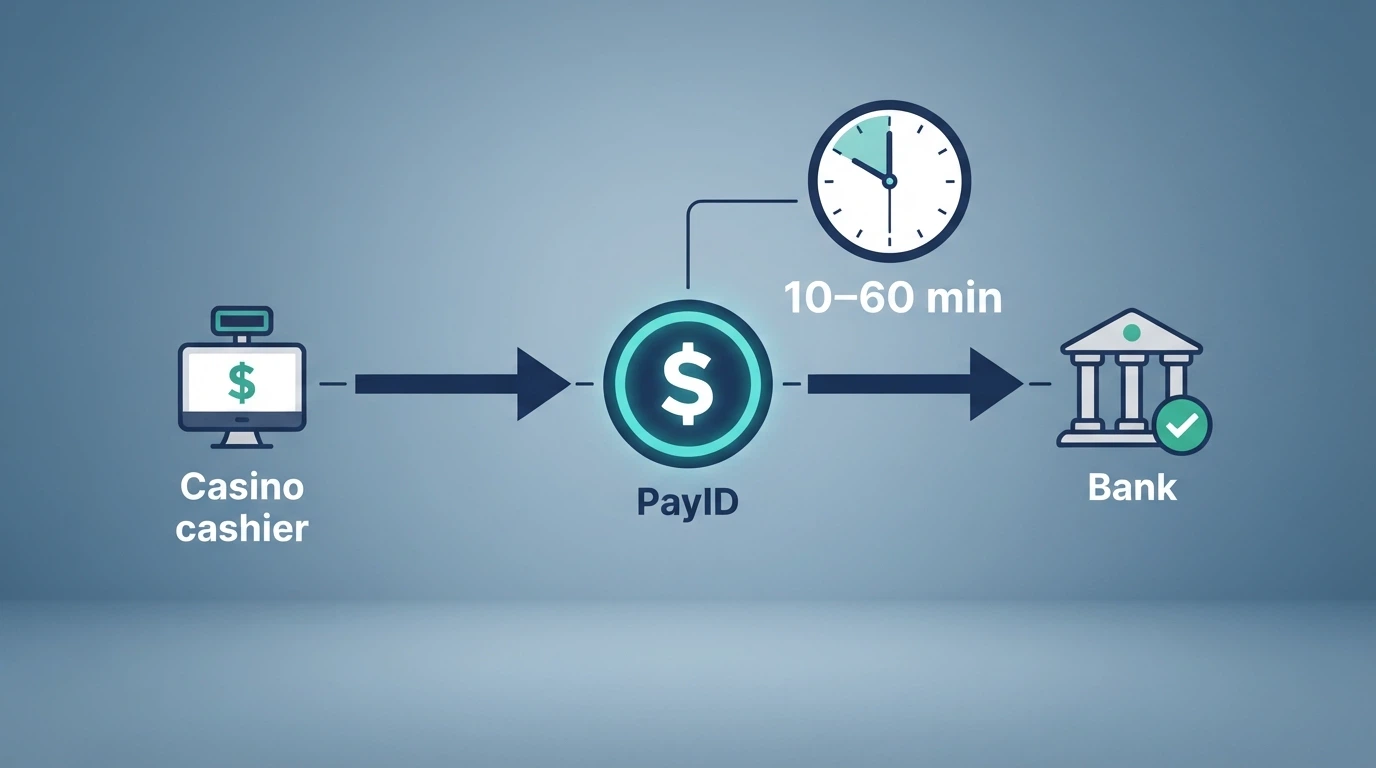
PayID is a memorable identifier — a mobile number, email address or ABN — linked to a bank account. Instead of typing in a BSB and account number, the sender enters the PayID, the recipient’s bank verifies it, and the transfer clears through the New Payments Platform. Osko is the real-time payments layer built on top of the NPP by BPAY Group; it is what makes the transfer settle in under a minute between participating banks, twenty-four hours a day, seven days a week.
The mechanic for a casino withdrawal is straightforward. The punter enters a withdrawal request, the casino’s cashier matches it to a verified PayID, and once the approval window closes the operator pushes the funds through Osko. The transfer itself typically lands in ten to sixty minutes with limits running from a A$10 minimum to roughly A$5,000 maximum per transaction, and no fee on either side. That is the underlying reason PayID dominates Australian-facing casino banking: it is faster, cheaper and easier than a traditional bank transfer, and every major Australian bank supports Osko.
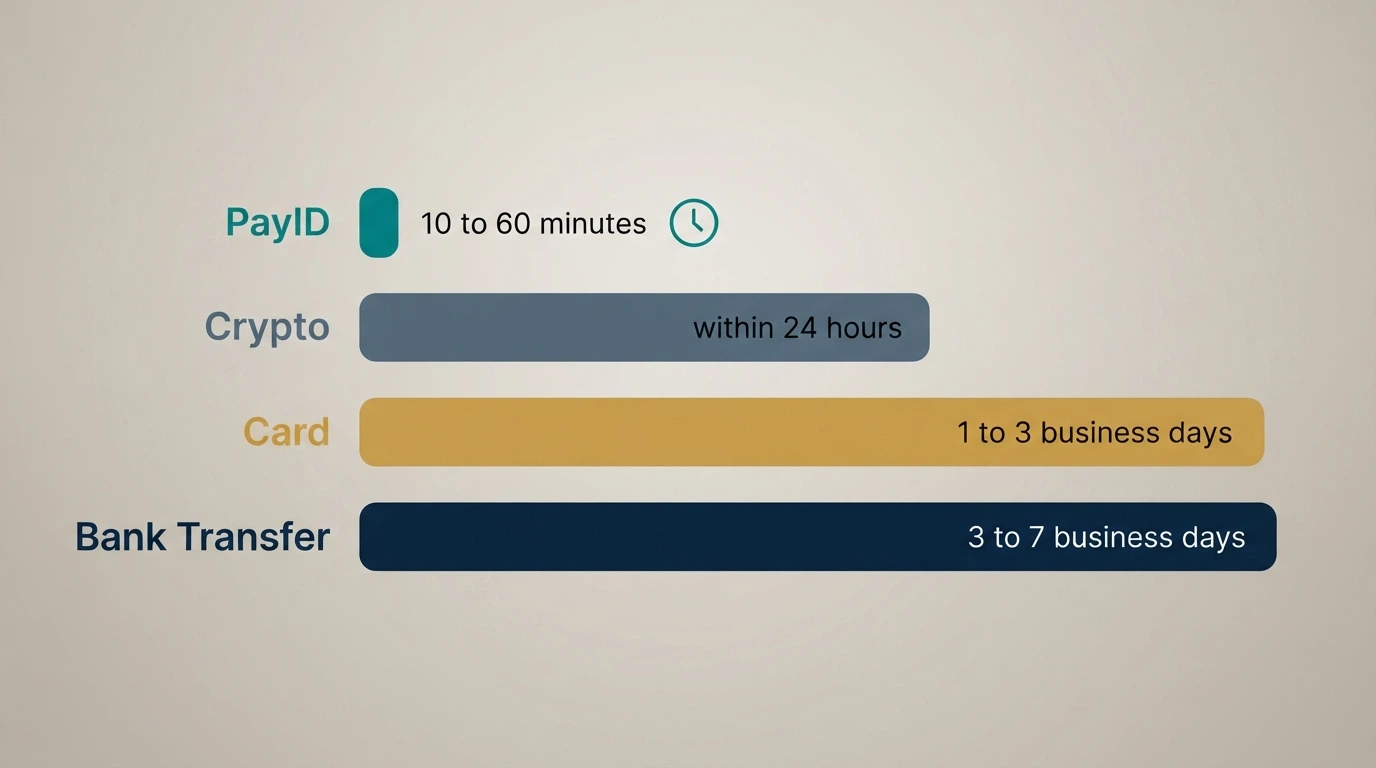
The advantage over a BSB-and-account-number transfer is the practical one. A traditional bank transfer takes three to seven business days at the House of Pokies end, with a A$350 minimum and a A$30 fee. A PayID transfer has no fee, a A$10 minimum and the same ten-to-sixty-minute window. The advantage over a card withdrawal is the speed: cards take one to three business days and the punter is paying with money that has already cleared the casino’s bank. PayID is the only method that combines low minimum, no fee, and sub-hour delivery.
PayID Withdrawal Speed: What Real Testing Shows in 2026
The spread of tested times in current cashout logs is wide enough that the headline number is the distribution, not the average. At the fast end, SkyCrown cleared a A$920 weekday cashout in eleven minutes and a A$450 weekend one in eighteen. Goldenbet ran twenty-eight minutes, Lucky7 thirty-five. The Betsquare.org median across fast-payout casinos sits at two hours, with a worst case of eight. MadCasino took one hour forty-three minutes on a weekday test and one hour twelve on a weekend start.
The instant tier that Casinobeats.com defines — zero to fifteen minutes approval plus one to two hours delivery — describes the operators at the top of the testing pool. The fast tier, fifteen to ninety minutes approval plus same-day delivery, covers the bulk of the set. Operators outside both tiers are simply slow, and the marketing on their sites is no longer a useful guide.
Weekday versus weekend, and amount versus speed, are the two practical patterns the data shows. Larger amounts can clear faster simply because they tend to be flagged for higher-tier processing. Weekend starts sometimes run faster, sometimes slower, depending on staffing. None of that is reliable enough to plan a session around, but it is reliable enough to say that the worst case is an order of magnitude longer than the best case.
PayID vs Every Other Withdrawal Method: Speed, Limits and Fees
The comparison below uses the House of Pokies terms as the reference for the non-PayID methods, since they are the only operator in the set with confirmed specifics across all four methods. PayID ranges are the published industry norm.
| Payment Method | Transfer Speed | Min Withdrawal | Max Withdrawal | Fees | Notes for AU Players |
|---|---|---|---|---|---|
| PayID (Osko) | 10–60 minutes | A$10 | A$5,000 per transaction | None | Available at most major AU-facing sites; first withdrawal may wait on KYC |
| Bank transfer (BSB/account) | 3–7 business days | A$350 | Varies | A$30 at House of Pokies | Slowest method; common fallback when PayID not offered |
| Card (Visa/Mastercard) | 1–3 business days | A$100 | Varies | None | Many sites pay back to the deposit card only |
| Bitcoin | Within 24 hours | A$100 | Varies | Network fee | Crypto banned as AU wagering payment since 11 June 2024; offshore use only |
The takeaway is not subtle. PayID beats every other method on speed, on minimum amount, and on fees. The only situation where a punter needs to consider an alternative is when the site does not support PayID for withdrawals at all — and in that case the deposit-versus-withdrawal gap, covered in the next section, is the issue to solve before the deposit is made.
The PayID Deposit-vs-Withdrawal Trap: Why Some Sites Take It In But Won’t Send It Out
The deposit method and the withdrawal method at an offshore casino are not always the same list. PayID is near-universal for deposits at AU-facing sites because it is fast, cheap and uses infrastructure the player already trusts. It is much less universal for withdrawals, because every withdrawal carries a Know Your Customer check and an anti-money-laundering review, and operators prefer to route payouts through methods they can reverse or audit more easily.
Three of the ten operators in the comparison set take PayID for deposits but pay out only via crypto or bank transfer. Wild Tokyo is the clearest case: PayID deposit, no PayID withdrawal, with the only fast option being a crypto payout that Australia now restricts at the banking level. FortunePlay is in the same position: PayID deposit available, no confirmed PayID withdrawal, with the same crypto workaround. House of Pokies does offer PayID for withdrawals but with a A$50 minimum and a one-to-twenty-four-hour wait that begins only after the forty-eight-hour internal pending window closes.
The check is mechanical. Before depositing, open the cashier, switch to the withdrawal tab, and look for PayID in the list. If it is there with a sensible minimum and a published processing window, the deposit route is the same as the withdrawal route. If the withdrawal tab shows only bank transfer, card and crypto, the PayID deposit is a one-way door.
KYC and Verification: The Real Reason Your First Withdrawal Takes Longer
Every offshore casino quotes a transfer speed, and almost every first-time punter discovers that the quoted speed is for the second withdrawal, not the first. The first withdrawal waits on Know Your Customer verification. The operator must confirm the player’s identity, address and payment method before releasing funds, and that means a copy of a photo ID, a recent utility bill or bank statement, and sometimes a photo of the card used to deposit. House of Pokies runs a forty-eight-hour internal pending window on top of the verification review; the PayID transfer that follows is one to twenty-four hours, but the clock on the punter’s wait started at the request, not at the approval.
The practical move is to verify early. Most operators allow document upload through the cashier or account page before the first withdrawal is requested. A punter who uploads the ID and address proof at signup, then waits for confirmation, removes the largest variable from the first cashout. The punter who waits until the win lands before verifying will spend that win’s first forty-eight hours inside the pending window.
The verification requirement is not a marketing trick. It is a regulatory obligation that every licensed operator (offshore or otherwise) is bound by, and the documents requested are standard. The trap is the surprise: a punter who has not seen the requirement before is the one most likely to assume the quoted transfer time applies from the moment they click “withdraw.”
What Separates a Genuinely Fast-Payout Pokies Site from the Rest
The fast-payout label is applied generously across the comparison set, and the differences between the operators who earn it and the ones who claim it are concrete. A genuinely fast-payout site passes three tests: it offers PayID for withdrawals (not just deposits), it publishes a processing window in hours rather than vague language, and it has a complaint record that does not flag routine withdrawal problems.
The instant tier, per the Casinobeats.com framework, approves cashouts in zero to fifteen minutes and delivers PayID funds in one to two hours. The fast tier approves in fifteen to ninety minutes and delivers on the same day. Operators who slip out of both tiers are slow by this market’s own classification, regardless of what their banner says.
The FortunePlay case is the most instructive counter-example. The casino has a Tobique Gaming Commission licence and a 10,000-game library from ninety-plus providers, which on paper reads as strong. The reality is documented withdrawal delays, an unpublished maximum-bet rule, and winnings confiscation complaints from players who breached the rule without knowing it. The complaint data is the more reliable signal: a generous library and a Tobique licence are features, but they are not the same as a clean payout record.
Tested vs Advertised: How We Verify Withdrawal-Speed Claims
The cashout times on this page are pulled from the published test logs of independent review sites, not from operator marketing. Wildfish.com logs the amount, the method, the day and the timestamp of each test. SkyCrown’s eleven-minute figure comes from a A$920 weekday test on that site; SkyCrown’s eighteen-minute figure comes from a A$450 weekend one. MadCasino’s two figures (one hour forty-three minutes weekday, one hour twelve minutes weekend start) follow the same pattern. The Betsquare.org median of two hours and worst case of eight is an aggregate across its own test pool, which includes SpinBoss at one hour eighteen minutes, WestAce at fifty-eight minutes via PayID and SkyCrown at one hour forty-four minutes via crypto.
Operator-advertised times are not used because they describe the transfer leg, not the approval leg, and the gap between the two is the variable that matters most. The fastest advertised time, sixty seconds, is technically possible at the PayID/Osko level. The fastest tested total wait, eleven minutes, includes both legs at a high-performing site. Reading the marketing figure as the player experience is the error this market is built on.
Red Flags That Signal a Slow Payer
A handful of patterns, drawn from the comparison set, are reliable enough to warn a player before they deposit.
- No published withdrawal processing time. An operator that says “fast” without a number is hiding the answer.
- PayID available for deposit only. Wild Tokyo, FortunePlay and the deposit-only operators in the set route withdrawals through slower methods, and the deposit-versus-withdrawal gap is the issue.
- A dormant-account confiscation clause. House of Pokies zeroes balances after six to twelve months of inactivity. Any equivalent clause is a quiet trap on a long break.
- An unpublished maximum-bet rule. FortunePlay’s rule is not in the published terms; the confiscation complaints come from players who breached it without knowing. A rule that is not published cannot be followed.
- High complaint volume and black points. House of Pokies’ 26,985 black points is the benchmark; a high count means the operator has a track record of disputes that the regulator record does not clean up.
- No casino licence at all. House of Pokies is the case in this set: Casino.guru assigns a Safety Index of 2.9 (“Very low”) and the operator carries no licence on its site. An unlicensed operator has no regulator to answer to, anywhere.
10 Offshore Pokies Sites for Australian Players: PayID Withdrawal Performance, Tested
The table below compares the ten operators on the dimensions that drive the comparison: licence, welcome offer, wagering, free spins, PayID withdrawal status and game library. Where the comparison set carries no confirmed figure, the cell shows an em dash rather than a guess. The full write-up for each operator follows the table.

| Operator | Licence/AU Status | Welcome Bonus | Wagering | Free Spins | PayID Withdrawal | Game Library |
|---|---|---|---|---|---|---|
| SkyCrown | Offshore (Curaçao eGaming) — no AU licence | 100% up to A$4,000 + 400 FS across 5 deposits | 40× (bonus) | 400 FS + 20 no-deposit FS | Confirmed — under 1 hour tested | 6,000+ |
| Golden Crown | Offshore (Curaçao eGaming) — no AU licence | 100% up to A$15,000 + 300 FS | 40× (bonus) | 300 FS | Confirmed — deposit + withdraw | 6,500+ |
| LuckyVibe | Offshore — no AU licence | Up to A$5,000 + 300 FS across 3 deposits | 35× (bonus) | 300 FS | Confirmed — under 2 hours tested | 10,000+ total (7,000+ pokies) |
| Wild Tokyo | Offshore (Curaçao) — no AU licence | 250% up to A$5,300 + 600 FS | 50× (bonus) | 500–700 FS | Deposit only — no PayID withdraw | 8,000+ |
| National Casino | Offshore — no AU licence | 100% up to A$500 + 100 FS | 40× (bonus) | 100 FS | Confirmed — same day | — |
| StoneVegas | Offshore — no AU licence | 100% up to A$750 + 200 FS | — | 200 FS | Confirmed — deposit + withdraw | — |
| 7Bit Casino | Offshore — no AU licence | Up to A$10,800 + 250 FS | — | 250 FS | Confirmed — deposit + withdraw | — |
| FortunePlay | Offshore (Tobique Gaming Commission) — no AU licence | Multi-deposit up to A$5,000 + 300 FS | 40× (welcome); 50× (reload) | 300 FS | Deposit only — no confirmed PayID withdraw | 10,000+ |
| Rolling Slots | Offshore — no AU licence | 310% up to A$6,400 + 570 FS | — | 570 FS | Bank transfer + PayID | 15,000+ |
| House of Pokies | Unlicensed — no AU licence | Up to A$1,000 + 100 FS | — | 100 FS | PayID A$50–A$5,000, 1–24 hrs after 48h pending | 1,879 slots |
SkyCrown
SkyCrown is the fastest tested PayID cashout in the set: eleven minutes for a A$920 weekday withdrawal, eighteen minutes for a A$450 weekend one. The operator carries a Curaçao eGaming licence published in its site footer, processes PayID withdrawals within one hour for verified accounts, and sets withdrawal ceilings at A$7,500 daily, A$15,000 weekly and A$50,000 monthly, with negotiable VIP limits up to A$100,000 per month. The welcome package is 100% up to A$4,000 plus 400 free spins across five deposits at forty-times wagering, with a A$30 minimum deposit and twenty no-deposit free spins on registration. SkyCrown is the benchmark for what a tested fast cashout looks like in this market, and the closest the set comes to a “twenty-eight-minute” headline that matches reality.
Golden Crown
Golden Crown’s headline is the largest in the set: 100% up to A$15,000 plus 300 free spins at forty-times wagering, with a A$30 minimum deposit. The operator holds a Curaçao eGaming licence and confirms PayID for both deposits and withdrawals. The library sits at 6,500-plus titles across Pragmatic Play, Microgaming and Evolution. The bonus number is the story: A$15,000 against a forty-times playthrough means the punter must turn over A$600,000 in bonus-cleared bets before the cash becomes withdrawable, and that figure is what the headline really contains. A player comparing this offer to a smaller one with the same wagering multiple should be comparing the turnover requirement, not the headline cap.
LuckyVibe
LuckyVibe runs the lowest wagering requirement in the set at thirty-five times, against a welcome package of up to A$5,000 plus 300 free spins across three deposits from a A$20 minimum deposit. The library is the deepest in the set outside Rolling Slots and FortunePlay: 7,000-plus pokies and 10,000-plus titles overall. PayID withdrawal is confirmed and tested at under two hours. The combination of low wagering, large library and tested PayID makes LuckyVibe the strongest profile for a player whose main criterion is bonus value weighed against clearing difficulty.
Wild Tokyo
Wild Tokyo is the case study in reading the deposit-versus-withdrawal gap. The welcome package is generous on paper — 250% up to A$5,300 + 600 free spins — but the wagering is fifty times on both cash and free spins, with a five-day clearing window and a AU$8 maximum bet while the bonus is active. Free-spin winnings are capped at A$170; cash bonus winnings are capped at ten times the deposit amount; weekly cashback withdrawals are capped at A$800. The bigger issue sits at the cashier: Wild Tokyo accepts PayID for deposits but does not support PayID for withdrawals. A player who deposits via PayID must withdraw via crypto, and crypto has been banned as a payment for Australian online wagering since 11 June 2024. The bonus number is high, the conditions are heavy, and the withdrawal route is restricted — three reasons to read the small print before the headline.
National Casino
National Casino keeps the welcome offer straightforward: 100% up to A$500 plus 100 free spins at forty-times wagering from a A$25 minimum deposit. PayID withdrawal is confirmed and processes on the same day. The smaller bonus cap means the turnover requirement sits at a manageable A$20,000 against the bonus maximum, which is the kind of position a player with a smaller bankroll can plan around. National Casino is the lowest-friction profile in the set for a player who wants the welcome offer, the same-day PayID cashout and a clear path to clearing the bonus.
StoneVegas
StoneVegas positions itself as a high-roller-friendly site with a 100% up to A$750 plus 200 free spins welcome offer, Pragmatic Play, BGaming and Evolution in the provider list, and PayID confirmed for both deposits and withdrawals. The published specifics stop there, which means the bonus terms and library depth need to be checked at the cashier. For a player whose criterion is a confirmed PayID route both ways with a moderate welcome offer, StoneVegas is one of the cleanest fits in the set.
7Bit Casino
7Bit Casino is the longest-running operator in the comparison set, active since 2014, with a welcome package of up to A$10,800 plus 250 free spins. The library carries a strong Megaways catalogue. PayID is confirmed for both deposits and withdrawals. The longevity is the profile signal: 7Bit has been operating under changing Curaçao oversight for over a decade, which is a longer track record than most of the set. The published specifics on wagering and clearing windows are thinner than for the top-of-set operators, so the player should verify at the cashier before staking the welcome offer.
FortunePlay
FortunePlay carries the largest game library in the set — 10,000-plus titles from ninety-plus providers including Pragmatic Play, Evolution, NetEnt, Hacksaw, Big Time Gaming and Yggdrasil — under a Tobique Gaming Commission licence through operator Novatrix SRL. The welcome package is a multi-deposit offer up to A$5,000 plus 300 free spins at forty-times wagering on the welcome and fifty-times on reload bonuses. The trade-off is the complaint record: FortunePlay has documented withdrawal delays, an unpublished maximum-bet rule, and winnings confiscation complaints from players who breached that rule without seeing it. PayID is available for deposits only; the withdrawal route runs through crypto and bank transfer. A player attracted by the library size is paying for it in terms that are not all in the welcome offer.
Rolling Slots
Rolling Slots runs the largest game count in the comparison set at 15,000-plus titles, with featured providers including Pragmatic Play, VoltEnt and Booongo. The welcome offer is 310% up to A$6,400 plus 570 free spins. PayID is available for deposits, and both bank transfer and PayID are listed for withdrawals, which is the cleanest deposit-withdrawal symmetry in the set outside SkyCrown and 7Bit. Rolling Slots is the strongest library profile for a player who wants the deepest catalogue with a confirmed PayID route out, and the welcome offer is competitive at the head of the set.
House of Pokies
House of Pokies is the most scrutinised operator in the comparison set, and the one that comes out worst in the scrutiny. Casino.guru assigns it a Safety Index of 2.9 (“Very low”) and lists it as operating without a casino licence at all. The withdrawal terms are restrictive: a A$30,000 monthly cap, a A$200 minimum, a A$5,000 per-transaction maximum, and a forty-eight-hour internal pending window with mandatory KYC before any PayID transfer can begin. PayID deposits start from A$10, PayID withdrawals from A$50, and the PayID leg is one to twenty-four hours after the pending window closes. The site carries sixteen direct complaints in Casino.guru’s database, with another seventy-three against related casinos, totalling 26,985 black points. It confiscates the entire balance of any account inactive for six to twelve months. The library is 1,879 slots from BetSoft, Habanero, iSoftBet and twenty-four other providers. The user rating sits at 1.6 out of 5 from 41 votes, and the operator ranks 1,690 of 1,774 casinos reviewed. House of Pokies is included here because players search for it by name; it earns its position by being the case study for what the rest of the set is not.
Cashing Out on Your Phone: Mobile Pokies Withdrawals That Work in Australia
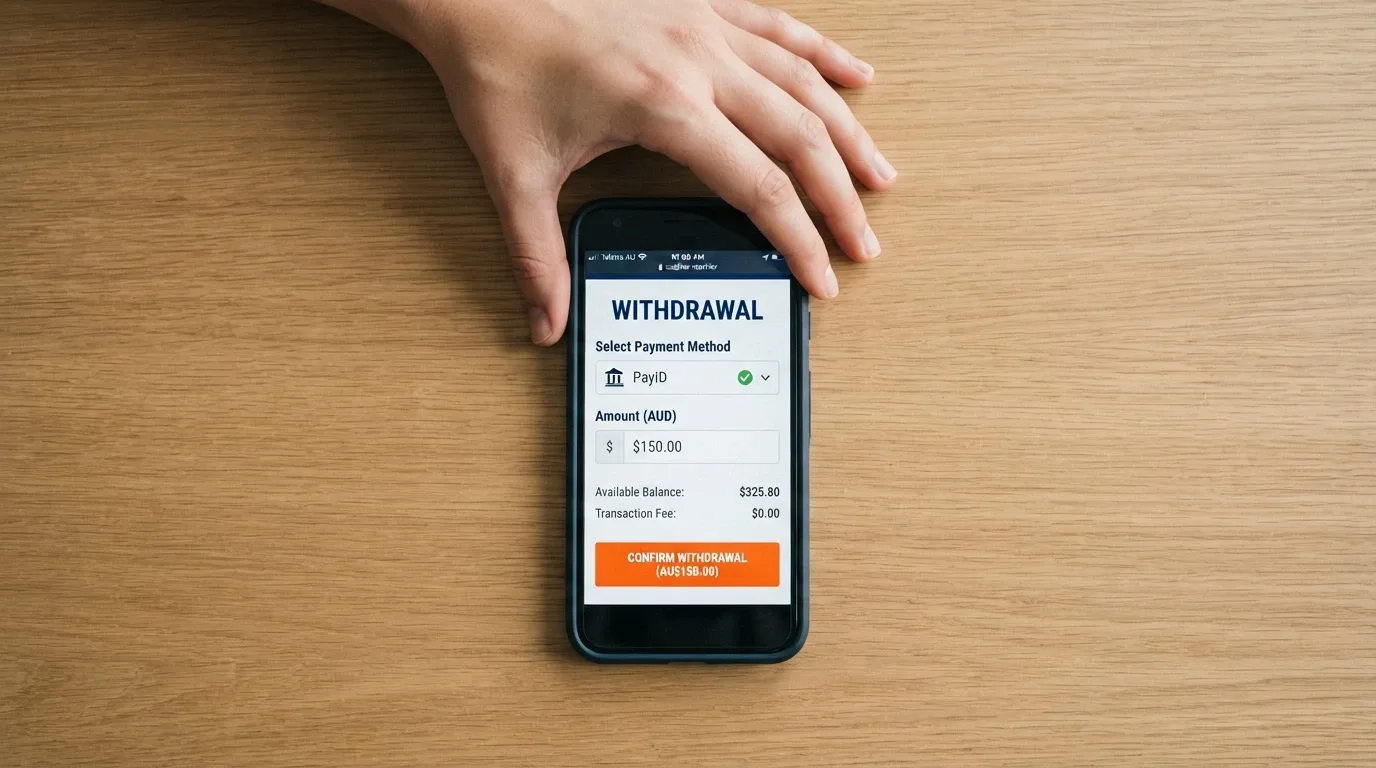
The mobile withdrawal experience at an offshore pokies site is, at the technical level, identical to the desktop experience. The PayID/Osko transfer is device-agnostic — it is a bank-to-bank leg that runs through the New Payments Platform regardless of whether the punter initiated it from a browser tab or a phone. The differences are at the cashier interface, where a mobile browser can feel cramped compared to a desktop, and at the app-store level, where the punter will not find a real-money pokies app to download.
Why There Are No Real-Money Pokies Apps in Australian App Stores
Apple and Google do not allow real money casino apps in Australian app stores. The policy sits on top of the IGA prohibition: an Australian app store cannot distribute a product that is illegal to provide from inside Australia, and the offshore operators do not qualify for the licensed-wagering carve-out the stores apply to local bookmakers. The workaround is a mobile web app — a casino site loaded in the phone’s browser and added to the home screen as a shortcut. The interface looks and behaves like an app; the underlying delivery is a website, which is what keeps it within the store policies and within the IGA’s offshore-licence structure.
Play-Money vs Real-Money Withdrawal Paths on Mobile
The Australian app stores are full of free-play pokies apps. These are demo-mode games with no real-money cashout and no path to withdrawing winnings, because there are no winnings to withdraw. A real-money mobile cashout only happens inside a mobile web app added from a casino site, and the PayID withdrawal route is the same as the desktop route described above. The visible difference is the absence of an app-store icon and the presence of a browser-based cashier; the practical difference is that real money is on the line and the operator’s terms (including the forty-eight-hour pending window at sites like House of Pokies) apply in full.
Why Offshore Pokies Sites Promise Fast Payouts That No Australian Site Can Match
The reason an offshore pokies site can advertise an “instant” PayID cashout that an Australian-licensed bookmaker cannot match is that no Australian-licensed pokies site exists to compete. The IGA 2001 prohibits the product, and the offshore market is the only market there is. The promise of speed is real at the technical level (PayID/Osko is fast) and constrained at the structural level (no Australian regulator can compel the operator to release funds). Both halves of that sentence matter to a player deciding where to deposit.

The Interactive Gambling Act 2001: What It Actually Prohibits
The IGA targets the provider, not the player. It is an offence to provide a prohibited interactive gambling service to a person physically in Australia, with maximum penalties of A$360,000 per day for individuals and A$1.8 million per day for bodies corporate. Prohibited services include online casino games (pokies, roulette, blackjack and the rest), in-play sports betting and any other interactive wagering product not specifically licensed. The licensed carve-out is narrow: pre-event wagering on sport and races, lotteries and keno, through operators licensed by a state or territory. The Northern Territory Racing and Wagering Commission, through Licensing NT, is the de facto national licensor for online wagering, with Sportsbet, bet365, Ladbrokes and roughly fifty others holding NT licences.
ACMA enforces the prohibition. Since its first blocking request in November 2019, ACMA has had 1,564 illegal gambling and affiliate websites blocked by Australian internet service providers, and more than 225 illegal services have withdrawn from the Australian market since enforcement began in 2017. The most recent quarterly report, covering October to December 2025, logged 23 completed investigations, 45 sites and 69 breaches, including 38 for providing a prohibited interactive gambling service and 26 for providing an unlicensed regulated service. The enforcement is real and ongoing; the offshore operators in this comparison set are all on the wrong side of it by definition, since the product they offer is illegal to provide from inside Australia.
Offshore Licences Explained: Curaçao, Tobique and What They Actually Mean for Your Payout
An offshore licence is a permission to operate from the licensing jurisdiction, not a guarantee to the player. Curaçao eGaming is the dominant licence among the comparison set: SkyCrown, Golden Crown and Wild Tokyo all carry one. The Tobique Gaming Commission, a newer Canadian First Nations regulator, covers FortunePlay. Both licences require the operator to maintain segregated player funds, run KYC and anti-money-laundering checks, and submit to the regulator’s dispute process — but neither regulator has an Australian office, an Australian complaints body, or an enforcement arm that can compel an Australian-facing operator to pay a player who has been wronged.
That is the gap the offshore licence does not close. ACMA can block the site, but the regulator cannot recover a player’s balance. The Curaçao or Tobique regulator can take a complaint, but the enforcement power stops at the licence. An Australian player with a real dispute has no Australian consumer-protection framework to fall back on, and that is the structural reason the offshore pokies market is faster on cashouts and weaker on recourse than the licensed Australian wagering market that surrounds it.
House of Pokies is the unlicensed case in the set. Casino.guru lists the operator as carrying no licence at all and assigns a Safety Index of 2.9 (“Very low”). An unlicensed operator has no regulator to answer to, anywhere, and the consumer-protection floor is at zero.
What Protections Australian Players Actually Have (and the Gaps)
The Australian player-protection framework is built around licensed wagering, not offshore pokies. The tools that exist — BetStop, the National Gambling Helpline, the credit and crypto payment ban — work as far as the licensed market reaches and stop at its edge.
BetStop, the National Self-Exclusion Register, has accumulated 67,480 registrations since going live in August 2023, with 41,290 exclusions still active as at 31 July 2026. Seventy-eight per cent of registrants were under 40 and 38 per cent chose lifetime exclusion. One registration excludes a person from every Australian-licensed online and phone wagering service. The critical limitation: BetStop binds only Australian-licensed wagering services. An offshore casino is not connected to the register and will keep accepting a self-excluded person’s money. For the player using any operator on this page, BetStop is not a backstop.
The National Gambling Helpline, 1800 858 858, is free, confidential and staffed 24 hours a day, seven days a week, with online chat and counselling through Gambling Help Online at gamblinghelponline.org.au. The helpline is the most concrete safety net available to an Australian player, and it does not depend on the operator’s licence.
The payment ban, in force since 11 June 2024, prohibits credit cards, credit-related products and digital currency (crypto) as payment for online wagering in Australia, with penalties of up to A$247,500 for non-compliance. The ban applies to AU-facing operators regardless of their licence. From 1 January 2027, banks and payment providers gain express authority to block transactions to illegal gambling operators, which is the structural change that may eventually reach the offshore market where the credit and crypto ban has not.
The 2026–2027 Gambling Reforms: What Changes in January
The Interactive Gambling Amendment (Gambling Reform) Bill 2026 passed Parliament on 19 August 2026, with the bulk of its measures commencing 1 January 2027. The new rules apply to licensed wagering operators, not to the offshore comparison set on this page, but they reshape the Australian wagering landscape the offshore market sits inside.
From 1 January 2027, no more than three wagering advertisements per hour may air between 6:00 am and 8:30 pm. A live-sport blackout applies from fifteen minutes before to five minutes after each event, and athletes, celebrities and influencers are barred from promoting wagering. Direct marketing of inducements is prohibited for fourteen days after signup, three months after BetStop deregistration, and indefinitely for at-risk customers. The Stop the Gambling Ads Bill, introduced to the House of Representatives on 30 March 2026, sits alongside the reform as a separate proposal to prohibit advertising of licensed interactive wagering services entirely.
For an offshore pokies player, the relevant change is the bank-blocking authority from 1 January 2027. Australian banks gain the express power to block transactions to illegal gambling operators, which means a PayID deposit to a blocked site may start failing at the bank level. The reform does not legalise offshore pokies, and it does not extend BetStop to them. It does add a layer of friction at the payment step that the offshore market has not previously had to navigate.
Playing It Safe: Real Help for Aussie Punters Beyond the Deposit-Limit Checkbox
The most useful framing for responsible gambling on this page is honest about the gap it cannot close. The deposit-limit checkbox, the session timer and the operator’s responsible-gambling page are features of the licensed market. Every operator on this page sits outside that market, and the protections those features would normally pair with — BetStop, an Australian complaints body, a regulator who can compel a refund — are not in place. The help that is real, the help a punter can act on tonight, runs through the National Gambling Helpline, Gambling Help Online and the player’s own bank.

How Big the Problem Is: Gambling Harm in Australia by the Numbers
About 2.1 per cent of Australian adults — roughly 430,000 people — experience problem gambling, and the Australian Institute of Health and Welfare put high-risk gambling at 1.8 per cent in 2022. The BetStop registrant data shows a younger skew than the AIHW prevalence figure suggests: 78 per cent of registrants are under 40, and 38 per cent have chosen lifetime exclusion. The age pattern is the warning: the cohort most active in online gambling is the cohort most represented in self-exclusion data. Offshore pokies access removes the safety barriers the licensed market builds around that cohort, and that is the structural concern behind the responsible-gambling conversation on this page.
Help That Is There Right Now: Helpline, Chat and Self-Exclusion
The National Gambling Helpline is 1800 858 858, free, confidential and staffed 24/7. Online chat and counselling are available through Gambling Help Online at gamblinghelponline.org.au. Both services are Australian-run, both are free, and neither depends on the licence of the operator the caller is using. BetStop is the third leg: it does not reach any operator on this page, but it does close off the licensed wagering market, which is where most of a self-excluded player’s money would otherwise go.
The single most important warning on this page is that BetStop does not cover offshore casinos. A player who registers with BetStop and continues to use an offshore pokies site has not self-excluded from that site. The site will keep accepting deposits, will keep running bonuses and will keep paying out (or not) on its own terms. The helpline and Gambling Help Online do reach the player directly, and they are the safety net that operates regardless of where the player has been playing.
Setting Boundaries That Actually Work on Offshore Pokies Sites
Offshore operators vary on the responsible-gambling tools they offer. Most will set a deposit limit on request; some will set a session limit; a smaller number offer a self-exclusion at the site level. The first practical step is to read the responsible-gambling page at the operator before depositing, because the tools on offer are not consistent across the set.
The second step, from 1 January 2027, is the bank. Australian banks gain express authority to block transactions to illegal gambling operators on that date, which means a player can ask their bank to block gambling-related transactions rather than relying on the operator’s own limit. The block is at the bank level, which is the layer the offshore operator does not control.
The third step is the one most often skipped, and it is the most effective. Telling a friend or family member that gambling has stopped feeling like a choice, and asking them to help enforce a break, is a harder conversation than clicking a deposit-limit checkbox and a more reliable guardrail than any tool an offshore operator can offer. The helpline number and the chat link are the entry points when that conversation feels too big to start alone.
How We Evaluated These Offshore Pokies Sites for Withdrawal Speed
The ten operators in this comparison set were chosen for the data the independent review sites carry about them. The published sources used here are Pokiesaustralia.com, Wildfish.com, Betsquare.org, Casinobeats.com, Casino.guru, lcb.org, Culture.org, metrotimes.com and nodeposit.org. Each source publishes either tested cashout logs (with amount, method, day and timestamp) or operator-specific data on welcome offers, wagering, game libraries, complaint records and licence status. The two types of data cover the same operators from different angles, and where they agree the figure is used; where they disagree, the more recent tested figure is preferred.
The evaluation criteria are tested PayID withdrawal time, licence status, complaint volume, bonus-term fairness, and game library depth. Operators without PayID-relevant data were excluded, as were operators that do not accept Australian players. The comparison set is not a ranking in the strict sense: SkyCrown is the fastest tested cashout, LuckyVibe the lowest wagering, Rolling Slots the deepest library, House of Pokies the worst complaint record, and a player optimising for any one of those dimensions would choose differently. The table and the write-ups are structured to let the reader weigh them.
ACMA’s published enforcement record and the Australian Communications and Media Authority register set the regulatory benchmark. No operator in the comparison set appears on any Australian register, because no register exists for the product they offer. The offshore-licence status in the table is taken from the operator’s own site footer or from Casino.guru’s safety-index entry; where the licence is described as “unverified” or where the operator carries no licence at all, the table says so.
What to Actually Do Next: Picking a Pokies Site That Pays You Without the Runaround
The fastest PayID cashout in current testing was eleven minutes, at SkyCrown, on a weekday, for a A$920 withdrawal from a verified account. The median across fast-payout casinos was two hours, and the worst case was eight. Set the expectation to the median, not the headline, because the headline describes the transfer leg rather than the total wait and the total wait is what the player actually feels.
Before depositing at any operator on this page, run three checks. The first is the PayID withdrawal list at the cashier — if PayID is on the deposit list but not the withdrawal list, the deposit-versus-withdrawal gap is going to cost the player time. The second is the published processing window — a site that quotes a one-to-twenty-four-hour PayID turnaround in its payments page is showing its hand; a site that does not is hiding it. The third is the dormant-account clause, the unpublished max-bet rule, and the complaint record — a forty-eight-hour pending window plus a six-to-twelve-month dormant confiscation is a different proposition from a one-hour PayID turnaround, and the small print is where that difference lives.
Complete KYC at signup rather than at the first cashout. The first withdrawal waits on the document review; the second does not. Uploading ID, address proof and payment-method confirmation before the first win lands removes the largest variable from the total wait.
Never deposit more than the player is willing to lose to an operator outside Australian consumer law. ACMA can block the site, but the regulator cannot recover a balance. An offshore pokies site that decides to close an account or void a withdrawal is the only authority on that decision, and the player has no Australian backstop. The amount that respects that limit is the amount the player can lose without it changing the rest of the week.
If gambling stops feeling like a choice, the National Gambling Helpline is 1800 858 858, free and confidential and answered around the clock, with online chat at gamblinghelponline.org.au. BetStop does not reach any operator on this page; the helpline does, and the helpline is the safety net no offshore casino can offer.
Frequently Asked Questions
Is “instant withdrawal” at online pokies real or just marketing?
The transfer leg of a PayID/Osko cashout is genuinely near-instant once the operator releases the funds — typically ten to sixty minutes between the casino and an Australian bank account. The marketing claim of sixty-second payouts describes only that leg. The total wait also includes the operator’s internal approval window, which runs from zero to fifteen minutes at the fastest sites and forty-eight hours or more at the slowest. The realistic spread on a PayID withdrawal at an Australian-facing offshore pokies site is from eleven minutes (the fastest tested) to roughly two hours (the median) to eight hours (the worst case in current testing).
Are online pokies legal in Australia and what protections do I have?
No Australian company can legally offer real money online pokies to Australians — the Interactive Gambling Act 2001 prohibits the provision of online casino games and pokies to people in Australia, with penalties of up to A$360,000 per day for individuals and A$1.8 million per day for bodies corporate. The licensed carve-out covers pre-event wagering, lotteries and keno only. Every site on this page is an offshore operator offering a product that is illegal to provide from inside Australia. The Australian protections — BetStop, the National Gambling Helpline, ACMA’s enforcement — do not reach offshore casinos in the same way they reach licensed wagering. A player using an offshore pokies site has no Australian consumer law covering the balance, no Australian complaints body, and no regulator who can compel a payout.
What is the withdrawal verification (KYC) process and how long does it take?
Every offshore casino requires Know Your Customer verification before the first withdrawal. The standard documents are a government-issued photo ID, a recent utility bill or bank statement as proof of address, and sometimes a photo of the payment method used to deposit. House of Pokies runs a forty-eight-hour internal pending window on top of the verification review. The verification itself typically completes within twenty-four to seventy-two hours once the documents are submitted; the first cashout waits for both the verification and the pending window. The practical move is to upload the documents at signup, before the first win lands, which removes the verification wait from the first withdrawal.
What are the typical withdrawal limits at PayID pokies sites?
PayID withdrawal limits at Australian-facing offshore pokies sites typically run from a A$10 to A$30 minimum to a A$2,000 to A$10,000 maximum per transaction, with no fees on either deposits or withdrawals. Per-operator limits vary: SkyCrown sets a A$7,500 daily, A$15,000 weekly and A$50,000 monthly cap with negotiable VIP limits up to A$100,000 per month. House of Pokies sets a A$200 minimum, a A$5,000 per-transaction maximum and a A$30,000 monthly cap. Weekly and monthly caps differ significantly between operators and are worth checking before staking an amount that would hit them.
Can I withdraw pokies winnings to my bank account using PayID on mobile?
Yes. The PayID/Osko transfer is device-agnostic — it runs through the New Payments Platform regardless of whether the cashout is initiated from a desktop browser or a mobile browser. The mobile experience differs from the desktop only at the cashier interface, where a smaller screen means more scrolling through the withdrawal method list. There are no real-money pokies apps in Australian app stores (Apple and Google do not allow them), and the standard mobile route is a casino site loaded in the phone’s browser and added to the home screen. PayID deposits credit in under sixty seconds at every verified casino tested, and the same speed applies to the withdrawal leg.
What happens if an offshore casino refuses my withdrawal?
The short answer is that the player has no Australian backstop. ACMA can block the site at any time, but the regulator cannot recover a balance and no Australian complaints body has jurisdiction over a Curaçao or Tobique licensee. The offshore regulator (Curaçao eGaming, Tobique Gaming Commission) can take a complaint, but its enforcement power stops at the licence. The practical moves are to verify the operator’s licence and complaint record before depositing (House of Pokies’ 26,985 black points in Casino.guru’s database is a benchmark of what to avoid), to keep documentation of every deposit, bonus claim and withdrawal request, and to set the deposit amount at a level the player can lose to an operator outside Australian consumer law.
Mobile Web vs Desktop: Does Withdrawal Speed Change on Your Phone?
The transfer speed does not change. PayID deposits credit in under sixty seconds at every verified casino tested, and that figure is identical on mobile and desktop because the bottleneck is the bank, not the device. Where mobile differs is the cashier experience: a smaller screen means more scrolling through the withdrawal method list, and the PayID handle (mobile number, email, ABN) may need to be re-entered or selected from a saved list. Operators with well-built mobile cashiers handle this without friction; the ones that simply shrink the desktop interface do not. The practical test is whether the cashier completes in two or three taps from the home screen — if it does, mobile cashout is as fast as desktop.