
No Deposit Bonus Casinos Australia: What the 2026 Offers Actually Cost
A no-deposit bonus sounds like the only honest offer in online gambling: the casino gives you something, you give it nothing back. The fine print under that promise is what this page is about. Below is what an Australian player actually receives from the offshore casinos running no-deposit offers this year, what those offers cost in wagering and time, and what protections are missing when the site taking your play is operating outside every Australian rule.
Current as of 16 October 2026 · Operator licence claims verified against the ACMA register
Table of Contents
- What a No Deposit Bonus Actually Costs You
- The Real Shape of No Deposit Bonuses in 2026
- The No Deposit Bonus Casinos Australians Can Actually Play at in 2026
- New Casinos Betting on No Deposit Offers in 2026
- Why Your Payment Method Decides Whether You See a Cent of That Bonus
- The Pokies Your No Deposit Bonus Actually Works On
- Crypto No Deposit Bonuses — Fast Payouts, No Australian Safety Net
- Why Every No Deposit Casino for Australians Is Operating Illegally
- Playing No Deposit Offers Without Handing Over More Than the Bonus
- Free Play vs Real Money — What Demo Mode Actually Delivers
- How We Picked and Ranked These Casinos
- What You Should Actually Do With a No Deposit Bonus
- Frequently Asked Questions
What a No Deposit Bonus Actually Costs You
The Interactive Gambling Act 2001 makes it an offence to provide an online casino game to a person physically in Australia. No online casino licence exists in this country — not federally, not in any state or territory. Every operator offering a no-deposit bonus to an Australian player is doing so from offshore and without an Australian licence. That is the frame around every number that follows.
A no-deposit bonus is the casino’s hook. You register, verify a phone number or email, and a small amount of bonus credit appears on your account without you having deposited a cent. Two main forms dominate the market this year: a bundle of free spins locked to a single pokie, and a small free-chip credit (usually A$10 to A$25) you can spend across the lobby. The word “bonus” is the marketing choice; the contract says “conditional credit”, and the conditions are the entire offer.
The arithmetic against the player is built into the product. A typical Australian no-deposit offer runs 40x to 60x wagering on the bonus, with a max cashout ceiling of AU$50 on free spins and AU$50 to AU$200 on free chips. On a A$25 chip at 30x wagering — the more generous end of the spectrum — a player must run A$750 through the casino before a cent becomes withdrawable. The pokies the bonus is spent on carry a 3% to 5% house edge. Across A$750 of turnover the casino statistically earns back A$22 to A$37 of those bets before payout conditions are met. Most players never clear the wagering.
The marketing label says “free”. The arithmetic says “expensive on the casino’s terms, with a ceiling on your winnings”. The reader who skips the fine print takes the worst of both worlds.
The core definition — and why it is never really free
A no-deposit bonus is a small credit or spin bundle the casino credits to a new account without an accompanying deposit. It is genuinely free at the moment it lands — there is no money out of your pocket to receive it. What it costs you is everything that comes after.
The two forms behave differently. Free-spin offers name a spin count and a per-spin value; 50 spins at A$0.10 each is A$5 of total bonus, while 50 spins at A$0.20 is A$10. A free-chip offer is a flat credit, typically A$10 to A$25, that you can usually spend across multiple games. Free spins dominate the 2026 Australian market — most offers sit between 20 and 100 spins on a single named pokie, with wagering of 30x to 50x on the winnings. Free-chip offers are rarer and tend to carry heavier wagering because the credit is larger.
The word “bonus” is doing a lot of work. It sounds like a gift. The contract reads as a conditional credit that becomes withdrawable cash only after wagering conditions, game restrictions, max-bet caps, time limits and a ceiling on the winnings are all satisfied. Each condition is a door that can close on the way to payout. Treating the bonus as the casino’s gift rather than its funnel is the mistake every comparison page on the topic makes.
The Real Shape of No Deposit Bonuses in 2026
Eight mechanical parts decide whether a no-deposit bonus pays out anything: the welcome structure, the form (spins or chip), the wagering multiple, the max cashout cap, the bonus code or trigger, the game contribution rates, the max-bet cap during wagering and the expiry window. Each one is negotiable in the small print. Each one shifts the value of the offer from “worth claiming” to “trap” without changing the headline number.

A reader who knows what each part does can read any offer in five minutes and tell which ones are worth their time. The sections that follow are that short course.
Welcome and sign-up no deposit offers — what you actually get
A welcome no-deposit bonus is the smallest entry in a casino’s promotional stack: you create an account, verify a contact method, and the bonus appears. The trigger has shifted over the past two years from “enter a bonus code at registration” to “verify your phone number or email” — which means the offer is automatic once the verification is done, and the player’s job is to find it on the casino’s promotions page rather than to remember a string of letters and numbers.
The Australian-facing market this year includes Skycrown’s 100 free spins via phone verification, BitStarz’s 50 free spins credited on registration, Royal Reels’ A$10 chip after phone verification, RocketPlay’s 50 free spins auto-credited on signup, WinSpirit’s 35 free spins no deposit, and Bizzo’s 15 free spins tied specifically to PayID registration. The cluster skews to free spins rather than chips, in the 20 to 100 spin range, with the wagering attached to winnings rather than to the bonus itself.
What triggers one is also what gates the next stage. Phone verification opens the offer, but it also opens the casino’s records of you — meaning the same verification the bonus requires is the same data the operator can later use to enforce a max cashout cap, a country exclusion or a bonus abuse flag.
Free spins vs free chips — what each is actually worth
The two currencies of no-deposit bonuses do not exchange at the same rate. A spin bundle’s value is the spin count times the per-spin value, which the operator names in the offer. RocketPlay’s 50 free spins on Gamzix “3×5 Hold The Spin” at A$0.10 per spin totals A$5 of bonus. BitStarz’s 50 free spins at A$0.20 per spin totals A$10. Both are 50-spin offers; the second is worth twice the first on paper, before wagering is applied to anything won.
A free chip is simpler: a flat credit, A$10 to A$25 typical, that can usually be spent across multiple games. Royal Reels’ A$10 free chip is the only chip-style offer in the featured set this year. A chip carries higher wagering because the credit is larger — A$10 at 30x means A$300 of turnover, against A$5 of spins at 40x on winnings that may total less than A$50. The chip wins on flexibility; the spins win on simplicity. Neither wins on raw expected value, because both are hedged by a max cashout ceiling and a wagering requirement the casino chose.
The honest reading: a free-spin offer at A$0.20 per spin with reasonable wagering is a stronger deal than a small chip at heavy wagering, because the spins cost the casino nothing to grant if the player does not win, while the chip is a guaranteed liability the moment it is credited. That is why the market tilts toward spins.
Wagering requirements — the fine print that eats your winnings
Wagering is the multiplier applied to either the bonus or the winnings from the bonus, and it is the single number that decides whether a no-deposit offer is worth the registration. A 30x wagering on a A$25 chip means A$750 must be run through eligible games before any winnings become withdrawable. A 40x wagering on free-spin winnings of A$20 means A$800 of play on top of the spins you already used.
The Australian benchmark this year runs from 30x at the player-friendly end to 60x at the punishing end. Reasonable offers cluster at 30x to 35x. Acceptable offers sit at 40x. Steep offers run 45x to 50x. Anything above 50x on no-deposit winnings is practically unclearable for most players — the time and turnover required outweigh any realistic payout after the max cashout cap is applied.
Game contribution rules decide which bets count toward that turnover. Pokies contribute 100%. Table games contribute 10% to 30%, and live casino contributes 0%. A player who tries to clear a pokies bonus at blackjack is wagering ten times the required turnover for the same progress. The contribution table is the second trap, and it is set up so the player who picks the wrong game does all the work and gets none of the credit.
The max-bet cap during wagering is a third constraint, and a hard one. Most Australian-facing casinos cap bets at A$5 per spin while a bonus is active. Exceeding that on a single spin — even by accident — typically voids the bonus and any winnings tied to it. The cap is built to stop a player from racing through turnover with one big wager; the practical effect is that the player must place 150 A$5 bets to clear A$750 of turnover, which is roughly twelve and a half minutes of play at one spin every five seconds, and that math ignores the spins that lose and the time spent picking games.
What a 30x wagering requirement actually costs the player
Take the cleanest version of the offer: a A$25 free chip with 30x wagering, played on a Pragmatic Play pokie running at the typical 96.0% to 96.7% return-to-player range. The required turnover is A$25 multiplied by 30, which is A$750. The house edge on a 96.5% pokie is 3.5%. Multiply A$750 by 0.035, and the casino’s expected take from the bonus is A$26.25 before any cashout cap or game restriction is applied.
That is the offer’s cost on average. The actual experience for any individual player varies around it: some will run hotter than 96.5% over a short session, some cooler. The mean is A$26.25 in expected loss, and that figure sits on top of the time spent clearing wagering without any guaranteed payout. If the max cashout cap is AU$50 and the player runs hot enough to clear wagering with a A$50 balance, the casino pays A$50 and keeps the rest of the theoretical edge from the spins along the way. If the player does not clear wagering, the casino keeps the entire bonus value plus whatever was lost in the chase. Both outcomes move money in one direction.
The reading for a player: the bonus costs roughly A$26 in expected value to clear at the friendly end of the wagering spectrum, and the realistic ceiling on what comes back is the max cashout cap. A 60x offer roughly doubles the turnover, doubles the expected loss and roughly doubles the time. The market does not get more generous as you climb the wagering ladder; it gets tighter.
Max cashout caps — why a A$200 win might only pay A$50
The max cashout cap is the ceiling on what the casino will actually pay out from bonus winnings, regardless of how much is sitting in your balance when wagering clears. A AU$200 win on free spins at a casino with a AU$50 cap becomes a AU$50 payout. The rest is forfeit. The cap is the second number to check after wagering, because it is what determines the actual maximum value of any given bonus.
The Australian market this year clusters at AU$50 for free-spin offers and AU$50 to AU$200 for chip offers. WinSpirit and RocketPlay sit at the AU$50 floor for spins. BitStarz caps at AU$100. Royal Reels and Skycrown extend to AU$200 for the largest offers. A high cap combined with low wagering is the configuration a player wants; a low cap combined with high wagering is the configuration where the bonus exists mostly to acquire the player’s email address.
The cap is also the lever that protects the casino’s edge after wagering is cleared. A player who runs hot enough to build a A$300 balance under a AU$50 cap is paid A$50 and loses A$250 by walking away with anything at all. The mechanism is not illegal — it is in the terms the player accepted at registration — but it is the reason a “big win” on a no-deposit bonus frequently pays a small amount.
Bonus codes and how to use them
A bonus code is a short string — letters, numbers or both — that activates a specific promotion when entered into a registration or cashier field. Codes were the dominant activation mechanism five years ago. They are rarer now.
Most of the featured operators this year credit the no-deposit bonus automatically once a verification step completes. Skycrown credits 100 free spins after phone verification. Royal Reels credits the A$10 chip after phone verification. RocketPlay credits 50 free spins on signup. Bizzo’s 15 free spins are tied specifically to PayID registration, which is a payment-method trigger rather than a code. Where a code is still in use, it is usually surfaced on the casino’s promotions page or in an affiliate partner’s listing — and the player enters it at registration or in the cashier before the qualifying action.
The practical advice: if the bonus is described as auto-credited, do not waste time looking for a code. If the bonus is described as code-activated, the code is what stands between you and the spins. The mistake is assuming every offer needs a code, or assuming none does; the mistake is not reading the activation line on the offer page.
Converting bonus credit into real withdrawable cash
The last step is where most bonuses die. The path from a cleared wagering requirement to money in a bank account runs through several gates, and the player’s job is to clear them in order.
The sequence is: clear the wagering requirement, meet the max cashout cap, pass the casino’s KYC verification, make a minimum real-money deposit if the casino requires one, then request the withdrawal to an eligible payment method. Each step has a failure mode. The wagering can fail to clear before the expiry window. The KYC check can flag a mismatch between the name on the account and the name on the payment method. The minimum deposit — A$20 at BitStarz, for instance — can be missed, in which case the withdrawal is held even if wagering is clear.
The minimum-deposit gate is the trap most reviews skip. A no-deposit bonus that requires a real-money deposit before any winnings can be withdrawn is no longer fully no-deposit. It is a free-trial offer that converts on first cashout. The cost is small (A$20 is the typical floor) but the principle is the one the page keeps returning to: the bonus is the casino’s funnel, not its gift.
The No Deposit Bonus Casinos Australians Can Actually Play at in 2026
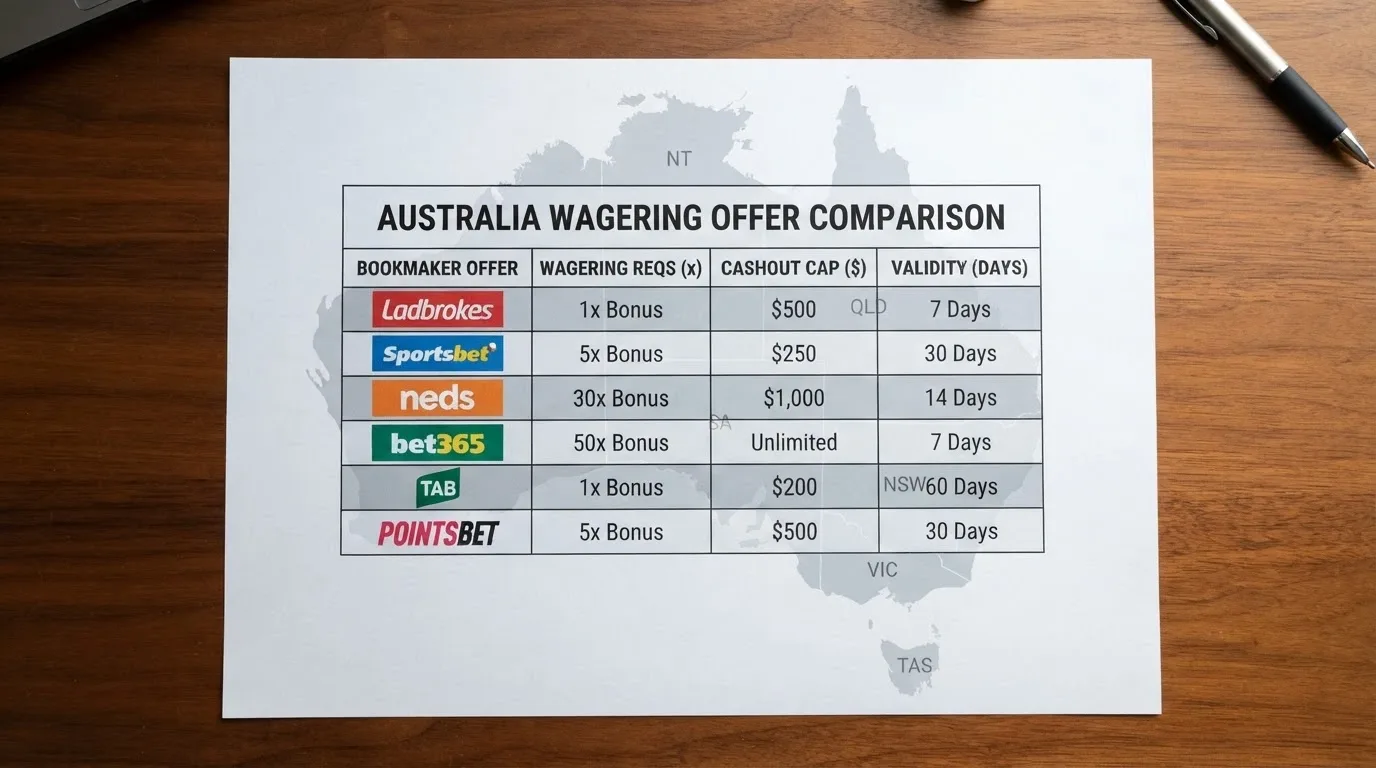
Ten operators make up the featured set this year. None holds an Australian online casino licence — none exists. All are offshore brands accessible from Australia, and the legal position of playing at them is covered in a later section. The table ranks them on the no-deposit offer they actually publish, plus the wagering, cashout cap and expiry that determine what comes out the other side.
| Casino | No-Deposit Offer | Wagering | Max Cashout | Bonus Validity | Licence / Status |
|---|---|---|---|---|---|
| Skycrown | 100 free spins (phone verification) | 40x bonus / 30x FS winnings | AU$200 (FS) | 14 days per tier | Offshore; no AU licence |
| BitStarz | 50 free spins (registration) | 40x on bonus cash | AU$100 | 7 days | Offshore; no AU licence |
| Royal Reels | A$10 no-deposit chip (phone verification) | 30x on bonus | AU$200 | 7–14 days | Offshore; no AU licence; blocked by ACMA |
| RocketPlay | 50 free spins (A$0.10/spin, Gamzix) | 60x on winnings | AU$50 | 1 day activation | Offshore; no AU licence |
| WinSpirit | 35 free spins | Not specified in available sources | AU$50 | 7 days | Offshore; no AU licence |
| Fair Go Casino | A$10–A$25 free chip or spins (rotating) | 30x on winnings | Not specified in sources | 7–14 days typical | Offshore; no AU licence |
| Casino Rocket | No NDB confirmed for 2026 | N/A | N/A | N/A | Offshore; no AU licence |
| Stake | No NDB confirmed for 2026 | N/A | N/A | N/A | Offshore; no AU licence |
| Bizzo Casino | 15 free spins (PayID registration) | 40x | Not specified in sources | Not specified | Offshore; no AU licence |
| Scream Casino | Not confirmed | Not confirmed | Not confirmed | Not confirmed | Offshore; no AU licence |
The cluster is uneven. Skycrown and Royal Reels publish the strongest offers in raw numbers — high spin counts or larger chips, the highest cashout caps and reasonable wagering. BitStarz sits in the middle with a smaller offer but a fast crypto payout path. RocketPlay and WinSpirit are at the floor on both spin count and cap. Casino Rocket and Stake publish no no-deposit bonus at all in 2026 — they are included because readers searching this term may still land on their pages, and their welcome packages deserve mention. Bizzo’s 15 spins are the smallest in the set but locked to a PayID trigger that is unusual. Fair Go’s 30x wagering is the most player-friendly multiple in the table. Scream Casino is included for completeness; its no-deposit terms did not surface in the available sources this run.
The ranking below is editorial — informed by offer size, wagering burden, cashout cap and library depth — not derived from a numerical score. The legal status column is uniform for a reason: every operator in the set is offshore and unlicensed in Australia.
Skycrown — 100 free spins and the biggest game library
Skycrown’s no-deposit offer is the largest spin bundle in the featured set: 100 free spins credited after phone verification, with a 10,400+ game catalogue drawing on 50+ providers including Pragmatic Play, NetEnt, Microgaming, Play’n GO, BGaming, Hacksaw Gaming and Nolimit City. The wagering split is 40x on the bonus amount and 30x on the free-spin winnings — the second figure is the one most players actually clear against. The max cashout on free-spin winnings is AU$200, the highest cap in the set, and the welcome package adds A$8,000 plus 400 free spins across four deposits at 40x/30x wagering with a A$20 minimum deposit, A$5 max bet during wagering and 14 days per tier.
PayID and crypto are both supported. A PayID withdrawal of AU$180 was tested at roughly two hours and twenty-nine minutes end-to-end, which is competitive against any other option in the table. The casino claims a Curaçao eGaming licence; that claim is unconfirmed in this run.
The verdict for a player comparing options: Skycrown pairs the largest spin count with the largest cashout cap and the deepest game library in the table. The 40x/30x split is reasonable but not generous. The phone-verification trigger is standard. For a player who wants the largest NDB surface area to play on, this is the strongest line in the set.
BitStarz — 50 free spins and crypto-speed withdrawals
BitStarz runs 50 free spins on registration at A$0.20 per spin — a A$10 total bonus — with 40x wagering on bonus cash, a AU$100 cashout ceiling and a 7-day expiry. The library runs to 79+ providers, the largest count in the featured set, and the welcome package on the deposit side is a 200% match up to A$2,000.
The catch most reviews skip is the minimum-deposit gate: BitStarz requires a real-money deposit of at least A$20 equivalent before any no-deposit bonus withdrawal can be processed. KYC is applied on a risk basis — verification is not requested at signup, but the casino reserves the right to request it for any no-deposit withdrawal. Crypto withdrawals are processed at an average of around ten minutes once verified, which is the fastest payout path in the table. The casino claims a Curaçao eGaming licence; that claim is unconfirmed in this run.
The verdict: BitStarz is the strongest crypto-payout option in the table, and its 50 free spins are reasonable on the wagering front. The A$20 deposit gate converts the no-deposit offer into a deposit-required offer at the moment of cashout, which the player should know before chasing the bonus.
Royal Reels — A$10 no deposit chip and 5,400+ pokies
Royal Reels offers the only free-chip no-deposit bonus in the featured set this year: A$10 credited after phone verification, with 30x wagering on the bonus amount — the second-lowest in the table — and a AU$200 max cashout, the joint-highest cap. The library runs to 5,400+ pokies from 40+ providers, and there is a 10-tier VIP program on top. The deposit welcome package adds A$2,500 plus 50 free spins across three deposits at 35x wagering with a A$5 max bet.
The critical fact: Royal Reels is among the sites blocked by the Australian Communications and Media Authority. Australian players can still reach the site through some routes, but the operator’s domain is on ACMA’s blocking list. That makes it harder to access, and any balance held with the operator is at risk if the blocking extends to a payment channel under the 2027 reforms.
The verdict: Royal Reels’ A$10 chip with 30x wagering and a AU$200 cap is one of the strongest no-deposit values in the table on paper. The ACMA block is the obstacle. A player who can reach the site and clears the chip’s wagering faces the same offshore-recreational calculus as the other brands in the set, plus the operational risk of the block deepening.
RocketPlay — 50 free spins at 60x wagering
RocketPlay runs 50 free spins on Gamzix “3×5 Hold The Spin” at A$0.10 per spin — a A$5 total bonus — with 60x wagering on winnings, a AU$50 max cashout and a 1-day activation window. The 60x multiple is the highest in the featured set. The 1-day activation deadline is the tightest deadline on the page. The library runs to 3,000+ games. The welcome package on the deposit side is up to AU$1,000 at 30x to 40x wagering. Crypto is supported and weekly cashback runs at 5x wagering.
The combination is punishing. A player has 24 hours to activate the spins after registration, then faces a turnover requirement that doubles or triples what most other operators in the set demand. AU$50 is the maximum payout regardless of how much is won. The bonus exists for the registration, not for the payout.
The verdict: RocketPlay is the hardest offer in the set to clear. A player who values the spin count over the conversion chance may still find it worth the registration; a player who wants a realistic path to a payout should look elsewhere on the table.
WinSpirit — 35 free spins, crypto-focused
WinSpirit offers 35 free spins no-deposit with a AU$50 cashout cap and a 7-day wagering window. The library is multi-provider and the operator accepts Tether, Bitcoin, Ethereum and Litecoin, which makes it the most crypto-flexible brand in the featured set.
The gap in the available sources is the wagering requirement on the 35 spins. It is not specified in the materials reviewed this run, and the operator’s terms page did not return a clean figure. A player considering the offer should check the current wagering multiple on the promotions page before activating; the 7-day window leaves no time to discover an unworkable multiple after the spins have been used.
The verdict: WinSpirit’s 35 free spins with a AU$50 cap sit below Skycrown and BitStarz in raw offer size but the multi-crypto deposit support is a meaningful edge for a crypto-native player. The missing wagering figure is a real hole in the offer’s terms — exactly the kind of specification a player should verify before activating.
Fair Go Casino — 30x wagering, the lowest in the set
Fair Go runs rotating no-deposit offers — free chips or free spins, typically A$10 to A$25 — with 30x wagering on free-spin winnings. That 30x is the lowest wagering multiple in the featured set this year, and it is the strongest argument for the offer.
The trade-off is the library. Fair Go is RealTime Gaming-only, which means the game count sits well below the multi-provider operators in the table and the slot catalogue is constrained to one supplier’s output. The max cashout on the NDB is not specified in the materials reviewed this run. Validity typically runs 7 to 14 days.
The verdict: Fair Go’s 30x wagering is the most player-friendly multiple in the table. The single-provider library and the missing cashout figure pull the offer back. A player who values clearing chances over library size will find this a reasonable line; a player who wants game variety should look at Skycrown or BitStarz.
Casino Rocket — no confirmed NDB, but a Big Bass Splash welcome
Casino Rocket does not publish a confirmed no-deposit bonus for 2026. The operator’s first-deposit welcome is a 100% match up to AU$525 plus 50 free spins on Big Bass Splash (Pragmatic Play) at 45x wagering, with a AU$30 minimum deposit. PayID is supported.
The page includes Casino Rocket because readers searching this term may arrive at its deposit welcome by mistake. A player who lands here looking for a no-deposit offer and decides to deposit instead is looking at a 45x wagering multiple — steep against the rest of the table — on a single-deposit bonus that pays up to AU$525 plus 50 spins on one of the most volatile Pragmatic Play titles in the market.
The verdict: no NDB means the reader who came for one leaves empty-handed. The Big Bass Splash welcome is a deposit product, not a no-deposit one, and the 45x wagering sits in the steep band. A player set on a no-deposit offer should not count Casino Rocket among the available lines.
Stake — no NDB, crypto-only with daily races
Stake does not offer a no-deposit bonus in 2026. The operator’s proposition is a 200% deposit match up to A$2,000 plus a continuing promotional structure built around a daily A$100,000 race every 24 hours and a weekly A$75,000 raffle. The platform is crypto-only — there is no AUD payment rail. The library runs to 3,000+ games.
The verdict: Stake is in this ranking for completeness, not for a no-deposit offer. A reader who came for an NDB will not find one. The daily races and the crypto-only setup describe a different product — a high-volume wagering venue, not a free-trial signup — and the player who values either will get value from Stake that the table does not capture.
Bizzo Casino — 15 free spins for PayID players
Bizzo runs 15 free spins on Wild West Trueways for players who register using PayID, at 40x wagering. The 15-spin count is the smallest in the featured set. The PayID trigger is the most distinctive activation method on the table.
The gaps in the available sources are the max cashout and the bonus validity window. Neither figure was specified in the materials reviewed this run. PayID is supported for both deposits and withdrawals. A player who registers with PayID is betting on a payment-method-aligned offer that requires verification of intent before the spins land.
The verdict: Bizzo’s 15 free spins are a niche offer for a player who wants to use PayID as the first action and is comfortable with a 40x wagering multiple on a small spin count. The missing cashout and validity figures are a real hole in the offer’s terms — check the promotions page before activating.
Scream Casino — presence confirmed, NDB terms not found
Scream Casino holds a measurable share of the tracked Australian gambling market, which is why it appears in this ranking. The no-deposit bonus terms did not surface in the available sources this run: offer, wagering, cashout and validity are all unconfirmed. The operator runs multiple providers offshore with no Australian licence.
The verdict: Scream Casino is included because it is part of the AU-facing offshore market, but the reader looking for a no-deposit offer here will not find one in the materials reviewed. Check the operator’s promotions page directly, or treat the inclusion as a marker of presence rather than an actionable offer.
New Casinos Betting on No Deposit Offers in 2026
New online casinos use no-deposit bonuses to buy what an established brand already has: a registered player who has handed over a verified email and phone number. The offers tend to be larger at launch than at maturity, because the operator is paying for acquisition rather than rewarding loyalty. The cost of that strategy to the player is the operator’s track record — there is no payout history, no reputation with Australian-facing forums, and no published record of how a withdrawal dispute has been resolved.
The standard benchmarks for evaluating a new operator’s no-deposit offer are the same as for any other operator: max cashout above A$100, wagering under 35x, no max bet below A$5 per spin during wagering. An offer that meets all three is unusually player-friendly. An offer that meets one is typical of the market. An offer that meets none is the casino’s marketing arm writing a cheque it does not intend to clear.
New online casinos using no deposit bonuses to build a player base
The acquisition economics drive the offer size. A new operator would rather grant A$25 in spins and lose A$5 of expected value than spend A$25 on a paid ad that returns nothing. The bonus is the marketing budget, and the wagering requirement is the filter that ensures only some of that budget is paid out.
The player’s check before claiming is the operator’s licence and withdrawal history. A Curaçao or Anjouan claim should be checked against the relevant public register. A withdrawal history is harder to verify for a brand that launched this calendar year — the player is the proof of concept. The minimum sensible due diligence is a search for the brand name plus “withdrawal problem”, “not paid”, or “scam” in player forums, with the awareness that anonymous forum reports are evidence rather than proof.
The new-casino NDBs in the featured set do not break dramatically from the established operators’ offers. Skycrown and Royal Reels publish the strongest NDBs in the table; both have been in the AU-facing market long enough that the absence of a payout scandal is itself information.
New Australian-facing casinos and their 2026 NDB terms
The Australian-facing segment this year is dominated by established offshore brands rather than fresh launches. The operators on the table above — Skycrown, BitStarz, Royal Reels, RocketPlay, WinSpirit, Fair Go, Casino Rocket, Stake, Bizzo and Scream — are not all new entrants, but several are recent enough that their withdrawal track record is short. A player comparing offers should weight the offer terms over the operator’s launch date, because a generous offer from a brand with a thin reputation is riskier than a moderate offer from a brand with a year of payouts behind it.
The specific offers from newer entrants do not break the market pattern. NDB spin counts cluster between 15 and 100, wagering between 30x and 60x, and max cashout between AU$50 and AU$200. The new-entrant strategy is to match or beat one of those axes while leaving the others at market standard, not to reset the whole grid.
Why Your Payment Method Decides Whether You See a Cent of That Bonus
The payment method is not a checkout detail. For Australian players at offshore casinos it determines whether the casino will pay out, how fast, and whether the transaction itself is breaking Australian rules. The choice of method is the choice of consequence.
PayID and Osko instant bank transfers are the AUD-native fast route. E-wallets sit in the middle. Crypto is fast, mostly untraceable, and entirely outside the Australian consumer-protection framework. Credit cards and crypto for online wagering have been banned in Australia since 11 June 2024, and an operator asking for either is advertising that it sits outside Australian rules. The ban is enforced through penalties of up to A$247,500 on the operator, not the player — but the practical effect is that any licensed-Australian-style operator will refuse those methods, and any operator that accepts them is offshore by definition.
PayID and instant bank transfers — the fastest AUD route
PayID is the standout withdrawal method for Australian players. It links a bank account to a mobile number or ABN, and a PayID transfer arrives in the recipient’s account within minutes rather than days. For casino withdrawals, an approved PayID payout is processed in minutes once the account is verified, with a typical minimum of AU$30. Bizzo’s 15 free spins are tied to PayID registration specifically, which is the most direct acknowledgement on the page of how central PayID has become to the Australian-facing market. Skycrown, Royal Reels and Casino Rocket all support PayID for deposits and withdrawals.
The ceiling on PayID is the casino’s own processing window, which on the offshore side is usually marked as 24 to 48 hours but frequently completes in under an hour. The Australian bank leg is the fast part. What slows a PayID withdrawal down is the casino’s KYC step, which the player meets by uploading the same documents the no-deposit bonus would have triggered: a government ID, a proof of address, sometimes a screenshot of the payment method itself. The verification holds the withdrawal, not the transfer.
The verdict: PayID is the right method for an Australian player at an offshore casino — fast, AUD-native, and supported at most of the brands in the table. The A$30 minimum is reasonable. The KYC step is unavoidable, and the player should complete it before chasing the bonus rather than after.
E-wallets and crypto payouts — speed vs Australian protections
E-wallets sit between PayID and crypto on the speed-versus-protection axis. A withdrawal to an e-wallet is typically processed by the casino within hours, and the e-wallet leg is immediate. The Australian consumer-protection framework does not extend to e-wallets, but the e-wallet operator may have its own dispute process that the casino cannot ignore.
Crypto is the fastest payout path on the page. BitStarz’s approved crypto withdrawals average around ten minutes end-to-end. Bitcoin is the most widely accepted cryptocurrency at low-KYC operators; deposits confirm in 10 to 60 minutes, and network fees can climb past A$20 during congestion. The trade-off is total. There is no Australian consumer protection on a crypto withdrawal. The casino’s own T&Cs govern the payout, and if the operator refuses to release the funds there is no Australian dispute resolution body to escalate to. KYC is applied on a risk basis — verification is not requested at sign-up but can be triggered at any withdrawal. A common trigger at crypto casinos is the A$2,200 equivalent; below that figure, some operators process withdrawals without documents, especially for crypto.
The verdict for an Australian player: e-wallets are a reasonable middle ground if PayID is unavailable. Crypto is the fastest payout path but sits entirely outside Australian protections — and accepting a crypto deposit offer is an immediate tell that the operator is outside Australian rules.
The Pokies Your No Deposit Bonus Actually Works On
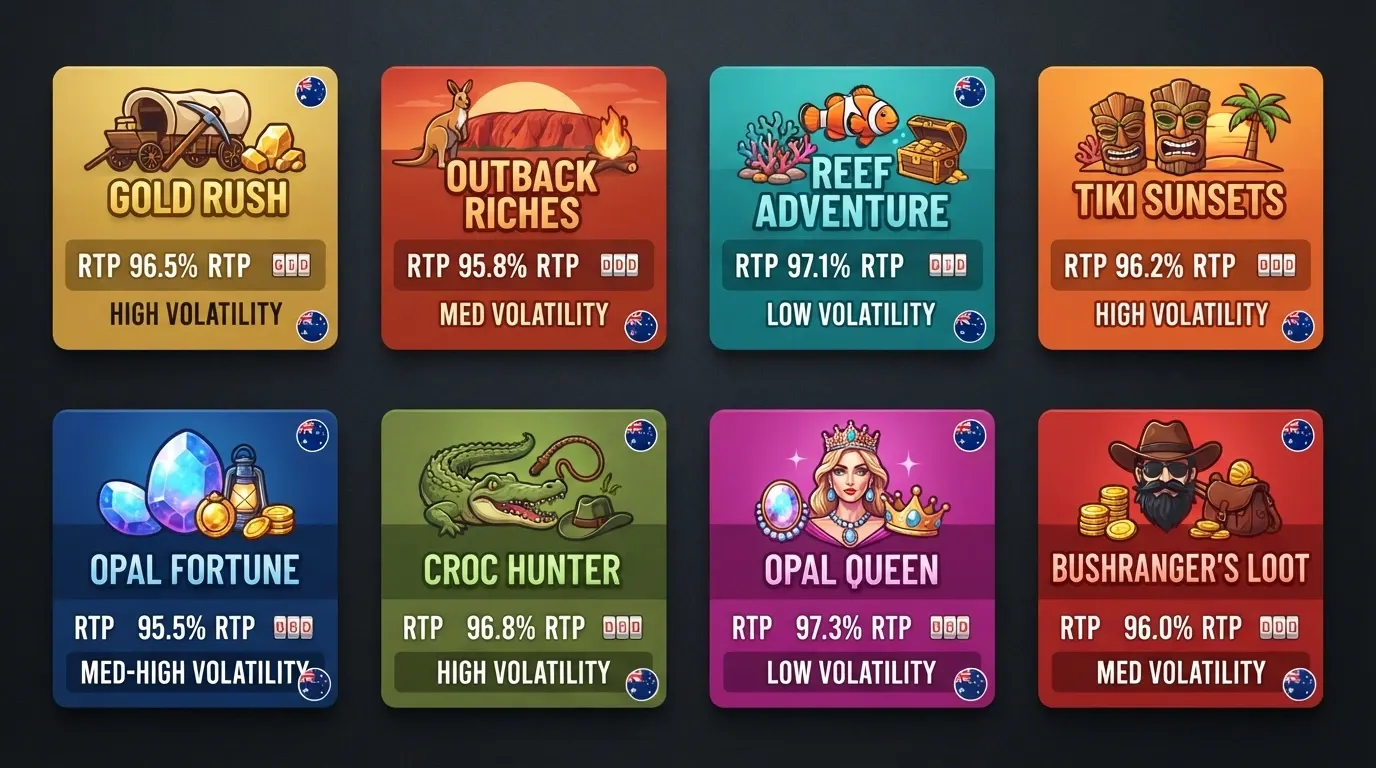
A free-spin no-deposit bonus is locked to a specific pokie. The wagering contributes only on the games the operator names, and the RTP and volatility of those games decide how much of the bonus survives the playthrough. The table below lists the pokies the available sources carry real per-title data for.
| Slot Title | RTP | Provider | Volatility |
|---|---|---|---|
| Big Bass Bonanza | 96.71% | Pragmatic Play / Reel Kingdom | High |
| Sweet Bonanza | 96.51% | Pragmatic Play | High |
| Gates of Olympus | 96.50% | Pragmatic Play | High |
| Wolf Gold | 96.01% | Pragmatic Play | Medium-High |
| Book of Dead | 96.21% | Play’n GO | High |
| Starburst | 96.09% | NetEnt | Low |
| Sugar Rush | 96.50% | Pragmatic Play | High |
| Lightning Link | 90–95% range | Aristocrat | Medium-High |
| Dead or Alive 2 | 96.82% | NetEnt | Very High |
Pragmatic Play’s published RTP range is 94.0% to 97.5%, with most titles clustered between 96.0% and 96.7%. Nolimit City’s default is 96.0% to 96.2% with high-to-extreme volatility. The titles above are the ones the NDB market currently rotates through.
Which pokies your free spins actually land on
The featured-set NDBs lock spins to specific pokies rather than opening the full library. RocketPlay’s 50 free spins are tied to Gamzix “3×5 Hold The Spin” — a title outside the table above, which is itself information about how narrowly the offer is structured. Bizzo’s 15 free spins are tied to Wild West Trueways. Casino Rocket’s deposit welcome (no NDB) runs on Big Bass Splash, which sits at the top of the table at 96.71% RTP and high volatility.
The high-volatility pattern is not accidental. Operators choose high-volatility titles for free-spin offers because the math of the bonus is built around the ceiling on the cashout cap: a player is more likely to either bust out quickly on a high-volatility pokie or hit a single large payout that the cap then trims. Either outcome keeps the bonus cost down on the casino side. The player chasing wagering through a low-volatility pokie is the worst case for the casino’s expected value, which is why so few NDBs target low-volatility games.
Pokies RTP and volatility — what they mean for your bonus
RTP, or return to player, is the percentage of all wagered money a pokie is programmed to return to players over a very large number of spins. A 96.5% RTP returns A$96.50 for every A$100 wagered across millions of spins. The house edge is the other 3.5% — the casino’s long-run cut. Over a single bonus session of a few hundred spins, RTP does not behave like an average; a player can be well above or well below the published figure, and short-term variance dominates.
Volatility describes the distribution of outcomes. A low-volatility pokie returns small wins frequently. A high-volatility pokie returns wins rarely but in larger chunks. A very-high-volatility pokie like Dead or Alive 2 can go hundreds of spins without a feature hit, then pay a prize worth thousands of times the stake. The two numbers interact: a high-volatility pokie at 96.8% RTP can be just as expensive to clear as a lower-volatility pokie at 95%, because the bankroll swings wipe out the player’s position before the average returns.
For a no-deposit bonus specifically, the implication is that high-volatility pokies make wagering harder to clear in a single session, because the player needs to survive long enough for the average to play out. A player with a A$5 free-spin bonus on a high-volatility pokie is one unlucky streak away from a zero balance before any wagering is completed. Low-volatility pokies preserve the bankroll longer but offer smaller wins, which is why operators prefer them less as a free-spin target.
The honest reading for a player picking a pokie to clear a deposit-funded bonus: low-volatility titles preserve the bankroll; high-volatility titles give the player a shot at a payout large enough to matter after the cashout cap. The choice depends on whether the player is trying to grind the wagering or hoping for one big hit. For a no-deposit bonus specifically, the choice is usually made by the operator, not the player.
Crypto No Deposit Bonuses — Fast Payouts, No Australian Safety Net
Crypto-funded casino play promises speed, low fees and partial privacy. The Australian position on crypto for wagering is unambiguous: digital currency is banned as a payment method for online wagering, with effect from 11 June 2024. Penalties for non-enforcement reach A$247,500. Any operator asking an Australian player to deposit in crypto is, by definition, outside Australian rules. The bonus and the payout may be honest, the games may be fair, the licence may be real — but the consumer-protection framework the player is operating under is not Australian.
The crypto path is faster than PayID. BitStarz’s approved crypto withdrawals average around ten minutes. The KYC framework is lighter at sign-up but triggers at withdrawal — the common A$2,200 threshold means a player withdrawing less than that may not be asked for documents, while a larger withdrawal will trigger a full check. Bitcoin is the most widely accepted cryptocurrency; deposits confirm in 10 to 60 minutes and network fees can climb past A$20 during congestion. From 1 January 2027, banks and payment providers gain express authority to block transactions to illegal gambling operators, which includes crypto on-ramps that route to offshore casinos.
Bitcoin and no-KYC casino bonuses — the reality behind the promise
“No KYC” is a marketing claim, not a legal status. International anti-money-laundering standards require some form of customer identification at any operator processing real-money transactions, and the threshold at which that verification triggers varies by operator and by jurisdiction. A common pattern is threshold KYC — verification kicks in at the A$2,200 equivalent or at the first significant withdrawal, not at sign-up. BitStarz runs verification on a risk basis and reserves the right to request KYC for any no-deposit bonus withdrawal, with nothing cashable until a real deposit of at least A$20 equivalent has been made.
A genuinely zero-KYC casino operating at any meaningful scale is essentially impossible in the current regulatory environment. The pitch is real on the small-withdrawal end and misleading on the large-withdrawal end. The Australian player who takes the pitch at face value finds out where the threshold sits at the moment of the first significant cashout.
The Australian crypto ban is the load-bearing fact in this section. The operator accepting crypto is outside Australian rules, which means the player is too. The bonus is real. The payout is real when the operator chooses to make it. The protection that would normally back a real payout — a regulator, a dispute resolution body, an Australian court — is absent.
Why Every No Deposit Casino for Australians Is Operating Illegally
This is the gap in every other comparison page for this term. The product being offered is prohibited in Australia. The operator offering it is offshore. The player accepting the offer is not committing an offence under the Interactive Gambling Act 2001 — the Act targets the provider — but the player is operating outside every Australian protection, from BetStop to consumer law to the dispute resolution bodies that exist for licensed wagering.

The Interactive Gambling Act — what it actually bans
The Interactive Gambling Act 2001 prohibits the provision of online casino games, online pokies and in-play sports betting to a person in Australia. There is no licence for online casino anywhere in the country — not federally, not in any state or territory. The Interactive Gambling Amendment Act 2017 closed the loopholes offshore operators had used and gave ACMA enforcement and blocking powers.
What is permitted: wagering on races and sport placed before the event begins, lotteries, keno — through operators licensed by a state or territory. Sportsbet, bet365, Ladbrokes and the state TABs are licensed for that narrower product. None of them is licensed to offer an Australian player an online casino game or a pokie.
The 2026 reform — the Interactive Gambling Amendment (Gambling Reform) Bill 2026 — passed Parliament on 19 August 2026 and its measures commence on 1 January 2027. The reform caps broadcast television wagering advertising at three ads per hour between 6 am and 8:30 pm, with a complete ban during live sport broadcasts within those hours. Direct marketing of inducements is prohibited for 14 days after a customer signs up, three months after a person deregisters from BetStop, and indefinitely for customers identified as at risk of gambling-related harm. From 1 January 2027, banks and payment providers gain express authority to block transactions to illegal gambling operators. None of this legalises the product. It tightens the rules around the wagering that is legal and the marketing that targets Australians for the wagering and casino products that are not.
What you lose by playing offshore — BetStop, consumer protection, and site blocking
BetStop, the National Self-Exclusion Register, has been live since August 2023 and binds approximately 150 Australian-licensed wagering providers — every operator a self-excluded person has used to place a wager through an Australian-licensed account. As at 31 July 2026, BetStop recorded 67,480 registrations, of which 41,290 exclusions were still active. 78% of registrants were under 40, and 38% chose lifetime exclusion.
The critical limitation: BetStop covers Australian-licensed wagering providers only. An offshore casino is not licensed in Australia, is not connected to the register, and will keep accepting a self-excluded person’s money. The protection a player expects from a self-exclusion does not extend across the border.
The other loss is consumer protection. There is no Australian dispute resolution body for offshore casino disputes. There is no Australian court with straightforward jurisdiction over a Curaçao or Anjouan operator that refuses a withdrawal. The casino’s own T&Cs govern the payout, and the player has accepted them at registration. The site’s own complaint process is the entire remedy.
ACMA’s enforcement record illustrates the operational risk. Since its first blocking request in November 2019, ACMA has had 1,564 illegal gambling and affiliate websites blocked by Australian internet service providers, and more than 225 illegal services have withdrawn from the Australian market since enforcement was strengthened in 2017. A player’s balance can be stranded when a site is blocked — there is no mechanism in the IGA that protects a balance held with an offshore operator when the site becomes inaccessible. The casino holds the funds; the access is the only leverage the player has; ACMA’s blocking removes that leverage.
The individual player is not prosecuted under the IGA. The Act targets the provider. But the player has no protection, no recourse, and no guarantee that the balance remains accessible. The minimum age for any commercial gambling in Australia is 18, and offshore operators do not enforce it under any Australian framework.
Playing No Deposit Offers Without Handing Over More Than the Bonus
A no-deposit bonus is supposed to cost nothing. The design of the wagering and the psychology of a casino lobby can turn it into the most expensive freebie a player ever claims. The line is the one between “the bonus is entertainment with a ceiling” and “the bonus is a funnel into a deposited account”. The page below returns to that line every time it can.

About 2.1% of Australian adults — roughly 430,000 people — experience problem gambling, and the Australian Institute of Health and Welfare put high-risk gambling at 1.8% in 2022. The bonus is a small commitment, but the structure that produces it is the same structure that produces a chasing pattern in a small share of players. Knowing where the line sits before claiming is the difference between using the offer and being used by it.
Setting limits before you claim a bonus — the conversation most reviews skip
The first limit is the deposit limit, and it matters even though the bonus is no-deposit. The reason is the conversion: a bonus that converts on first cashout requires a real deposit before withdrawal, and a player who is chasing a cleared wagering requirement has already decided the next step is to deposit. Setting a deposit limit before the first spin — even a low one, even for a single payment method — is the moment a player decides the chasing will stop somewhere.
The second limit is time. A bonus that requires A$750 of turnover at one spin every five seconds is about twelve and a half minutes of straight play. The expiry window is 7 to 14 days. The session length a player chooses is the second variable — and choosing it in advance, rather than discovering it after ninety minutes of chasing, is the practical protection.
The third limit is the recognition of chasing. A player who has deposited to clear wagering, or who is planning to, has crossed the line the bonus was designed to push them across. The bonus is no longer no-deposit at that moment; it is the entry fee to a deposited account. That is the structure. The marketing makes it sound like a free trial; the contract makes it a funnel.
The most player-friendly NDBs in this market share three traits: max cashout above A$100, wagering requirement under 35x, and no max bet cap below A$5 per spin during wagering. An offer that meets all three is unusually generous. An offer that meets one is typical. An offer that meets none is the casino’s marketing arm writing a cheque the bonus was designed to clear.
Where to get help — BetStop, the Helpline, and financial counselling
- National Gambling Helpline — 1800 858 858 — free, confidential, staffed 24 hours a day, seven days a week. The number is the same across Australia and the call is free from any phone.
- Gambling Help Online — free 24/7 chat, email counselling and support, run in partnership with state-based services.
- BetStop — the National Self-Exclusion Register. A single registration excludes a person from every Australian-licensed online and phone wagering service in one step. BetStop covers approximately 150 licensed wagering providers. It does not cover offshore casinos — a self-excluded person who opens an offshore account will not be blocked there.
- Financial counselling — the 2026 reform expands specialised financial counselling services for people experiencing gambling-related financial difficulty, available through the National Debt Helpline and state-based financial counselling providers.
Free Play vs Real Money — What Demo Mode Actually Delivers
Demo mode is the no-deposit experience with zero financial risk — and zero financial return. A demo spin pays nothing, contributes nothing toward a real-money wagering requirement, and qualifies the player for no progressive jackpot. The difference between demo mode and a no-deposit bonus is the difference between trying a pokie and playing a pokie: one is a look, the other is a contract.
The casino lobby in demo mode is universally available at most offshore casinos and on the major providers’ websites — Pragmatic Play, NetEnt, Play’n GO and Nolimit City all host their own demo lobbies. A player can try every pokie in the table above in demo mode without registering anywhere. The output of demo mode is the player’s own knowledge of how a game behaves over a few hundred spins, which is information the casino cannot take back.
Demo mode access — where to try pokies without spending a cent
Demo mode is the true zero-risk route to a pokie. It costs the player nothing, exposes the game’s volatility over a session, and lets the player decide whether the title is worth a real bet. The provider websites and the casino lobbies without login are the two main access points. The major providers — Pragmatic Play, NetEnt, Play’n GO, Nolimit City — each maintain demo lobbies that load without registration. Casino lobbies in demo mode usually do the same; a real-money play button is the only thing standing between the player and a wager.
The practical advice for a player considering a no-deposit bonus: try the pokie in demo mode first. If the title’s volatility wipes out a 1,000-spin demo session, the no-deposit bonus on the same title will behave the same way at real-money stakes. The data the player gathers in demo mode is the data the casino would prefer the player not to have.
How We Picked and Ranked These Casinos
The ranking is editorial. The operator set was drawn from offshore brands accessible from Australia with no-deposit bonus claims or measurable AU market presence in 2026; all ten operators named in this page come from that set. Sources consulted were the ACMA register (which confirmed no AU online casino licence exists for any of the ten), operator websites for current terms, independent affiliate reviews for cross-checking, and Australian regulation data for the legal context.
The ranking criteria, in order of weight: NDB offer size and terms, wagering requirement, max cashout cap, bonus validity, game library depth, and payment-method support. Each criterion was assessed qualitatively. No numerical weighting was applied; no synthetic score was generated. An operator with a larger NDB and a reasonable wagering multiple ranked above an operator with a smaller NDB and a tighter one. An operator with a confirmed Curaçao licence claim ranked above an operator whose licence status could not be verified, but the page treats Curaçao claims as unverified by default because the public register check did not return a clean confirmation in this run.
The page does not rank operators on payout speed as a primary axis, because the data is too thin across the set. PayID and crypto payout times are reported where the operator’s published figures or test data support them, and the comparison is left to the reader.
What You Should Actually Do With a No Deposit Bonus
A no-deposit bonus is a free look at an offshore casino, not a profit strategy. The honest reading is that most players do not clear the wagering requirement, the house edge reclaims the bonus value through turnover before a cent becomes withdrawable, and the max cashout cap limits the upside even on the rare clear. The arithmetic is built against the player at every step except the very generous end of the wagering spectrum, and even there the ceiling on the payout does most of the work for the casino.
The offers worth claiming share three traits: max cashout above A$100, wagering requirement under 35x, and no max bet below A$5 per spin during wagering. An offer that meets all three is unusually player-friendly. Royal Reels’ A$10 chip at 30x with a AU$200 cap and Fair Go’s 30x wagering are the closest fits in the featured set; Skycrown’s 100 free spins at 40x/30x with a AU$200 cap is the closest fit on the spin side.
The one rule that protects the player is the simplest: never deposit to chase wagering. The moment the player deposits, the bonus is no longer no-deposit. The marketing structure has done its job. The player has converted from a free-trial reader into a deposited customer. From that point forward the casino holds the leverage — on the bonus terms, on the max cashout cap, on the withdrawal timing, on the KYC step that gates payout. The Australian context is the final layer: every balance is held offshore, every protection that would normally back a real payout is absent, and ACMA’s blocking record shows 1,564 sites already removed from Australian reach. The balance a player holds at an offshore casino is, by structure, at risk of becoming inaccessible.
The verdict, stated plainly: a no-deposit bonus is worth claiming as entertainment if the wagering is reasonable, the cashout cap is meaningful and the player will not deposit to chase the requirement. It is not a profit strategy. It is not a substitute for a budget. It is a marketing funnel that occasionally pays out, on the casino’s terms, within a ceiling the casino sets.
Frequently Asked Questions
Can I win real money from a no deposit bonus at an online casino?
Yes, but the conditions are heavy. A no-deposit bonus pays real money once the wagering requirement is cleared, the cashout cap is respected, KYC is passed and any minimum deposit is made. Most players do not clear the wagering, because the required turnover multiplied by the house edge reclaims most of the bonus value first.
How much can I actually withdraw from a no deposit bonus win?
The max cashout cap the operator sets. Australian no-deposit offers typically cap free-spin withdrawals at AU$50 and free-chip withdrawals at AU$50 to AU$200. A AU$200 win on a capped-at-AU$50 offer pays AU$50. The cap applies regardless of balance size when wagering clears, and the operator’s terms are the only mechanism for contesting it.
Do no deposit free spins require a deposit before I can cash out?
Sometimes. BitStarz is the clearest case, requiring a real-money deposit of at least A$20 before any no-deposit bonus withdrawal can be processed. That deposit is separate from the bonus and converts the offer from no-deposit to deposit-gated at cashout. Other operators pay out without a prior deposit. Check the terms page before claiming.
Does BetStop cover online casino sites or only licensed wagering?
Licensed wagering only. BetStop binds approximately 150 Australian-licensed online and phone wagering providers. Offshore casinos are not connected to the register, and a self-excluded person who opens an offshore account will not be blocked there. BetStop is meaningful protection for the licensed market and has no reach into offshore casino sites.
Why do most no deposit casinos ask for phone verification?
Phone verification confirms the player is real with a unique contact, reducing multi-account fraud on the casino side and creating the verified account needed for KYC at withdrawal on the player’s side. The trigger has largely replaced bonus codes — the offer is auto-credited once verification completes, and the contact feeds the casino’s marketing database.