
Casino Bonus Codes in Australia: What the Terms Say, What the Law Says, and What You’re Actually Getting
A casino bonus code looks like a small thing — a string of letters, a “PROMO50” or “AUSSIE25,” typed into a box at sign-up. For an Australian player in 2026, it sits at the intersection of a flourishing offshore market and a legal prohibition the marketing never mentions. Every online casino bonus code a search engine returns to an Australian is offered by an operator that holds no Australian licence, because no online casino licence exists in this country. The codes work. The bonuses pay out, in most cases, eventually. The terms, however, are written by the house, and the house has spent decades learning how to make the small print do the heavy lifting.
This page walks through what an Australian bonus code actually delivers, the ten offshore casinos that dominate the local search results, and the legal and financial reality that frames every one of them. The aim is to let a reader compare offers on their real terms — wagering, cashout caps, validity, house edge — and to be blunt about the protections the Australian framework does not extend to anyone redeeming an offshore code.
Data current as of 16 October 2026. Operator bonus terms and licence claims verified against ACMA records, operator T&Cs pages, and the Curaçao Gaming Authority public register.
Table of Contents
- What Is an Online Casino Bonus Code and How Do AU Players Use It?
- Why Your ‘Free’ Casino Bonus Code Costs More Than the Fine Print Admits
- The Offshore Casinos Behind Every Bonus Code an Australian Can Redeem
- RocketPlay
- Skycrown
- Royal Reels
- BitStarz
- KatsuBet
- Mirax Casino
- 7Bit Casino
- Aussie Play
- Grande Vegas
- FairGO
- The Legal Reality Australians Ignore Every Time They Redeem a Bonus Code
- When a Bonus Code Opens a Door You Can’t Close: Responsible Gambling and Offshore Risk
- How We Evaluated These Bonus-Code Casinos
- Your Bonus Code, Your Risk: What an Australian Player Should Actually Do
- Frequently Asked Questions
What Is an Online Casino Bonus Code and How Do AU Players Use It?
A bonus code is a token the operator attaches to a promotional offer. It identifies the deal to the cashier system, activates the relevant terms, and starts the wagering clock. Some codes are universal — every player who enters them gets the same offer. Others are personalised, distributed by email or an account manager. A few are affiliate-linked, tied to a specific partner site, in which case the same operator can run several identical bonuses under different code strings, with the only real difference being who gets credited for the sign-up.
In the Australian market the code is almost always a no-deposit or a deposit-match offer. No-deposit codes credit a small amount of bonus funds or a fixed number of free spins the moment the account is verified, no payment required. Deposit-match codes require a qualifying deposit, usually in Australian dollars, and the operator credits a percentage of that deposit as bonus funds on top. Either way, the code triggers a set of terms the player agrees to by entering it: a wagering multiple, a list of games that contribute toward clearing that multiple, a maximum cashout figure, and a validity window in which everything has to happen.
The mechanics sit underneath the marketing in a way most players never see. A no-deposit code that promises “AU$25 free” does not put AU$25 of real money in the account. It puts AU$25 of bonus money, which cannot be withdrawn, can only be used on certain games, and only converts into withdrawable cash after the wagering requirement is satisfied. A deposit-match code that promises “100% up to AU$500” doubles the deposit on screen, but the bonus half is locked behind the same kind of terms, and in many cases both the deposit and the bonus have to be wagered before any withdrawal is possible. The code, in other words, is a key. The fine print is the room it opens.
Redeeming a Bonus Code: Registration, Deposit and Activation
The redemption path runs through three steps and rarely takes more than a minute. First, the player signs up at the operator, providing an email, a username and a password, and in most cases a date of birth and a residential address. The address matters — Australian players are explicitly targeted, and the sign-up form usually includes a country selector that defaults to Australia. Second, the bonus code is entered: in some operators it is a dedicated field on the registration form, in others it is a box at the cashier that becomes visible only after the account is created. A handful of operators skip the manual step entirely and credit the bonus automatically; BitStarz’s 50 no-deposit free spins are a clean example, applied to the account without any code at all.

Third, the bonus is activated. For a no-deposit offer, activation usually happens the moment the account is verified — an email confirmation is enough, though some operators require a phone number or a copy of an ID document. For a deposit-match offer, activation happens the moment a qualifying deposit clears, and the bonus funds appear alongside the real-money balance. In both cases the wagering clock starts immediately, which is the part of the process players most often miss. The “validity” countdown does not wait for a first spin, or a first login the next day. The clock is running the second the bonus is credited.
A practical note for anyone moving through this for the first time: read the activation confirmation screen. The bonus terms are usually linked from the credit notification, and the validity window is stated there, not on the promotional page that advertised the offer. The advertised bonus and the activated bonus are the same offer, but the advertised one is the version with the worst terms cut for length.
Online Casino Bonus Codes vs Land-Based Voucher Systems
Australia has a long history of physical casino vouchers — a Crown or Star City member’s card swiped at a table, a paper coupon handed out at a poker tournament, a promotional credit loaded onto a player account at a land-based venue in Melbourne or Sydney. Those systems have nothing to do with the online bonus-code market, and the differences are worth understanding because the marketing language around them sometimes blurs the two.
An online bonus code is digital, instant, and enforced automatically. The code is entered into a form, the terms are applied by software, the wagering requirement is tracked spin by spin in the background, and the moment a term is breached the system voids the bonus without human intervention. There is no venue to visit, no card to swipe, no cashier to argue with, and no paper trail a player can hold up at a desk. The whole exchange happens in a browser or an app, and the operator’s house rules are the only rules that apply.
A land-based voucher, by contrast, is a physical artefact tied to a venue, a member’s club, and an Australian-licensed casino floor. The terms are negotiated at the desk, the redemption is supervised by staff, and the consumer protections of Australian consumer law sit underneath the transaction. The same marketing language — “bonus code,” “free play,” “complimentary credit” — is used in both markets, but only the offline version is regulated under Australian law, and only the offline version is tied to an Australian-licensed operator. The “bonus code” that turns up in a Google search for Australian players is the offshore, automated, software-enforced kind, and the protections that come with the physical version do not travel across the digital border with it.
The AU Bonus-Code Landscape: What the Search Results Show and What They Leave Out
The first page of an Australian Google search for “casino bonus code” is, with very few exceptions, an affiliate landscape. Pokiesaustralia, Gambling Insider, Wizard of Odds, Slotozilla, TrueBlueCasinos, Laneway Finance, Casino.info, Best Bonus List, Bonus Maniac, New Game Network — the operators themselves do not rank for the head term. The casino brands pay affiliates for clicks, the affiliates write listicles ranking the brands, and the result is a page of search results in which every page on page one is a commercial intermediary with an economic interest in the click.
What the search results universally omit is the legal frame. None of the affiliate pages on page one lead with the Interactive Gambling Act. None mention that the Interactive Gambling Act 2001, strengthened by amendments in 2017, makes it an offence to provide online casino games, online pokies, and in-play sports betting to a person physically in Australia. None distinguish between licensed wagering operators — which is the only form of online gambling Australia permits — and offshore casino brands, which is every brand in their list. The page-one treatment of the market is, in this respect, exactly backwards: the law is treated as a footnote, the offers are treated as the substance, and the player is left to work out that the absence of an Australian licence from every brand listed is not a minor detail.
A reader who wants the legal reality has to go looking for it, and most do not. The shape of the market in 2026 is a generous supply of bonus codes on one side, an Australian prohibition that has been enforced for years on the other, and a list of search results that connects them without explaining which side of the line each brand is on. That gap is the reason the rest of this page exists.
The Fine-Print Checklist Every Bonus Code Player Must Run Before Clicking ‘Claim’
The headline offer is the easy part. The four terms that decide whether a bonus code is worth using are buried further down, and the difference between a generous promotion and a marketing trap is almost always hiding in one of them.
The first is the wagering multiple. This is the number of times the bonus — or, in some cases, the bonus plus the deposit — has to be turned over before any winnings can be withdrawn. Typical no-deposit bonuses at Australian-facing offshore casinos carry wagering requirements of 30x to 60x the bonus amount or winnings. A 30x multiple on a AU$25 free chip means AU$750 in bets before the AU$25 is yours; a 60x multiple means AU$1,500. The lower end of the range is competitive; the upper end is punitive.
The second is the game contribution weighting. Pokies contribute 100% toward wagering at most Australian-facing casinos; table games contribute 0% to 10%; live casino games are typically excluded entirely. A player who tries to clear a bonus at the blackjack table will, in the worst case, make no progress at all, and the clock keeps running. The weighting exists to push play onto the games with the highest house edge, which is where the casino’s statistical advantage is largest. The marketing never says that.
The third is the maximum cashout cap. No-deposit bonuses at Australian-facing casinos typically cap withdrawals at AU$50 to AU$200, regardless of how high the on-screen balance climbs. A player who hits a lucky run on a AU$25 free chip, satisfies the wagering requirement, and looks at a AU$2,000 balance will be told that AU$200 — or, at the lower end, AU$50 — is the most the cashier will release. The cap converts a win into a ceiling, and the ceiling is set by the operator before the player sits down.
The fourth is the validity window. The clock starts when the bonus is credited, and it runs from 24 hours at the aggressive end to 14 days at the standard end. A 5-day window, as RocketPlay applies to its standard deposit bonus, is short enough to put a real squeeze on casual play. If the wagering is not met inside the window, the bonus and all winnings are void — a clean wipe, and the marketing language around the offer rarely says so in the headline.
These four fields are the whole evaluation, and the rest of the page works through them one at a time.
Why Your ‘Free’ Casino Bonus Code Costs More Than the Fine Print Admits
The word “free” is doing a lot of work in a no-deposit bonus offer. A AU$25 free chip is free in the sense that the player has not paid for it. It is not free in the sense that no one has paid for it. The operator is the one funding the promotion, and the operator has built a statistical mechanism for recovering the cost, and most of the time the mechanism works.
The mechanism is the wagering requirement combined with the house edge. Pokies in the Australian market — the only games a bonus code will let a player stake bonus money on, in most cases — return about 95% to 97% to the player over the long run, which means the house edge sits between 3% and 5%. Every dollar wagered on a pokie during bonus play is, statistically, returning 95 to 97 cents to the player. The other 3 to 5 cents goes to the house. On a AU$750 turnover obligation — the figure a AU$25 free chip at 30x wagering produces — the operator is statistically earning back somewhere between AU$22 and AU$37. The “free” AU$25 has cost the house a fraction of that, and the rest is the cost of the marketing channel that delivered the player.
That arithmetic is what makes a no-deposit bonus a viable promotion for the operator. The expected loss to the player is built in. The marketing reaches the player with the offer, the player accepts, the player plays, the house edge does the rest. The exceptional cases — the player who hits a bonus round on a high-volatility pokie, clears wagering in 50 spins instead of 7,500, and lands a balance above the cashout cap — are the cost of customer acquisition. They are budgeted for, and the cashout cap is the line that limits how badly the operator can lose on any one player.
The cashout cap is the term that does the most work in the no-deposit market. It is what turns a balance that can climb to four figures on a lucky spin into a withdrawal of AU$50 to AU$200. It is the only place the operator can lose on an individual promotion, and the cap is the wall at the top of it. The max-bet cap (RocketPlay’s AU$7.50 per spin during wagering is the cleanest example) is the wall at the side: a player cannot just bet large and try to grind through the wagering in a few spins, because the operator has set a per-spin ceiling that drags the play out.
The combined effect, on a typical no-deposit offer, is that the player has a small chance of a real withdrawal, a near-certainty of some play time funded by the house, and a near-certainty of finishing with less than the marketing implied. The arithmetic is the marketing, in this market, and the arithmetic is set up to favour the house.
| Bonus Type | Wagering Multiple | Turnover Required (on AU$25) | Estimated House Edge (5%) |
|---|---|---|---|
| Low Wagering | 30x | AU$750 | AU$37.50 |
| Standard Wagering | 45x | AU$1,125 | AU$56.25 |
| High Wagering | 60x | AU$1,500 | AU$75.00 |
No-Deposit Bonus Codes: The AU Player’s Zero-Risk Entry Point
No-deposit bonus codes are the dominant Australian search angle for a reason: they ask nothing of the player except registration. The offer is real — a small amount of bonus cash or a fixed number of free spins, credited without a deposit — and the player walks away with no out-of-pocket loss if the wagering is not met and the bonus is voided.

The Australian market in 2026 runs mostly on no-deposit free spins rather than no-deposit cash, and the free-spin offers are clustered in a fairly tight band. Most operators in the featured set give between 25 and 50 free spins, valued at AU$0.10 to AU$0.20 per spin, with a max cashout between AU$50 and AU$200. Royal Reels’ 50 free-spin Friday drop on Sweet Bonanza, NeoSpin’s 50 free spins, RooSpin’s 30 free spins, and Jackpot Jill’s 25 free spins are the shape of the current market. The older pattern — a no-deposit cash bonus of AU$5 to AU$50 — still exists at a few operators, but the bulk of the search-volume offer has moved to spins.
A no-deposit free-spin offer looks small and is small, but it is the cleanest test of how a casino applies its terms. The wagering multiple on free-spin winnings is where the spread between operators lives: KatsuBet’s 30x is the lowest in the featured set, 7Bit Casino’s 45x and Aussie Play’s 40x sit at the upper end, and the gap is the difference between a withdrawal that the player can actually achieve and a wagering requirement that runs out the validity clock. Max cashout caps are more uniform — most operators in the set cap free-spin withdrawals at AU$100, with RocketPlay at AU$75 and Royal Reels at AU$200 as the outliers. The 7-day expiry is standard across the set.
The “zero-risk” framing is half right. There is no financial risk to the player in the sense that no deposit is required. The risk is the time cost of working through a wagering requirement that may not be achievable in the validity window, and the risk of landing a balance above the cashout cap and having the cap absorb the difference. A no-deposit offer is a marketing handshake, and the terms decide what kind of handshake it is.
Deposit Match Bonus Codes: When You Put Your Own Money on the Line
Deposit-match codes are the larger, more generous half of the bonus-code market, and the half where the player’s own money is the engine. The headline number — “100% up to AU$500” or “200% up to AU$500” — describes a percentage match on a deposit the player has to make first. RocketPlay’s first-deposit package is a clean example: 100% up to AUD 500 plus 100 free spins, with 40x wagering on the bonus amount. The second deposit at the same operator is 200% up to AUD 500, a more aggressive match rate on a smaller ceiling.
Two structural points matter here. The first is that a deposit-match bonus is not a free credit — the player has funded the deposit, and the bonus funds sit on top of it as a marketing sweetener. The second is the wagering structure. At most Australian-facing operators, the wagering requirement applies to the bonus amount only (RocketPlay’s 40x on the bonus, not the bonus plus the deposit), but at some operators it applies to the bonus plus the deposit combined, which is a substantially heavier obligation. The terms page at each operator specifies which structure applies, and the difference is large enough to check before the deposit is made.
The other feature of a deposit-match code is the max-bet cap during wagering. A player who has a deposit-match bonus live cannot, in most cases, bet above a fixed ceiling per spin while the bonus is being cleared. RocketPlay’s AUD 7.50 per spin is the explicit figure. The cap exists to slow the play down: a player who could bet AU$100 per spin could clear a AU$500 bonus at 40x in 200 spins, which is not the marketing the operator wants from the offer. The cap forces the play out over hundreds of spins, sometimes thousands, and the house edge is taking a small percentage of every one of them.
The risk profile of a deposit-match code is therefore not zero. The player has committed real funds, the bonus funds are locked behind wagering, the cap forces extended play, and the cashout ceiling still applies. The upside — a larger bonus balance, often with free spins attached — is real, but the terms are tighter than the no-deposit equivalents, and the time investment is heavier.
Free Spins Bonus Codes: What 50 Spins on a Named Pokie Actually Delivers
Free-spin codes tied to a specific pokie title are a more transparent product than the cash bonus codes, because the value can be roughly calculated before the player accepts the offer. A 50-free-spin code at AU$0.20 per spin on a named pokie has a face value of AU$10. After wagering, the realised value depends on the game’s RTP, the volatility, and the cashout cap. On a high-volatility title like Pragmatic Play’s Sweet Bonanza — the pokie Royal Reels uses for its rotating Friday drop — a 50-spin batch can either return almost nothing or return a balance well into three figures. The median outcome is closer to the lower end.
The per-spin value is the lever the operator uses to set the headline. AU$0.10 per spin is the floor in this market, AU$0.20 per spin is the ceiling, and most operators sit somewhere in between. A 50-spin offer at AU$0.10 is a AU$5 face value, and a 50-spin offer at AU$0.20 is a AU$10 face value — a 100% difference on a marketing surface that reads identically. The player who does not check the per-spin figure is reading the same offer as a much better or much worse deal than it actually is.
The cashout cap is the second lever. The Royal Reels 50-free-spin drop on Sweet Bonanza carries the highest no-deposit cap in the featured set at AU$200, and that single figure is what makes the offer stand out. The 30x–40x wagering range is competitive, the 7-to-14-day validity is generous, and the AU$200 ceiling means a lucky run is noticably more payable than at a competitor capping the same offer at AU$100.
A useful rule of thumb: a 50-free-spin code at AU$0.10–AU$0.20 per spin, with a AU$100–AU$200 cashout cap, is the shape of the modern Australian no-deposit offer. Anything significantly outside that band is either an unusually generous promotion or a sign that the terms have been tightened in a way the headline is not advertising.
Wagering Requirements: The Multiplier That Decides Whether You Ever See a Dollar
Wagering requirements are the centre of gravity in any bonus-code offer. A 30x multiplier on a AU$25 bonus is AU$750 in turnover. A 50x multiplier on the same bonus is AU$1,250. A 60x multiplier is AU$1,500. The number on the front of the promotion is the same in all three cases — “AU$25 free” — and the actual cost to the player of working through the offer differs by a factor of two.
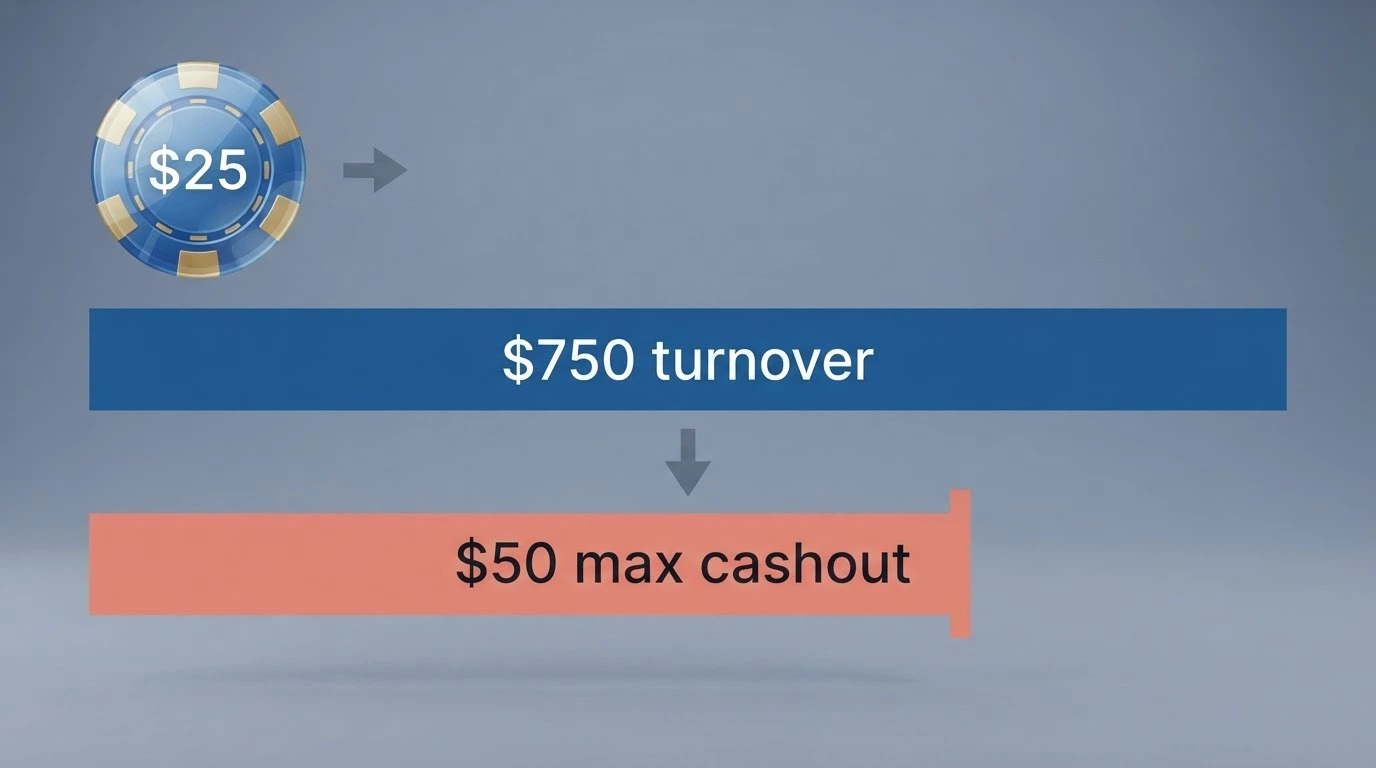
The turnover required is straightforward arithmetic, but the time required is where the multiplier starts to bite. A player working through a AU$750 turnover at the AU$7.50 max bet allowed during wagering is looking at 100 spins minimum, and a typical 5-second spin interval puts that at just under nine minutes of continuous play. A player working through a AU$1,500 turnover is looking at 200 spins and just over 16 minutes. A player working through a AU$3,000 turnover — which is the rough figure for a AU$50 free chip at 60x wagering — is looking at 400 spins and roughly 33 minutes. None of these are unreasonable in absolute terms. The problem is that the offer has to be cleared inside the validity window, and at the aggressive end of the validity range (24 hours), the player has to find half an hour of focused play to use the offer at all. The clock does not pause for sleep, work, or a weekend away.
The game-contribution table is the second part of the wagering calculation. Pokies contribute 100% at most Australian-facing operators; table games contribute 0% to 10%; live casino games are typically excluded. A player who likes blackjack and tries to clear a pokie-only bonus at the blackjack table will, at the worst end, make zero progress on the wagering requirement, and the bonus will expire with the requirement intact and the winnings voided. The contribution table exists to push play onto the games with the highest house edge, where the operator’s statistical recovery is fastest.
The max-bet cap is the third term, and it is the one that catches players who are used to unrestricted play. RocketPlay’s AUD 7.50 per spin is the explicit example in the featured set. A player who tries to bet AU$20 per spin during wagering — a perfectly normal stake outside a bonus context — will have the bonus voided, and the winnings with it. The cap is enforced by the cashier system, which means the bet is either accepted at the capped level or rejected outright; there is no warning, no second chance. The terms state the cap. The cashier enforces it. The player has to know which is which.
The moment a wagering term is breached is the moment the bonus is voided. There is no partial credit, no “you got 70% of the way there, here is 70% of the bonus.” The whole balance is removed, the wagering counter resets, and the player is back to the deposit they made (less any losses during the wagering period). For a no-deposit bonus, the voiding is the end of the engagement. For a deposit-match bonus, the deposit is still in the account, but the bonus half is gone, and any free-spin winnings are gone with it.
Max Cashout and Expiry: The Two Traps That Make a ‘Win’ Disappear
The max-cashout cap is the term that most often surprises first-time bonus-code players, because it operates after the wagering is complete. A player clears a 50x wagering requirement on a AU$25 free chip, sees a balance of AU$2,000 in the cashier, and goes to withdraw — and is told that the most the operator will release is AU$75 (at RocketPlay) or AU$100 (at most of the featured set) or AU$200 (at Royal Reels). The AU$1,900 to AU$1,925 above the cap is removed from the account. There is no warning that this is going to happen, because the warning was in the terms the player agreed to when they entered the code. The cap is a contractual ceiling, applied at the point of withdrawal, and the difference between a AU$2,000 balance and a AU$200 balance is the cap doing its job.
The cap is not a punishment. It is the operator’s protection against the small number of players who would, without it, hit a lucky spin early in the wagering period, clear the requirement at a small multiple of the bonus, and walk away with a sum vastly larger than the marketing budget for the promotion. Every operator in the featured set has a cap. The variation between them is the figure, and the figure is the single most important number on a no-deposit offer for a player who hits a big win.
The validity window is the second trap, and it is the one that affects players who never come close to the cap. A 24-hour validity window on a bonus that requires AU$1,500 in wagering is a structural mismatch: the player cannot clear the requirement in the time available, the bonus expires, and the wagering counter resets. A 14-day window on the same offer is workable; a 5-day window (RocketPlay’s deposit-bonus standard) is tight; a 3-day window is hostile to anyone who is not planning their week around the promotion. The window is the operator’s second protection — the protection against a slow player who would otherwise grind the wagering down at a casual pace over a month. The window forces a pace, and the pace is set by the house.
The combination of the cap and the window is what makes a bonus-code offer what it is. A generous headline number with a tight window and a low cap is a marketing surface, not a value proposition. A player who evaluates the offer on the headline alone is reading the same offer as a much better deal than the terms support.
The Offshore Casinos Behind Every Bonus Code an Australian Can Redeem
The following table compares the ten offshore casinos that dominate the Australian bonus-code market on the terms that matter most. Every brand listed is unlicensed in Australia. Under the Interactive Gambling Act 2001, no online casino licence exists in this country, which means every operator offering an online casino bonus code to a person in Australia is offering an unlicensed product. The brands are presented in the order the featured set ranks them; the table compares them on the no-deposit terms that define the local market.

| Operator | Licence jurisdiction | Wagering on no-deposit | Max cashout | Bonus validity |
|---|---|---|---|---|
| RocketPlay | Curaçao | 50x | AU$75 | 5 days |
| Skycrown | Curaçao | — | — | — |
| Royal Reels | — | 30x–40x | AU$200 | 7–14 days |
| BitStarz | Curaçao | 40x | AU$100 | 7 days |
| KatsuBet | Curaçao | 30x | AU$100 | 7 days |
| Mirax Casino | Curaçao | 35x | AU$100 | 7 days |
| 7Bit Casino | Curaçao | 45x | AU$100 | 7 days |
| Aussie Play | — | 60x (no-deposit) | A$180 | 7 days per batch |
| Grande Vegas | — | — | — | — |
| FairGO | — | — | — | — |
The pattern in the table is the pattern of the market. Most operators cap no-deposit withdrawals at AU$100. Most run a 7-day validity. The wagering multiple is the only figure that moves much, and it moves across a 30x–60x range. Skycrown, Grande Vegas and FairGO carry em dashes across the no-deposit columns because the bonus-code terms at those operators are not documented in a form this research could confirm. Their inclusion in the table is on the strength of their presence in the Australian search results and their provider footprint, not on confirmed bonus-code figures.
A reader evaluating the table should weight the wagering multiple and the max-cashout cap above the headline offer. KatsuBet’s 30x and Royal Reels’ AU$200 cap are the strongest combinations in the set. Aussie Play’s 60x is the heaviest in the set, and the A$180 cap is the highest no-deposit cap in the table, but the 60x wagering on a no-deposit offer is a heavy lift against a 7-day window. The cluster of operators at 40x–45x wagering with a AU$100 cap and a 7-day window is the centre of the market — neither the best nor the worst deal, the standard a player can compare against.
RocketPlay
RocketPlay is the operator in the featured set with the most complete bonus-code documentation. The Curaçao licence is confirmed. The first-deposit package is a 100% match up to AUD 500 plus 100 free spins, the second deposit is a 200% match up to AUD 500, and the wagering on both is 40x the bonus amount. The no-deposit offer is 30 free spins with 50x wagering on winnings and a AUD 75 max withdrawal — the lowest cashout cap in the table. The game library runs to 100+ providers, including Pragmatic Play and Playson.
Two terms set RocketPlay apart from the rest of the set, and they both work against the player. The first is the AUD 7.50 per-spin max bet during wagering, which is the lowest cap in the set and the most strictly enforced. A player who bets above the cap voids the bonus. The second is the 5-day validity on the standard deposit bonus, the shortest in the set, and the most aggressive at converting extended play into an expired bonus. The RocketPlay terms are also the most explicit in the set about what happens at expiry: if the wagering requirement is not met inside the 5 days, the bonus and all winnings are void. There is no pro-rata credit, no grace period, no appeal.
The RocketPlay offer is a high-volume, high-turnover product. The match rate is competitive, the free-spin allocation is large, and the game library is broad. The wagering window is tight, the max bet is restrictive, and the no-deposit cashout cap is the lowest in the table. For a player who can carve out several focused sessions inside a 5-day window and stick to AU$7.50 per spin, the offer is workable. For a player who gambles casually, the validity window is hostile.
Skycrown
Skycrown is a Curaçao-licensed operator with a large game library — 100+ providers, including Pragmatic Play, Belatra and Play’n GO — and a small but well-known title in Lady Wolf Moon Megaways, a Megaways-format pokie with an RTP of 96.75%, very high volatility, and a maximum win of 6,000x the stake. The game portfolio is the strength of the Skycrown offer; the bonus-code documentation is the gap.
The research available for this page did not turn up confirmed bonus-code terms, wagering multiples, max-cashout caps or validity windows for Skycrown. Free spins are available, the marketing confirms as much, but the underlying T&Cs are not in a form the page can transcribe with confidence. A player interested in Skycrown should treat the operator as a “library-first” brand — the games are the reason to be there, the bonus is an open question until the player reads the terms page directly.
Royal Reels
Royal Reels is the operator in the set with the highest no-deposit cashout cap, and the highest figure is what makes the brand worth singling out. The 50 no-deposit free spins on Pragmatic Play’s Sweet Bonanza, distributed through a rotating Friday drop, carry a max cashout of AU$200 — AU$100 above most of the set — with 30x–40x wagering and a 7-to-14-day validity. The Friday drop pattern is unusual in the market: a weekly free-spin allocation tied to a specific day, rather than a one-off sign-up offer, which means a player who signs up between drops may have to wait several days for the next batch.
The licence jurisdiction for Royal Reels is not confirmed in the research, which is a meaningful gap. The offer is strong on the cashout cap, competitive on wagering, and generous on validity. The operator-side documentation is thinner than at the Curaçao-licensed brands. A player attracted by the AU$200 cap should weigh that figure against the operator’s licence status, the absence of confirmed game-provider details, and the fact that the rotating-drop model means the offer is not always available at the moment of sign-up.
BitStarz
BitStarz is a clean, well-documented no-deposit offer: 50 free spins credited automatically on sign-up, no manual code entry, 40x wagering on winnings, AU$100 max cashout, 7-day expiry, Curaçao licence. The simplicity is the point. There is no code to forget, no cashier field to find, no support session to chase if the bonus is not applied — the free spins land in the account, the wagering counter starts, and the player has 7 days to clear the requirement.
The wagering multiple is mid-range, the cashout cap is the standard AU$100, and the validity is the standard 7 days. BitStarz is not the most aggressive offer on the table and not the most generous — it is the most frictionless, and friction is the hidden cost in this market. A player who values certainty over headline size will find BitStarz easier to evaluate than most of the competitors in the set.
KatsuBet
KatsuBet is the operator in the featured set with the lowest no-deposit wagering multiple, and the lowest is the number that matters. The no-deposit free spins carry 30x wagering on winnings, AU$100 max cashout, and 7-day expiry, under a Curaçao licence. A 30x wagering multiple on a free-spin offer is, statistically, the most achievable of the figures in the table — the player is being asked to turn over less per AU$1 of bonus value, which means fewer spins, less time, and a smaller house-edge drag before the wagering is complete.
The combination of a 30x multiple and a AU$100 cashout cap is the most favourable wagering-to-cashout ratio in the set. The trade-off is the headline number: KatsuBet is not the largest offer on the table, and the bonus allocation is not the most generous. But the player who cares about the realised value — the amount of money that actually leaves the operator’s cashier after the wagering is done — is looking at the strongest combination in the set.
Mirax Casino
Mirax Casino is a 40-free-spin no-deposit offer with 35x wagering on winnings, AU$100 max cashout, and 7-day expiry, under a Curaçao licence. The wagering multiple sits between KatsuBet’s 30x and the 40x cluster, and the cashout cap and validity are the standard. Mirax is the kind of mid-table offer that does not stand out on any single metric but does not fail on any of them either.
The research for this page did not surface broader bonus-code documentation beyond the no-deposit free spins. A player who wants a deposit-match offer, or a larger free-spin allocation, will need to look at the operator’s terms page directly. The 35x multiple is a fair figure; the AU$100 cap and 7-day window are the standard; the operator sits in the centre of the market.
7Bit Casino
7Bit Casino is a Curaçao-licensed operator with a no-deposit free-spin offer at 45x wagering, AU$100 max cashout, and 7-day expiry. The 45x multiple is the second-highest in the featured set, behind only Aussie Play’s 60x, and it is the figure that pulls the offer down. A 45x multiple on free-spin winnings is heavier than the 30x–40x cluster, and the player is being asked to turn over substantially more per AU$1 of bonus value to reach the same cashout ceiling.
The standard 7-day window and the standard AU$100 cap do not compensate for the heavier multiple. 7Bit is the kind of offer that reads as competitive in the headline but lands as punitive in the wagering. A player attracted to the brand should check the 45x figure carefully before accepting.
Aussie Play
Aussie Play is the largest deposit-match package in the featured set, and the heaviest no-deposit wagering in the set. The first-deposit offer is 200% up to A$1,000 plus up to 400 free spins distributed across three deposits, taking the total package to A$3,000. The no-deposit offer runs at 60x wagering with an A$180 max cashout. The free-spin winnings are at 40x. The game provider is RealTime Gaming (RTG), which is a different content ecosystem from the Pragmatic-Play-led libraries at the Curaçao operators higher up the table.
The 200% first-deposit match is the most generous headline in the set, and the A$3,000 total package is a substantial commitment from the operator. The 60x no-deposit wagering is the heaviest in the table, and the 7-day batch expiry on the free spins forces the play into a tight cycle. The A$180 no-deposit cashout cap is the highest in the set, which is the offset against the 60x multiple — a player who can clear the heavy wagering has more headroom on the withdrawal ceiling.
The licence jurisdiction for Aussie Play is not confirmed in the research, and the RTG-only game library is narrower than the multi-provider brands above. Aussie Play is a high-headline, heavy-terms offer, and the player who takes it is making a real commitment to the wagering.
Grande Vegas
Grande Vegas is an RTG-powered operator with a 150% deposit match up to A$300 and a A$25 no-deposit chip. The headline offer is modest by the standards of the larger brands in the set, and the documentation of the bonus-code terms — wagering multiples, validity windows, max-cashout caps — is not in a form this research could confirm. The A$25 no-deposit chip is a small entry point, and the 150% match is mid-range, but the lack of confirmed terms means a player interested in the offer has to read the T&Cs page at the operator directly before committing.
The licence jurisdiction is not confirmed. The RTG provider is the strength of the offer for players who specifically prefer that content ecosystem. The gap on the terms page is the weakness.
FairGO
FairGO is an RTG-powered operator with a market presence in Australia but minimal verified bonus-code data. The provider is the only confirmed data point in the research for this page — the rest of the bonus-code profile (wagering, validity, max-cashout, licence) is not in a form that can be transcribed. A player looking at FairGO is looking at an operator whose name and provider footprint suggest an Australian-targeted brand, but whose offer cannot be compared against the rest of the set on the same terms.
The inclusion of FairGO in the ranking is on the strength of market presence, not on confirmed bonus-code specifics. A player interested in the operator should approach it as an unknown, read the terms page directly, and weigh the offer on the same four terms (wagering, game contribution, max cashout, validity) that apply to every other brand in the set.
The Legal Reality Australians Ignore Every Time They Redeem a Bonus Code
The Interactive Gambling Act 2001, strengthened by amendments in 2017, makes it an offence to provide online casino games, online pokies and in-play sports betting to a person in Australia. The Act does not prosecute the individual player — the target is the provider — but the player who redeems an offshore bonus code sits on the unprotected side of a bright legal line. Every one of the ten operators ranked above is on that side. None holds an Australian licence, because no online casino licence exists in this country. The Northern Territory Racing and Wagering Commission (NTRWC), administered through Licensing NT, is the de facto national licensor for online wagering, and the licences it issues cover sports and race betting only. Online casino is not on the menu.

The Australian Communications and Media Authority (ACMA) enforces the prohibition. Since its first blocking request in November 2019, the ACMA has had 1,788 illegal gambling and affiliate websites blocked by Australian ISPs. Over 230 illegal services have withdrawn from the Australian market since 2017, when the strengthened IGA came into effect. The blocking list is published, the withdrawals are public, and the operator set that remains in the market is by definition the set that has not yet been reached — or the set that has re-entered under a different brand, a different URL, or a different corporate structure.
The distinction between prohibited online casino and licensed wagering is the most important framing a player can hold. A bonus code for an online pokie is, by definition, offered by an unlicensed operator — the law does not permit a licensed one. A bonus code for a sports bet is a different product, offered by a different category of operator, under a different legal regime. The Australian search results for “casino bonus code” return exclusively the first kind, and the affiliate pages that list them do not say so.
The player’s legal position is asymmetric. Using an offshore casino is not a criminal offence for the individual. The penalties in the IGA attach to the provider. But the player has no Australian consumer protection, no ACMA complaints body to recover funds, no BetStop coverage, no recourse if the operator refuses a withdrawal, and the site can be blocked at any time — with a balance on the account.
What the 2026 Gambling Reform Bill Changes for Bonus Codes From January 2027
The Interactive Gambling Amendment (Gambling Reform) Bill 2026 passed Parliament on 19 August 2026, and its measures commence on 1 January 2027. The Bill is the most significant tightening of the Australian online gambling framework since the 2017 amendments, and several of its provisions are aimed squarely at the marketing and payment channels that offshore bonus-code operators rely on.
The first provision is the bank-blocking authority. From 1 January 2027, banks and payment providers gain express authority to block transactions to illegal gambling operators. An Australian player who has been depositing at an offshore casino through a debit card or a bank transfer may find the transaction declined at the bank’s discretion, with no obligation on the bank to warn the player first. The provision does not make the deposits illegal, but it makes them operationally more difficult, and it puts the Australian banking system into the enforcement chain for the first time.
The second is the inducement marketing ban. From 1 January 2027, direct marketing of inducements is prohibited for 14 days after a customer signs up with a licensed wagering operator, for three months after a person deregisters from BetStop, and indefinitely for customers identified as at risk. The provision is aimed at licensed operators, but its presence in the statute book is a signal of the legislative direction: inducements — the bonus codes, the free spins, the deposit matches — are now a regulated marketing surface, not just a promotional one.
The third is the advertising cap. Wagering advertising on television is capped at three ads per hour between 6:00 am and 8:30 pm, with a live-sport blackout from 15 minutes before the event until 5 minutes after. The cap applies to licensed wagering operators; offshore casino operators are not licensed, and so the cap does not formally apply to them. The practical effect is that licensed operators lose a marketing channel, and the offshore operators that fill the gap operate in a market the Australian framework is actively trying to contract.
The fourth is the strengthening of BetStop. The reform measures reinforce the National Self-Exclusion Register’s coverage and operation. The basic fact — that an offshore casino is not connected to BetStop and is not affected by any of the above provisions — does not change under the new Bill. The reform tightens the licensed side. The unlicensed side is still outside the framework.
The most relevant fact for a reader is the date. The Bill is passed, but the measures are not yet in force. From 1 January 2027, the deposit channel starts to narrow.
Offshore Casino vs AU-Licensed Wagering: What You Actually Lose
The contrast is cleanest when stated directly. An Australian player who uses a licensed wagering operator — a sports bookmaker licensed by the NTRWC, placing a bet on a horse race or a football match — sits inside a framework of Australian consumer law, ACMA oversight, and BetStop coverage. An Australian player who redeems an offshore casino bonus code sits outside every one of those protections.

The first loss is BetStop. A person who has self-excluded through BetStop is excluded from every Australian-licensed online and phone wagering service. The exclusion is binding on the operator side. An offshore casino is not connected to BetStop, will not check the register, and will keep taking the self-excluded person’s money. The mechanism that is supposed to interrupt a harmful pattern of play does not reach the offshore market. A player who has registered with BetStop and is using an offshore casino has, in practical terms, not self-excluded from the offshore casino.
The second loss is the complaints body. A licensed wagering operator is subject to Australian consumer law and to the ACMA’s oversight. A dispute over a withdrawal, a voided bet, or a bonus term can be raised with the operator, escalated to an external dispute resolution scheme, and ultimately referred to the ACMA. An offshore casino is subject to its own jurisdiction’s regulator — Curaçao, in most cases in the featured set — and the player’s practical ability to escalate a complaint to a Curaçao regulator from Australia is limited. The terms are enforced by the operator, in the operator’s favour, and the player has no Australian body to appeal to.
The third loss is the blocking risk. The ACMA has had 1,788 illegal gambling and affiliate websites blocked by Australian ISPs since November 2019. A block is a unilateral act: the operator does not get advance notice, the player does not get advance notice, and any balance on the account at the time of the block is, in most cases, inaccessible from an Australian IP address. The operator is not required to refund the balance, and the player has no Australian body to recover it from.
The fourth loss is the payment-channel risk. From 1 January 2027, banks gain express authority to block transactions to illegal operators. A player depositing at an offshore casino from an Australian bank account may find the transaction declined, the bank may close the account, and the player has no consumer protection on the Australian side to fall back on.
The test for whether an operator sits inside or outside the framework is straightforward. A licensed Australian wagering operator does not offer online casino games. An operator offering online casino games to an Australian player is, by definition, offshore. The credit-card and crypto payment ban, in force since 11 June 2024, is a useful indicator: an offshore casino still accepting credit cards or crypto is operating outside Australian rules by definition, and an operator that accepts those payment methods is signalling its jurisdictional status before the player has read a single term.
Payment Realities: Why Credit Card and Crypto Deposits Are a Red Flag
The Interactive Gambling Amendment (Credit and Other Measures) Act 2023 banned credit cards, credit-related products and digital currency (crypto) as payment for online wagering in Australia, with the ban taking effect on 11 June 2024. The penalty for an operator that fails to enforce the ban is up to A$247,500. The legal deposit routes for a licensed Australian wagering operator are debit card, bank transfer, PayID/Osko, and BPAY.
The offshore casino market, by contrast, still accepts credit cards and crypto across most of the featured set. The acceptance is, in itself, a signal: an offshore operator is not subject to the Australian prohibition, and a player depositing by credit card or crypto at an offshore casino is using a payment method that an Australian-licensed operator would refuse. The payment method is not a moral judgement, but it is a reliable indicator of jurisdictional status.
For a player, the practical implication is that the legal protections of the Australian payment system — the chargeback rights, the consumer law, the Australian Financial Complaints Authority — do not attach to a deposit made at an offshore casino. A credit-card chargeback is theoretically available in some circumstances, but the credit card itself cannot legally be used to fund the deposit in the first place, and the bank’s willingness to process a chargeback on an illegal transaction is uneven. Crypto deposits are, in practical terms, irreversible.
A player who wants to stay within the Australian framework uses a licensed operator and a legal payment method. A player who uses an offshore casino accepts that the payment is outside the Australian framework, and that the protections that attach to an Australian deposit do not travel across the border.
When a Bonus Code Opens a Door You Can’t Close: Responsible Gambling and Offshore Risk
The Australian gambling-harm picture in 2025–2026 is the most important context for any discussion of bonus codes, and it is the part of the market the affiliate pages on page one of the search results most often leave out. Approximately 2.1% of Australian adults — roughly 430,000 people — experience problem gambling, and the Australian Institute of Health and Welfare put high-risk gambling at 1.8% in 2022. Roy Morgan Research, reporting in July 2026, found that 15.1% of the Australian adult population — an estimated 3.32 million people — are experiencing some level of harm from their own gambling behaviours or those of someone close to them. The ANU Centre for Social Policy Research found that overall gambling participation declined to 58.8% in 2025, but risky gambling increased from 13.7% in 2024 to 19.4% — a sharp upward move in the proportion of gamblers playing in ways associated with harm. More than 56% of individuals who gambled in Australia in 2025 were mainly participating online.
The demographic profile most at risk from online gambling, according to ANU research in 2025, is male, younger, higher-income, with frequent play, psychological distress, and loneliness as compounding factors. The offshore bonus-code market is targeted at exactly this profile. The offers are digital, instant, and mobile-friendly. The marketing reaches the player through affiliates, social media, and search engines. The deposit is a debit card or a crypto transfer, the bonus is credited in seconds, and the wagering clock starts before the player has finished reading the terms. The mechanism is efficient, and the consumer protections are absent.
The offshore casino ecosystem, in particular, bypasses every domestic safeguard. BetStop does not reach it. The ACMA’s blocking programme reaches only the operators the regulator has identified and referred, not the full offshore set. The credit-card and crypto ban applies to the licensed market, not the offshore one. The advertising caps in the 2026 reform apply to licensed operators. The responsible-gambling messaging on the operator’s own site is the only messaging the player sees, and the operator’s interest is in the player continuing to play, not in the player self-excluding.
BetStop and Self-Exclusion: What It Does — and What It Cannot Reach
BetStop, the National Self-Exclusion Register, went live in August 2023. The register lets a person self-exclude from every Australian-licensed online and phone wagering service in a single step, for a minimum of three months up to a lifetime. As at 31 July 2026, BetStop had 67,480 registrations, of which 41,290 exclusions were still active. Seventy-eight per cent of registrants were under 40. Thirty-eight per cent chose lifetime exclusion. The register is the most concrete player-protection mechanism in the Australian framework, and it is the mechanism most directly affected by the offshore market.
BetStop’s reach is precise. It binds every Australian-licensed online and phone wagering service. It does not bind land-based venues in the same way (state-based exclusions apply there), and it does not bind offshore casinos at all. An offshore casino is not connected to BetStop, does not check the register, and will keep accepting deposits from a person who has self-excluded. The self-exclusion is real on the licensed side. On the offshore side, it is a piece of paper that the operator has never seen.
The implication is straightforward. A person who has registered with BetStop and is using an offshore casino has, in practical terms, not self-excluded. The mechanism is designed to interrupt a pattern of harmful play, and the offshore casino is the gap in the mechanism. A player who is registering with BetStop should understand that the registration is a step, not a complete solution, and that the offshore market is a separate jurisdiction with separate rules.
AU Help and Support Routes: Helpline, Chat and Financial Counselling
The help infrastructure available to an Australian player does not depend on where the gambling took place. A player who has used an offshore casino has the same access to support as a player who has used a licensed operator, and the support is free, confidential, and available around the clock.
The National Gambling Helpline is 1800 858 858 — free, confidential, and staffed 24 hours a day, 7 days a week. The Helpline is operated by the Department of Social Services and provides immediate counselling, information, and referral to face-to-face services across the country. Gambling Help Online, at gamblinghelponline.org.au, provides free online chat, email counselling, and self-help tools, also 24/7. Financial counselling is available through the Helpline referral pathway. BetStop, at betstop.gov.au, is the entry point for self-exclusion from every Australian-licensed online and phone wagering service.
A player who is concerned about their own gambling, or about the gambling of someone close to them, can call the Helpline at any time and from anywhere in Australia. The call is free. The conversation is confidential. The referral pathway leads to a real service, and the service does not ask where the gambling happened.
How We Evaluated These Bonus-Code Casinos
The operator ranking on this page is built from three layers of evidence. The first is the operator’s own published bonus terms — the T&Cs pages, the promotion descriptions, and the cashier screens that govern how each offer is applied, wagered, and capped. The second is the affiliate and review-site landscape, which collects and curates the same data across operators and provides a comparative view. The third is the regulator and licence-registrar data — the ACMA’s enforcement record, the Curaçao Gaming Authority’s public register, and the NTRWC’s licence list — which lets the licence jurisdiction of each operator be cross-checked against the Australian framework.
The licence verification step is the most important. Every operator in the ranking was checked against ACMA records and the NTRWC wagering-licence registry. None of the ten holds an Australian online casino licence, because no such licence exists. The Curaçao licence held by most of the set is recorded; the unverified-jurisdiction status at three operators (Royal Reels, Aussie Play, Grande Vegas, FairGO) is recorded as such, not corrected. The verification is a confirmation of what the market is, not an endorsement of it.
The ranking criteria, in order of weight, are: bonus-code value net of wagering, term transparency, licence-jurisdiction clarity, and AU-market relevance. The criteria are stated qualitatively because the data points are not uniform across the set — three operators carry em dashes across the no-deposit columns because the underlying terms are not in a form this research could confirm. The ranking reflects what is verifiable, and the gaps are part of the ranking.
The legal frame that organises the ranking is the Interactive Gambling Act 2001, strengthened by the 2017 amendments and supplemented by the 2026 reform Bill. The frame is the reason every operator in the ranking is offshore, and the reason the licence-jurisdiction column matters more than the licence type itself.
Your Bonus Code, Your Risk: What an Australian Player Should Actually Do
A casino bonus code is a marketing handshake, and the handshake is built so that the house wins more often than the player. The arithmetic is the point. A AU$25 free chip at 30x wagering means AU$750 in turnover, and a 3%–5% house edge on that turnover means the operator is statistically earning back AU$22–AU$37. The “free” chip has cost the operator a fraction of the headline number, and the marketing channel that delivered the player has absorbed the rest. A player who treats the offer as genuinely free is misreading the math.
The legal risk runs on a different axis. The player is not prosecuted for using an offshore casino — the IGA targets the provider — but the player has no Australian consumer protection, no ACMA complaints body, no BetStop coverage, and no recourse if the operator refuses a withdrawal. The site can be blocked at any time, with a balance on the account, and the player has no Australian body to recover it from. From 1 January 2027, banks gain express authority to block transactions to illegal gambling operators, which narrows the deposit channel. The credit-card and crypto acceptance that signals an operator is offshore is also a payment channel the Australian framework treats as outside the rules.
The practical checks for a player who still wants to proceed are four. First, the licence jurisdiction — and the recognition that no online casino licence exists in Australia, which means every casino offering a bonus code is offshore by definition. Second, the wagering multiple — 30x is the bottom of the set, 60x is the top, and the multiple is the single biggest determinant of whether the offer is achievable. Third, the max-cashout cap — AU$50 to AU$200 is the standard range, and the cap is the wall at the top of the offer. Fourth, the validity window — 5 days is tight, 7 days is standard, 14 days is generous, and the window is the wall at the side of the offer.
No bonus code from an unlicensed offshore operator is genuinely free. The cost is either financial — the expected loss to the house edge during wagering, the cashout cap that converts a balance into a ceiling — or legal — the absence of Australian consumer protection, the blocking risk, the bank-blocking risk from 1 January 2027. A player who reads the four terms, compares them across operators, and accepts the jurisdictional position is making an informed decision. A player who reads the headline and ignores the rest is the player the marketing is written for.
The Australian help infrastructure is free, confidential, and available 24/7. The National Gambling Helpline is 1800 858 858. Gambling Help Online is at gamblinghelponline.org.au. BetStop is at betstop.gov.au. A player who is concerned about their own gambling, or about the gambling of someone close to them, can call at any time. The call does not require the gambling to have happened at a licensed operator, and the support is the same regardless of where the play took place.
Frequently Asked Questions
Can I keep what I win from a no deposit bonus code without depositing?
No. A no-deposit bonus code credits bonus funds or free spins to a new account, and any winnings generated are subject to the wagering requirement and the max-cashout cap. Until the wagering requirement is met, winnings are locked. Until the cashout cap is applied, withdrawals above the cap are removed. The deposit is not required to claim the offer, but the wagering and the cashout cap are required to withdraw any winnings.
What wagering requirements apply to Australian casino bonus codes?
Wagering requirements at Australian-facing offshore casinos typically range from 30x to 60x the bonus amount or winnings. The lower end (30x) is competitive; the upper end (60x) is heavy. The wagering requirement applies only to eligible games — pokies contribute 100%, table games 0% to 10%, live casino typically excluded. A player who tries to clear the requirement on a non-contributing game makes no progress and the bonus expires.
How much money can I actually cash out from a no deposit bonus code?
The max cashout on a no-deposit bonus at an Australian-facing offshore casino typically sits between AU$50 and AU$200. The cap is applied at the point of withdrawal, after the wagering requirement is met, and any balance above the cap is removed. A player who satisfies the wagering with a balance above the cap is paid the cap, not the balance.
What happens to my bonus if I try to withdraw before meeting wagering?
Withdrawing before the wagering requirement is met voids the bonus and all winnings generated. There is no partial credit, no pro-rata withdrawal, and no appeal. The deposit (if any) remains in the account, but the bonus half and any free-spin winnings are removed. The cashier system enforces this automatically; there is no warning and no second chance.
Are there bonus codes for pokies with a high RTP?
Bonus codes are not tied to specific RTP figures in any consistent way across the Australian-facing offshore market. The free-spin offers usually name a specific pokie title (Pragmatic Play’s Sweet Bonanza is the most common in the featured set), and the pokie’s RTP is whatever the developer has published. High-RTP pokies (96% and above) are available across the featured operators; whether a bonus code can be used on them depends on the operator’s eligible-games list, which is in the T&Cs.
Do mobile casino bonus codes work differently?
The short answer is no. The Australian-facing offshore casino market in 2026 does not, on the evidence available, run a separate set of bonus-code terms for mobile users. A code entered through a mobile browser, a mobile app, or a desktop browser is the same code, with the same terms, the same wagering requirements, the same cashout caps, and the same validity windows. Some operators have published mobile-specific bonuses in the past — a small batch of extra free spins for downloading the app, a phone-verification bonus — but the pattern is not consistent enough across the market to be a feature a player can rely on.
Mobile Casino Bonus Codes: Do They Work Differently on Your Phone?
The short answer is no. The Australian-facing offshore casino market in 2026 does not, on the evidence available, run a separate set of bonus-code terms for mobile users. A code entered through a mobile browser, a mobile app, or a desktop browser is the same code, with the same terms, the same wagering requirements, the same cashout caps, and the same validity windows. Some operators have published mobile-specific bonuses in the past — a small batch of extra free spins for downloading the app, a phone-verification bonus — but the pattern is not consistent enough across the market to be a feature a player can rely on.
What does differ between mobile and desktop is the redemption flow. The promo-code field is sometimes harder to find on a mobile sign-up form, particularly if the operator’s mobile site has been compressed for smaller screens. The cashier is occasionally accessible only through a hamburger menu on mobile, where on desktop it sits in the navigation bar. These are usability issues, not terms differences, but the practical effect is that a mobile player is more likely to miss the code field, redeem without the offer, and have to contact support to have the bonus applied retroactively. The support teams are usually willing to do this — the bonus is cheap to apply and a complaint is expensive — but it costs the player a chat session and a delay.
The deeper point is that the bonus-code market in Australia does not reward the device. It rewards the offer, the operator, and the terms. A player on a phone in Sydney and a player on a desktop in Perth are looking at the same promotion, and the terms are the same either way.