
What Offshore Solana Casinos Actually Deliver to Australian Players
A Solana casino is an online gambling site that takes deposits in SOL — or in an SPL stablecoin issued on Solana — and settles them on the Solana blockchain. The product looks similar to any other online casino on the surface: slots, dice, crash, blackjack, live dealer tables. What sets a Solana casino apart is what happens behind the cashier. Withdrawals land in seconds rather than days. The wallet replaces the email-and-password registration. And the operator is, almost without exception, based offshore.
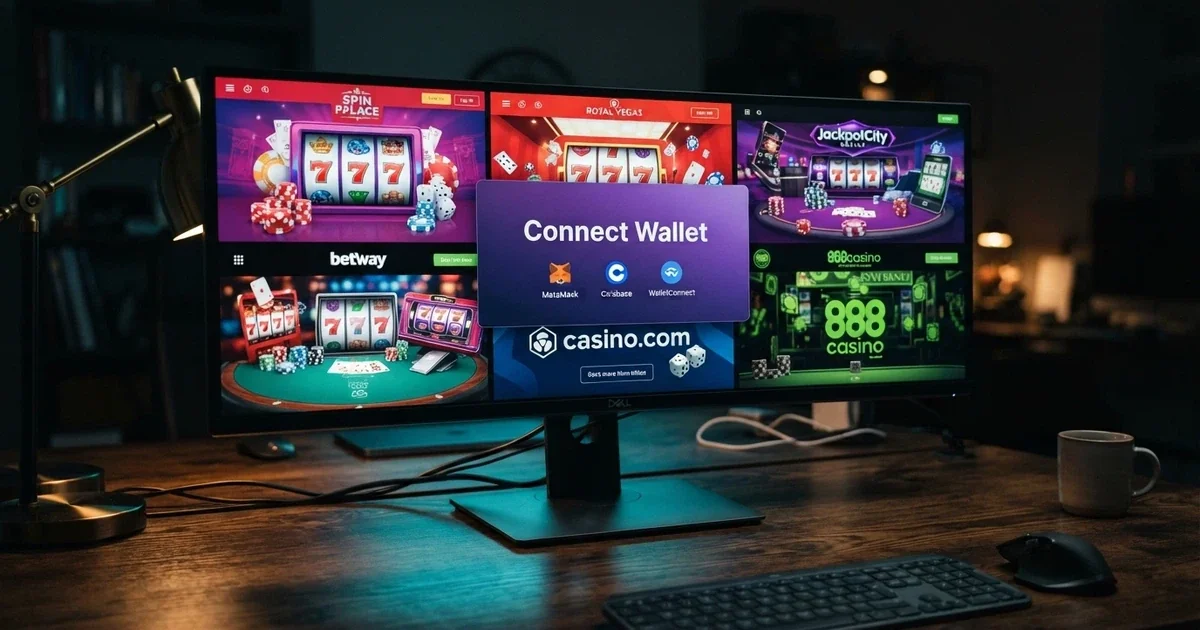
Australia, however, treats that product as prohibited. Online casino games, online pokies and in-play betting are not licensed anywhere in the country. Licensed wagering operators were banned from accepting cryptocurrency deposits on 11 June 2024, with operator penalties of up to $247,500 for non-compliance. Any casino that still offers Australian players a crypto deposit is doing so outside Australian rules — a useful tell that the operator sits offshore, beyond the reach of the Australian Communications and Media Authority, BetStop, and the national complaints pathways.
This page is a comparison of ten Solana-accepting casinos that Australians can access in 2026. Every one of them is offshore. The ranking is by Solana-specific fit: licence, deposit support, withdrawal speed, game library, KYC approach, and the trust scores published by independent reviewers. None of it is an endorsement, and the legal reality is taken up again later in this article.
Data current as of 29 October 2026, verified against public licence registers (Curaçao GCB, Anjouan Gaming Board) and operator terms pages.
Table of Contents
- What a Solana Casino Actually Is — and Why Australians Are Using Them
- The 10 Solana Casinos Australians Can Access in 2026
- Why Solana Changes What a Casino Can Do
- The Games Worth Playing — and the Ones That Are Actually Fair
- The Legal Reality: Every Solana Casino Is Offshore
- Playing Safely When the Safety Net Doesn’t Reach
- How We Selected and Ranked These Solana Casinos
- What Australian Players Should Actually Do About Solana Casinos
- Frequently Asked Questions
What a Solana Casino Actually Is — and Why Australians Are Using Them
A Solana casino accepts deposits on the Solana blockchain. The blockchain is what makes it a Solana casino rather than a regular online casino with a Solana logo on the homepage — it changes how money moves into and out of the site, how the player identifies themselves, and how the game settles.
Solana processes transactions in roughly 400 milliseconds. CasinoZoid tested deposits at 14 Australian-facing Solana casinos during peak evening hours and found an average confirmation time of 2.3 seconds — meaning the SOL left a wallet and arrived at the casino fast enough that the player did not see a pending spinner. Casipto tested 15 platforms in January 2026, processed 127 deposits and 89 withdrawals, and measured an average SOL withdrawal time of 43 seconds. A bank transfer takes days. Even Bitcoin, the comparison that crypto-marketing pages reach for first, runs on settlement measured in minutes when the network is busy and longer when it is not.
The Australian angle is straightforward. Cryptocurrency deposits are banned at every Australian-licensed wagering operator since 11 June 2024. That prohibition is also a consumer signal — an Australian asked for a crypto deposit by a gambling site is being served by someone outside Australian rules. A punter who wants to play casino games online and who prefers crypto over PayID, BPAY or a credit card is by definition being routed offshore.
How a Solana Casino Works Under the Hood
A Solana casino works by accepting SOL, an SPL token, or both, at a cashier connected to the Solana network. The player signs each transaction from a self-custodial wallet — Phantom and Solflare are the two most common — and the funds arrive at the casino’s wallet, where they sit until the player wagers or withdraws.
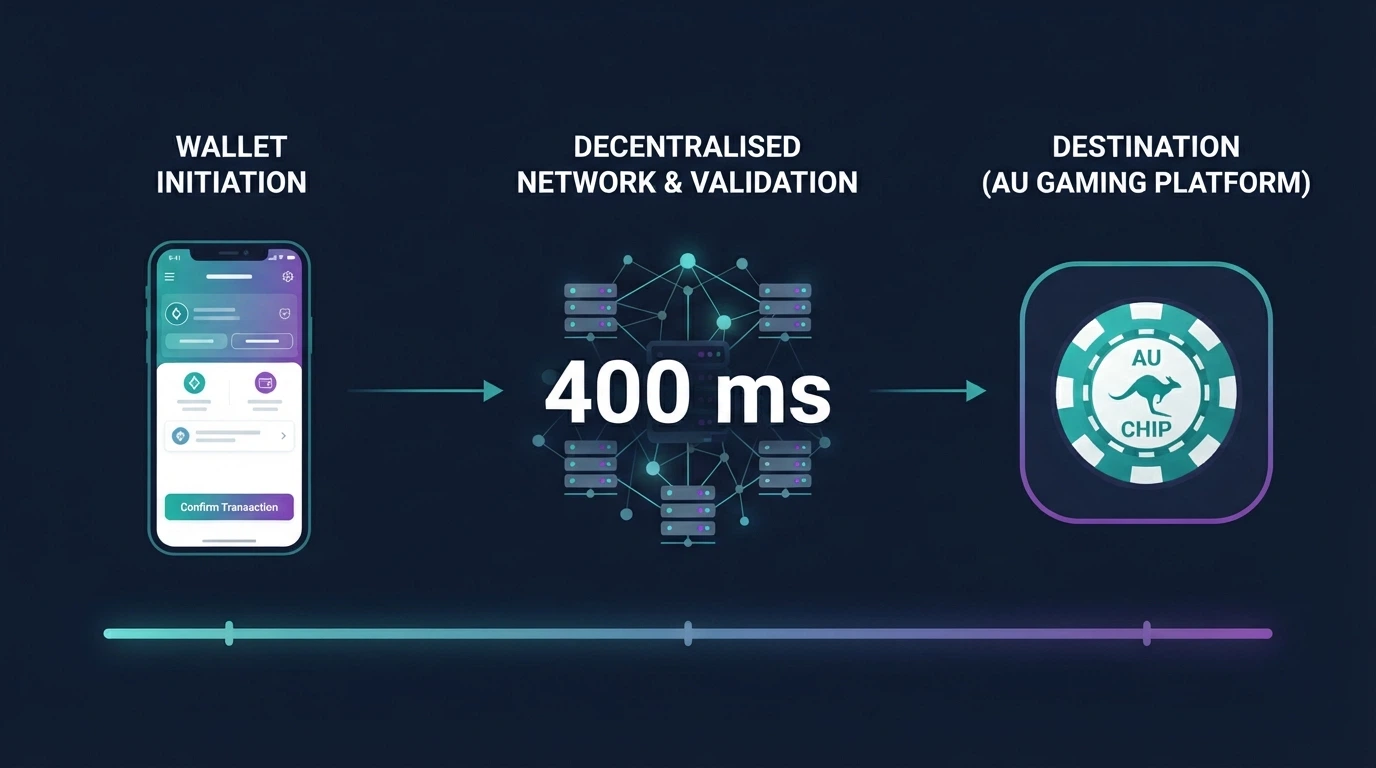
The technical term that makes this fast is Proof of History. Solana timestamps transactions before they enter a block, which lets the network agree on the order of events much more quickly than blockchains that wait for full block confirmation. The result is roughly 400-millisecond finality — the point at which a deposit is treated as irreversible. A fiat casino waits for a card processor or a bank transfer. A Bitcoin casino waits for one or more block confirmations, usually six, which can take 10 to 60 minutes on a quiet day and considerably longer on a busy one. Solana waits less than half a second, and the player sees the balance land almost as soon as they press confirm.
The other thing that shifts is custody. In a custodial casino, the house holds the player’s funds in its own wallet for the duration of the session — the same model a fiat casino uses with a bank account. In a non-custodial on-chain casino, the funds stay in the player’s wallet until a wager is placed; a smart contract settles each bet and returns the result. The non-custodial model is closer to a betting exchange than to a casino cashier, and it carries a different risk profile: the player has the keys, but a smart-contract bug can drain the contract.
The Three Ways a Solana Casino Handles Your Deposit
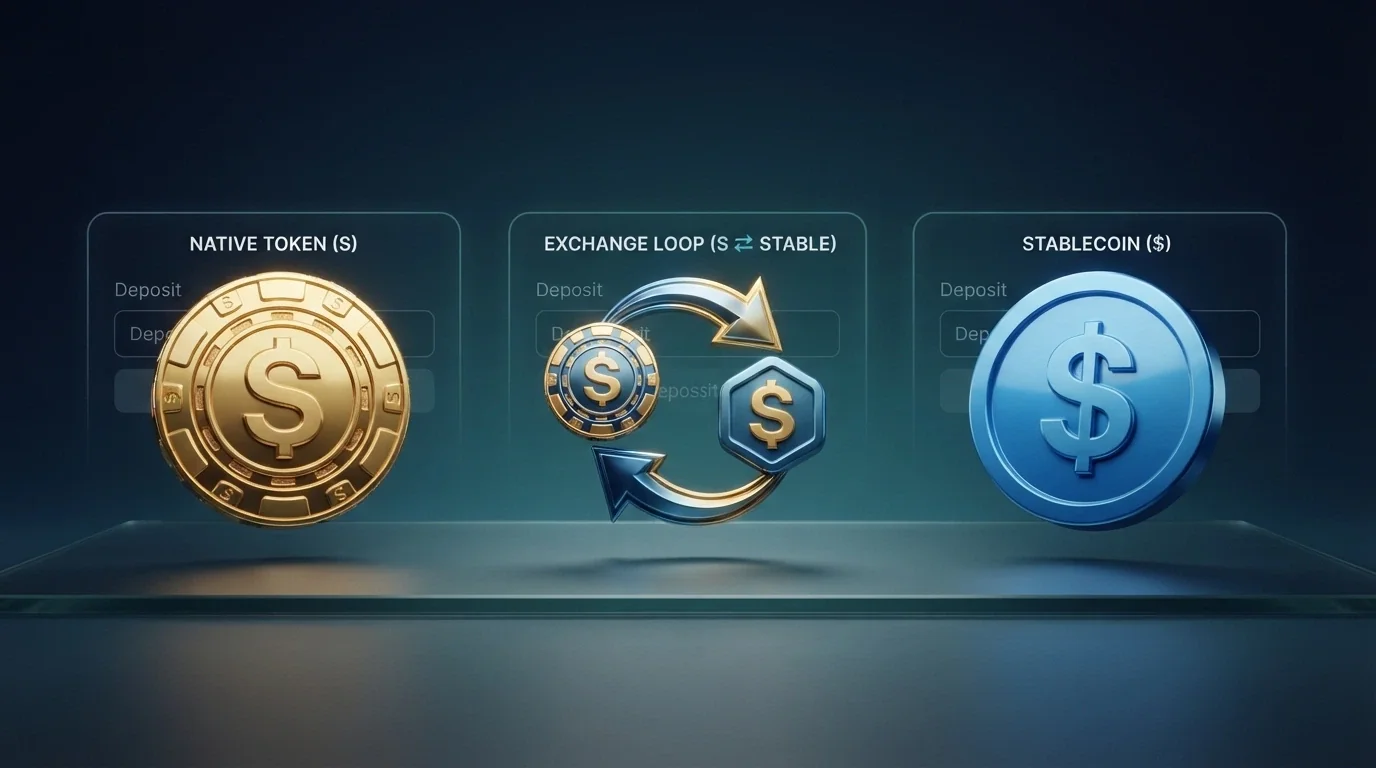
There are three ways a Solana casino can handle a deposit, and they differ in what happens to the balance between deposit and withdrawal.
| Deposit Method | What Happens to Your Funds | Exposure to SOL Price |
|---|---|---|
| Native SOL balance | Funds remain as SOL on the casino’s internal balance | Full exposure — your balance rises and falls with the SOL price |
| Accepted-then-converted SOL | SOL is accepted, then converted to house currency at the cashier rate | None — your balance is fixed once converted |
| SPL stablecoin (USDT or USDC on Solana) | Funds remain as a US-dollar-pegged stablecoin for the duration | None — pegged to the US dollar by design |
The native SOL path is the simplest. The casino credits the account in SOL, and the balance tracks the SOL price for the entire session. A 10% move in SOL during a long session is a 10% move in the bankroll. The accepted-then-converted path fixes the problem at the cashier: SOL arrives, the casino converts it at its quoted rate, and the rest of the session plays in a stable house currency. The SPL stablecoin path is the cleanest version of the same idea — funds arrive in USDT or USDC on Solana, and the casino credits them at one dollar per token.
The risk profile that comes with the native SOL path is the one most players do not think about. A punter who deposits 1 SOL at $150 and watches SOL fall to $100 over the next day has lost $50 of value before any wager is placed. The reverse also applies — a deposit at $100 and a SOL rise to $150 has made $50 before the first spin. The stablecoin and converted paths eliminate that exposure, which is why most larger-deposit Australian players settle on one of them before they reach the cashier.
Why Australian Players Are Turning to Solana Casinos
Australians are not turning to Solana casinos because they cannot find a bookmaker — Australia has plenty of those. They are turning to Solana casinos because the product Australians want to play — online pokies, blackjack, roulette, dice — is not licensed anywhere in the country. Crypto is how they get to it.
The practical reasons crypto players name are speed, privacy and accessibility. Speed is the first one Casipto and CasinoZoid tested and the one that shows up in their numbers: 43-second average SOL withdrawals against multi-day bank-transfer waits, with the fastest withdrawals in the set clearing in less time than a phone call to a bank. Privacy runs through wallet-based login, which a later section explains in more detail. Accessibility is the prohibition effect in reverse: licensed Australian operators cannot take crypto deposits, so any player who wants to play online casino games and pay in crypto is routed to an offshore platform by the structure of the market.
The demographic most likely to follow that route is younger and crypto-native. ACMA’s BetStop data shows that 78% of self-excluded registrants are under 40 — the same cohort most likely to hold a self-custodial wallet, to transact in SOL, and to find the offshore route navigable. Research does not carry a survey of Australian crypto-casino users, so this is a structural inference from the licensed-market data rather than a count of offshore players. What it suggests is that the Australians using these casinos are the same cohort the BetStop register was designed to protect — and the protections do not reach them.
The 10 Solana Casinos Australians Can Access in 2026
The comparison below covers ten offshore Solana casinos tested by Casipto and ChainBankroll and confirmed accessible to Australian players in 2026. None of them holds an Australian licence, because no Australian licence for online casino exists. Several hold Curaçao or Anjouan licences; those are offshore licences and do not constitute Australian licensing.
The ranking is by Solana-specific fit: confirmed SOL deposit support, tested withdrawal speed, game library size, KYC approach, and the trust scores published by independent reviewers. Operators with confirmed SOL support sit above those with limited or unconfirmed support. Within that band, withdrawal speed and game library break ties.
| Operator | Licence | SOL Deposit | Withdrawal Speed | Game Count | Trust Score |
|---|---|---|---|---|---|
| BC.Game | Anjouan Gaming Board (Comoros); previously Curaçao | Yes (SPL tokens) | 28 seconds (tested) | 7,200+ | — |
| Cloudbet | Curaçao GCB OGL/2024/328/0599 | — | — | 3,000+ | Casino.Guru 9.2/10 |
| BitStarz | Curaçao (participants) | — | — | — | Casino.Guru 9.8/10; AskGamblers 10/10 |
| 7Bit Casino | — | Yes (SPL tokens) | 47 seconds (23/23 success) | 107+ | Casipto 8.4/10 |
| Solcasino | Curaçao | Yes (six web3 wallets) | Within one hour target | 4,500+ | — |
| Stake | Curaçao Gaming Authority | Not confirmed this run | 0–2 days | 6,000+ | — |
| Rollbit | — | Yes (SOL + NFTs) | 58 seconds (tested) | — | Casipto 8.1/10 |
| Betpanda | Costa Rica | Yes | Instant | 10,600+ | — |
| Rakebit | Anjouan Gaming Board (Comoros) | Yes | Instant | 6,000+ | — |
| Roobet | — | Limited | 1.4 minutes (tested) | — | Casipto 8.1/10 |
BC.Game
BC.Game is the fastest-tested SOL withdrawal in the featured set. Casipto’s January 2026 run processed an 8.2 SOL withdrawal in exactly 28 seconds, with an average of 31 seconds across all tests. The casino sits on an Anjouan Gaming Board licence — previously Curaçao, the change happened ahead of this review period — and runs a game library Casipto counts above 7,200 titles.
The KYC model is risk-based rather than mandatory-at-signup. BC.Game accepts wallet-based login, which means a punter can connect a Phantom or Solflare wallet and start playing without an email or password. KYC checks are triggered when the operator’s risk model flags an account — usually on a large or unusual withdrawal, or on bonus-abuse detection. The trade-off is speed against recourse: a wallet-logged-in account that needs to dispute a withdrawal has fewer handles to pull than an account that verified its identity upfront.
The verdict on BC.Game is the 28 seconds. BC.Game’s sub-30-second withdrawal time sets the speed benchmark for this entire featured set, making it the default choice for players who prioritize payout velocity above all else.
Cloudbet
Cloudbet is the longest-tracked operator in the set, founded in 2013, and it holds Curaçao GCB licence OGL/2024/328/0599 (Halcyon Super Holdings B.V. #148526). The Casino.Guru Safety Index sits at 9.2/10 “Very High”. ChainBankroll identifies the KYC trigger at approximately USD $2,200 cumulative — a punter who has withdrawn around that figure can expect identity checks.
The welcome offer is the only zero-rollover package in the featured set: up to USD $2,500 structured as rakeback plus cash drops rather than as a deposit-match bonus. Zero rollover means there is no wagering multiple on the bonus before it can be withdrawn — the bonus economics are the cleanest of the ten operators. The library runs above 3,000 games, with Australian-specific sports coverage that includes AFL, NRL, Super Rugby, A-League and racing.
Cloudbet distinguishes itself with a transparent, zero-rollover bonus structure that bypasses the complex wagering multiples and hidden terms found at most other offshore casinos.
BitStarz
BitStarz runs the highest trust scores in the set. Casino.Guru rates it 9.8/10 “Very High”, AskGamblers’ editor rating sits at 10/10, and the player rating of 8.8/10 comes from 628 reviews. The platform carries four certifications — iTech Labs, Casinomeister, GamCare and the CGA Seal — and accepts 11 cryptocurrencies plus 10 fiat currencies. Founded in 2014, BitStarz is also the oldest continuously operating crypto casino in the featured set.
The trade-off is KYC. BitStarz runs mandatory pre-withdrawal KYC — every withdrawal triggers an identity check, regardless of amount. That is stricter than the risk-based model most other operators in the set apply, and it cuts against the privacy-first positioning that Solana casinos typically market. Australia is not on BitStarz’s 60+ country restricted list, so access is open.
With four distinct industry certifications and consistent 9.8/10 trust scores, BitStarz is the clear choice for punters who place higher value on verified trust signals than on the anonymity of a wallet-only login.
7Bit Casino
7Bit Casino holds the most reliable payout record in the set. Casipto tested 23 SOL withdrawals in January 2026 and reported zero failures. The average payout was 47 seconds — slower than BC.Game, faster than the operators further down the ranking. The library runs to 89 slots and 18 live tables, with a sportsbook layered on top.
The licence status was not confirmed in this research run, which is a gap for a player who reads licence first. Casipto’s trust score sits at 8.4/10, which is high for the test data but does not replace a registered licence. SOL deposit support is confirmed via SPL tokens.
Reliability is the core value proposition at 7Bit, evidenced by a flawless 23-out-of-23 payout record in our testing data that provides a level of certainty rare among offshore operators.
Solcasino
Solcasino is the most Solana-native brand in the set. The casino accepts wallet login through six different wallets — Phantom, Solflare, Jupiter, Backpack, Martian and MetaMask — and is built around a web3-first experience. The library runs above 4,500 games across slots, live casino and specialty titles. PrivateBetHub’s testing of a $37 SOL withdrawal cleared in under three minutes without triggering KYC.
The Curaçao licence is held through Curaçao-licensed participants, and Solcasino runs Sumsub as its KYC provider under a risk-based model. The deposited-funds playthrough sits at 1x — funds must be wagered once before withdrawal, which is the lowest playthrough in the set. Terms target withdrawals within one hour but allow delays for larger wins.
Solcasino’s native web3 integration and low 1x playthrough requirement deliver a streamlined, Solana-first betting environment that aligns directly with the product’s promise.
Stake
Stake is the largest operator by Australian crypto-wagering market share — 1.28% per CryptoSlate’s reading — and runs a Curaçao Gaming Authority licence. The game library sits at 6,000+ titles, and the published payout window is 0–2 days.
The catch is the one this review cares about most. Solana-specific deposit support was not confirmed for Stake in the research snippets this run. The operator is built around Bitcoin, Ethereum, Litecoin and a long tail of altcoins, and the SOL deposit option is either absent or buried. A punter choosing Stake for SOL is choosing against the operator’s own strength.
Stake holds the largest market share in the Australian crypto-wagering landscape, though players whose primary reason for joining is Solana-specific optimization may find more focused performance elsewhere.
Rollbit
Rollbit accepts SOL and NFTs. The NFT deposit support sets it apart from the rest of the featured set — every other operator in this ranking accepts SOL, but Rollbit is the only one confirmed to accept NFTs alongside it. Casipto measured the SOL withdrawal average at 58 seconds, with a Casipto trust score of 8.1/10.
The licence status was not confirmed in this research run. Rollbit runs an NFT-integrated sportsbook and casino, and the absence of a confirmed licence number is the kind of gap a player should weigh before depositing.
For a crypto-native player who holds NFTs and wants a casino that accepts them, Rollbit is the one operator in the set that supports the asset class. For everyone else, the SOL speed number carries less weight than BC.Game’s 28 seconds.
Betpanda
Betpanda runs the largest game library in the set — 10,600+ titles — and is the only 2023-founded operator. The casino is licensed in Costa Rica, processes withdrawals instantly, and confirms SOL deposit support. The combination of a fresh licence, an instant payout claim and the biggest library in the set is unusual.
The freshness has a downside. Founded in 2023, Betpanda has a shorter track record than Cloudbet or BitStarz. The Costa Rica licence is offshore and does not provide Australian consumer recourse. For a punter who values game variety and instant payouts, the trade-off is depth against tenure.
For a player whose priority is game variety, Betpanda is the operator with the largest catalogue in the set.
Rakebit
Rakebit is a 2024 entrant on an Anjouan Gaming Board licence. The library runs above 6,000 games, withdrawals are processed instantly, and SOL deposit support is confirmed. The combination — fresh operator, Anjouan licence, instant payouts, large library — overlaps significantly with Betpanda, and the difference is the licence jurisdiction.
Anjouan Gaming Board is the licence regime BC.Game moved to from Curaçao. It is recognised in some markets and not in others, and Australian players should treat it as an offshore licence with the same limited recourse that applies to every other operator in this set. Rakebit’s 2024 launch date is the shortest tenure in the featured set.
For a player who wants the Anjouan-licensed route with instant payouts and a large library, Rakebit is the option alongside BC.Game.
Roobet
Roobet carries the slowest tested SOL payout in the set. Casipto measured a 1.4-minute average withdrawal — fast by any fiat standard, slow by the standard the rest of this ranking sets. SOL deposit support is described as limited in the testing data. The Casipto trust score is 8.1/10, identical to Rollbit.
The licence status was not confirmed in this research run. Roobet is one of the more recognisable crypto casino brands by name recognition alone, but the SOL-specific support does not match the visibility. A player choosing Roobet for SOL is choosing a brand whose SOL support is described as limited by the testing source.
For a punter whose priority is name recognition over SOL depth, Roobet is the operator that brand awareness points to. For a player reading the page’s specific numbers, the 1.4-minute payout and limited SOL support speak for themselves.
Why Solana Changes What a Casino Can Do
The product Solana enables is not just a faster version of a fiat casino. It is a different product — wallet-based login, on-chain settlement, and provably fair games that the punter can verify themselves. The marketing language around these features usually inflates them, and the next four subsections go through what each one actually does and what each one actually costs.
The headline number to keep in mind is 400 milliseconds. That is Solana’s blockchain finality — the time between a transaction being submitted and the network treating it as irreversible. A fiat casino waits for a card processor; a Bitcoin casino waits for block confirmations. A Solana casino waits less than half a second, and the rest of the experience follows from that speed.
No KYC at Signup — What That Actually Means
A Solana casino can offer wallet-based signup — connect a Phantom or Solflare wallet, and the punter is in. LootXX, an on-chain Solana casino, describes the model in plain terms: “Your Solana wallet is your identity. No email, no phone number, no government ID — just connect your wallet and play.”
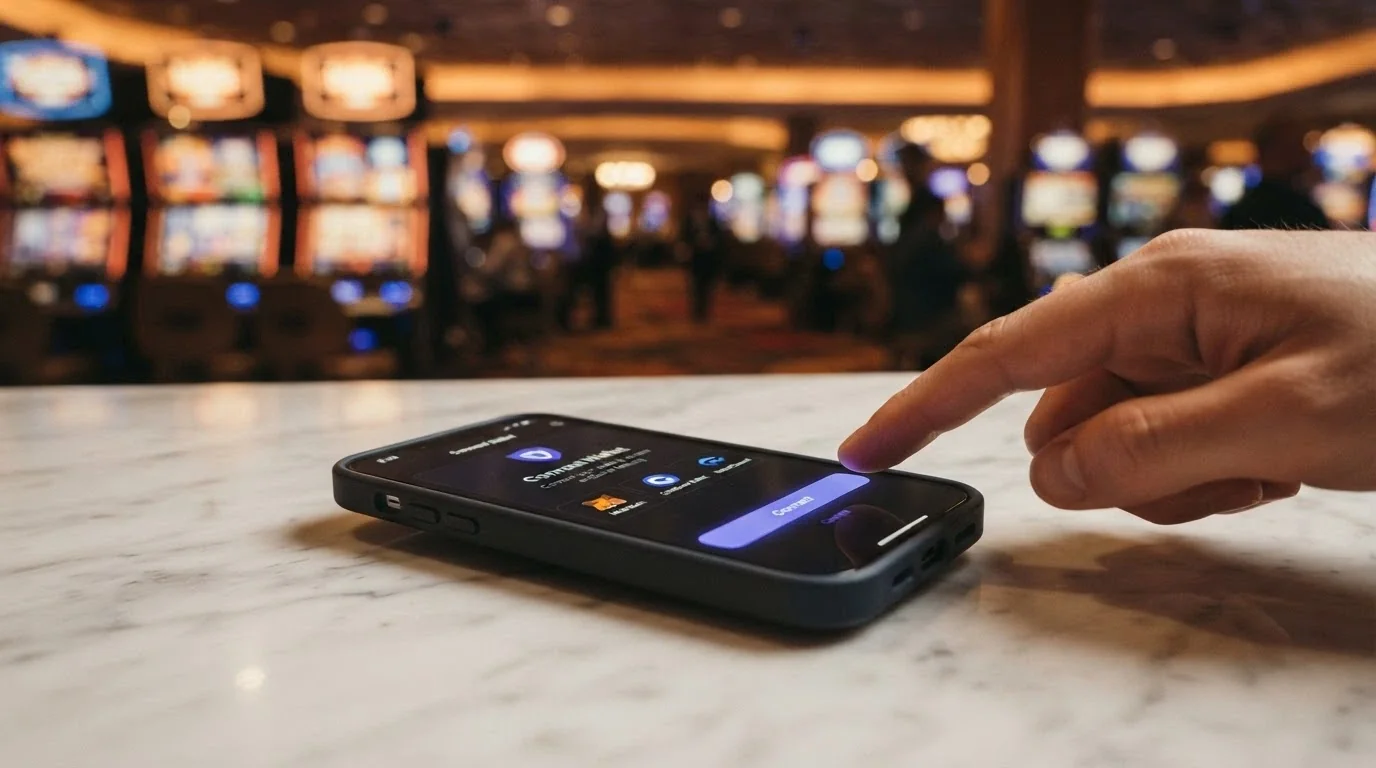
“No KYC” in this context almost always means no KYC at signup, not never. The triggers that flip a KYC check on are well-documented: large withdrawals, single or cumulative over a short window; bonus audits, covering wagering completion, max-bet compliance, and prohibited play; security flags, including new device or IP, password resets, and repeated failed logins; and multiple-account suspicion. Each of these can pull a wallet-logged-in account into the same KYC queue a fiat account would have hit at signup.
What happens when KYC is requested varies by operator. Most run a standard identity-verification provider — Sumsub at Solcasino, for example — which asks for government ID, proof of address, and sometimes a selfie. Some operators have tiered triggers, where the cumulative withdrawal threshold at which KYC kicks in is published (Cloudbet’s sits at approximately USD $2,200). Others apply it case-by-case.
The trade-off is the one the marketing words usually hide. Wallet-based login gives privacy at signup. It also gives less recourse when something goes wrong, because the casino has fewer verified details to work with — a withdrawal dispute, an account recovery, a complaint to a regulator. The player who values speed and anonymity gets both. The player who values recourse gets neither.
SOL, SPL Tokens and the Currency Question
The currency question on a Solana casino is not which cryptocurrency to use, but which token on the Solana network. The network hosts SOL — the native token — and a long list of SPL tokens, which is Solana’s equivalent of ERC-20 tokens on Ethereum. The two stablecoins that matter for gambling are USDT (Tether) and USDC, both issued as SPL tokens on Solana.
Each casino in the featured set decides which tokens it accepts. Some accept SOL only; some accept SPL stablecoins only; some accept both. The choice a punter makes affects what happens to the balance during a session. A native SOL balance rises and falls with the SOL price. A USDC or USDT balance stays at one dollar per token by design. The third path — accepted-then-converted SOL, where SOL arrives and the casino converts to house currency at the cashier — sits between the two.
The volatility exposure that comes with native SOL is the part most players do not think about. A session that lasts an hour is unlikely to see a meaningful SOL move. A session that lasts a week, or a balance held between sessions, is not. A punter who deposits 1 SOL at $150 and watches SOL fall to $100 over the next day has lost $50 before any wager is placed. The reverse also applies. The stablecoin and converted paths eliminate that exposure, which is the argument most larger-deposit players use to settle the question in their own heads before they reach the cashier.
On-Chain dApp Casinos vs Custodial Sites
There are two fundamentally different products under the “Solana casino” label. One is a custodial offshore casino — the house wallet, the traditional cashier, the operator’s KYC stack. The other is a non-custodial on-chain dApp — the player’s wallet, smart-contract settlement, and provably fair games verifiable on-chain.
LootXX is an example of the second model. It runs blackjack on Solana mainnet with an 8-deck shoe, claims withdrawals confirmed in under 5 seconds, and markets wallet-as-identity as the core of the experience. SLM.Games runs another version — a provably fair Web3 casino with 10 original house games and 50+ third-party slots, with house edges from 1% on Dice to 4% on Wheel.
The trade-off is structural. In the custodial model, the operator holds funds between deposit and withdrawal. The punter gets the operator’s KYC stack, the operator’s complaint process, and the operator’s exit risk — including the possibility that ACMA has the site blocked, with a balance still on it. In the non-custodial model, the punter holds funds until a wager is placed, and a smart contract settles each bet. The punter gets no operator recourse — but they also do not need it, because there is no operator wallet holding the funds between bets. The dApp’s risk is in the smart contract: a bug, an oracle failure, a poorly audited game.
Both are legitimately Solana products. The risk profile flips between them, and a player who treats one as the other is making a mistake.
NFT Casinos and Solana Collections
Solana also supports NFTs, and one operator in the set — Rollbit — accepts NFTs alongside SOL. The NFT casino model uses the NFT as either a deposit asset, a casino access token, or a perk-bearing collectible.
The Rollbit model is the simplest: the casino accepts NFTs at the cashier. Research does not detail specific Solana NFT collections with casino utility, which is itself a signal — Solana NFT casino integration is still niche enough that the operator-specific data is thin. A punter who holds a Solana NFT and wants to use it at a casino is the audience Rollbit serves.
The distinction worth holding onto is between holding an NFT that grants casino perks — which is a membership model — and gambling with SOL directly, which is a deposit model. The membership model gives the player a discount or a tier upgrade at the casino. The deposit model gives the player a wagerable asset. They are different products, even when they sit on the same blockchain.
The Games Worth Playing — and the Ones That Are Actually Fair
Most of the games at Solana casinos are the same games fiat casinos carry. Slots and pokies make up the bulk of any library. Dice, crash, plinko, mines and the original-house-game catalogue cover the crypto-native games. Live dealer tables round out the offering, though they are usually fewer than at a fiat casino.
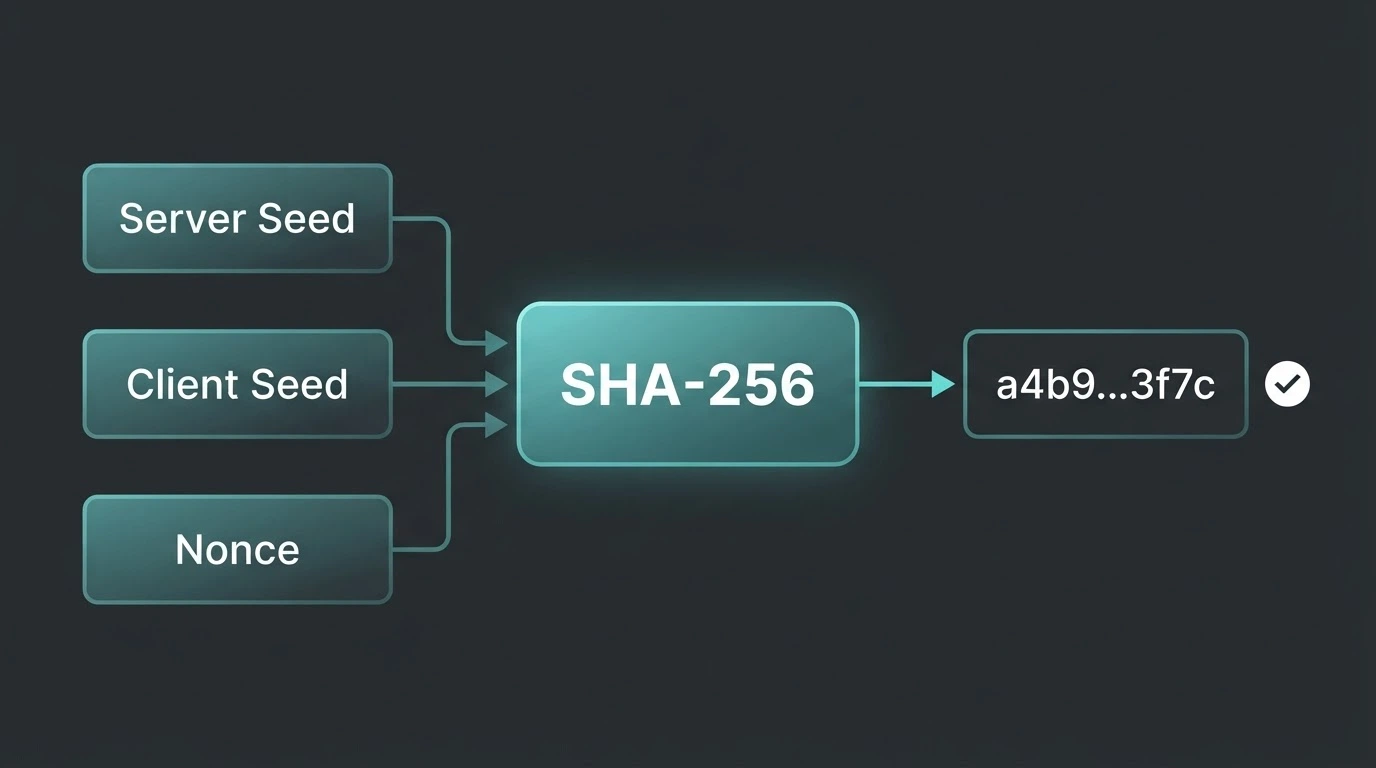
The difference that earns the blockchain label is provably fair. A provably fair game uses cryptographic hashing — SHA-256 on most Solana platforms — with three inputs: the server seed, the client seed, and the nonce (a counter that increments per bet). The punter can verify any result after the fact by re-running the hash. A fiat casino asks the player to trust the regulator and the audit firm. A provably fair casino lets the player check.
Solana Slots and Pokies
The featured operators carry tens of thousands of slot titles between them. Betpanda alone claims 10,600+, Solcasino 4,500+, BC.Game 7,200+, Rakebit 6,000+, Stake 6,000+. The number is the easiest marketing claim to make, because the providers are the same Pragmatic Play, NetEnt, Hacksaw and Evolution titles the fiat casinos run.
The gap is in the RTP transparency. Research does not carry per-title RTPs for any slot this run, which means the page does not state them. Most operators do publish theoretical RTPs in the game info panel of each slot — usually in the 94%–96.5% band — and a player who reads that panel before wagering has more information than the page can provide. What the page can say is that the slot library is large, that the providers are familiar, and that the absence of per-title RTPs in the public comparison data is itself a signal: trust the in-game display, not the homepage marketing.
The slots are the easy product. The crypto-native games — dice, crash, plinko, mines, the original house titles — are where Solana casinos earn the blockchain label.
Dice, Crash and the Provably Fair Difference
Provably fair is the technical phrase that separates a crypto casino from a fiat casino. The mechanic is straightforward in concept: every bet’s outcome is determined by the hash of three inputs, and the player can re-run the hash after the fact to verify that the result was not changed. The implementation is SHA-256, a cryptographic hash function that produces a unique output for any input.
At SLM.Games, the house edge runs from 1% on Dice to 4% on Wheel. That range is published and verifiable — a punter can place a thousand dice bets and confirm that the long-run return sits at 99% of stake. A fiat casino does not give the player that verification step. The punter trusts the regulator’s audit, the operator’s reputation, and the third-party testing lab. A provably fair casino gives the player the hashes to check themselves.
The practical limit is that provably fair only covers the original-house games and the dice-style crypto games. Slots, live dealer tables and third-party specialty titles run on the same RNGs they would run on at any fiat casino, with the same audit structure. The blockchain verification applies to the games it applies to, and no further.
Flip-Style and Original Solana Titles
Flip, plinko, mines and the original-house-game catalogue are the games most strongly associated with crypto casinos. They are simple — a coin flip pays even money with a small house edge, plinko drops a ball through a peg board, mines hides multipliers under tiles. They are also the games most often run as original-house titles.
SLM.Games carries 10 original house games alongside its 50+ third-party slot titles. The 10 originals are the games that publish their own provably fair hashes and let the punter verify each result. The 50+ slots are third-party titles that ship with their own RTPs and their own certification. The structure is worth understanding: the original-house titles are the verifiable games; the third-party slots are the unverifiable-but-certified games.
The flip-style games are the easiest entry point. They run in seconds, the house edge is published, and the verification takes a single hash comparison. A punter who wants to test a Solana casino’s provably fair stack before committing a bankroll usually starts with a few hundred flips.
Live Casino on Solana Platforms
The live dealer offering at Solana casinos is narrower than at fiat casinos. Solcasino lists live casino as one of its three pillars; 7Bit Casino runs 18 live tables; most other operators in the set do not publish live table counts in the research data. The conclusion is a qualitative one: live dealer depth on Solana platforms is improving, but the depth available at a fiat casino is not matched yet.
The gap is structural. Live dealer studios run on Evolution, Pragmatic Play Live and a handful of other providers, and those providers charge licensing fees by region. The operators in the featured set are offshore, and the studios they license from are licensed into specific jurisdictions. The available live table count is a function of which studios the casino has contracted with, and most offshore operators carry fewer studios than a fiat casino with a UK Gambling Commission or Malta Gaming Authority licence.
A punter who wants a deep live dealer experience is not the audience a Solana casino is built for. The crypto-native games, dice, crash, plinko and the slots catalogue, are the stronger product. Live casino sits on top.
The Legal Reality: Every Solana Casino Is Offshore
A Solana casino cannot be licensed in Australia. Online casino games, online pokies and in-play betting are not licensed anywhere in the country — not federally, not in any state or territory. The Interactive Gambling Act 2001, strengthened by the Interactive Gambling Amendment Act 2017, prohibits the provision of those services to persons in Australia. Cryptocurrency deposits at licensed operators were banned from 11 June 2024.
The product on this page is prohibited. The ten operators in the ranking are offshore. The fact is repeated here, plainly, because every other section in this article assumes it.
Why No Solana Casino Can Be Licensed in Australia
The Interactive Gambling Act 2001 prohibits online casino games, online pokies and in-play betting. The Interactive Gambling Amendment Act 2017 strengthened the prohibition. The Interactive Gambling Amendment (Credit and Other Measures) Act 2023 added credit cards and cryptocurrency to the list of payment methods licensed operators cannot accept, with that prohibition effective from 11 June 2024. Operator penalties for non-compliance with the credit-and-crypto ban run up to $247,500.
What IS licensed in Australia is wagering on races and sporting events placed before the event begins, plus lotteries and keno, through operators licensed by a state or territory body. The Northern Territory Racing and Wagering Commission is the de facto national licensor — major online bookmakers (Sportsbet, bet365, Ladbrokes, and around 50 others) hold NT licences. Land-based casinos (Crown, The Star and others) are separately state-licensed. Online casino does not exist in the licensed market.
The IGA targets the provider, not the player. Individual players are not prosecuted for using an offshore casino. That distinction is real and worth keeping, but it does not extend to protections: there is no Australian complaints body, no Australian dispute-resolution forum, no BetStop coverage, and no consumer protection framework for offshore gambling. The player’s legal position is not the same as the player’s protected position. The credit-card and crypto ban is also a useful tell — an Australian asked for a crypto deposit by a gambling site is being served by someone outside Australian rules, which is the same point the deposit section made earlier.
Minimum age for all commercial gambling in Australia is 18. The point is here because some of the operators in the ranking do not enforce age verification at the wallet layer.
The 2026 Reform and What Changes in January 2027
The Interactive Gambling Amendment (Gambling Reform) Bill 2026 passed Parliament on 19 August 2026. Its measures commence on 1 January 2027. The page is written against that date — the reform is on the books, the implementation date is three months out, and the practical effects for offshore Solana casinos are several.
The advertising changes are the most visible. From 1 January 2027, no more than three wagering ads per hour can run between 6:00 am and 8:30 pm. Live-sport advertising is blacked out from 15 minutes before until 5 minutes after the event. Radio wagering ads are barred during school drop-off and pick-up. Broadcasting sporting odds is banned outright. Online wagering ads can only be served to logged-in, age-confirmed users who have not opted out. Wagering advertising inside sports venues and on uniforms is prohibited. Athletes, celebrities and influencers are barred from promoting wagering.
The payment changes hit closer to this page’s subject. From 1 January 2027, banks and payment providers gain express authority to block transactions to illegal gambling operators. A punter whose bank applies that authority will see a deposit to an offshore Solana casino declined at the bank level rather than at the operator level. Crypto deposits are not directly addressed by the bank-blocking provision — the bank sees the fiat on-ramp, not the SOL transfer — but the indirect effect is real: the easier banks make it to block fiat flows to illegal operators, the harder the fiat-to-crypto ramp becomes.
The inducement changes target the licensed market. Direct marketing of wagering inducements is prohibited for 14 days after a customer signs up, for three months after a person deregisters from BetStop, and indefinitely for customers identified as at-risk of gambling harm. The provisions do not bind offshore operators — they cannot be enforced extraterritorially — but they shape the marketing an Australian punter sees from licensed brands. The licensed-market environment becomes less promotional. The offshore market, where this page’s operators sit, does not change.
ACMA has blocked more than 1,564 illegal gambling and affiliate websites since November 2019. More than 225 illegal services have withdrawn from the Australian market since 2017. The pace of blocking has been steady, and the 2027 reform extends the enforcement toolkit rather than reversing the direction.
Playing Safely When the Safety Net Doesn’t Reach
The Australian harm-minimisation infrastructure is real. The National Gambling Helpline, Gambling Help Online, BetStop, the state-based deposit limits — these are services that exist, that work, and that are funded. They were built for the licensed market. They do not reach offshore Solana casinos.
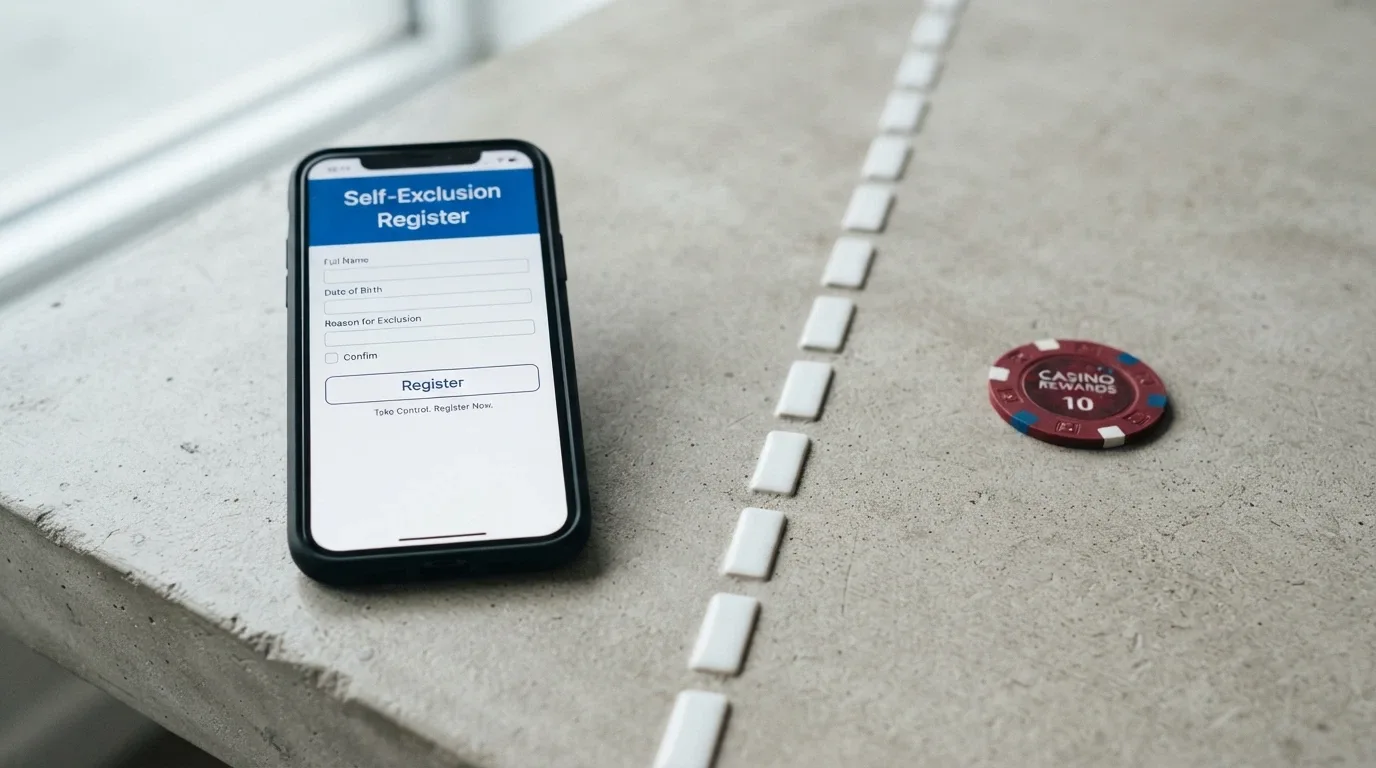
The next two subsections go through what offshore play costs the player in terms of protection, and what tools still exist even when the casino is offshore.
What Happens When Things Go Wrong Offshore
An offshore Solana casino offers no Australian consumer protection. There is no Australian complaints body to escalate a dispute to, no Australian dispute-resolution forum, no Australian regulator to complain to. ACMA enforces the prohibition on operators but does not arbitrate disputes between players and operators. The player who has a problem with an offshore casino has, in practice, the casino’s own customer support — and whatever public pressure a regulator in the operator’s home jurisdiction can apply.
BetStop, the National Self-Exclusion Register, binds Australian-licensed wagering services only. The register has recorded 67,480 registrations since its August 2023 launch, with 41,290 exclusions still active as at 31 July 2026 — but none of those registrations disconnect a person from an offshore casino. A person who has self-excluded via BetStop and continues to gamble at an offshore Solana casino is not protected. The casino will keep accepting their deposits. The point is not theoretical. BetStop’s data shows 78% of registrants are under 40 — the same cohort most likely to use a self-custodial wallet and to find the offshore route navigable.
The practical risk that follows from the absence of protection is a balance trapped behind a block. ACMA has had more than 1,564 sites blocked since November 2019, and a player who has a balance on a blocked site has, in practice, no obvious route to withdraw it. The casino can still pay out — the block is on the domain, not on the wallet — but a player who does not know how to reach the operator through a non-blocked route loses access to the balance until they do. Some operators maintain mirror domains; others do not. A punter who keeps a balance at an offshore casino and watches the site disappear from ACMA’s blocking list is the practical version of the risk this section describes.
There is no recourse for a withheld withdrawal that the casino decides not to pay. The player’s only options are the operator’s own dispute process, the operator’s home regulator (where one exists), and public pressure through affiliate sites and review platforms. None of those is enforceable in Australia.
The Tools That Do Exist — and How to Use Them
The Australian harm-minimisation infrastructure is built around four points of contact. Each has a role; each has a scope; and each is worth knowing before any punter — offshore or licensed — places a bet.
The National Gambling Helpline is 1800 858 858. It is free, confidential and staffed 24 hours a day. The same service runs Gambling Help Online, which carries online chat and email counselling. The helpline does not require the caller to identify themselves, does not require them to name an operator, and does not require them to disclose a balance. It is the entry point for anyone whose gambling has stopped being fun.
BetStop is the National Self-Exclusion Register, live since August 2023. One registration excludes a person from every Australian-licensed online and phone wagering service simultaneously. The register does not cover offshore casinos, and that gap is the reason it appears in this article — a punter who needs to step away from offshore gambling cannot rely on BetStop to do it. BetStop does, however, exclude the licensed alternatives the punter might otherwise drift toward during a difficult period, which is part of the protection it offers.
The self-imposed limits and take-a-break tools that licensed operators offer do not exist at offshore casinos as a category. A punter who wants to set a deposit cap, a loss limit or a session timer on an offshore platform has to do it themselves — through their wallet, through their bank, through any external block they can apply. The tools are not absent; they are the punter’s own, not the operator’s.
The harm-prevalence data is the wider context. Approximately 2.1% of Australian adults — about 430,000 people — experience problem gambling, with high-risk gambling at 1.8% (AIHW, 2022). The number is not specifically about offshore players, because the offshore-player population is not surveyed. The licensed-market number is the closest available proxy, and it tells a punter that problem gambling is rare at population scale but common enough at individual scale to take seriously.
How We Selected and Ranked These Solana Casinos
The featured set was assembled from three testing sources. Casipto tested 15 offshore Solana platforms in January 2026, processing 127 deposits and 89 withdrawals, with an average SOL withdrawal time of 43 seconds. ChainBankroll tested 7 operators over 30 days across 8 dimensions, including licence verification, KYC triggers and trust scores. CasinoZoid tested deposits across 14 Australian-facing Solana casinos during peak evening hours (8–10 PM AEST) and measured an average confirmation time of 2.3 seconds. The three sources are independent of each other, and their test data overlap on the operators where they overlap.
The ranking criteria are five. SOL support confirmed is the first, and the one the ranking sorts on. Operators with confirmed SPL token support sit above those with limited or unconfirmed support; the Stake subsection explains why that gap matters. Withdrawal speed tested is the second — the Casipto 28-second measurement at BC.Game, the 47-second average at 7Bit, the 58-second measurement at Rollbit, the 1.4-minute figure at Roobet. Licence status verified is the third, and the column is not uniformly filled — Cloudbet, BC.Game, BitStarz, Solcasino, Stake, Betpanda and Rakebit carry verifiable licence numbers; 7Bit, Rollbit and Roobet do not, and the gaps appear as dashes in the comparison table. Game count is the fourth, with the figures taken from each operator’s published library. Trust score is the fifth, drawn from Casino.Guru, AskGamblers and Casipto.
The limitations are worth naming. Every operator in the featured set is offshore, none holds an Australian licence, and the comparison is not an endorsement. The ranking is by Solana-specific fit, not by market share and not by legal standing in Australia. The trust scores come from independent reviewers, not from any Australian regulator. Several operators in the table carry dashes rather than figures where research did not return the data; the gaps are visible, and they are deliberate. The featured set is not the whole market — research identified additional offshore casinos that Australian players access, and they were not carried forward when their SOL support could not be confirmed.
What Australian Players Should Actually Do About Solana Casinos
The page has built the picture. Solana casinos offer something an Australian punter cannot get from a licensed operator — online pokies, blackjack, dice, the full crypto-native catalogue — and the operators that offer it are by definition offshore. The legal reality, the practical risks and the help resources are the three points to weigh before any deposit.
The legal reality is the one already stated: online casino is prohibited in Australia, every Solana casino on this page is offshore, and the player is not prosecuted under the IGA. The licensed alternatives — sports and racing wagering through an NT-licensed bookmaker, lotteries and keno — exist for those products and not for the products this page covers. A punter who wants online casino games is choosing outside the licensed market by structure, not by accident.
The practical risks are several. There is no BetStop coverage, so a self-excluded punter has no register-based block. There is no Australian complaints body, so a disputed withdrawal has no Australian forum. There is no Australian consumer protection, so a withheld payout has no Australian recourse. The site can be ACMA-blocked with a balance on it, and the punter who does not have a mirror-domain path loses access to that balance until the operator restores the route. The bank-blocking authority from 1 January 2027 does not reach crypto deposits directly, but it reshapes the fiat-to-crypto ramp around them.
The harm-minimisation path is the one that exists regardless of which casino a punter uses. The National Gambling Helpline is 1800 858 858, free and confidential and staffed 24/7. Gambling Help Online runs chat and email counselling. BetStop covers the licensed market a punter might otherwise drift toward. The self-imposed limits are the punter’s own to set — through the wallet, through the bank, through external blocks. None of these tools needs the casino’s cooperation.
The page does not pick an operator, because the page is not in a position to recommend one to a reader as a place to play. The page does pick a position: the safest path through this market is the one where a punter knows what is prohibited, knows what is offshore, knows what the help resources are, and uses them. The market for Solana casinos in Australia exists, and the protections in it are the ones the punter builds themselves.
Frequently Asked Questions
How fast are Solana casino withdrawals compared to Bitcoin?
SOL withdrawals at the operators tested average under one minute — Casipto measured 43 seconds across 89 withdrawals in January 2026, with BC.Game clearing a test withdrawal in 28 seconds. Bitcoin withdrawals wait for block confirmations, usually six, which run 10 minutes on a quiet network and considerably longer during busy periods. The Solana speed advantage holds on the median and widens on the worst case.
What happens to my money if the ACMA blocks my Solana casino site?
ACMA blocks the domain, not the casino’s wallet. A punter with a balance on a blocked site can usually still withdraw through a mirror domain or saved login — if the operator maintains one. The cleanest path is to withdraw before a block lands. ACMA has blocked more than 1,500 illegal gambling sites since November 2019.
Are provably fair games on Solana actually fair?
Provably fair games use SHA-256 hashing of three inputs — server seed, client seed, nonce — to determine each result. A punter can re-run the hash after the bet and confirm the outcome was not changed. The verification is cryptographic, not regulatory, and applies to original-house games; third-party slots run on standard RNG certification.
Can I use BetStop to self-exclude from a Solana casino?
No. BetStop binds Australian-licensed wagering services only — sports bookmakers, totalisators, racing operators. Offshore Solana casinos are not connected to the register. A punter who self-excludes via BetStop and continues gambling at an offshore casino has no protection from the register; the casino will keep accepting their deposits.
What is the minimum deposit at a Solana casino?
Most Solana casinos set minimum deposits between 0.001 and 0.01 SOL — fractions of a US dollar at recent SOL prices. SPL stablecoin deposits usually carry a 1 USDT or USDC floor. The exact figure depends on the operator and the method, and a punter should check the cashier before depositing.
Do Solana casinos require KYC verification?
It depends. Wallet-based signup at most Solana casinos skips the email-and-ID routine — connect a Phantom or Solflare wallet and play. KYC checks still fire on large withdrawals, bonus audits, security flags, and multiple-account suspicion. BitStarz runs mandatory KYC before any withdrawal regardless of size; most operators apply it case-by-case with cumulative thresholds around USD $2,000–$2,500.