
A $200 No-Deposit Bonus in Australia: What the Headline Number Hides
 Available in AU
The “$200 no-deposit bonus” is one of the most heavily advertised promises in the Australian online casino market, and one of the most consistently misunderstood. A standalone bonus of that size, credited to a new account with no deposit required, is the single rarest thing the offer refers to. Out of forty-seven casinos that ran ads for a $200 free no-deposit deal aimed at Australian players, only six had offers that were actually available to Australians in 2026 — the rest were expired promos, geo-blocked bonuses, or ads that quietly switched to deposit-required deals at the checkout. The real figure most players can access, on a no-deposit basis, sits closer to A$50 than to A$200, and is almost always part of a bundled package rather than a clean chip in the account.

This page walks through what that “$200” headline is built from, what the fine print costs the player who claims it, which operators actually serve Australian accounts, and what the law says about the product they are selling. The conclusion it reaches is not a recommendation to play. It is a set of figures and a frame the reader can decide inside.
Offer data current as of 18 October 2026 and cross-checked against the Interactive Gambling Act 2001 and the ACMA’s national register of blocked illegal gambling services.
Table of Contents
- Why Your 2026 $200 No-Deposit Bonus Is Smaller Than It Looks
- How the Offer Works — and the Fine Print That Caps It
- PayID at AU Casinos — Instant Deposits, but Not a Safety Net
- 10 Offshore Casinos Accepting Australian Players in 2026
- Online Casino and the Law in Australia — What the IGA Actually Says
- Responsible Gambling — Help That Works and Numbers That Hit Home
- How We Evaluate and Rank AU-Facing Casinos
- What You Should Actually Do With a $200 No-Deposit Bonus Offer
- Frequently Asked Questions
Why Your 2026 $200 No-Deposit Bonus Is Smaller Than It Looks
The gap between the advertised figure and the actual amount credited is the single thing worth understanding before anything else on this page. The marketing for these offers is loud because the number is round and the promise feels free, and the gap exists because almost every “up to $200” headline is a sum of parts, not a single bonus.
What a no-deposit bonus actually is comes down to this: a casino credits a small amount of bonus money to a new account without requiring a deposit first, on the condition that the player meets a set of wagering terms before any of it can be withdrawn. A “free chip” is the most common version — usually A$10 to A$30 in bonus funds, sometimes a handful of free spins, and almost always with strings attached in the form of playthrough, cashout caps and a short expiry. The casino gets a chance to put its product in front of a player who has not paid for the privilege, and the player gets a short test drive. Neither side is being generous, and neither side is being deceived; the structure is just heavily tilted toward the house once the small print is read.
The “up to $200” trick is where the disappointment gets compounded. The most common marketing approach is a “combined package value” — a headline figure that adds together a small no-deposit chip, a free-spin bundle, a deposit match, and reload or loyalty credits that only become available once money has been put in. The actual no-deposit slice of that bundle is often A$10 to A$30; the rest of the headline value is contingent on the player depositing, sometimes more than once. Some operators inflate the package further by valuing free spins at A$1.00 each, when the maximum stake allowed during bonus play caps the real per-spin value at A$0.20, so 200 spins at A$0.20 is A$40 of real play, not the A$200 the banner suggests. The arithmetic is in the bonus terms, but the marketing never reaches for it.
Who these offers target is, in the Australian market, the pokie player. The audience is the same group that lines up at pubs and clubs, and the offshore casino market has been built to look like a digital version of that floor. Pokies are the only game category where bonus bets count toward wagering requirements at 100%; table games typically contribute 10–20% and live dealer games zero. That weighting is not an accident — it channels bonus play into the highest-house-edge product on the site, and it is the reason a bonus with pokies-only terms is worth less to the player than the same number of bonus dollars with a wider game weight.
What a No-Deposit Bonus Actually Is
A no-deposit bonus is bonus money or free spins a casino credits to a new account without requiring the player to deposit first. Two structural points matter from the first sentence. First, the credited amount is bonus funds, not withdrawable cash — the player cannot simply cash it out, and any play from the bonus is locked behind the casino’s terms until those terms are met. Second, the casino is not giving the player money; it is selling the player the chance to play a sample of its platform, in exchange for the player’s attention, the player’s data and the player’s contact details.
The reason the offer exists is the same reason any free sample exists. A casino that can put its games in front of a player for an hour or two has a measurable chance of converting that player into a depositing one. The no-deposit bonus is the sample, the deposit match is the first purchase, and the reload and loyalty offers are the retention. Every part of the system is built to move the player from one stage to the next, and the no-deposit stage exists because it is the cheapest way to acquire a new account.
The honest reading of a no-deposit bonus is that it is a trial, not a payday. Standalone no-deposit offers of A$200 do exist, but they are exceptionally rare and they almost always carry wagering requirements of 50x to 80x, which means a player would need to bet A$10,000 to A$16,000 before withdrawing a cent. The realistic cap on what a no-deposit offer can be, for an Australian account in 2026, sits in the A$50 to A$100 range — and even at that level, the playthrough, the max cashout and the expiry window do most of the work of bringing the real value down.
The “Up to $200” Trick — How Combined Packages Work
The phrase “up to $200” is doing a particular kind of work in the bonus market, and it is worth being specific about how it is built.

A combined package value is the sum of several smaller offers, presented as one headline. The typical structure runs: a small no-deposit chip (A$10 to A$30) on sign-up, a free-spin bundle at sign-up, a first-deposit match, a second or third deposit match, reload bonuses for ongoing deposits, and loyalty credits earned through play. The advertised $200 figure is what all of those pieces add up to in theory, if the player claims every part of the package, deposits the maximum qualifying amount for each match, and plays long enough to earn the loyalty slice. The actual no-deposit component — the part the player gets without putting any money in — is the smallest line in that sum.
The free-spin valuation is the second place the headline inflates. A 200-spin bundle stated at A$1.00 per spin is worth A$200 on paper; if the bonus terms cap maximum bets at A$0.20 during bonus play, the real per-spin stake is A$0.20, and the real value of the bundle is A$40. That gap is not hidden, exactly, but it is buried in the bonus terms under a column heading most players never open. The same trick runs in reverse at the upper end: a 200-spin bundle at A$0.10 per spin is A$20 of real play, not A$200, even though the round figure of “200 spins” carries the same marketing weight regardless of the per-spin value.
The cleanest way to read these offers is to strip the headline back to its no-deposit slice, multiply that slice by what the bonus can actually pay out after terms, and ignore the rest. For a player who never deposits, the relevant number is what the no-deposit chip and its free spins are worth in real, withdrawable cash. For a player who plans to deposit anyway, the relevant number is the combined package value minus the conditions each piece carries. Either way, the round $200 figure is a ceiling, not a number the player should expect to land in the account.
Who These Offers Target — and Why Pokies Players See Them Most
The Australian player the offshore casino market is built for is the pokie player, and the bonus terms are built around the same audience. Pokies — slots, in international terminology — are the dominant product on every AU-facing offshore site, the games the welcome bonus applies to, and the only category where bonus play counts toward wagering at the full rate. Table games contribute 10–20%, live dealer contributes nothing, and progressive jackpots are usually excluded from bonus play altogether.
The “free” framing of no-deposit offers is the lever that pulls the pokie player in. A round number, a zero-cost entry, and a few minutes of play are the cheapest way to convert a curious punter into an account holder, and the conversion matters more to the operator than the bonus it just gave away. The player is the product at this stage; the bonus is the cost of acquiring them. The follow-up deposit is the metric the operator is actually optimising, and the rest of the bonus terms — the wagering, the cashout cap, the bet limit, the expiry — exist to make sure that follow-up deposit, when it comes, is profitable for the house.
A pokie player who reads a $200 no-deposit headline and assumes the marketing is literal is a player who has not yet read the terms. The terms are where the offer’s real value lives, and the terms are unfailingly honest about the gap between the figure and the cash.
How the Offer Works — and the Fine Print That Caps It
The mechanics of a no-deposit bonus turn the advertised figure into a structured set of conditions, and the conditions are what determine what the player walks away with. Wagering requirements, max cashout, bet limits, expiry and game contribution are the five clauses that do almost all the work of converting a round headline into a real number.
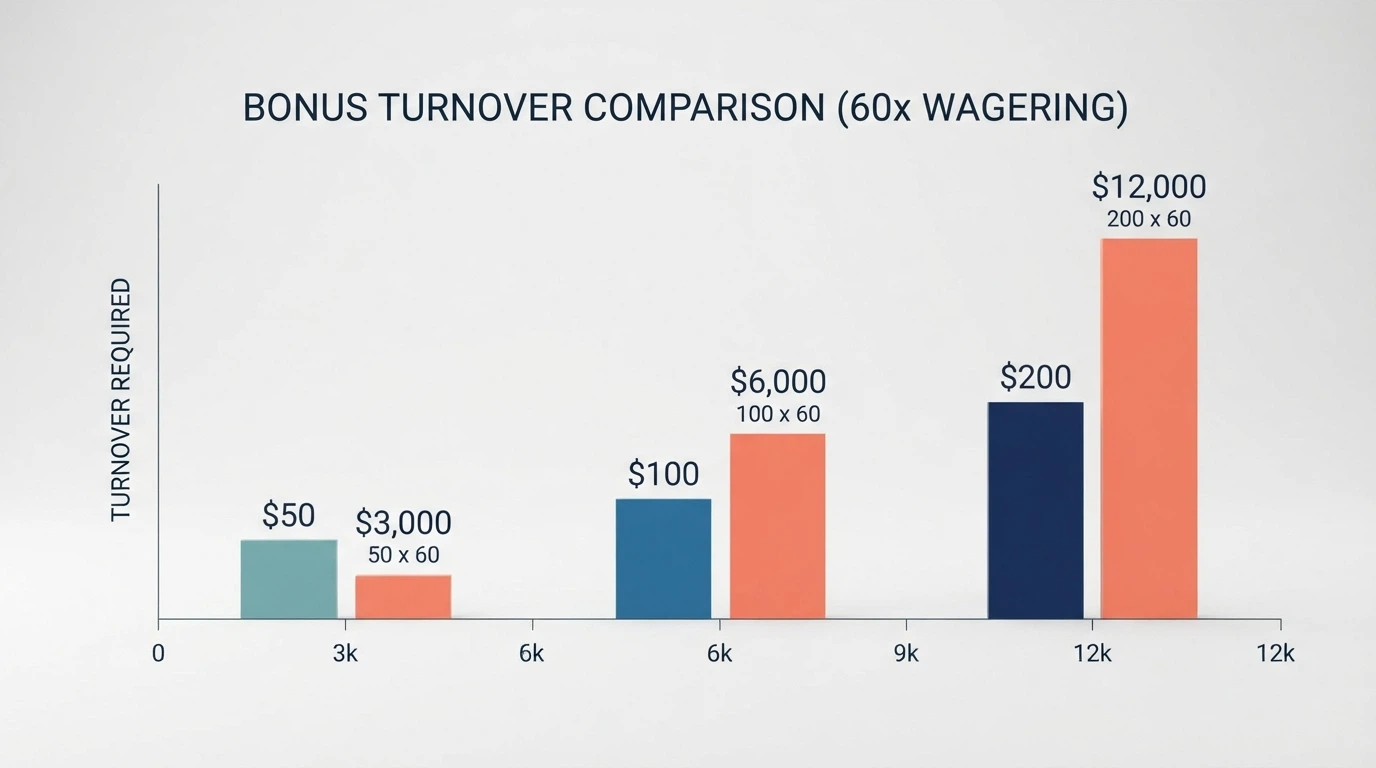
Wagering, playthrough and turnover are the same thing under three names, and they are the single most important clause in any bonus. The rule is: the bonus amount, multiplied by the wagering factor, equals the total amount the player must bet before any of the bonus balance converts to withdrawable cash. A $200 bonus at 60x wagering requires A$12,000 in total bets; at A$1.00 per spin on a pokie, that is 12,000 individual spins. Typical no-deposit wagering at Australian-facing sites runs from 20x to 60x, with the higher end of the range more common on cash chips and the lower end more common on free-spin winnings. Free-spin winnings often carry lower wagering — 20x to 30x is a common range — because they are a smaller, more conditional version of the same offer.
Maximum cashout is the ceiling on what a no-deposit bonus can actually pay. Many casinos restrict no-deposit winnings to an A$100 or A$200 maximum cashout, regardless of how much the player wins during bonus play. A player who runs a no-deposit balance to A$500 on a pokie and clears the wagering will, at a typical A$100 cashout cap, be paid A$100 and have the rest of the winnings voided. The cashout cap is the reason a cleared no-deposit bonus is worth less than its win amount, and it is the reason a no-deposit bonus is a trial of the platform, not a route to a payout.
Maximum bet during bonus play is the third cap. While a no-deposit bonus is active, the casino typically restricts each spin or hand to A$5 to A$10, and any bet above that limit can void the bonus and the winnings attached to it. The rule exists partly to slow bonus play and partly to prevent players from running a small balance to a large one in a single hand. Either way, the cap is enforced, and the player who ignores it loses the bonus.
Expiry is the simplest clause and the easiest to forget. No-deposit bonuses typically expire within 7 to 14 days, with some extending to 30 days. If the player does not clear the wagering inside the window, the bonus balance and any winnings attached to it are voided. The clock starts the moment the bonus is credited, and it does not stop for inactivity.
Game contribution is the weighting system that channels bonus play into pokies. Pokies count 100% toward wagering; table games count 10–20%; live dealer counts 0%. A player who tries to clear a no-deposit bonus by playing blackjack is betting ten times the amount they would need to bet on a pokie, and a player who tries to clear it on live dealer is not making any progress at all. The weighting is not a hidden rule, but it is the clause that determines which games are even worth playing with bonus money.
No-Deposit vs Welcome and Match Bonuses
The $200 bonus offer maps to three different bonus types, and they are not interchangeable. A no-deposit bonus is credited without a deposit; a welcome or sign-up bonus is credited after the first deposit; a match or percent bonus is a percentage of the deposit added to the player’s balance up to a cap. The three are often bundled into a single “welcome package” at offshore casinos, and the $200 headline figure is typically the sum of a no-deposit first slice, a first-deposit match, and a second or third deposit match.
A player who claims a “welcome bonus up to $200” and expects a $200 no-deposit chip will be disappointed at the cashier. A player who understands the offer is a package — A$10 to A$30 in no-deposit bonus, plus 100% match up to A$100 on the first deposit, plus reload credits on deposits two and three — has read the offer correctly. The honest description of a typical $200 package is a small no-deposit trial followed by a tiered deposit-match ladder, and the player’s real decision is how far up that ladder they intend to climb.
The distinction matters because the no-deposit slice is the only part that costs the player nothing to test. The deposit-match slice is the part the player pays for, and the bonus terms that apply to it are usually tighter in absolute terms (the same 40x wagering on a larger bonus is a larger turnover requirement, even at the same multiplier) and more carefully enforced.
Wagering, Playthrough and Turnover — The Numbers That Matter
The math of wagering is straightforward once the formula is in plain language. Required turnover equals the bonus amount multiplied by the wagering factor. A $200 bonus at 60x wagering means A$12,000 in total bets; the same $200 bonus at 30x means A$6,000. The number of spins to clear the bonus depends on the per-spin stake: at A$1.00 per spin, A$12,000 is 12,000 spins; at A$0.20 per spin, it is 60,000 spins.
The reason high wagering erases the bonus’s apparent value is that every spin has a house edge, and the more spins the player has to make, the more that edge compounds. A pokie with a 96% return-to-player has a 4% house edge, which means A$12,000 in spins costs the player an expected A$480 in losses before the bonus converts. The player who started with a $200 bonus and ends with a $200 cashout, after expected losses of $480 during the playthrough, has in fact paid to play — and the bonus has done its job for the operator, not the player.
The same arithmetic applies, scaled down, to smaller bonuses at lower wagering. A $50 no-deposit bonus at 20x wagering requires A$1,000 in turnover; at A$1.00 per spin, that is 1,000 spins and an expected loss of A$40. The bonus is still negative expected value for the player — every honest bonus is — but the size of the loss is small enough to be an acceptable cost for an hour of play, which is what the casino is selling.
Maximum Cashout, Bet Limits and Bonus Expiry
These three caps do most of the practical work of converting a bonus’s theoretical value into its actual payout.
The max cashout cap is the ceiling. Even a player who runs a small no-deposit balance to a large one during bonus play will be paid only the capped amount; the rest is voided. A typical A$100 cap on no-deposit winnings means a player who would otherwise have won A$400 receives A$100 and sees the remainder disappear. The cap is enforced, and it is the most common reason a “big win” on a no-deposit bonus pays less than the screenshot suggests.
The max bet cap is the throttle. A typical A$5 to A$10 ceiling on each spin or hand prevents the player from converting the bonus to withdrawable cash in a single high-stakes round. Any bet above the cap can void the bonus, which is why bonus play is a slow, low-stakes exercise rather than a quick one.
The expiry window is the deadline. A 7 to 14-day validity is the standard for no-deposit bonuses, with some offers extending to 30 days. The clock starts at credit and does not pause, so a player who lets the bonus sit idle for a week has used most of the available time before the wagering even begins. The expiry is the cap most likely to surprise a casual player, because the bonus is credited silently and the deadline is rarely announced.
Game Contributions — Why Only Pokies Count at 100%
The game contribution table is the structural reason a no-deposit bonus is, in practice, a pokie bonus. Pokies count 100% toward wagering, table games count 10–20%, live dealer counts 0%, and most progressive jackpots are excluded. A player who tries to clear a $200 no-deposit bonus on blackjack is betting A$10 toward wagering for every A$100 staked, which is the same as having a 1,000x wagering requirement instead of a 40x. A player who tries it on live dealer is not making any progress at all.
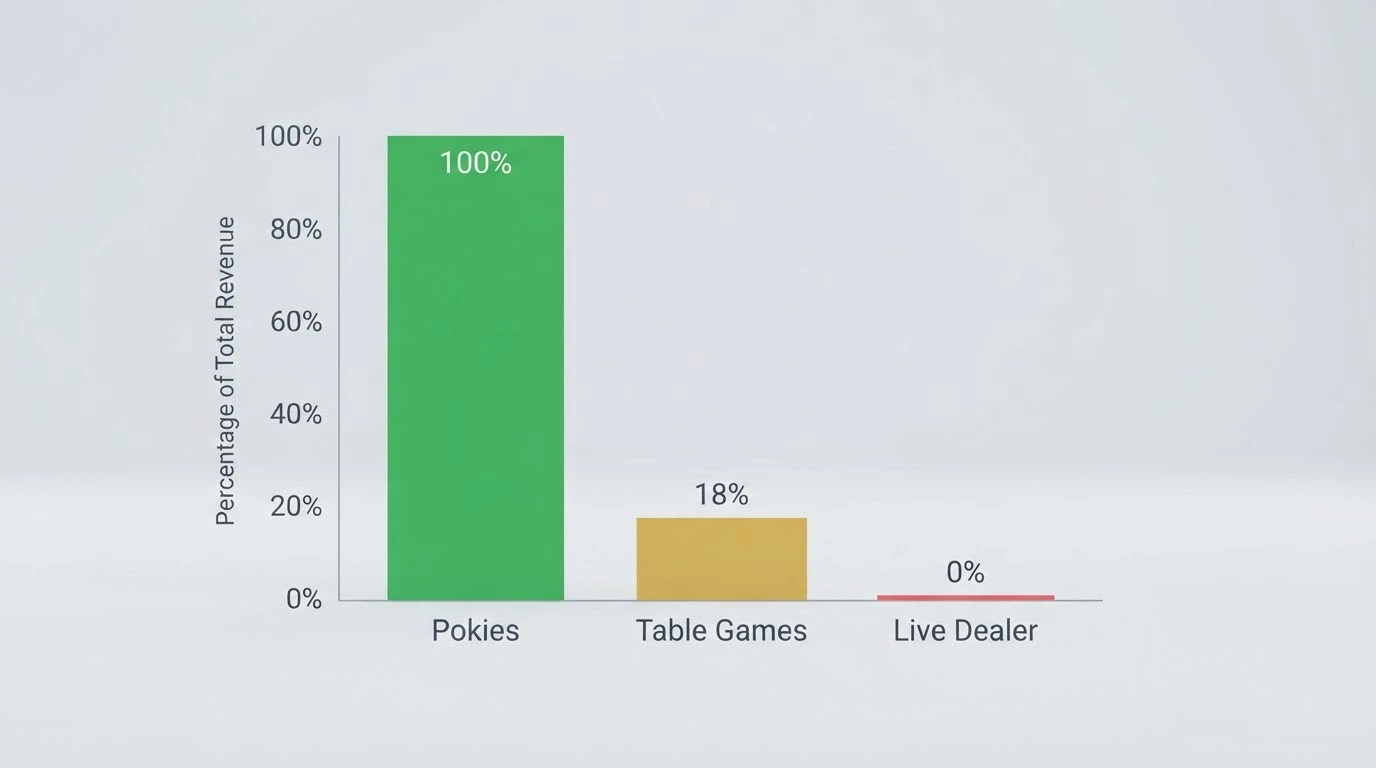
The weighting is not arbitrary. Pokies are the highest-margin product on an offshore casino’s floor, and the bonus structure is designed to channel the player’s required turnover through the games that return the least to the player. The casino is not being dishonest about the weighting — every bonus terms page lists it — but the design of the bonus assumes the player will not read that part carefully, and the design usually wins.
The practical reading is that a no-deposit bonus is only ever worth the time it takes to clear on pokies. On any other game type, the time cost is multiplied by ten or more, and the bonus is no longer worth the play.
Bonus Codes and How to Claim
A bonus code is a short alphanumeric string the player enters at registration or in the cashier to activate a specific offer. The string is supplied by the casino — usually in a promotional email, an affiliate page, or a banner ad — and it is the trigger that links the player’s new account to a particular promotion.
The claim flow at a no-deposit offer typically runs: register an account, verify contact details (email, sometimes a mobile phone number), enter the bonus code in the field provided, and the bonus credits to the account. Some offers skip the code and credit the bonus automatically; others require a deposit to be made before any part of the package is released, even if the headline says “no deposit”.
Codes expire and rotate, which is why the same operator can run several different “no-deposit” offers across the year, each tied to a different affiliate partner or a different promotional window. The code is also the mechanism an operator uses to attribute the new account to a particular marketing channel, which is why the same casino can be advertised under several bonus figures on different sites — the headline changes, the underlying bonus is the same, and the code is what the operator actually uses to identify the player.
The practical advice is to read the offer’s terms before entering any code, because the code is the player’s confirmation that they have accepted the bonus and its conditions. Opting out of a bonus after the code is entered is usually impossible.
PayID at AU Casinos — Instant Deposits, but Not a Safety Net
PayID is the Australian banking system’s instant-transfer layer, and it is the payment method most heavily advertised alongside no-deposit bonuses in the Australian market. The mechanism is real, the speed is real, and the connection to the casino is real — and none of that makes the casino licensed in Australia.

PayID is built on the New Payments Platform (NPP), the real-time interbank settlement system operated by Australian Payments Plus, and Osko, the NPP overlay that handles consumer-to-consumer and consumer-to-business transfers. As of 2026, more than 100 Australian financial institutions are connected to the NPP and support PayID. A PayID itself is an alias — an email address, a mobile phone number, or an Australian Business Number — that the customer’s bank maps to a BSB and account number behind the scenes. The customer no longer needs to enter the BSB and account number for a transfer; they enter the PayID, confirm the recipient’s name, and the transfer settles in seconds.
The casino deposit flow built on PayID is built for speed. PayID deposits at Australian-facing casinos credit within 60 seconds, with the underlying PayID transfer settling in 30 seconds to 2 minutes depending on the banks involved.
| Feature | Detail |
|---|---|
| Settlement Speed | Instant (30s – 2min) |
| Availability | 24/7 (incl. holidays) |
| Minimum Deposit | A$10 – A$20 |
| Minimum Withdrawal | A$30 – A$50 |
The transfer runs 24 hours a day, including weekends and public holidays, which is the structural reason PayID has replaced POLi and direct bank transfer for the AU-facing offshore market. The minimum deposit and the maximum are set by the casino, not the bank; the daily limit is set by the customer’s bank, with the major banks allowing default NPP limits well above any reasonable casino deposit — CommBank’s default daily NPP limit is A$20,000, and limits above A$100,000 are available on request.
The minimum withdrawal via PayID at an AU-facing casino is typically A$30 to A$50, and the processing time on a verified account is 5 to 30 minutes, with the best-run casinos paying out within 1 to 5 minutes. The withdrawal side is where PayID is genuinely better than the alternatives — a card withdrawal can take three to five business days, a bank transfer can take one to two, and a PayID withdrawal is, in the best case, faster than the player can refresh the cashier page.
The A$200 deposit amount referenced in the headline is a separate question from the A$200 no-deposit bonus, and they are not the same. A $200 deposit is the trigger for a first-deposit match at many offshore casinos — typically a 100% match, sometimes more, sometimes with a free-spin bundle attached — and it is the threshold at which the player moves from the no-deposit stage of the welcome package to the deposit-matched stage. What a $200 deposit actually unlocks depends on the operator’s match percentage, the cap, the wagering, and the game contribution; the round figure is the floor, not the ceiling.
PayID’s speed does not, however, make the receiving casino licensed, regulated, or connected to any Australian consumer protection. The deposit is instant, the withdrawal is fast, and the operator behind the cashier is still offshore, unlicensed, and outside the reach of BetStop, the ACMA and the Australian Financial Complaints Authority. A player who values speed of payment should use PayID; a player who values recourse if the operator refuses a withdrawal should use a licensed Australian wagering operator for any money they cannot afford to lose.
What PayID Is — NPP, Osko and How Australian Banking Powers It
The New Payments Platform is the real-time settlement layer that connects Australian banks, built and operated by Australian Payments Plus (the merged entity formed from BPAY Group, eftpos and NPP Australia). The NPP launched in 2018 and now connects more than 100 financial institutions, including the four major banks, most regional banks, most credit unions and most building societies. Settlements on the NPP happen in real time, which is the structural difference between PayID and the older direct-entry system that took one to two business days to clear.
Osko is the consumer overlay on the NPP. It is the product most Australians use when they send money via PayID — the transfer appears in the recipient’s account within seconds, with a 280-character optional message field. BPAY is the bill-payment overlay, also on the NPP, and is the layer most Australian-licensed wagering operators use to accept deposits from bank accounts.
The practical difference for a player is that a PayID transfer to a casino is the same kind of transfer as a PayID transfer to a friend. The funds leave the sender’s account in real time, the recipient’s bank confirms receipt in real time, and the transaction is final. There is no chargeback mechanism on a PayID transfer in the way there is on a card payment, which is one reason offshore casinos prefer it.
Depositing Into Casino and Pokies Sites With PayID
The deposit flow at an AU-facing casino runs: open the cashier, select PayID as the deposit method, the casino displays its PayID (an email address, a phone number or an ABN), the player opens their banking app, initiates a PayID transfer to that alias, confirms the recipient’s name matches, enters the deposit amount, and submits. The casino credits the deposit within 60 seconds in the normal case, faster at the best-run sites, and the funds are available for play immediately.
The amount a player can deposit via PayID is bounded by the casino on the low end and the player’s bank on the high end. Casino minimum deposits are typically A$10 to A$20; maximums vary by operator and are usually high enough that the binding constraint is the bank. CommBank’s default daily NPP limit is A$20,000, and limits of A$100,000 or more are available on request; the other major banks have comparable structures. A player who wants to deposit more than their default limit has to ask their bank to lift it, which is a process measured in days, not minutes.
The minimum withdrawal at the same casino is typically A$30 to A$50 — the same threshold that the deposit minimum is set just below, so a player who deposits A$20 cannot withdraw by PayID until the balance is over the withdrawal floor. The threshold is set by the casino, not by PayID, and it is one of the small places where the operator’s terms cost the player a small fee in the form of a leftover balance.
The A$200 Deposit Amount and What It Actually Unlocks
The “$200” headline is doing two jobs, and a player who is comparing offers needs to separate them. A $200 no-deposit bonus is a free credit of A$200 to the account, with the wagering and cashout terms described above — an offer that, in standalone form, essentially does not exist in the Australian market in 2026. A $200 deposit is a cash transfer the player makes to the casino, which triggers the first-deposit match and the rest of the welcome package.
What a $200 deposit actually unlocks depends on the operator’s match terms. A 100% match up to A$200 turns a $200 deposit into a $400 starting balance; a 50% match up to A$200 turns the same deposit into a $300 balance. The match is bonus money, with wagering requirements, and the same game-contribution and max-cashout caps that govern the no-deposit slice of the package. The deposit itself is real money, withdrawable at any time subject to the casino’s terms, but the match attached to it is bonus money and behaves like any other bonus.
The honest reading is that a $200 deposit is the threshold at which the player moves from the free-trial stage of an offshore casino to the paying-customer stage, and the rest of the welcome package — the reloads, the second and third deposit matches, the loyalty credits — is built to keep the player there. The bonus value the player walks away with depends less on the headline match percentage than on the wagering, the game contribution and the max cashout on each tier of the package.
10 Offshore Casinos Accepting Australian Players in 2026
Every operator on this list is an offshore brand serving Australian players from a licence jurisdiction outside Australia. The Australian Communications and Media Authority has blocked more than 1,500 illegal gambling and affiliate websites since November 2019, and 225 or more services have withdrawn from the Australian market since 2017. None of the operators below holds an Australian casino licence, because no such licence exists — online casino games and online pokies are prohibited products under the Interactive Gambling Act 2001. None of them is connected to BetStop, the National Self-Exclusion Register. The table summarises the legal status of each; the write-ups that follow note the bonus data confirmed for that operator and, where research could not verify terms this round, state that fact plainly.
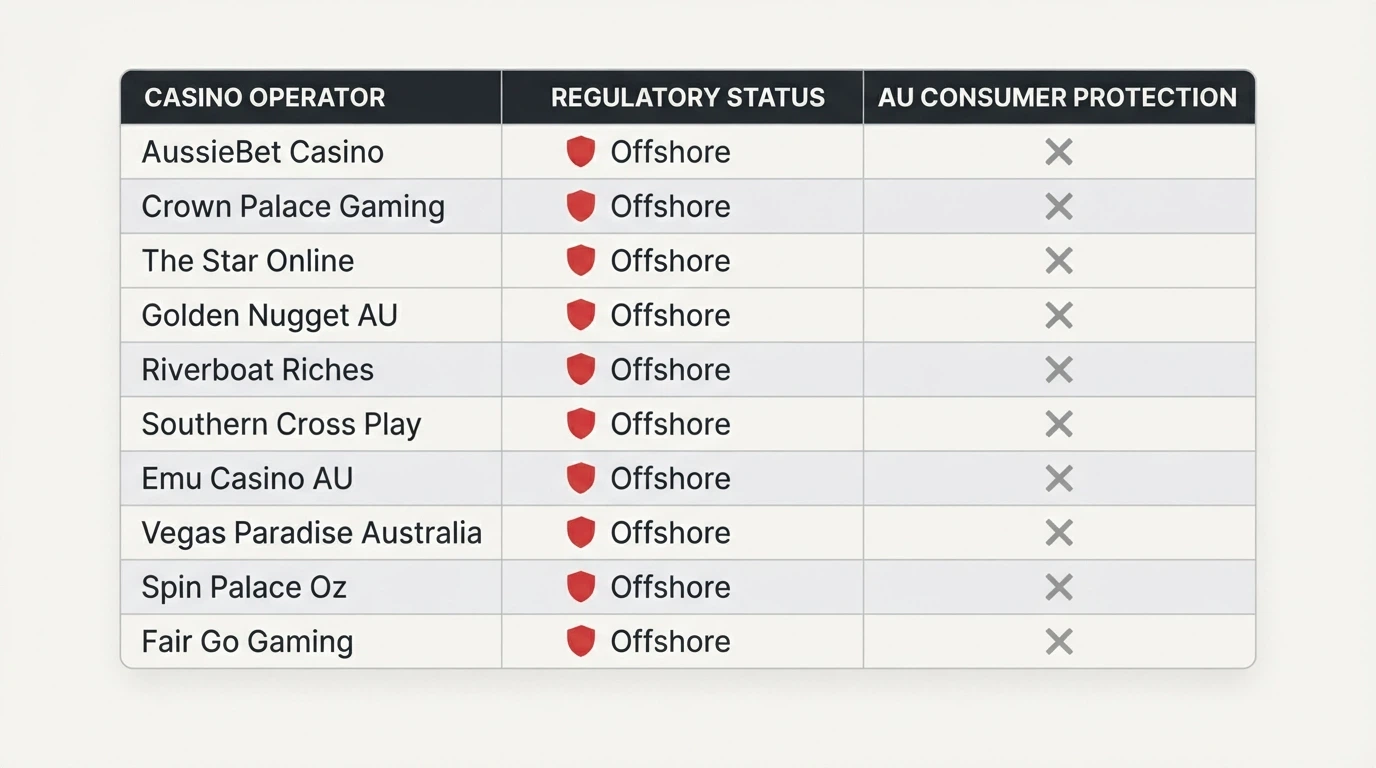
| Operator | Legal Status in Australia | BetStop Coverage |
|---|---|---|
| Rocket Play | Offshore — no Australian casino licence | Not covered |
| Skycrown | Offshore — no Australian casino licence | Not covered |
| Royal Reels | Offshore — no Australian casino licence | Not covered |
| WinSpirit | Offshore — no Australian casino licence | Not covered |
| Stake | Offshore — no Australian casino licence | Not covered |
| Rainbet | Offshore — no Australian casino licence | Not covered |
| Scream Casino | Offshore — no Australian casino licence | Not covered |
| FairGO | Offshore — no Australian casino licence | Not covered |
| Bizzo Casino | Offshore — no Australian casino licence | Not covered |
| Rocket Casino | Offshore — no Australian casino licence | Not covered |
The table is honest in one direction and silent in another. Every cell in the “Legal Status in Australia” column reads the same way because every operator on the list is in the same legal position, and a column that says the same thing ten times is doing the work of a single statement. The column exists because a reader comparing operators needs to see the sameness at a glance, not because each row is telling a different story. The “BetStop Coverage” column carries the same one-direction information — every offshore casino sits outside the register, and the reason is structural, not operator-specific.
A note on what the table is not. The table does not rank the operators by bonus generosity, payout speed, game selection, or any other measured criterion, because no such measurement was confirmed for this set in the research window. The ranking orders the operators by fit to the bonus-focused topic — market reach among AU players, then by the depth of bonus information available — and a reader who reads the table as a quality ranking is reading past the data. The market-share figures that informed the ordering are not published here; they are background context for the editorial decision about which operators to include, not a per-brand metric a reader is being asked to act on.
Rocket Play
Rocket Play is the largest-reach offshore brand serving Australian players in the market-share data behind this page, and the operator most likely to appear in the ads a casual punter sees for “no-deposit” offers. It is an offshore operator with no Australian casino licence, because no such licence exists for any online casino in Australia. The product it offers — online casino games, online pokies — is a prohibited interactive gambling service under the Interactive Gambling Act 2001, and the ACMA has the power to direct Australian ISPs to block the domain at any time.
Rocket Play is among the larger offshore brands available to Australians. Like all operators here, it operates without an Australian casino licence and outside the protections of BetStop or Australian consumer law. The operator’s site structure follows standard offshore welcome-package protocols. Because bonus specifics for this operator were not documented this run, review all relevant terms directly on the site before opening an account.
Skycrown
Skycrown is an offshore casino serving Australian players, and it is the one operator on this list for which a no-deposit offer is confirmed in the research behind this page. The offer is 100 free spins credited on registration, with the condition that the player verifies a mobile phone number before the spins are released. There is no deposit required to claim the free spins; the verification is the trigger.
The 100 free spins are a bonus, and they sit behind the same terms any no-deposit offer sits behind. Wagering requirements apply to whatever the spins win; the wagering multiplier on free-spin winnings at offshore casinos typically runs 20x to 30x, lower than the 50x to 80x more common on cash no-deposit chips. The max cashout on free-spin winnings is typically capped — A$100 to A$200 is a common range — and the bonus will expire within the standard 7 to 14 day window. None of those specific figures were confirmed for Skycrown in the research behind this page; the player should read the offer terms at the cashier before claiming.
For a player who is comparing no-deposit offers, Skycrown is the operator on this list for which the no-deposit slice of the offer is a real, confirmed data point. The dollar value of the spins depends on the game they are issued on and the per-spin stake; 100 spins at A$0.10 per spin is A$10 of real play, not A$100. The wagering and cashout terms attached to those winnings are the numbers that determine what the player walks away with, and they are terms a player should check before claiming.
Royal Reels
Royal Reels is an offshore casino with an Australian-facing brand — the name, the marketing, the visual language of the site are all positioned at an Australian audience. The product is the standard offshore offering: online pokies, table games, live dealer, a welcome package built on a no-deposit or free-spin slice followed by a deposit-match ladder. No Australian casino licence is held, because none exists; the operator sits outside the reach of BetStop, ACMA enforcement and Australian consumer protection.
Specific bonus terms for Royal Reels were not documented here; check the operator’s current terms directly at the cashier. The “Royal Reels” brand and the AU-targeted positioning are what distinguish it from the rest of this list, and they are a marketing choice, not a regulatory one. A player who values an Australian-branded product over a globally-marketed one is choosing the brand, not the licence status — the legal position is the same.
For a player who is choosing on branding alone, Royal Reels is the AU-positioned brand on this list. The casino’s payout speed, the wagering on its welcome offer, the max cashout and the game contribution table are all things a player has to check before committing. The general offshore package structure applies, and the same off-Australian dispute resolution applies if the operator refuses a withdrawal.
WinSpirit
WinSpirit is a mid-reach operator serving Australian players. As with all sites on this list, it is unlicensed in Australia and outside the scope of BetStop or local consumer protections. The operator provides a standard offshore suite of pokies, table games, and live dealer options. Verify all bonus wagering and cashout terms directly at the cashier before playing, as these specifics were not documented this run.
Stake
Stake is one of the larger international crypto-focused casino and wagering brands, and it operates offshore to Australian players under a Curaçao licence. The Curaçao licence was not independently confirmed in the research behind this round of the page, and a player who needs to verify the licence should check the footer of Stake’s site for the licence number and the regulator’s name. The operator has no Australian casino licence, because none exists; Stake’s product is a prohibited interactive gambling service under the IGA, and the operator sits outside the reach of BetStop and Australian consumer protection.
The defining feature of Stake compared to the rest of this list is its cryptocurrency focus. Bitcoin, Ethereum and other major cryptocurrencies are the primary deposit and withdrawal rails, and the operator’s bonus structure is built around that. Australian-licensed wagering has had credit cards, credit-related products and digital currency banned as payment methods since 11 June 2024, which means a player who values crypto rails is by definition playing with an offshore operator.
For a player who specifically wants a crypto-native casino and accepts the offshore position, Stake is the largest international brand on this list. The legal position is the same as every other operator here, and the licence, the bonus terms, and the payout speed are all things a player has to check at the cashier. The crypto focus is the brand distinction; it is not a regulatory distinction.
Rainbet
Rainbet is a mid-reach site serving Australian players with a typical offshore selection of pokies, table games, and live dealer games. Like all operators featured here, it operates without an Australian licence and is not subject to BetStop or Australian consumer laws. Always read the site’s terms regarding wagering and payouts before committing.
Scream Casino
Scream Casino is a lower-reach offshore operator providing a standard selection of pokies and table games. As an unregulated service in Australia, it lacks BetStop integration and local consumer protections. Players should perform their own due diligence on bonus terms, as specifics were not available for this review. Compared to higher-reach alternatives, Scream Casino offers a similar offshore structure without the added stability of a larger market presence.
FairGO
FairGO uses the RealTime Gaming (RTG) platform and focuses on the Australian market, though it is an offshore operator lacking an Australian licence, BetStop coverage, or local consumer protections. Verify all bonus terms and payout conditions at the cashier before playing.
Bizzo Casino
Bizzo Casino provides a standard offshore selection of slots and live dealer games. It operates without an Australian licence and is not covered by BetStop or local consumer law. If you decide to play here, ensure you fully understand the site’s wagering requirements and cashout limits, as these were not verified this run. For a site with lower market presence, you may find better stability at larger, more established alternatives.
Rocket Casino
Rocket Casino is distinct from Rocket Play, sharing only a similar name. It is an offshore provider without an Australian licence or BetStop integration. As with other offshore options, it sits outside the scope of local consumer laws. Players should verify all conditions on the site, as bonus specifics were not confirmed this run. Treat this as an independent site and confirm you are accessing your intended destination.
Online Casino and the Law in Australia — What the IGA Actually Says
The legal position is the frame the rest of the page sits inside, and the legal position is that the product is banned. The Interactive Gambling Act 2001 makes it an offence to provide online casino games, online pokies or in-play betting to a person in Australia. There is no licence for online casino anywhere in the country — not federally, not in any state or territory. The Australian Communications and Media Authority is the regulator that enforces the prohibition, and the enforcement has been substantial: 1,564 sites blocked since November 2019, more than 225 services withdrawn from the Australian market since 2017.
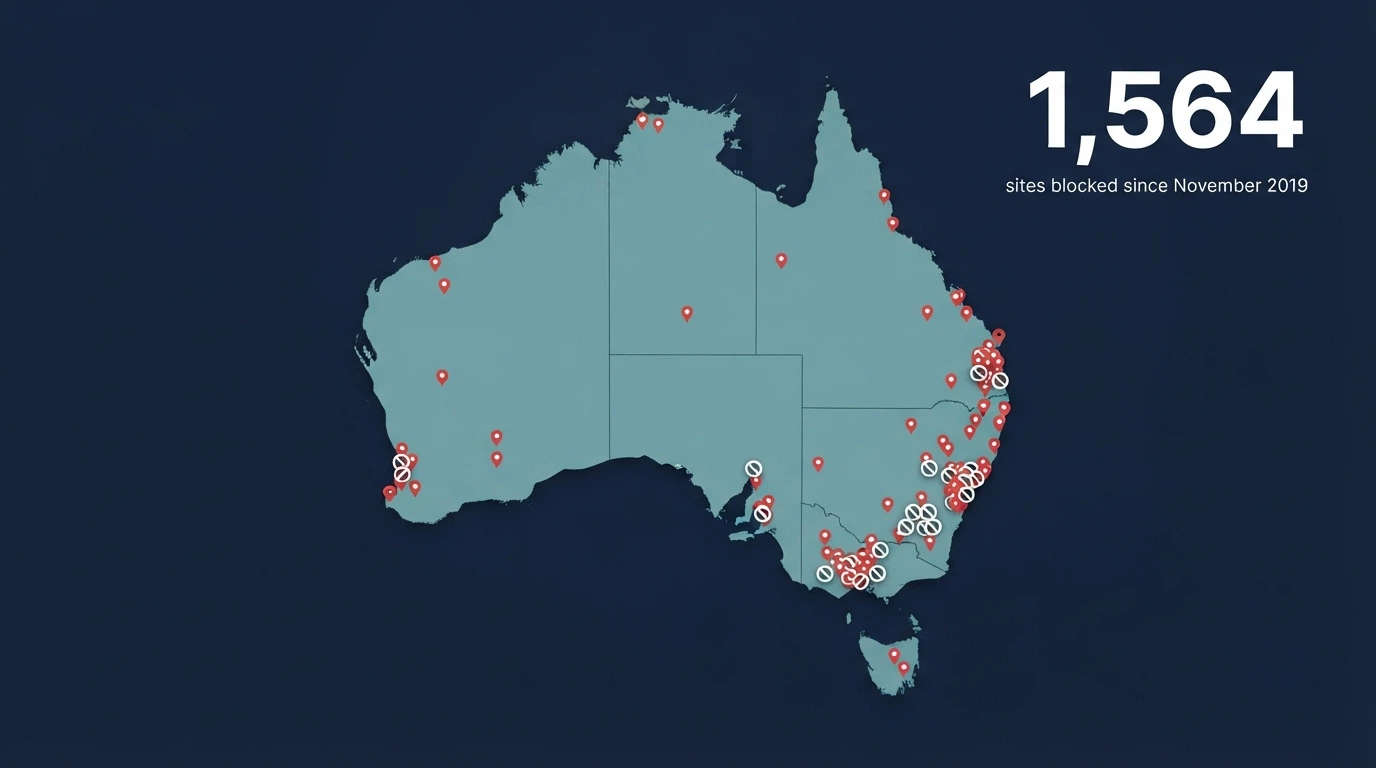
The Interactive Gambling Act 2001 is the central statute. It prohibits the provision of online casino games, online pokies and in-play betting to Australian customers. Wagering on races and sport before the event is licensable through state and territory regimes (the Northern Territory Racing and Wagering Commission, administered through Licensing NT, is the de facto national licensor for large online bookmakers). Lotteries and keno are licensable at state level. Online casino is not. The 2017 amendments to the IGA closed the offshore loopholes that had allowed operators to claim they were not “providing” a service to Australians, and they gave the ACMA formal blocking and enforcement powers.
The ACMA’s enforcement record is the proof that the prohibition is real. The regulator has directed Australian ISPs to block 1,564 illegal gambling and affiliate websites since November 2019. More than 225 illegal services have withdrawn from the Australian market since the 2017 amendments took effect. The penalty regime under the IGA is A$1.65 million per day for corporations and A$220,000 per day for individuals — fines that target the operator, not the player. A player using an offshore casino is not prosecuted under the IGA, but the site they are using is operating illegally, and the site can be blocked at any time with a balance on the player’s account.
The 2026 reform is the next chapter. The Interactive Gambling Amendment (Gambling Reform) Bill 2026 passed Parliament on 19 August 2026, and its measures commence on 1 January 2027. The changes include: advertising caps (3 wagering ads per hour between 6 am and 8:30 pm, with a live-sport blackout from 15 minutes before to 5 minutes after live events); a ban on athletes, celebrities and influencers promoting wagering; inducement marketing freezes (14 days after sign-up, 3 months after BetStop deregistration, indefinitely for at-risk customers); and, most relevant to offshore casinos, express authority for banks and payment providers to block transactions to illegal gambling operators. The bank-blocking power is the structural change that will most affect offshore casino deposits and withdrawals from Australian accounts.
What the law means for the individual player is a different question from what it means for the operator. The IGA targets the provider; the player is not prosecuted, and the ACMA’s enforcement focus is on the operator, not the user. But “not illegal for you” is not the same as “safe”. A player who uses an offshore casino forfeits every Australian consumer protection: no BetStop coverage (the self-exclusion register binds only the ~150 licensed Australian wagering providers, not offshore casinos), no recourse to the Australian Financial Complaints Authority, no ombudsman service, no guarantee that the operator will pay a withdrawal, and no protection if the site is blocked mid-session. The credit card and crypto ban that took effect on 11 June 2024 is a tell in the other direction: a casino asking an Australian player to deposit via credit card or crypto is being served by an offshore operator outside the Australian rules.
Offshore licences are not Australian licences. The offshore casinos serving Australian players are typically licensed in Curaçao or Anjouan — jurisdictions that offer basic consumer protection (KYC, dispute processes, anti-money-laundering rules) but at a slower and less rigorous standard than Australian ombudsman services. A Curaçao-licensed casino has a regulator, a licence number, and a process for filing a complaint; what it does not have is the same enforcement weight as an Australian regulator, and a player who escalates a dispute through Curaçao can expect months rather than weeks for resolution. The offshore licence is a real but thinner layer of consumer protection, and it is the only layer that applies to the operators on this list.
The Interactive Gambling Act 2001 — What It Prohibits
The IGA 2001 prohibits the provision of online casino games, online pokies and in-play betting to a person in Australia. The statute does not prohibit the player from accessing these services — it prohibits the operator from providing them. The distinction is structural, and it is the reason the ACMA’s enforcement record is measured in blocked sites and withdrawn services rather than prosecuted players.
The 2017 amendments closed the offshore loopholes that had allowed operators to argue they were not “providing” a service to Australians because the service was technically offered from another jurisdiction. The amendments also gave the ACMA formal blocking powers, which the regulator used first in November 2019 and has used consistently since. The product the IGA prohibits is specific: online casino games (slots, table games, live dealer) and in-play betting. Wagering on races and sport before the event is licensable through state and territory regimes and is the only online gambling product that holds a legitimate Australian licence.
The licensed anchor in Australia is the wagering operator. The Northern Territory Racing and Wagering Commission, administered through Licensing NT, is the de facto national licensor for large online bookmakers — Sportsbet, Ladbrokes, Bet365, and the rest of the licensed wagering market. These operators offer sports and racing wagering, not casino games. A reader who is looking for a licensed Australian alternative to an offshore casino is looking for a product that does not legally exist in Australia.
ACMA Enforcement — Site Blocking, Penalties and the 2026 Reform
The ACMA is the federal regulator that enforces the online gambling prohibition. Its powers include investigating complaints, issuing formal warnings, bringing civil penalty proceedings, referring operators for enforcement, and directing Australian ISPs to block illegal sites. The blocking power is the regulator’s most visible tool: 1,564 sites blocked since November 2019, and the list grows each quarter.
The penalty regime is set by the IGA itself. Providing a prohibited interactive gambling service to a person in Australia carries penalties of up to A$1.65 million per day for corporations and A$220,000 per day for individuals. The penalties target the operator, not the player, and the regulator’s enforcement record reflects that focus. The 225 or more services that have withdrawn from the Australian market since 2017 are operators that have made the business decision that the Australian market is not worth the regulatory risk; they are not operators that have been fined into submission.
The 2026 reform is the most significant change to the IGA since 2017. The Interactive Gambling Amendment (Gambling Reform) Bill 2026 passed Parliament on 19 August 2026, and its measures commence on 1 January 2027. The changes most relevant to offshore casinos are: the express authority for banks and payment providers to block transactions to illegal gambling operators, which will give Australian banks a direct role in stopping deposits to and withdrawals from offshore casinos; the inducement marketing freezes that will constrain how licensed Australian wagering operators can market bonuses; and the advertising caps and influencer ban that will reshape how wagering is promoted in Australia. The bank-blocking power is the change that will most directly affect an offshore casino’s relationship with Australian players.
What the Law Means for You as a Player
The IGA does not target the player. The statute’s penalties are aimed at the operator, and the ACMA’s enforcement record is a record of blocked sites and withdrawn services, not prosecuted players. A player who uses an offshore casino is not committing an offence under the IGA.
What the player does commit to, by choosing an offshore casino over a licensed Australian wagering operator, is the forfeiture of every Australian consumer protection. The offshore casino is not connected to BetStop — the National Self-Exclusion Register binds the ~150 licensed Australian wagering providers, and an offshore casino is not on the list. A player who has self-excluded through BetStop and then plays at an offshore casino is not violating the BetStop terms (BetStop only binds the licensed operators), but they have also not been excluded from the offshore casino, and the offshore casino will keep taking their money. The player has no recourse to the Australian Financial Complaints Authority if the offshore operator refuses a withdrawal, no ombudsman service to escalate to, and no guarantee that the site will be online next week. The site can be blocked by the ACMA at any time, and a balance in the account at the moment of blocking is a balance the player may not be able to recover.
The credit card and crypto ban is a useful tell. Since 11 June 2024, credit cards, credit-related products and digital currency have been banned as payment methods for online wagering in Australia. A casino asking an Australian player to deposit by credit card or by cryptocurrency is being served by an operator outside the Australian rules — the payment method is itself a signal that the site is offshore and unlicensed. A licensed Australian wagering operator accepts debit card, bank transfer, PayID and BPAY; nothing else.
Offshore Licences — Curaçao, Anjouan and What They Actually Cover
Most $200 no-deposit offers available to Australian players come from Curaçao-licensed sites, and Anjouan is the other common offshore jurisdiction. Both jurisdictions issue licences to online casino operators, both require KYC and anti-money-laundering compliance, and both have a regulator and a dispute process. What they do not have is the same enforcement weight as the ACMA, and a player who escalates a complaint through Curaçao or Anjouan can expect a slower process than the same complaint would get from an Australian ombudsman.
The basic consumer protection an offshore licence offers is real: the operator has to identify its customers, hold player funds in some form of segregated account, and respond to complaints through the regulator’s process. The thinner part of the protection is in the enforcement: a Curaçao-licensed operator that refuses a withdrawal can be pursued through Curaçao’s regulator, but the practical leverage an Australian player has over a Curaçao-based business is limited. A player who weighs the choice between an offshore casino with a Curaçao licence and a licensed Australian wagering operator should weigh it knowing that the offshore licence is a thinner layer of protection, not an equivalent one.
Responsible Gambling — Help That Works and Numbers That Hit Home
The harm is real and the help is concrete, and both belong on the same page as a $200 no-deposit bonus. The numbers below are Australian figures, drawn from Australian research bodies, and the services are Australian services that a player can contact today.

BetStop, the National Self-Exclusion Register, launched on 21 August 2023. As of 31 March 2026, 59,830 people had registered to self-exclude, of whom 37,247 had active exclusions. Seventy-eight per cent of registrants were under 40, and 38% chose lifetime exclusion. The register binds approximately 150 licensed online and phone wagering providers in Australia. It does not bind offshore casinos, and that gap is the structural reason the rest of this page’s responsible-gambling section is more than a BetStop link.
Awareness of BetStop is the second gap. Only one in three wagerers (33.5%) know the register exists, and only around one in four Australian adults (26.5%) are aware of it. The awareness is lowest among 18–35 year olds, the same group with the highest at-risk gambling prevalence. A self-exclusion tool that the people most likely to need it have never heard of is a tool that is not doing the work it could.
The prevalence of gambling harm in Australia is the number that makes the rest of this section non-optional. An estimated 3.32 million Australians (15.1% of the adult population) are experiencing some level of gambling harm — 13.0% (2,857,000 people) from their own gambling and 5.4% (1,177,000) from other people’s gambling. Approximately 2.1% of adults (~430,000 people) experience problem gambling, and an estimated 1,970,000 Australian adults are classified as having at-risk or problem gambling. The annual health loss associated with gambling-related harm in Australian adults is estimated at over 400,000 Years Lived with Disability. On average, gamblers at the highest risk levels affect six other people — partners, children, family members, friends, colleagues.
The help infrastructure is concrete and Australian. The National Gambling Helpline is 1800 858 858, free, confidential, staffed 24/7, with online chat and counselling through Gambling Help Online. BetStop registration is at betstop.gov.au. State-based face-to-face counselling services operate in every state and territory. The 1,564 sites the ACMA has blocked and the 225 services that have withdrawn from the Australian market are the regulator’s contribution to harm reduction; the helpline, the register, and the counselling services are the services a person in harm can use directly.
BetStop — The National Self-Exclusion Register and What It Covers
BetStop is the National Self-Exclusion Register, a federal register that lets a person exclude themselves from every Australian-licensed online and phone wagering service in a single registration. The register launched on 21 August 2023 and is administered by the ACMA. Registration is free, can be done online at betstop.gov.au, and the exclusion period can be set from three months to a lifetime.
The numbers behind BetStop are the proof of the demand. As of 31 March 2026, 59,830 people had registered to self-exclude, of whom 37,247 had active exclusions. The age profile skews young: 78% of registrants are under 40, and 38% have chosen lifetime exclusion. The most common exclusion period among the under-40 group is the longer end of the available range, which is consistent with the broader pattern of at-risk gambling prevalence skewing younger.
The structural limit of BetStop is what it does not cover. The register binds approximately 150 licensed online and phone wagering providers — the Australian licensed market. An offshore casino is not connected to BetStop, and a person who has self-excluded through BetStop can still deposit and play at any offshore casino on this list. The offshore casino is not breaking BetStop (BetStop’s terms bind the licensed operators, not the player and not the offshore operator), but the offshore casino is also not honouring the exclusion. The gap is the reason BetStop is one tool among several, not a complete solution.
The awareness gap is the other limit. Only 33.5% of wagerers and 26.5% of Australian adults are aware BetStop exists. The group most likely to be experiencing gambling harm — 18 to 35 year olds — is the group least likely to know the register is available. A self-exclusion tool that the people who need it most have never heard of is a tool that is not doing the work it could, and the awareness gap is the single biggest gap in Australia’s responsible-gambling infrastructure.
Deposit Limits, Activity Statements and Take-a-Break Tools
Australian-licensed wagering operators are required to offer customer-set deposit limits, activity statements and take-a-break or time-out tools under state and territory conditions. The conditions vary by jurisdiction — there is no single national standard — but the broad requirement is consistent across the country: a licensed operator must let a customer set a deposit limit, must produce an activity statement showing the customer’s betting history, and must offer a way for the customer to take a break from the platform.
These tools exist on the licensed side of the market, and they do not exist on the offshore side. An offshore casino is not required to offer deposit limits, not required to produce activity statements, and not required to provide a take-a-break function. A player who has set a deposit limit on a licensed Australian wagering account and then plays at an offshore casino has, by definition, stepped outside the system the deposit limit was designed to constrain. The offshore casino’s own responsible-gambling page may offer similar tools, but the tools are voluntary, and the operator’s incentive to enforce them is lower than the regulator’s.
The practical implication is that a player who is using harm-minimisation tools — a deposit limit, a session timer, a time-out — is better served by a licensed Australian wagering operator than by an offshore casino. The offshore casino can offer the same tools, but the licensed operator is required to, and the requirement is enforced.
Australia’s Gambling Harm in Numbers
The prevalence data is the part of the page a reader cannot argue with. An estimated 3.32 million Australians — 15.1% of the adult population — are experiencing some level of gambling harm. 2,857,000 are harmed by their own gambling, and 1,177,000 are harmed by someone else’s. Approximately 2.1% of adults (~430,000 people) experience problem gambling, and the AIHW put high-risk gambling at 1.8% in 2022. An estimated 1,970,000 adults are classified as having at-risk or problem gambling, and approximately 1,381,000 adults are affected by another person’s gambling.
The health-system cost is in the same order of magnitude. The annual health loss associated with gambling-related harm in Australian adults is estimated at over 400,000 Years Lived with Disability. The cost is not abstract: it is years of life lived with the consequences of gambling harm, and it is concentrated in the same age group most heavily exposed to offshore casino marketing.
The social cost is the figure most often left out. On average, gamblers at the highest risk levels affect six other people. A problem gambler is not a single person in a single household; they are a node in a network, and the harm radiates outward. Partners, children, parents, friends, colleagues, employers — the affected count grows faster than the prevalence figure suggests, because the affected count is per problem gambler, not per gambler.
Where to Get Help — Helplines, Counselling and Online Support
The National Gambling Helpline is 1800 858 858. The line is free, confidential, staffed 24 hours a day, and operates nationwide. Online chat and email counselling are available through Gambling Help Online at gamblinghelponline.org.au. BetStop registration is at betstop.gov.au. State and territory face-to-face counselling services operate in every jurisdiction, and the national helpline can refer a caller to the local service.
These services are designed to be used. They are free, confidential, and reachable without identifying yourself beyond what the helpline needs to route the call. A player who is reading this page and recognising their own behaviour in the numbers above is a player the helpline is built for. A partner, a parent, or a friend of a player in harm is also a caller the helpline is built for, because the six-other-people figure cuts in every direction.
The 1 January 2027 changes will add the AdStop register and the bank-blocking powers to the harm-minimisation toolkit, but the help lines and the counselling services are available now, before any reform takes effect.
How We Evaluate and Rank AU-Facing Casinos
The operators on this page are the AU market-share shortlist of offshore casino brands that actually reach Australian players. They were checked against the ACMA’s framework for licensed online gambling services, against the Interactive Gambling Act 2001’s prohibition on providing online casino to Australians, and against the BetStop register of bound operators. The first check found that none of the operators holds an Australian casino licence, because no such licence exists; the second confirmed that the product each operator offers is a prohibited interactive gambling service under the IGA; the third confirmed that none of the operators is connected to the National Self-Exclusion Register.
The criteria applied to the comparison were the criteria the research behind this page could verify: legal status in Australia, bonus terms where confirmed in the research, payment method support, and the licence jurisdiction of each operator. Where research could not confirm a specific figure — a wagering multiplier, a max cashout, a free-spin bundle — that absence is on the page as an absence, not as a fabricated number. A column of unverified values is a column of invented values, and the table above uses the article-language no-data marker where research did not confirm a figure.
The ranking orders the operators by fit to the bonus-focused topic, not by a scored metric. The fit ordering is informed by the AU market-share data (which gives a sense of which operators actually have Australian accounts), by the depth of bonus information available in the research, and by the structural features of each operator (the AU-branded positioning, the RTG software backbone, the crypto focus). The ranking does not weigh payout speed, game selection, or bonus generosity, because no consistent measurement of those criteria was confirmed for this set in the research window. A reader who reads the ranking as a quality ranking is reading past what the data supports.
The page is built to be read alongside the ACMA’s website, the BetStop register, and the bonus terms of any individual operator. None of those three sources is a substitute for the others, and the page’s job is to set the frame, not to replace any of them.
What You Should Actually Do With a $200 No-Deposit Bonus Offer
The honest conclusion of the page is the conclusion the research supports, and the research supports a few specific points that a player can act on.
First, a standalone $200 no-deposit bonus, where the full amount lands in the account with no deposit required, is not a product that exists in any reliable form in the Australian market in 2026. The closest available offers cap out in the A$50 to A$100 range, and even those are exceptional. The advertised $200 is a combined package value — a no-deposit slice, a free-spin bundle, a first-deposit match, reload bonuses, loyalty credits — and the player’s real exposure is to the whole package, not the headline slice. The realistic cap on what a no-deposit bonus can pay, even after wagering is cleared, is A$100 to A$200, because most no-deposit winnings are subject to a max cashout cap in that range.
Second, every operator offering a $200 no-deposit bonus to an Australian player is an offshore brand. None of them holds an Australian casino licence, because no such licence exists. None of them is connected to BetStop. None of them is subject to ACMA enforcement in the way a licensed operator is. The penalty regime under the IGA targets the operator, not the player, so the player is not at legal risk — but the player is at the kind of consumer risk that comes from being outside every Australian protection. A site can be blocked with a balance on the account. A withdrawal can be refused. A dispute can be filed through a Curaçao or Anjouan regulator and resolved in months rather than weeks. The “free” in “no deposit” is the price of admission, not the cost of the relationship.
Third, the bonus is a trial, not a payday. The 7 to 14 day expiry, the 20x to 60x wagering, the A$5 to A$10 bet cap, the pokies-only game contribution — these are the terms the player agrees to when they enter the bonus code, and the terms are what determine the real value. A $200 no-deposit bonus with 60x wagering is a bonus that costs the player an expected A$480 in playthrough losses before the cashout cap of A$100 or A$200 is reached. The player who reads the bonus as a free hour of play has read it correctly; the player who reads it as a route to a payout has read it wrong.
Fourth, if a player is going to engage with an offshore casino — and that is the player’s call, not the page’s — the practical advice is to set a personal deposit limit, a personal time limit, and a personal loss limit before the first spin. The licensed Australian wagering market’s deposit limits and activity statements are not available on the offshore side, so the player has to set their own. The National Gambling Helpline (1800 858 858) and Gambling Help Online are free, confidential and available 24/7, and the BetStop register is the tool that will exclude the player from every Australian-licensed wagering service. None of those tools is a substitute for the player’s own decision, and the tools are most useful when the player uses them before the moment they would otherwise have needed them.
The page’s central claim is the one the numbers support: a $200 no-deposit bonus in Australia is a marketing figure, not a payout, and the reader who knows the difference has read the page for the right reason.
Frequently Asked Questions
Is a $200 no deposit bonus real at Australian online casinos?
A standalone $200 no-deposit bonus, where the full amount lands in a new account with no deposit required, is exceptionally rare in the Australian market in 2026. The realistic cap on a no-deposit offer sits in the A$50 to A$100 range. Most $200 headlines are combined package values built from a small no-deposit chip, free spins, a deposit match, and reload credits. The no-deposit slice of the package is usually A$10 to A$30.
What is the maximum I can withdraw from a no deposit bonus in Australia?
Most no-deposit bonuses carry a max cashout cap of A$100 to A$200, regardless of how much the player wins during bonus play. The cap is enforced, and any winnings above the cap are voided when the player requests a withdrawal. The cap is set in the bonus terms and applies regardless of the wagering being cleared.
Is it legal to play at online casinos in Australia?
The Interactive Gambling Act 2001 prohibits the provision of online casino games, online pokies and in-play betting to a person in Australia. The Act targets the operator, not the player, and the player is not prosecuted. However, no Australian casino licence exists, no Australian consumer protection applies, and BetStop does not cover offshore casinos. The site can be blocked by the ACMA at any time.
What payment methods can I use to deposit and withdraw at Australian online casinos?
Licensed Australian wagering operators accept debit card, bank transfer, PayID, BPAY and POLi. Credit cards, credit-related products and cryptocurrency have been banned for online wagering since 11 June 2024. Offshore casinos typically accept the above plus credit cards and crypto, and the payment method is itself a signal that an Australian-facing site is unlicensed. From 1 January 2027, banks gain express authority to block transactions to illegal operators.
What is PayID and how does it work for casino deposits and withdrawals?
PayID is an instant-transfer system built on the New Payments Platform (NPP) and the Osko overlay. A PayID is an alias — an email, a phone number, or an ABN — mapped by the customer’s bank to a BSB and account number. Transfers settle in real time, 24/7, including weekends and public holidays. At AU-facing casinos, PayID deposits credit within 60 seconds and withdrawals process in 1 to 30 minutes for verified accounts.
What is BetStop and how do I self-exclude from online gambling in Australia?
BetStop is the National Self-Exclusion Register, administered by the ACMA. Registration is free, online at betstop.gov.au, and the exclusion period can be set from three months to a lifetime. BetStop binds approximately 150 licensed Australian online and phone wagering providers. Offshore casinos are not connected to the register, and BetStop does not exclude a player from offshore sites. Only 33.5% of wagerers and 26.5% of Australian adults are aware BetStop exists.
Are online casino winnings taxed in Australia?
Betting and gambling winnings are not assessable income under section 6-5 of the ITAA 1997, and gambling losses are not deductible under section 8-1, unless the person is carrying on a business of betting or gambling. The ATO’s IT 2655 sets out the business-of-betting test. The player side of casino gambling is not a tax event in Australia; the operator side carries state and territory point-of-consumption tax.
Created by the ”Free Spins No Deposit AU” editorial team.