
$5 Minimum Deposit Pokies Australia: The Real 2026 Picture for Players
A genuine $5 pokies deposit in Australia in 2026 is mostly a marketing promise. What the comparison pages promise and what an Australian wallet can actually move are two different numbers, and the difference is the whole story. Online casino games and pokies remain prohibited under the Interactive Gambling Act 2001, which means no Australian licence exists for the product anywhere in the country — federally, in any state, in any territory. Every operator a person can reach with real money is offshore, licensed somewhere else, and operating outside the reach of Australian consumer law. The $5 entry point is real for a player who can fund with crypto. For everyone paying in Australian dollars through PayID, Neosurf or a debit card, the floor sits at A$10, and most welcome bonuses still need a deposit two to six times that to fire.
This page walks through the offshore-only landscape for Australian pokies players, the payment methods that will and will not accept a $5 deposit, the welcome-bonus machinery most reviews gloss over, the legal and consumer-protection gaps offshore play sits inside, and the mobile and crypto paths that actually work. The aim is not to talk a reader into depositing, and not to talk one out of it either. It is to lay out what the figure on the page means in 2026, what it will and will not buy, and what it costs in turnover and time when the marketing words are translated into what an offer actually requires.
Current as of 3 November 2026 against the ACMA register of licensed interactive gambling providers, the ACMA blocking tally, and operator bonus terms pages.
Table of Contents
- Why a $5 Pokies Deposit Is Smarter Than It Sounds
- Where Australians Really Play Low-Deposit Pokies in 2026
- The Legal Reality: Why Offshore Pokies Exist in a Country That Banned Them
- Bonuses on a $5 Deposit: The Trigger Trap Most Reviews Miss
- Depositing $5: Why Most Payment Methods Won’t Let You
- Mobile $5 Deposit Pokies: Playing on Your Phone
- Crypto Deposits: The Only Honest Way to Play Pokies for Under $10 in Australia
- How We Selected and Verified Every Site on This List
- What Your $5 Actually Buys: Making a Small Deposit Work Hard
- Frequently Asked Questions
Why a $5 Pokies Deposit Is Smarter Than It Sounds
The pitch for a $5 deposit is, at its best, a low-risk way to test an offshore site without overcommitting. At its worst, it is a comparison-page artefact — a figure the comparison sites round to because round figures rank, while the actual deposit floors at fiat-supported operators sit higher. Both readings point at the same practical move. A small deposit caps a session’s downside. If a player puts A$5 into a site and the experience is poor — the game library is thin, the bonus terms are unfriendly, the withdrawal minimum is above the balance — the loss is bounded at the price of a coffee. The same logic works in reverse when the experience is fine: a small outlay tests mechanics, deposit flows and payout speed without forcing a bigger commitment before the reader knows what the site is.
Risk management is the whole reason a $5 floor exists. Offshore casinos target low minimums to lower the activation energy of a first deposit. The marketing gain belongs to the operator: a player who funded the account has crossed a psychological threshold, even if the deposit was tiny. A player who has not funded the account is still browsing, and browsing has a far lower conversion rate. The minimum-deposit figure is therefore not a generosity measure; it is an acquisition tool, and the bonus terms stacked on top of it are built to keep a funded account active. A reader who reads the bonus terms before depositing — and reads them as a cost rather than a freebie — understands the shape of the product better than the marketing hype ever will.
What “Minimum Deposit” Actually Means (and Why $5 Matters)
A casino’s “minimum deposit” is the smallest sum the cashier will accept to fund the account. It is not the smallest sum that triggers the welcome bonus. The two figures can be different, and in the Australian offshore market they usually are. A site that accepts a A$5 deposit may demand A$20, A$25 or A$30 before the headline 100% match fires. The deposit minimum is a payment-system setting; the bonus minimum is a marketing-offer setting, and it almost always sits higher.
Neosurf vouchers sold in Australia start at A$10 — the A$5 voucher is an EU-only denomination that does not ship here. Card processors impose a A$10 to A$20 floor. PayID, the instant bank-transfer rail most Australian players default to, has a casino-side minimum of around A$20 at most operators, even when the published account-deposit floor is lower. The honest Australian figure for a fiat deposit that actually triggers a welcome bonus lands somewhere between A$20 and A$30, and the A$5 figure that comparison pages repeat is in most cases a product of the affiliate economy rather than a number a cashier will accept.
That gap — between “deposit accepted” and “bonus activated” — is what makes $5 worth thinking about as a concept. A reader who deposits A$5 and does not read the bonus terms gets the deposit experience without the welcome offer. A reader who deposits A$20 and reads the terms gets the offer but faces a turnover obligation that runs into the tens of thousands of dollars on the headline bonus. Both cases are “minimum deposit” situations. They are not the same situation, and the page should not treat them as one.
The Online-Only Reality: Why Land-Based Pokies Don’t Compare
Australian land-based casinos are state-licensed — Crown in Melbourne, The Star in Sydney, a handful of smaller venues in each jurisdiction. They are valid gambling products and they are heavily regulated. What they are not is a substitute for online pokies. The product, the wager size, the convenience and the regulatory framework are all different, and the IGA 2001 draws the line precisely between the two: online casino games and online pokies are prohibited; land-based casino games and poker machines in a licensed venue are not.
The reason offshore online pokies exist for Australian players at all is a structural loophole in the IGA itself. The Act targets providers, not customers — the prohibition runs against anyone who offers a prohibited interactive gambling service to a person physically in Australia, with penalties running to A$360,000 per day for an individual and A$1.8 million per day for a body corporate. The player is not prosecuted. That asymmetry is what makes the offshore market accessible: the offshore operator is the one breaking Australian law by offering the product, and the Australian customer is the one left without Australian consumer protection because the offshore operator is not in the regulator’s reach.
The 2017 amendment to the IGA closed several offshore loopholes and gave the ACMA its blocking and enforcement powers. The 2026 reform, which passed Parliament on 19 August 2026 and commences on 1 January 2027, goes further — banks gain the power to stop payments to illegal gambling sites from that date. The product has not become legal; the perimeter around it has tightened, and the consumer-protection gap a player sits inside has widened.
Real Money vs Free Play: What Changes When You Deposit $5
Demo mode is free and unlimited, and it covers most of what a player wants to learn about a game: the volatility profile, the bonus-feature frequency, the hit rate, the visual feel. It does not cover what real money changes. Real money unlocks real wins — even small ones, but cashable ones. Real money unlocks the bonus machinery, which demo mode never engages with. Real money unlocks the loyalty and VIP layers, which demo mode does not feed. And real money introduces the constraint the demo does not have: the balance. Once the deposit is on the site, every spin is paid for, and the session is bounded by what was deposited plus what was won.
A few of the featured operators run their own provably fair games with demo mode that mirrors the real-money mechanics, and that closes some of the gap for a curious player who wants to test volatility without funding the account. Rainbet, for example, runs 14 Originals with demo mode alongside a library of 7,000+ third-party games. The wider pattern across the featured operators is that demo mode exists for the bulk of the catalogue, but the bonus-eligible games, the loyalty-tier mechanics and the real-money-only tournaments all require a funded account to access.
The $5 deposit, in this context, is the cheapest path from demo to real. It does not unlock the full operator experience — the welcome bonus will not fire at most featured operators at $5, and the loyalty tier is determined by cumulative turnover rather than a single deposit — but it does cross the threshold. Whether the threshold is worth crossing depends on what the reader is testing. A $5 deposit on a paytable the reader already knows is a session purchase, not a learning exercise, and should be treated as one.
Where Australians Really Play Low-Deposit Pokies in 2026
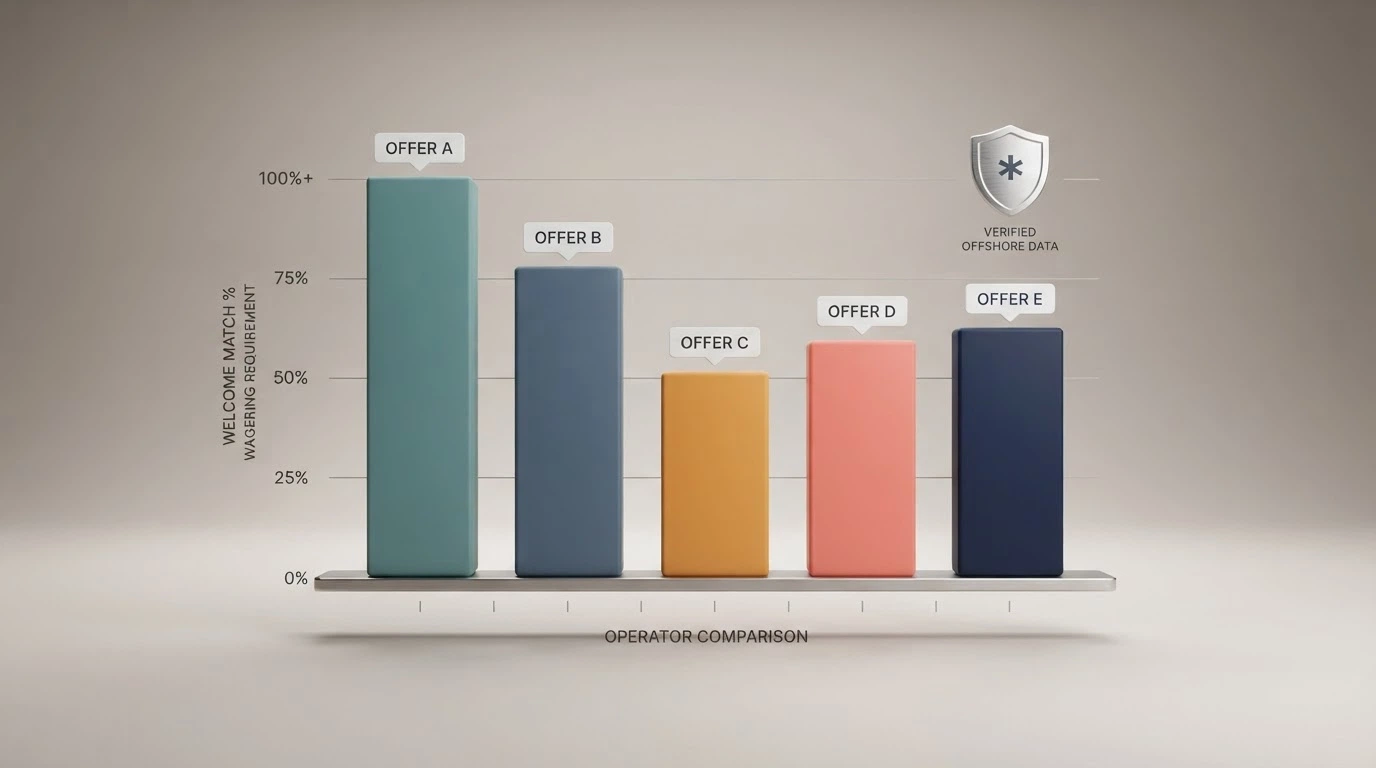
The table below ranks the operators Australians access for low-deposit pokies in 2026. None holds an Australian online casino licence — no such licence exists. Every brand listed is offshore and unlicensed in Australia, which means an Australian player using it has no Australian consumer protection and no recourse through the ACMA or any Australian court if a withdrawal is refused, an account is closed, or a balance is voided. The ranking reflects accessibility and traffic, not legality or endorsement.
| Operator | Licence / Jurisdiction | Welcome Match (% and Cap) | Min. Deposit for Bonus | Wagering Multiplier |
|---|---|---|---|---|
| Rocket Play | Curaçao | 100% up to A$1,000 + 100 FS | A$30 | 40x |
| SkyCrown | Curaçao | 450% up to A$8,000 + 400 FS | A$30 (first), A$100 (fourth) | 40x |
| Royal Reels | Offshore (jurisdiction unconfirmed) | 100% up to A$500 + 50 FS | A$30 | 30x |
| WinSpirit | Offshore (jurisdiction unconfirmed) | Multi-tier welcome package (details unconfirmed) | Unconfirmed | 40x |
| Stake | Curaçao | Rakeback / VIP focus (no traditional welcome bonus) | N/A (crypto floor) | N/A |
| Rainbet | Anjouan | 250% up to $1,750 + 60 FS | $30 | 40x or no-wager gradual release |
| Fair Go | Curaçao (RTG) | 100% up to A$200 × 5 deposits (A$1,000 total) | A$20 | 30x deposit + bonus |
| Bizzo Casino | Curaçao | Up to A$7,250 + 175 FS + 1 bonus game | A$25 | 40x |
| Scream Casino | Offshore (jurisdiction unconfirmed) | Welcome package (details unconfirmed) | Unconfirmed | Unconfirmed |
| Rocket Casino | Curaçao | Welcome match + FS (details unconfirmed) | A$15 (PayID) | Unconfirmed |
The gap between the first deposit minimum and the bonus-eligibility minimum is what most reviews bury in the small print. Of the fifteen AU-facing brands surveyed in 2026, eight enforce a higher minimum for welcome-bonus eligibility than for play — a player deposits A$10 expecting the match, then discovers the bonus needed A$20. That single fact is the single most useful thing to check before depositing. Welcome matches are stacked to maximise a reader’s first outlay, not minimise it.
Rocket Play
Rocket Play is a Curaçao-licensed veteran with a generous first-deposit offer and a clear bonus floor. The first deposit bonus is 100% up to A$1,000 with a minimum deposit of A$30, and the offer carries 40x wagering on the bonus amount, a 5-day validity window, and a maximum bet of A$7.50 during wagering. The free-spin package is 100 spins on Aztec Magic (BGaming) delivered in batches of 20 per day over five days, with each batch valid for 24 hours, 40x wagering on free-spin winnings, and a maximum win from free spins capped at A$300.
The library sits behind 70+ providers and includes BGaming, which is the engine behind Aztec Magic. That is enough pokies variety for any taste profile, though it does not match Bizzo’s 8,000+ library or Rainbet’s 7,000+ spread. What Rocket Play does have is a no-deposit bonus with a published maximum withdrawal of A$75 from the no-deposit offer — a small but real free-entry path for a player who wants to test the cashier before committing real funds.
The 5-day bonus validity is the tightest of the featured operators and the single most likely thing to catch a reader out. A 40x turnover on a A$1,000 bonus is A$40,000 of required play, and a reader who hits the slot of A$7.50 per spin at roughly one spin every five seconds would need about 7.5 hours of continuous play to clear it inside the five-day window. Most readers will not clear it. Most readers will forfeit the bonus and the winnings attached to it. Read the validity window before taking the offer.
SkyCrown
SkyCrown’s welcome package is the largest by headline figure of the featured operators: 450% up to A$8,000 plus 400 free spins across the first four deposits, with 40x wagering on both the bonus amount and the free-spin winnings. The minimum deposit runs from A$30 on the first deposit up to A$100 on the fourth, and the bonus validity sits at 14 days — three times longer than Rocket Play but still tight against the headline size. The maximum bet during wagering is A$7.50 (standard) or A$10 (high roller), and the maximum bonus-to-real-money conversion is A$5,000 per welcome bonus tier.
The first deposit alone is 120% up to A$1,200 plus 125 free spins on Wolf Treasure, which is an IGTech title. The scaled structure rewards higher deposits — the fourth-deposit A$100 minimum is the entry price for the largest bonus tier, and a reader depositing the minimum A$30 will see a much smaller proportion of the headline 450% match.
The A$5,000 conversion cap is the figure most readers will not see until they try to withdraw. A reader who has cleared 40x on a A$2,000 bonus and is sitting on A$6,000 of winnings will withdraw A$5,000 — and the remainder stays as bonus money or is forfeited depending on the terms. SkyCrown is a good fit for a high-turnover reader with a large bankroll and a willingness to read the bonus terms carefully. A reader with a $5 bankroll will not get close to the A$5,000 cap; they will see the 40x turnover on a much smaller bonus and need to decide whether the match is worth the wagering.
Royal Reels
Royal Reels is an AU-focused operator with a welcome match of 100% up to A$500 plus 50 free spins, a bonus minimum deposit of A$30, and a 30x wagering multiplier on the bonus amount — markedly lighter than the 40x operators in the rest of the featured set. Pokies contribute 100% to wagering, while table games and live dealer count only 3%, which means the bonus is built for pokies play and a reader who strays into the live casino will see almost no wagering progress.
The 30x wagering on the bonus amount — not on deposit plus bonus combined — also changes the maths. A reader depositing A$30 and receiving a A$30 bonus faces a turnover obligation of A$900 on the bonus alone, compared with A$2,400 on a 40x operator with the same deposit. The lower multiplier is the single biggest differentiator for Royal Reels and the reason a reader who wants to test a welcome bonus on a small bankroll should look here first.
Royal Reels also offers a no-deposit free chip of A$10 with 30x wagering and a maximum cashout cap shown on activation. The exact cashout cap varies by promotion and is shown when the chip is claimed. Licence jurisdiction was not confirmed in this run; Royal Reels is offshore and unlicensed in Australia, with the licence almost certainly Curaçao. Always verify the licence status directly on the operator’s terms page before funding an account.
WinSpirit
WinSpirit is an offshore operator with a multi-tier welcome package and a 40x wagering requirement per third-party listing. The package structure, the minimum deposit for bonus eligibility, the bonus validity, the maximum cashout, the maximum bet during wagering, and the provider list were not confirmed this run. What is confirmed is that the operator exists, runs a welcome offer, and applies a 40x wagering multiplier.
For a reader comparing options, WinSpirit is a serviceable entry but not a featured recommendation. Any player needing the bonus terms confirmed before depositing should check the operator’s own terms page on the day of deposit, as third-party listings often carry outdated information.
Stake
Stake is the crypto-native outlier of the featured set. Its published deposit floor is AU$0.10 BTC-equivalent — by far the lowest in the comparison. Stake does not run a traditional welcome bonus; the operator’s player-retention model is rakeback and VIP rather than matched deposits, which means a reader does not face a wagering obligation on a first deposit, and the bonus-trigger trap does not apply.
The trade-off is the deposit method. A reader who has Bitcoin, Ethereum, Litecoin or USDT in a self-custody wallet and is comfortable sending a transaction will see the deposit settle in seconds and at negligible cost on the TRON or a similar low-fee network. A reader paying in Australian dollars through PayID cannot deposit with Stake, and the A$0.10 floor is meaningless for them.
Stake holds a Curaçao licence, runs an extensive library, and is a strong fit for a crypto-comfortable reader who wants the lowest-possible entry point and is willing to skip the welcome-bonus mechanics. It is not a fit for a fiat-paying reader, and it is not a fit for a reader who wants the matched-deposit welcome-bonus experience the rest of the featured set is built around.
Rainbet
Rainbet is an Anjouan-licensed operator with a three-deposit welcome package of 250% up to $1,750 plus 60 free spins, a minimum deposit of $30 for the bonus (with a maximum of $700 per deposit), and a 7-day expiry from activation. The wagering comes in two flavours: a 40x wager-locked route and a no-wager gradual-release option that returns the bonus in instalments as the player wagers. The wager-locked route is the more conventional; the no-wager route is the more transparent, since the player never has a locked bonus balance to clear.
The library spans 7,000+ games plus 14 provably fair Originals with demo mode, and Rainbet runs approximately $1.7 million in monthly race prize pools plus a $20,000 weekly raffle. The KYC setup is the standout feature for a player worried about identity verification: withdrawals at Level 1 KYC require no ID documents and carry no maximum withdrawal limit. The catch is that larger withdrawals or suspicious-activity flags escalate the KYC level, at which point ID is required.
For a low-deposit player, Rainbet’s $30 bonus minimum is on the high end of the crypto-paying readers’ market, and the 2% of deposit max bet during wagering on the wager-locked route means a reader depositing $30 is capped at A$0.60 per spin during wagering — below the typical A$0.20 minimum bet at most pokies, which means the reader will need to bet at the floor regardless. The no-wager route sidesteps this entirely. It is the better option for a reader who wants the bonus experience without the wagering mechanics.
Fair Go
Fair Go is a Curaçao-licensed, RTG-powered operator with a five-deposit welcome package — 100% up to A$200 on each of the first five deposits, totalling up to A$1,000. The minimum deposit per stage is A$20, the wagering is 30x on the combined deposit and bonus amount, and there is no maximum cashout limit on the deposit bonus. That last point is the standout. Most featured operators cap the bonus-to-real-money conversion at some figure; Fair Go does not.
The 30x on combined deposit and bonus is a heavier effective multiplier than Royal Reels’ 30x on bonus alone. A reader depositing A$20 and receiving a A$20 bonus faces a turnover obligation of A$1,200 — the deposit and the bonus together. A reader depositing A$200 faces a turnover of A$12,000 on the bonus and deposit combined. The headline wagering multiplier is the same; the effective turnover obligation is much larger because the deposit is also in the calculation.
Fair Go also offers an alternative welcome bonus: a 300% match up to A$3,000 plus 50 free spins. The alternative package is more generous on the headline but is presumably attached to its own wagering terms, and a reader should check those before claiming. The RTG-powered library is the smaller end of the featured set by title count, and a reader looking for IGTech, Booongo, BGaming or Nolimit City content will not find it here. For a reader who likes the RTG catalogue and wants the no-max-cashout feature, Fair Go is a strong fit.
Bizzo Casino
Bizzo is a Curaçao-licensed operator with a four-deposit welcome package totalling up to A$7,250 plus 175 free spins and 1 bonus game, with 40x wagering and a maximum bet of A$6.50 during wagering — a tight max-bet cap during wagering. The first deposit is scaled by size: a 50% match at A$20–A$50 deposits, climbing to 125% at A$250 and above, with free spins scaling from 50 to 125 accordingly.
The library sits at 8,000+ titles from 70+ providers, which is the largest in the featured set. The variety covers the pokies spectrum from classic three-reel to high-volatility bonus-buy titles, and a reader with strong title preferences will find more options here than anywhere else on the page. The cost of the variety is the 40x wagering and the tight max-bet cap during wagering. A reader who plays at higher stakes for the bonus will breach the cap and forfeit the bonus.
Bizzo is a fit for a reader who values library size and is willing to play within a A$6.50 wagering cap. It is less of a fit for a high-stakes reader who plays above the cap by default and will need to either drop the stake during wagering or skip the bonus.
Scream Casino
Scream Casino is an offshore operator with a welcome package; the licence jurisdiction, bonus structure, minimum deposit for bonus eligibility, wagering multiplier, bonus validity, maximum cashout and provider list were not confirmed this run. What is confirmed is that the operator exists, runs a welcome offer to Australian-facing traffic, and is unlicensed in Australia. A reader considering Scream Casino should treat the bonus terms as unconfirmed until checked directly on the operator’s terms page on the day of deposit.
Rocket Casino
Rocket Casino is a Curaçao-licensed operator with the lowest confirmed fiat deposit floor in the featured set — A$15 via PayID, per Payoutverdict.com deposit testing. The welcome bonus structure (whether it is a match, a free-spin package or both), the wagering multiplier, the bonus validity, the maximum cashout, and the provider list were not confirmed this run. The Curaçao licence and the A$15 PayID minimum are confirmed.
For a fiat-paying reader, the A$15 PayID minimum is the headline number. A$15 is well below the A$20–A$30 bonus floors at most featured operators, and it puts Rocket Casino inside the A$20 sweet spot for the lower end of fiat-funded play. The catch is the bonus terms — a reader depositing A$15 may or may not trigger the welcome offer depending on the bonus minimum, and the wagering multiplier and maximum cashout apply to whatever bonus is claimed. Check the bonus terms before depositing.
The Legal Reality: Why Offshore Pokies Exist in a Country That Banned Them
Australia’s relationship with online pokies is not ambiguous. The Interactive Gambling Act 2001 makes it illegal for providers to offer online casino games, online pokies and in-play sports betting to people in Australia. The prohibition is provider-facing — a person who offers a prohibited interactive gambling service to a customer physically in Australia commits an offence, with penalties running to A$360,000 per day for an individual and A$1.8 million per day for a body corporate. The individual player is not prosecuted.

No licence for online casino games exists anywhere in Australia — not federally, not in any state or territory. The state and territory wagering licences that do exist cover pre-event sports betting, racing and lotteries, and the land-based casino venues. They do not cover online pokies. The Northern Territory Racing and Wagering Commission is the de facto national licensor for online bookmakers; its licence term runs up to 20 years and the operators it licences do not offer online casino games to Australian customers.
That is the structural shape of the offshore market. The product is banned. The operators that offer it do so from Curaçao, Anjouan or another offshore jurisdiction, and they accept Australian customers because the prohibition targets them, not their Australian players. The ACMA enforces by directing ISPs to block illegal sites — since its first blocking request in November 2019, the ACMA has had 1,788 illegal gambling and affiliate websites blocked by Australian ISPs. Over 230 illegal services have withdrawn from the Australian market since the ACMA started enforcing the strengthened rules in 2017.
The 2026 reform tightens the perimeter further. The Interactive Gambling Amendment (Gambling Reform) Bill 2026 passed Parliament on 19 August 2026, and its measures commence on 1 January 2027. From that date, banks and payment providers gain the power to restrict payments to illegal gambling sites. The advertising restrictions that take effect at the same time include a three-wagering-ads-per-hour cap between 6:00 am and 8:30 pm, a live-sport blackout, and a bar on athletes, celebrities and influencers promoting wagering products. The product remains prohibited; the channels to it are being narrowed.
Licensed vs Unlicensed: How to Spot an Offshore Operator
The cleanest test for an offshore pokies site is the licence footer — Curaçao, Anjouan, Kahnawake, Malta, the Isle of Man. None of those licences is Australian. None of them confers any right to operate inside Australia, and none of them provides Australian consumer protection. An Australian wagering licence is held by online bookmakers — Sportsbet, Ladbrokes, Bet365, Tabcorp, Betfair — and covers racing and pre-event sports betting only. An Australian wagering licence does not cover online pokies.
The land-based casino contrast is real but narrow. Crown Melbourne and The Star Sydney are state-licensed, regulated, supervised, and subject to Australian consumer law. Their online products, where they exist, do not include real-money online pokies. The Australian online casino licence does not exist. A reader who sees an offshore casino advertising “Australian-licensed” status is reading a misleading claim.
For an offshore pokies site, the practical licensing signals are: a Curaçao or Anjouan licence footer, no ACMA registration, no entry in the ACMA register of licensed interactive gambling providers (last updated 10 July 2026), and an absence from any Australian state or territory wagering register. The footer is the single most reliable signal; the operator’s own “About” or “Licence” page is the next; third-party review sites are the third. If no licence footer is visible, categorize the site as unlicensed offshore by default.
What the ACMA Actually Does (and What It Cannot Do)
The ACMA’s enforcement against offshore operators runs along three lines: ISP blocking, civil penalty proceedings, and referral for criminal prosecution. The blocking record is the headline number — 1,788 illegal gambling and affiliate websites blocked since November 2019, with 230+ illegal services having withdrawn from the Australian market since 2017. The penalty scale runs to A$360,000 per day for individuals and A$1.8 million per day for bodies corporate, and the ACMA’s blocking requests have to be carried by Australian ISPs within a defined timeframe.
The ACMA’s enforcement record is real. Its reach is also real, and that reach ends at the offshore operator’s border. The ACMA cannot recover money from an offshore operator that refuses a withdrawal, voids a win or closes an account. The ACMA cannot compel an offshore operator to honour its bonus terms. The ACMA cannot help an Australian player who is being treated unfairly by an offshore site. As the regulator itself notes, “if you use an illegal service, Australian regulators will not be able to help you if you believe the service provider has treated you or another player poorly.”
The 2026 reform adds a new tool. From 1 January 2027, banks and payment providers gain the legal backing to restrict payments to illegal gambling sites. The effect is that an Australian player trying to deposit to an offshore site via PayID, BPAY or a credit card may have the transaction declined at the bank. The blocking is transaction-level rather than domain-level, and it applies to operators on the ACMA’s list rather than to offshore gambling as a whole. Crypto sits outside the bank’s rails and remains accessible; fiat rails narrow.
Where to Get Help: Gambling Support That Actually Works
The National Gambling Helpline — 1800 858 858 — is free, confidential and staffed 24 hours a day, seven days a week. It is the single most useful phone number a reader in this market can carry. Gambling Help Online (gamblinghelponline.org.au) provides live chat, email support, self-help tools and online counselling for people worried about their own gambling or someone else’s. Both services are free and confidential and operate at the federal level.
BetStop — the National Self-Exclusion Register — has been live since August 2023. By the end of Q2 FY 2025-2026, 54,859 people had registered to self-exclude from every Australian-licensed online and phone wagering provider in a single step. As of 31 December 2025, 35,135 of those registrations were active. 78% of registrants were under 40, and 38% chose lifetime exclusion. BetStop is the most concrete player-protection tool available to Australian wagering customers.
The hard limit of BetStop is its reach. BetStop binds Australian-licensed wagering services only — an offshore casino is not licensed in Australia, is not connected to the register, and will keep taking a self-excluded person’s money. A reader who has registered with BetStop and is still gambling offshore is using a tool designed for one market in another market where it does not apply. The offshore RG gap is real, and it is the single largest consumer-protection cost of the offshore route.
The prevalence figures put the gap in context. Approximately 3.29 million Australians aged five and over are affected annually by their own or another person’s gambling. An estimated 1.97 million Australian adults are classified as having at-risk or problem gambling under the 2026 model. Roy Morgan reports 622,000 Australians with serious gambling problems on the PGSI, up 111,000 year-on-year. Risky gambling in Australia rose from 13.7% in 2024 to 19.4% in 2025, almost doubling since the COVID-19 lockdowns. 56.1% of Australians who gamble mainly participate online. The annual health loss associated with gambling-related harm is estimated at over 400,000 Years Lived with Disability. These are the people the offshore RG gap affects most.
Bonuses on a $5 Deposit: The Trigger Trap Most Reviews Miss
The welcome bonus is the single most-marketed element of any offshore pokies site, and the single most-easily-misread. The headline reads “100% up to A$1,000”. The reality reads “100% up to A$1,000 on a minimum deposit of A$30, with 40x wagering on the bonus amount, valid for 5 days, with a maximum bet of A$7.50 during wagering”. Each clause is a constraint, and the constraints run together into a cost.

Eight of the fifteen AU-facing brands surveyed in 2026 enforce a higher minimum for welcome-bonus eligibility than for play. A player deposits A$10 expecting a match and discovers the bonus needed A$20. The trigger trap is not a fringe case; it is the modal experience of an AU-facing bonus at the low end of the deposit range. The headline figure and the deposit figure are not the same figure, and a reader who treats them as one figure will leave money on the table — or, more often, will forfeit a bonus because the wagering was never on a bonus-eligible deposit.
The wider pattern across the market in 2026 is: welcome bonuses of AUD 500–7,500, free-spin packages of 25–300 spins, minimum deposits for bonus eligibility of AUD 5–30, common wagering of 20x–45x, max bets during wagering of AUD 5–10, free-spin expiries of 24 hours to 10 days, no-deposit cashout caps of AUD 50–100. The headline figure is large; the real cost is in the wagering and the constraints, and the constraints are where the offer’s character lives.
Welcome Offers That Actually Fire at Low Deposits
Fair Go at A$20 sits at the lowest traditional bonus-eligibility minimum in the featured set. Rocket Casino’s A$15 PayID minimum is lower as a deposit floor, but the bonus eligibility is unconfirmed. Bizzo’s A$25, Royal Reels’ A$30 and SkyCrown’s A$30 are the mid-range. The A$30 minimum for bonus eligibility is the modal floor for a welcome bonus in the featured set, and a reader depositing less than that will fund the account without triggering the match.
The crypto-paying readers have a different floor. Stake accepts deposits down to AU$0.10 BTC-equivalent and does not run a traditional welcome bonus, so the trigger trap does not apply. Rainbet’s $30 bonus minimum is on the high end of the crypto-paying market. BC.Game (not in the featured set, named here only as a benchmark) takes deposits at roughly AU$1 USDT. The crypto welcome bonus floor sits somewhere between the two extremes.
For a fiat-paying reader with a small bankroll, Fair Go at A$20 is the cleanest entry to a welcome bonus. A A$20 deposit at a 100% match and 30x deposit-plus-bonus wagering produces a turnover obligation of A$1,200. A A$20 deposit at Bizzo’s 50% first-deposit tier produces a A$10 bonus with 40x wagering on the bonus alone — a turnover of A$400. Both are within reach of a small bankroll; neither is cheap.
Wagering Requirements: Why 40x Isn’t What You Think
The wagering multiplier is the cost multiplier on a welcome bonus. A 40x wagering requirement on a A$1,000 bonus is A$40,000 of required turnover before the bonus is converted to real money. A 40x wagering requirement on a A$30 bonus is A$1,200 of required turnover. The multiplier is the same; the dollar cost is wildly different, and a reader who treats the multiplier as the cost will misread every offer on the page.
The deposit-versus-bonus distinction matters as much as the multiplier. Royal Reels’ 30x on bonus alone is structurally lighter than Fair Go’s 30x on deposit-plus-bonus combined. A A$30 deposit at Royal Reels receiving a A$30 bonus carries A$900 of turnover on the bonus. The same A$30 deposit at Fair Go receiving a A$30 bonus carries A$1,800 of turnover on deposit and bonus combined. The multipliers are the same; the obligations are not.
Game contribution rates change the calculation further. Pokies typically contribute 100% to wagering at most featured operators. Table games and live dealer count 3% at Royal Reels. A reader who switches to live casino mid-wagering will see almost no progress, and a reader who plays high-volatility slots hoping to clear the bonus in one hit is taking on variance the bonus was not designed to accommodate.
The max-bet cap during wagering is the constraint most readers will hit first. A$6.50 at Bizzo, A$7.50 at Rocket Play, A$7.50–A$10 at SkyCrown, 2% of deposit at Rainbet on the wager-locked route. The cap exists because high-stakes play would clear the wagering too quickly, and the bonus loses its player-retention function if a reader can grind it out in an hour. The cap is a feature of the bonus design, not a bug.
Free Spins and No-Deposit Deals Worth Claiming
Free-spin packages across the featured set range from 50 to 400. Royal Reels’ 50 free spins with the welcome bonus, Rocket Play’s 100 spins on Aztec Magic, SkyCrown’s 400 spins across four deposits, Bizzo’s 175 spins, Rainbet’s 60 spins. The spin counts are headline figures; the wagering on free-spin winnings is the cost.
Rocket Play’s free-spin package is 100 spins on Aztec Magic, delivered in batches of 20 per day over five days, with each batch valid for 24 hours. The 24-hour batch validity is the tightest constraint on the page — a reader who misses a day’s batch forfeits those 20 spins, and the cumulative loss over five missed days is the full 100. The 40x wagering on free-spin winnings is the same as the bonus wagering; the A$300 maximum win from free spins is the conversion cap.
No-deposit offers are rarer. Royal Reels’ A$10 no-deposit free chip with 30x wagering and a cashout cap shown on activation is one of the few. Rocket Play runs a no-deposit bonus with a published maximum withdrawal of A$75. These offers are the cheapest path to a real-money session, but the cashout caps and the wagering turn them into a way to test the cashier rather than a way to win money. Treat a no-deposit offer as a deposit alternative, not a winning opportunity.
Depositing $5: Why Most Payment Methods Won’t Let You
The honest answer in 2026 is that no fiat payment method available to Australian players at offshore pokies sites accepts a $5 deposit. Neosurf vouchers sold in Australia start at A$10. Card processors impose A$10–A$20 floors. PayID’s casino-side minimum sits at A$20 at most operators. The A$5 fiat deposit is a marketing artefact, not a product — the figure ranks in search results because round figures rank, and the actual cashier floor at every fiat-supporting operator in the featured set is higher.
| Payment Method | Typical Min. Deposit | Speed | Best For |
|---|---|---|---|
| PayID | A$10–A$20 | Instant | Fiat users |
| Neosurf | A$10+ | Instant | Voucher users |
| Crypto | ~AU$5 (USDT-TRC20) | Seconds/Minutes | Small deposits |
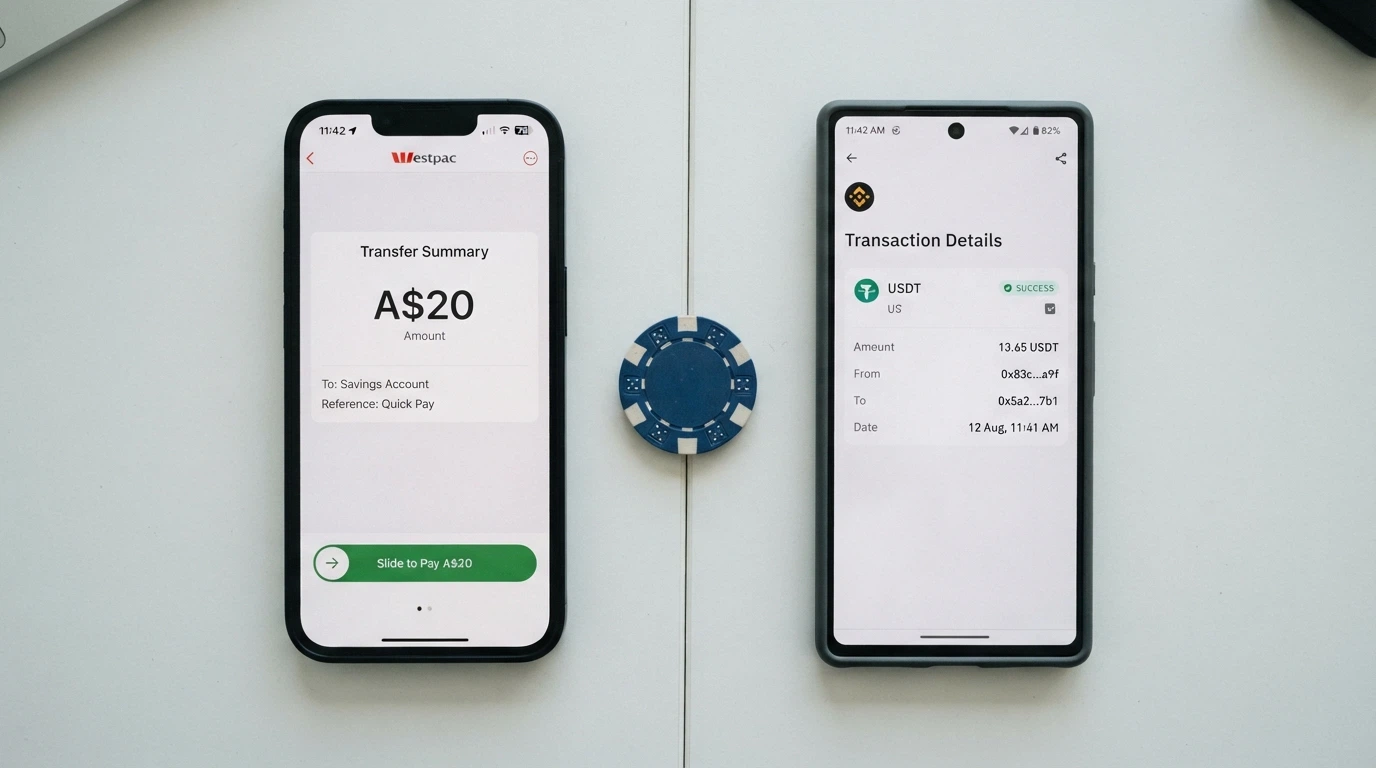
Crypto is the single route where a genuine sub-A$10 deposit exists. USDT on the TRON network (TRC20) is the practical standard: deposits settle in seconds, the gas fee is around AU$1, and the practical floor for a real-money session is roughly AU$5 once gas is accounted for. Bitcoin, Ethereum and Litecoin all work at lower floors in dollar terms but at higher gas costs on the main networks. TRC20 USDT is the cheapest credible route for a sub-A$10 deposit in 2026.
The withdrawal side tells a different story. Minimum withdrawals sit at A$25–A$50 at most AU-facing operators, sometimes A$50–A$100. A $5 deposit that wins a small amount — even a single payout above the deposit — may be unwithdrawable because it sits below the cashout floor. The deposit-withdrawal asymmetry is the single most useful thing to check before depositing, and it is the gap most reviews never frame.
PayID and Bank Deposits: The Hidden A$10–A$20 Floor
PayID is the default rail for most Australian players. It is instant, fee-free, and integrated into the major Australian bank apps. Its limitations at the offshore casino side are what most readers will not see until they try to deposit. The PayID deposit is instant — but the minimum the casino will accept is typically A$10 to A$30, and most featured operators sit at A$20. The PayID withdrawal is rarely supported — the operator reverts to crypto (2–60 minutes), e-wallet (up to 24 hours) or bank transfer (1–3 business days).
The credit-card ban compounds the issue. Credit cards, credit-related products and digital currency are banned as payment for online wagering in Australia, commencing 11 June 2024 under the Interactive Gambling Amendment (Credit and Other Measures) Act 2023. The ban applies to Australian-licensed wagering; offshore casinos are not bound by it and continue to accept credit cards. An Australian player using a credit card at an offshore site is operating outside the licensed market’s payment rules, and the credit card transaction itself is not enforceable as a gambling-related debt under the ban.
For a reader using PayID, the practical floor is A$10 to A$20. For a reader using BPAY or direct bank transfer, the floor is similar. For a reader using a debit card, the floor sits at A$10 to A$20. The A$5 figure does not arrive on a fiat rail.
Neosurf, Cards and the Deposit-vs-Withdrawal Gap
Neosurf is a prepaid voucher system widely used at offshore casinos. The A$5 Neosurf voucher is an EU-only denomination; the smallest voucher sold in Australia is A$10. A reader who has a A$5 Neosurf voucher in mind will not be able to buy one in Australia in 2026. The card floors at offshore operators sit between A$10 and A$20. The PayID floor is similar.
The withdrawal gap is the structural problem the deposit floors hide. Minimum withdrawals at AU-facing operators run from A$25 to A$50, sometimes up to A$100. A reader depositing A$5 and winning A$20 is sitting below the withdrawal floor. A reader depositing A$20 and winning A$30 is also below. The withdrawal minimum does not move with the deposit; it is a fixed operator-level setting, and it is set well above the deposit minimum so that the operator covers its own payment-processing costs on small payouts.
The withdrawal speeds vary by method. Crypto withdrawals settle in 2–60 minutes. E-wallet withdrawals take up to 24 hours. Bank transfers take 1–3 business days. PayID cash-outs are rarely supported at all, which means a PayID-funded account reverts to crypto, e-wallet or bank transfer on withdrawal. The fastest path from balance to wallet is crypto; the slowest is bank transfer.
Mobile $5 Deposit Pokies: Playing on Your Phone
The mobile experience at offshore pokies sites is a browser experience. Most offshore casinos do not have native apps in the Apple App Store or Google Play Store, because the app-store gatekeepers enforce their own rules against unlicensed gambling apps and the offshore operators do not meet the standards. The result is that a player opens the casino in the mobile browser — Chrome on Android, Safari on iOS — and the site loads as a responsive web app.

Game load times are the headline performance metric. Benchmark data from the featured set shows game launch times averaging around 2 seconds on a mid-range Android device, which is fast enough to feel instant. Game libraries on mobile are largely identical to desktop at most featured operators, since the games themselves are HTML5 and run in the browser. The differences between mobile and desktop are at the lobby level — touch-optimised interfaces, smaller thumbnails, collapsible menus — and at the connection level — a mobile data connection will be slower than a fixed-line broadband.
The deposit flow on mobile mirrors the desktop deposit flow. A PayID deposit on a phone goes through the bank app; a crypto deposit goes through the wallet app; a Neosurf deposit goes through the voucher code. The browser-based casino is the cashier; the user’s own apps do the funding. The integration is frictionless enough that most readers will not notice the seam.
Mobile-Optimised Sites vs Desktop: What’s Different
Game selection on mobile matches desktop at the catalogue level. The games themselves do not have a separate mobile edition; they have a single HTML5 build that adapts to the screen size. The lobby experience differs more than the game experience — most featured operators use a responsive web design that rearranges thumbnails, search filters and category menus for a smaller screen. A reader who plays the same titles on desktop and mobile will see the same games; a reader who browses the lobby on a phone will see fewer titles per page and a different navigation pattern.
Touch-optimised interfaces handle the gameplay itself. Spin buttons sit under the thumb. Bet-adjust controls sit within reach of the dominant hand. Autoplay is one tap. Turbo mode, where available, is one tap. The game canvas adapts from a 16:9 desktop layout to a portrait or landscape phone layout, and the games are designed to be playable on a 5.5-inch screen at minimum.
Data usage is the practical consideration most readers overlook. A five-reel pokie with bonus features will use roughly 5–10 MB per hour of play on a stable connection. Crypto deposits use a one-off data hit on the wallet side, then nothing. PayID deposits are a one-off hit on the bank app, then nothing. A reader on a mobile data plan with a tight monthly cap should play over Wi-Fi where possible and should not expect a session to chew through their data budget.
Game Load Times and the No-App Reality
The 2-second average game launch time on a mid-range Android is the benchmark for the featured set. A reader on a newer device will see faster load times; a reader on an older device will see slower. The games themselves are HTML5 and load as a self-contained page inside the casino’s web app — the load is the bundle of assets, the game logic and the connection handshake with the operator’s server.
The absence of native apps is a regulatory and commercial choice rather than a technical limitation. Apple and Google enforce app-store rules that exclude unlicensed gambling apps from their stores. The offshore operators do not meet those standards and do not appear in the stores. The browser-based play is the workaround, and it works well enough that most readers will not notice the difference.
For mobile play, the practical tips are: use Wi-Fi where possible, use a modern browser (Chrome on Android, Safari on iOS), and orient the phone in landscape for the best game layout. Disable battery-saver mode if a session is long; battery-saver throttles the browser and slows game load times. Close other tabs and apps to free up memory; a memory-constrained browser will struggle to load multiple games in sequence.
Crypto Deposits: The Only Honest Way to Play Pokies for Under $10 in Australia
Cryptocurrency is the single route where a genuine sub-A$10 pokies deposit exists for Australian players. The mechanics are straightforward: an Australian exchange on-ramps AUD to USDT or BTC, the player sends the crypto from their wallet to the casino’s deposit address, and the deposit settles in seconds on most networks. The gas cost on the TRON network is roughly AU$1 per transaction, which puts the practical floor at around AU$5 USDT-TRC20. The minimum on Bitcoin mainnet is similar but with higher gas costs in busy periods.
The regulatory backdrop is awkward. Crypto is banned as payment for online wagering in Australia, commencing 11 June 2024, under the same amendment that banned credit cards. The ban applies to Australian-licensed wagering operators. Offshore casinos are not bound by Australian rules and continue to accept crypto deposits from Australian players. An Australian player using crypto at an offshore site is in a grey zone: the licensed market bans the payment, the offshore market accepts it, and the player’s own legal exposure is limited because the IGA targets providers, not customers.
The 2027 bank-blocking powers will not affect crypto. Banks will gain express authority to block transactions to illegal gambling operators from 1 January 2027, but crypto sits outside the bank rails. The bank-blocking perimeter covers PayID, BPAY, debit card and direct bank transfer; it does not cover self-custody crypto wallets or decentralised exchanges. Crypto remains accessible after the reform even if fiat rails narrow.
Bitcoin and USDT: The Real Sub-A$10 Deposit Route
Bitcoin and USDT are the two crypto assets most featured operators accept, and they have different cost profiles. Bitcoin mainnet gas costs are unpredictable — a few dollars in quiet periods, AU$10 or more during network congestion — and the settlement time is 10–60 minutes. USDT on TRON (TRC20) is the cheap option: gas is around AU$1 per transaction regardless of the amount, settlement is seconds, and the practical floor for a real-money session is roughly AU$5.
For an Australian reader, the practical flow is: AUD to USDT on an Australian exchange (CoinSpot, Swyftx, Independent Reserve), USDT to the casino’s TRC20 deposit address, casino balance credited in seconds. The exchange side has its own KYC requirements; the casino side varies by operator. Rainbet offers Level 1 KYC with no ID documents and no maximum withdrawal limit; other operators require ID at lower thresholds. The reader’s exchange KYC and the casino’s KYC are separate processes, and neither substitutes for the other.
The minimums vary by operator and by asset. Stake’s published deposit floor is AU$0.10 BTC-equivalent, which is the lowest in the featured set. Rainbet’s $30 bonus-eligibility minimum is much higher, but the underlying deposit floor is lower. BC.Game accepts deposits at roughly AU$1 USDT, which is below the $5 practical floor once gas is accounted for. The right floor for a reader depends on what they want to do: a reader who wants to test the cashier with the minimum viable amount will pick the lowest deposit floor; a reader who wants to trigger a welcome bonus will pick the bonus-eligibility floor instead.
How a Crypto Pokies Deposit Works (TRC20, Gas, Settlement)
The walkthrough is short. An Australian reader signs up with an Australian exchange that supports AUD-to-USDT on TRC20. They complete the exchange’s KYC — typically a driver’s licence and a selfie — and fund the exchange account with AUD via PayID or BPAY. They buy USDT at the market rate, paying the exchange’s spread and any transaction fee. They withdraw USDT to their own self-custody wallet — a mobile wallet like Trust Wallet or a hardware wallet like a Trezor or Ledger. From the self-custody wallet, they send USDT to the casino’s TRC20 deposit address. The transaction settles in seconds, the gas fee is around AU$1, and the casino balance is credited in real time.
The exchange-to-wallet-to-casino chain has three fee points: the exchange’s AUD-to-USDT spread, the self-custody wallet’s network fee (often nil for incoming transactions, sometimes AU$1), and the casino-side deposit fee (often nil). The total cost in fees for a A$20 USDT deposit is typically under AU$2. The cost in time is 10–30 minutes for a reader who has not used the exchange before, and a few minutes for a reader who has.
The withdrawal reverses the chain. A reader requests a USDT withdrawal from the casino, the casino sends USDT to the reader’s TRC20 wallet address, the wallet receives the USDT in seconds, and the reader sends USDT back to the Australian exchange for conversion to AUD. The full round trip can be under an hour for a crypto-comfortable reader. The minimum withdrawal on the casino side is the constraint — most featured operators will not process a USDT withdrawal below A$25–A$50.
What Anonymity Actually Means When You Deposit with Crypto
Crypto is pseudonymous, not anonymous. The wallet address is a public identifier; the transactions are public on the blockchain; the link between the wallet and the person is whatever the person chooses to disclose. An Australian reader who buys USDT on a KYC-verified exchange and sends it from a self-custody wallet to a casino has a paper trail that starts at the exchange and ends at the casino — and the casino’s KYC will, at withdrawal, demand the same identity the exchange already holds.
KYC at offshore casinos is triggered by withdrawal, not deposit. Rainbet’s Level 1 KYC with no ID documents and no maximum withdrawal limit is the most generous setup in the featured set, and it allows a reader to deposit small amounts, play, and withdraw small amounts without identity verification. The level escalates at higher withdrawal thresholds or under suspicious-activity flags, at which point ID is required. Other featured operators apply KYC at lower thresholds and demand ID earlier in the relationship.
The privacy crypto offers is real but limited. A reader who deposits USDT and plays through a balance does not have their bank statement showing a gambling transaction. A reader who withdraws to a self-custody wallet does not have their bank statement showing a gambling payout. The casino does see the wallet address and the blockchain history. The ACMA cannot help the reader in any case — the regulator’s own statement is that “if you use an illegal service, Australian regulators will not be able to help you if you believe the service provider has treated you or another player poorly.”
How We Selected and Verified Every Site on This List
The featured operators in this comparison were checked against the ACMA register of licensed interactive gambling providers, last updated 10 July 2026. None of the operators listed holds an Australian online casino licence — because no such licence exists. Every brand in the comparison is offshore and operating outside Australian law. The ranking reflects accessibility and traffic among Australian-facing offshore operators, not legality or endorsement.
The bonus terms cited in the operator write-ups and in the comparison table were taken from the operators’ own terms pages where available, and from third-party review sites (Slotspeak.net, Payoutverdict.com, PlayCasino.com, Casinoshub.com, AustralianGamblers.com, SlotBonuses.info, ClearCasinos.com, VegasPokie.com, Esports.net, Casinority.com) where the operator’s terms page was incomplete or unavailable. Where a figure is unconfirmed in this run — WinSpirit’s bonus structure, Scream Casino’s licence jurisdiction, Rocket Casino’s bonus terms — the text states the gap explicitly rather than substituting an estimate.
The payment-method data came from Payoutverdict.com deposit testing, the Esports.net payment-method guide, and the VegasPokie.com withdrawal-asymmetry coverage. The legal and regulatory data came from the ACMA’s own enforcement record and from the Department of Infrastructure’s IGA materials. The harm-prevalence figures came from the Journal of Gambling Studies (Springer, 2026 model), Roy Morgan Research, and the POLIS / ANU Centre for Social Policy Research.
The criteria that ordered the ranking were: licence jurisdiction and the reader’s ability to confirm it; bonus terms including the wagering multiplier, the bonus-eligibility minimum deposit and the validity window; payment-method accessibility for Australian players including the deposit and withdrawal floors; and real-deposit testing where available from the third-party review sites. Operators with unconfirmed licence jurisdictions (WinSpirit, Scream Casino) are flagged in the write-ups; operators with the lowest fiat deposit floors (Rocket Casino at A$15 PayID) are highlighted for fiat-paying readers; operators with the lowest crypto deposit floors (Stake at AU$0.10 BTC-equivalent) are highlighted for crypto-paying readers.
What Your $5 Actually Buys: Making a Small Deposit Work Hard
The first decision is whether to deposit at all. A $5 deposit at an offshore pokies site is a session purchase, not a wealth-building exercise. The house edge on most pokies sits between 3% and 8% of turnover depending on the game; a $5 session that runs through 25 spins at A$0.20 per spin has an expected loss of roughly A$0.40 to A$1.00 — not catastrophic, but not zero, and not a deposit that earns itself back. The reader’s expected outcome over many sessions is a slow drain of the bankroll at the house-edge rate; a single session can deviate widely, and a $5 session that hits a bonus feature can pay out a multiple of the deposit, but the average case is the average case.
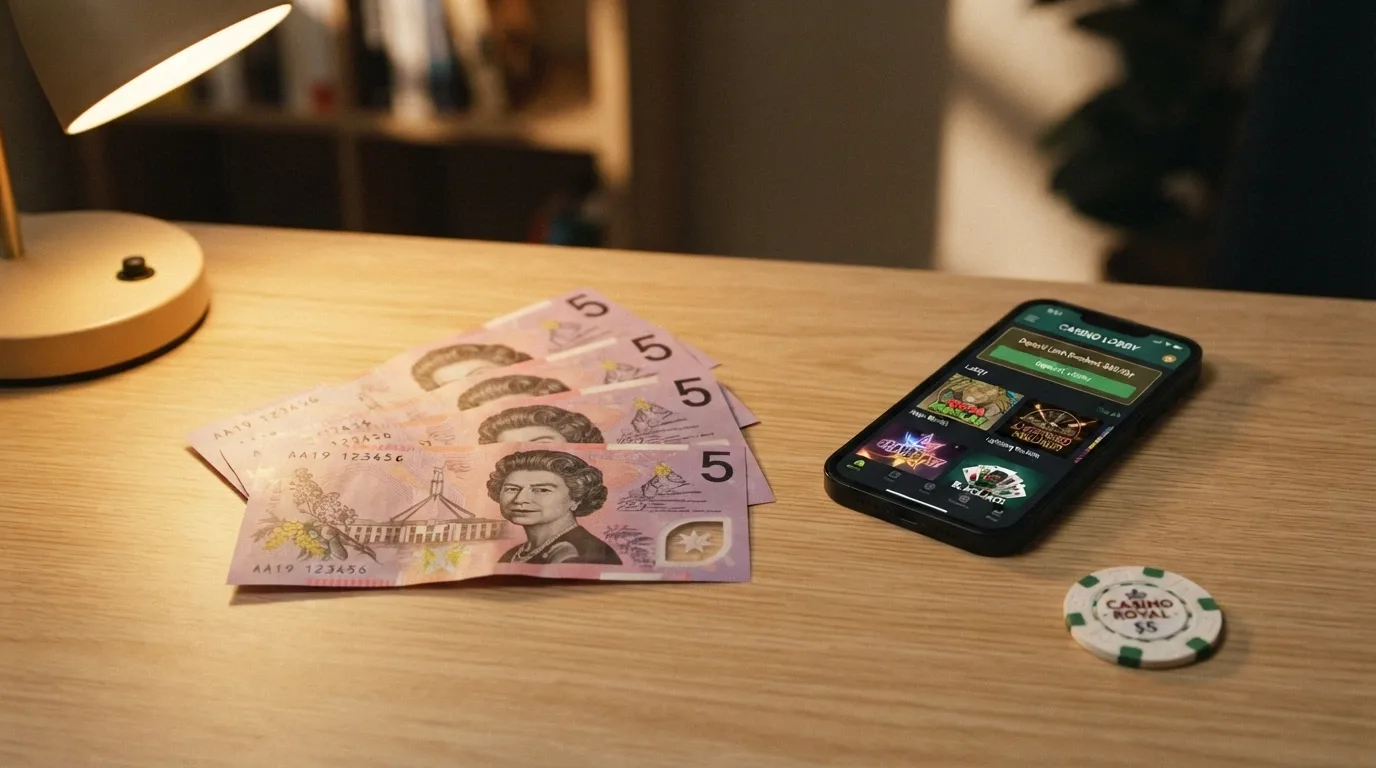
The bonus-trigger trap is the single most important check. Of fifteen AU-facing brands surveyed in 2026, eight enforce a higher minimum for welcome-bonus eligibility than for play. A reader depositing $5 expecting the headline 100% match will, at most featured operators, deposit without triggering the bonus. The honest read of the bonus terms is the difference between funding an account and getting a matched-deposit offer. A reader who wants the bonus must deposit at the bonus-eligibility minimum, not at the deposit minimum.
The withdrawal minimum is the structural cost most readers overlook. Minimum withdrawals sit at A$25–A$50 at most featured operators, sometimes A$50–A$100. A $5 deposit that wins A$20 sits below the withdrawal floor; a $20 deposit that wins A$30 sits below it; a A$50 deposit that wins A$40 sits below it. A small deposit is a session purchase and, if the session wins, often an unwithdrawable balance until the cumulative balance crosses the floor. Crypto withdrawals have lower floors than fiat withdrawals at most operators, and a crypto-paying reader has more flexibility on small payouts.
The course of action is straightforward. Start small — a $5 deposit caps the downside and tests the cashier. Verify the bonus minimum separately from the deposit minimum — the headline match is meaningless if the bonus floor is A$30 and the deposit is $5. Check the withdrawal minimum before depositing — a $5 deposit at an operator with a A$100 withdrawal minimum is money that cannot come back without further play. Set a loss limit before depositing — the deposit is the loss ceiling, and once it is spent the session is over. Keep the National Gambling Helpline number — 1800 858 858 — in case the session is no longer fun. Never deposit money that cannot be afforded to lose at an unregulated operator with no Australian consumer protection. And never chase a loss with a second deposit; the second deposit does not undo the first loss, and the third deposit does not undo the second.
The offshore trade-off is the structural shape of this market. Australian players have access to a much larger catalogue of pokies than the licensed market offers. The licensed market offers nothing — no online pokies, no online casino games, no in-play betting. The offshore market offers thousands of titles from dozens of providers, with welcome bonuses and loyalty tiers and crypto rails and mobile browser play. The cost is the consumer-protection gap: no BetStop coverage, no Australian regulator to complain to, no Australian court to enforce a withdrawal, and a 2027 bank-blocking perimeter that will narrow the fiat routes to the offshore market. The reader’s decision is whether the catalogue is worth the gap, and the answer is a personal one that no comparison table can produce. The page’s job is to put the figures on the table, name the constraints in the same breath as the opportunities, and leave the reader with enough information to make the call themselves.
Frequently Asked Questions
Will I get in trouble for playing pokies at an offshore casino?
No. The Interactive Gambling Act 2001 targets the providers of prohibited interactive gambling services, not the customers. The individual player is not prosecuted. The penalty scale runs to A$360,000 per day for individuals and A$1.8 million per day for bodies corporate — those penalties apply to the operator, not to you. What you do not have is Australian consumer protection. The ACMA cannot recover money from an offshore operator that refuses a withdrawal, voids a win or closes your account, and Australian courts cannot enforce offshore operator bonus terms.
What is the minimum bet on pokies with a $5 bankroll?
The typical minimum bet on pokies at AU-facing offshore casinos is around A$0.20 per spin. A $5 bankroll buys roughly 25 spins at that floor. Game load times, bonus-feature frequency and volatility all affect how long the bankroll lasts — a high-volatility pokie will run through the 25 spins faster than a low-volatility pokie because the high-volatility title concentrates the same payback into fewer, larger wins. A reader who treats $5 as a 25-spin session has a clear ceiling on what the deposit can do.
Can I withdraw winnings from a $5 deposit?
Sometimes, often not. The minimum withdrawal at AU-facing offshore casinos runs from A$25 to A$50, sometimes A$50 to A$100. A $5 deposit that wins A$20 sits below most withdrawal floors. A $5 deposit that wins A$200 is withdrawable but carries its own constraint: the bonus terms may apply a maximum cashout cap, the KYC process may demand ID, and the payment-method rails may add a fee. The deposit-withdrawal asymmetry is the single most useful thing to check before depositing — and most reviews never frame it.
Does BetStop cover offshore pokies sites?
No. BetStop — the National Self-Exclusion Register — binds Australian-licensed wagering services only. An offshore casino is not licensed in Australia, is not connected to the register, and will keep taking a self-excluded person’s money. 54,859 people have registered with BetStop since its August 2023 launch; 35,135 had active exclusions as of 31 December 2025; 78% of registrants are under 40 and 38% chose lifetime exclusion. The register is the most concrete player-protection tool in the licensed market. The offshore gap is its hard limit.
What happens if an offshore casino blocks my account or refuses to pay?
You have no Australian recourse. The ACMA’s own statement is that “if you use an illegal service, Australian regulators will not be able to help you if you believe the service provider has treated you or another player poorly”. An offshore casino that closes an account, voids a win, or refuses a withdrawal is operating outside the reach of any Australian regulator. The dispute resolution lies with the casino’s own licence jurisdiction — Curaçao, Anjouan, or whichever offshore body holds the licence — and the practical outcome depends on the operator’s own responsiveness. The offshore consumer-protection gap is the structural cost of the route.