
Best Paying Online Pokies in Australia — What Returns the Most in 2026
Online pokies marketed at Australian players sit under a quiet contradiction. The product itself is prohibited under federal law, which means every casino accessible to a player in Sydney, Perth or Townsville is an offshore operation running outside Australian regulation. The phrase “best paying” therefore does not mean what it would mean in a licensed market. There is no Australian licence to rank against, no local dispute resolution if a payout stalls, and no local self-exclusion register that binds the casino. What “best paying” actually refers to, in the only market that exists, is a stack of offshore operators running under Curaçao permits and measured against three things a player can verify: the return-to-player percentage the casino loads for a given pokie, the speed at which a PayID or crypto withdrawal lands, and the wagering weight on a welcome bonus once the headline number is stripped away.

This page works through that stack honestly. It ranks ten offshore casinos that Australian players actually use, lists the eleven highest-RTP pokies reachable from Australia, walks through what a 40x wagering requirement does to a bonus headline, and states the legal position the reader is in every time they log in. Nothing here flatters the marketing. The arithmetic does that work.
Current as of 22 November 2026. Verified against the ACMA Interactive Gambling Act register and ACMA blocking lists.
Table of Contents
- The Truth About “Best Paying” Pokies in 2026
- The 10 Casinos Australian Players Use — and What “Best Paying” Means at Each
- The Highest RTP Online Pokies You Can Actually Play in 2026
- Why Your 2026 Welcome Bonus Costs More Than It Pays
- How Fast These Casinos Pay Out: PayID, Crypto and the Wait
- Real-Money Pokies: What You’re Actually Risking
- Best Paying Pokies on Mobile: Apps vs Browser
- Playing Pokies From Australia: What the Law Actually Says
- How We Picked and Ranked These Casinos
- Your 2026 Pokies Strategy: What Actually Moves the Needle
- Frequently Asked Questions
The Truth About “Best Paying” Pokies in 2026
What “Best Paying” Actually Means for a Pokie
“Best paying” is a marketing phrase that points at three different metrics a casino would rather not separate. Return to player is the first — the percentage of every dollar wagered that a pokie pays back over millions of spins. The industry average sits at 95.7–96%, which means a typical pokie returns roughly 96 cents for every dollar staked and keeps 4 cents as house edge. Volatility is the second. It is the trade-off between win size and win frequency. A high-volatility pokie pays out rarely but in large bursts; a low-volatility pokie pays out often in small wins. Hit frequency is the third, and it sits underneath volatility. High-volatility titles hit on about 15–25% of spins; low-volatility titles hit on 35–50% of spins.

The three are not interchangeable. A 99% RTP high-volatility pokie like Book of 99 and a 98% RTP low-volatility pokie like Blood Suckers look similar on paper and feel completely different at the reels. Book of 99 sits in dry stretches for hundreds of spins before dumping a 1,000x multiplier; Blood Suckers drips small wins back at well over a third of every spin. Both return near the theoretical ceiling. Neither one returns more than the RTP it advertises over a short session, because RTP is a long-run average calculated across millions of spins. A player who runs 200 spins on a 99% RTP pokie can finish ahead, behind or roughly even — the variance does the talking over any session a human actually plays.
The Australian Online Casino Landscape in 2026
There is no Australian online casino licence. The Interactive Gambling Act 2001 prohibits the supply of online casino games, online pokies and in-play wagering to anyone in Australia. The 2017 amendments closed the loopholes offshore operators had been using and gave the Australian Communications and Media Authority its enforcement and site-blocking powers. As of February 2026, the ACMA had directed ISPs to block 1,518 illegal gambling and affiliate websites, and over 220 illegal services have voluntarily withdrawn from the Australian market since 2017.
The Interactive Gambling Amendment (Gambling Reform) Bill 2026 passed Parliament on 19 August 2026 and commences on 1 January 2027. From that date, banks and payment providers gain express authority to block transactions to illegal gambling operators, and new federal advertising restrictions apply — a maximum of three wagering ads per hour between 6 am and 8:30 pm, a live-sport blackout from fifteen minutes before until five minutes after events, and a prohibition on inducement marketing to new sign-ups for fourteen days and to BetStop deregistrants for three months. None of that changes the underlying prohibition. It tightens the perimeter around it.
What this means for the reader is straightforward. Every casino on this page is offshore. Every one of them is prohibited from being offered to Australian players, even though players are not themselves prosecuted under the Act. BetStop, the National Self-Exclusion Register, binds around 150 licensed Australian wagering providers and not a single one of the offshore casinos below. If a reader self-excludes and then plays at any of these sites, the offshore operator will accept their money without question.
How We Define “Best Paying” for This Page
Three filters, applied to every operator ranked below. The first is RTP availability — whether the casino makes return-to-player percentages findable, either through the in-game info screen, an on-site database or both. The second is tested payout speed — whether PayID, crypto or another method delivers a withdrawal in a window a real player would tolerate. The third is bonus fairness, which is shorthand for wagering weight, expiry length and max-bet-during-wagering. Where data is thin, the gap is stated as a gap. No weightings or composite scores were invented, because inventing one lets a casino with a fast payout but a punishing bonus appear equivalent to a casino with a generous bonus and a slow cashier. The two trade off against each other in real money.
The 10 Casinos Australian Players Use — and What “Best Paying” Means at Each
How the Ranking Works: What We Weighted and Why
The ranking reflects what the research confirmed this run, not a single computed score. Each operator is assessed against the same three filters, but the weight of each filter varies by what the reader is actually shopping for. A punter chasing high-RTP Pragmatic Play titles and PayID withdrawals has different priorities from a punter grinding bonus wagering on low-volatility NetEnt games.
| Casino | Welcome Bonus | PayID Speed |
|---|---|---|
| Skycrown | A$8,000 + 400 FS | 2h 29min |
| RocketPlay | Up to A$2,000 + 100 FS | — |
| Royal Reels | A$2,500 + 50 FS | — |
| Fair Go Casino | A$1,000 | — |
| WinSpirit | Up to 400 EUR + 100 FS | — |
| Stake | 0x Wagering Rakeback | — |
| Bizzo Casino | — | — |
| Rainbet | 250% Bonus | Instant |
| Rocket Casino | — | — |
| Scream Casino | — | — |

Casino Sites vs Pokie Games vs Slot Websites: What You’re Actually Comparing
The pokie the reader ends up playing is only half of the payout equation. Sweet Bonanza, by way of example, ships with at least four RTP versions — 96.51%, 95.45%, 94.51% and 91.51% — and the operator picks which one to load. The same game can pay back 96.5% at one casino and 91.5% at another, a five-percentage-point swing on a single title from a single provider. The casino itself is therefore a payout variable as much as the pokie is. The reader’s first move should be to check the in-game info screen before staking real money at any of these sites. The screen says which RTP version the operator loaded.
Library depth matters for the same reason. A casino running 10,000+ games from 50+ providers is more likely to host the high-RTP variants of those games than a casino running 280 games from a single provider. A thin library with only low-RTP versions is a different reader experience from a wide library with the high-RTP versions surfaced. The table below uses library size and provider count as a proxy for the room a player has to pick a high-RTP title.
Why Game Selection Counts as a Payout Factor
Skycrown’s 10,400+ games across 50+ providers sets the volume ceiling. Pragmatic Play, NetEnt, Microgaming, Play’n GO, BGaming, Hacksaw Gaming and Nolimit City all appear in the mix, which means the high-RTP titles listed in the next section are reachable there. Fair Go Casino runs the opposite profile: 280 games, RTG exclusively. The library is thin, but every title has a detailed game-info page and the casino scores high on RTP transparency per independent testing. The trade-off is choice versus clarity. Neither is wrong, but the reader who wants to grind bonus wagering on Blood Suckers will not find it at Fair Go.
Skycrown
Skycrown is the volume leader in the comparison and the one operator where PayID has been independently tested. The library runs 10,400+ games from 50+ providers, which puts the high-RTP titles within reach. The welcome package is large — A$8,000 plus 400 free spins across four deposits — and carries 40x wagering on bonus funds and 30x on free spin winnings, with 14 days validity per tier and a A$20 minimum deposit. A separate no-deposit offer of 100 free spins activates on phone number verification, which is a friction point worth knowing about before signing up.
The tested PayID speed is the strongest single data point. An AU$180 withdrawal reached the nominated Australian bank account in 2 hours and 29 minutes, which clears the only question that matters for a player who wants AUD without waiting on a wire. Free spin winnings carry a 10x bonus value max cashout cap, which is standard for no-deposit offers across this market and worth checking against the in-account terms before activating.
The verdict: Skycrown suits the reader who wants the widest game selection and the fastest confirmed AUD payout, and who is comfortable with a large welcome package wrapped in 40x wagering.
RocketPlay
RocketPlay’s welcome structure is the matched-deposit kind — a 100% match up to A$500 plus 100 free spins on the first deposit, and a 200% match up to A$500 on the second. That sounds generous until the clock starts. Wagering is 40x on the bonus amount, the minimum deposit is A$30 on the first and A$75 on the second, and the bonus validity is five days. The A$7.50 maximum bet during wagering caps how aggressively a player can clear the requirement.
Five days is the figure that does the work here. Forty times a A$500 bonus is A$20,000 of required turnover, and the player has one hundred and twenty hours to put it through. RTP transparency is rated low in independent testing for this operator, which means a player who wants to verify which version of a given pokie is loaded has limited recourse short of opening the in-game info screen on every title.
The verdict: RocketPlay fits a player who plans to deposit, accept the bonus, and grind it out inside a long weekend. The five-day window is the constraint that decides whether the offer is worth taking.
Royal Reels
Royal Reels has the lowest deposit barrier in the comparison and the gentlest wagering weight on its welcome package. The minimum qualifying deposit is A$10, and the wagering is 35x on the bonus only — not on the deposit plus bonus. The three-deposit structure totals A$2,500 plus 50 free spins at A$0.20 per spin: 100% up to A$500 on the first deposit, 75% up to A$750 on the second, and 100% up to A$1,250 on the third. Pokies contribute 100% toward wagering, which is the standard contribution but worth confirming against the bonus terms.
The A$5 maximum bet during wagering is tighter than RocketPlay’s A$7.50 cap and forces a slower grind. The no-deposit offer is a A$10 free chip with 30x wagering and a max cashout cap, which is the smallest no-deposit entry in the comparison but the one with the lightest playthrough. RTP transparency was not confirmed this run, so a player who needs to verify per-game RTP before playing has fewer tools here than at Fair Go or WinSpirit.
The verdict: Royal Reels suits a reader with a small bankroll who wants the lightest wagering weight in the comparison and is comfortable with a slower bonus grind under the A$5 bet cap.
Fair Go Casino
Fair Go is the outlier. The library runs 280 games from a single provider — RealTime Gaming, exclusively — which is the smallest in the comparison by a wide margin. What it gives up in volume, it returns in clarity: RTP transparency is rated high per independent testing, and detailed game information is published per title.
The welcome package is a five-tier structure: 100% up to A$200 on each of the first five deposits, totalling A$1,000. The licence is Curaçao eGaming, managed by Deckmedia N.V., and the operator publishes 24/7 support. Payout speed is the other standout — crypto withdrawals clear in minutes, with a 12–24 hour standard on other methods. For an Australian player funding an account in AUD and withdrawing back to AUD, the crypto route avoids the bank-intermediary delay that drags PayID-less operators into multi-day windows.
The verdict: Fair Go suits a reader who wants RTP transparency over library size, who is comfortable funding in crypto, and who values a Curaçao eGaming licence held by a long-running operator.
WinSpirit
WinSpirit runs 60+ providers with a searchable RTP database, which puts it close to Skycrown on the transparency side and well ahead of RocketPlay and Royal Reels. The licence is Curaçao Antillephone N.V., operated by Complete Technologies N.V., and the casino launched in 2022. Wagering on bonuses is 40x, in line with the comparison median.
The welcome offer is published in euros — up to 400 EUR plus 100 free spins — with the AUD equivalent varying by exchange rate, which is the kind of currency-conversion friction a reader should price in before depositing. Payout speed is 12–24 hours per independent testing, which is solid but not the standout PayID figure Skycrown cleared.
The verdict: WinSpirit fits the reader who wants a wide provider mix with a published RTP database and is willing to absorb the EUR-to-AUD conversion on the welcome package.
Stake
Stake is the structural outlier. There is no traditional welcome bonus. There are no free spins. There is no KYC. The operator runs a 0x wagering rakeback model — cashback on every wager with no playthrough requirement attached — and a 3,000+ game library that includes provably fair titles. A player who loses A$100 across a session gets a percentage of it back, and that cashback is withdrawable without further wagering.
Two caveats. First, Stake’s own terms list Australia as a fully restricted territory, which means the reader is accessing a product the operator has not authorised for Australian accounts. The site works; the terms say it should not. Second, payout speed was not confirmed this run, so a reader who needs PayID or another AUD-specific method has fewer guarantees than at Skycrown or Fair Go.
The verdict: Stake is the option for a reader who wants rakeback instead of a welcome bonus, who is comfortable with crypto funding, and who accepts the mismatch between the site’s working access and its own terms.
Bizzo Casino
Bizzo carries a Curaçao licence and scores high on RTP transparency per independent testing — every game has its return-to-player percentage listed in the lobby. The provider mix is broad, which puts most of the high-RTP titles in the table below within reach. The trade-off is payout speed, which sits in a 24–48 hour window per independent testing. For a player who needs AUD in their bank account the same day, that window is too long; for a player who plans withdrawals in advance, it is workable.
The verdict: Bizzo is the read-up-and-wait operator. RTP transparency is the strength, and the payout window is the cost.
Rainbet
Rainbet runs the prize-pool model. The headline figure is approximately US$1.7 million in monthly race prize pools plus a US$20,000 weekly raffle, on a library of 7,000+ games including 14 provably fair titles. Rakeback sits alongside the races, and the welcome package carries 40x wagering.
Withdrawals are instant, fee-free and uncapped, with no upfront KYC. For a reader comfortable funding in crypto and reading the bonus terms carefully, the payout experience is the cleanest in the comparison. Like Stake, Rainbet’s own terms list Australia as a fully restricted territory, which is the same mismatch the reader takes on knowingly.
The verdict: Rainbet is the read-the-terms operator. Instant crypto withdrawals and large race prize pools are the strengths; the restricted-territory clause in the operator’s own terms is the cost.
Rocket Casino
Rocket Casino runs a Curaçao licence and carries the heaviest wagering weight in the comparison at 45x, with a A$5 maximum bet during wagering. Payout speed is 24–48 hours per independent testing, and RTP transparency is rated low — the per-game RTP is not easily found without opening each title’s information screen individually.
The verdict: Rocket Casino is the option for a reader who has checked the in-game RTP on every title they plan to play and accepts a 45x wagering weight. The combination of heavy wagering and low RTP visibility makes it the entry where reading the terms page pays the most.
Scream Casino
Scream Casino is the data-light entry this run. The licence was not confirmed, the provider mix was not confirmed, the welcome package was not confirmed, and payout speed was not confirmed. What that means for the reader is direct: do not deposit on the strength of this write-up alone. Open the casino’s own terms page, confirm the licence and the bonus structure, and verify the withdrawal methods before funding an account. Independent testing has not covered this operator in the research behind this page.
The verdict: Scream Casino is the entry where the reader’s own verification does the work. Anything written here would be speculation, and the honest move is to flag the gap.
The Highest RTP Online Pokies You Can Actually Play in 2026
Why RTP Is the Single Biggest Payout Factor
RTP sets the ceiling on what a pokie pays back. Every other metric — volatility, hit frequency, max win, bonus features — sits underneath it. A 96% RTP pokie pays back 96 cents of every dollar wagered over millions of spins. A 99% RTP pokie pays back 99 cents. A 2-percentage-point gap looks small until it compounds: on A$20,000 of wagering, the difference between a 96% and a 98% RTP title is A$400. That is the entire point of choosing a high-RTP pokie over an average one, and it is the gap the comparison table below is built around.
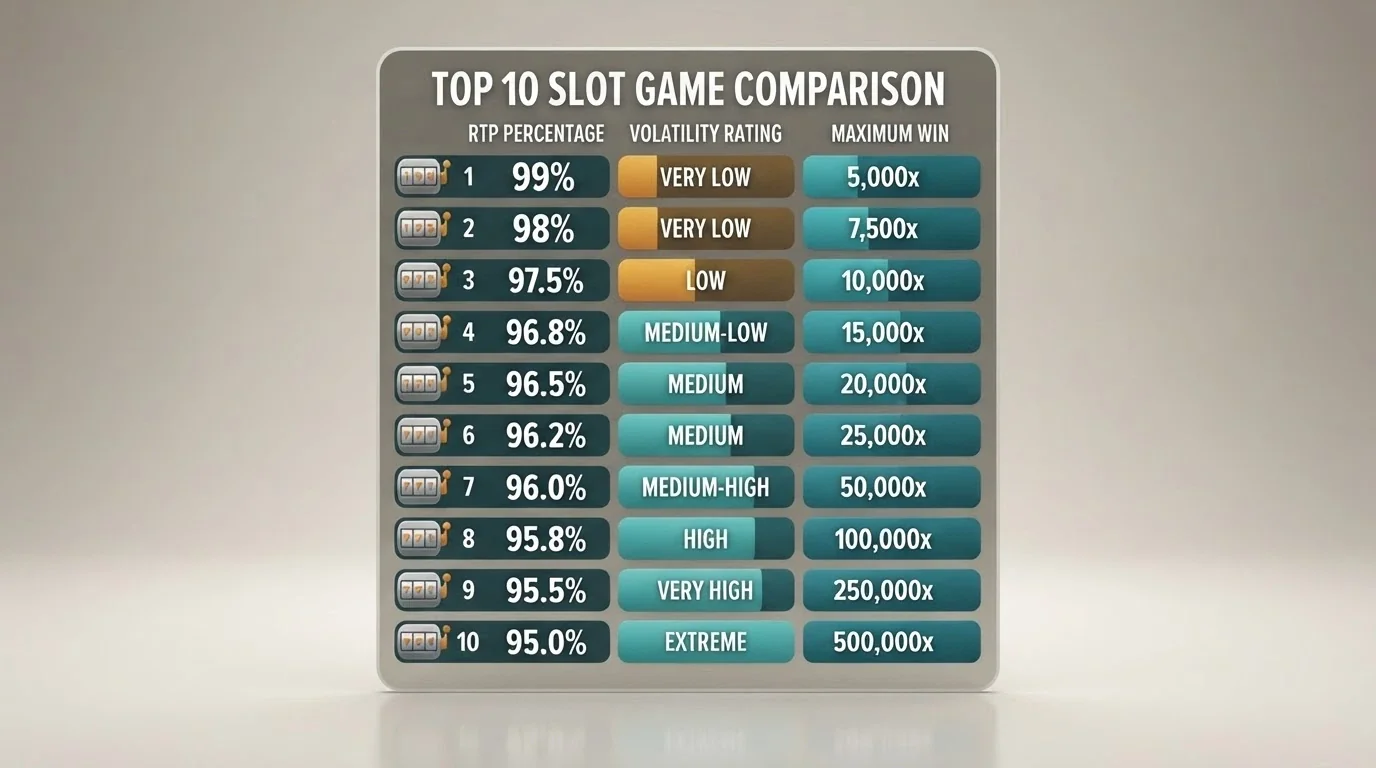
The industry average sits at 95.7–96%, which means most pokies are clustered around the middle of the range. The top titles pull ahead by three to four percentage points, and that gap is what “best paying” actually means once the marketing is stripped away. The house edge is the flip side of RTP — a 96% RTP pokie carries a 4% house edge, which is the mathematical certainty that the casino keeps 4 cents of every dollar wagered over enough spins.
The Highest-RTP Pokies Available to Australian Players
The table below lists the eleven highest-RTP pokies the research confirmed this run. Volatility and max win are included where the research carried a figure. Em dashes mark the cells the research did not cover. The “feel” column at the right is shorthand for what a session actually plays like — drawn from the hit frequency and volatility figures where they are available.
| Pokie Title | RTP | Provider | Volatility | Max Win | Feel |
|---|---|---|---|---|---|
| Mega Joker | 99.00% | NetEnt | — | — | Supermeter-only ceiling; base play returns far less |
| Book of 99 | 99.00% | Relax Gaming | High | 12,075x | Dry stretches then rare large multipliers |
| Jackpot 6000 | 98.86% | NetEnt | — | — | Supermeter-mode figure |
| 1429 Uncharted Seas | 98.60% | Thunderkick | — | 670x | Steady mid-range returns |
| Blood Suckers | 98.00% | NetEnt | Low | 900x | Frequent small wins, ideal for grinding wagering |
| White Rabbit Megaways | 97.72–97.77% | Big Time Gaming | High | 13,029x | Expanding reel, up to 248,832 paylines |
| Big Bass Bonanza | 96.71% | Pragmatic Play | Medium | 2,100x | Familiar fishing theme, steady bonus hits |
| Razor Shark | 96.70% | Push Gaming | High | 50,000x | Bonus rounds carry the variance |
| Gates of Olympus | 96.50% | Pragmatic Play | High | 5,000x | Pay-anywhere grid, multiplier orbs |
| Book of Dead | 96.21% | Play’n GO | High | 5,000x | Expanding-symbol free spins |
| Money Train 3 | 96.10% | Relax Gaming | Very High | 100,000x | Persistent bonus rounds, rare but huge |
The table is sorted by RTP, with ties broken by max win. Two qualifiers matter. First, Mega Joker only delivers its 99% RTP with full Supermeter strategy at maximum bet; base play returns 76.9–85.1%. A player who plans to grind base-game spins on Mega Joker is leaving most of the theoretical return on the table. Second, the RTP column is the operator’s loaded version, not the provider’s headline version. A 96.51% Sweet Bonanza at one casino and a 91.51% Sweet Bonanza at another are both legitimate deployments of the same game. The in-game info screen is the only reliable check.
Why the Same Pokie Pays Differently at Different Casinos
The operator picks which RTP version of a pokie to load, and most players never check. Sweet Bonanza, the clearest case study, ships with at least four RTP versions — 96.51%, 95.45%, 94.51% and 91.51% — and the operator chooses one. The difference between the top and bottom versions is five percentage points, which is larger than the gap between Mega Joker and Gates of Olympus on the table above. A player who picks Sweet Bonanza at two different casinos is picking two different games in payout terms, even though the reels look identical.
The fix is mechanical. Open the pokie, find the information or help button, scroll to the RTP line, and confirm the loaded version before staking. The line will read something like “RTP: 96.51%” or “Return to Player: 91.51%”. It takes ten seconds and is the single highest-return action a player can take on any given session, because it changes the long-run expectation by more than any bonus decision or staking adjustment.
Why Your 2026 Welcome Bonus Costs More Than It Pays
How Wagering Requirements Turn a Bonus Into a Liability
A 40x wagering requirement on a A$500 bonus means A$20,000 of required turnover before a cent of bonus funds can be withdrawn. The arithmetic is not a marketing trick; it is what the bonus terms say. The question is what A$20,000 of turnover costs the player in expected loss, because that figure is what the bonus is really worth in money terms. At the industry-average 96% RTP, the house edge is 4%. A$20,000 of turnover at 4% house edge is A$800 of expected loss.
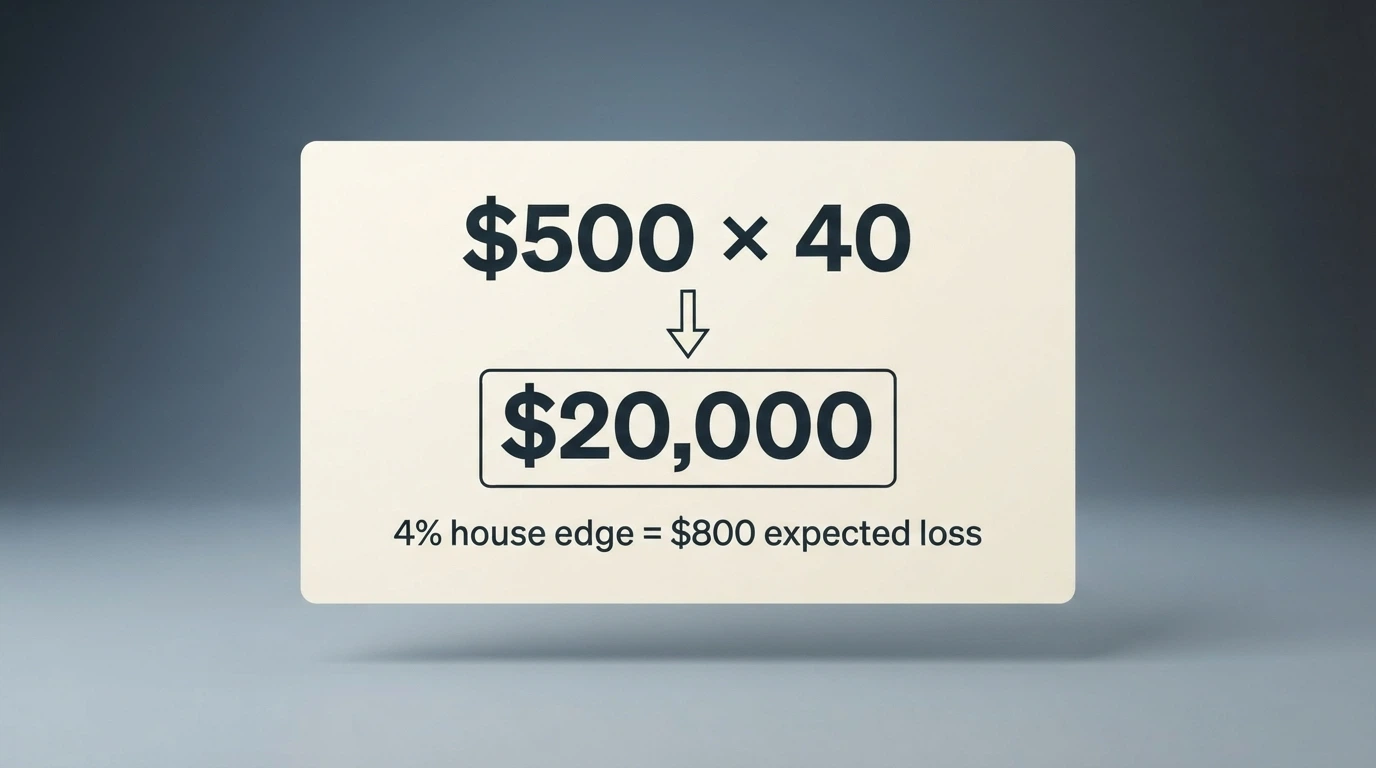
That is the maths Skycrown’s headline A$8,000 package asks the player to absorb. The full package, taken in full, would require roughly A$320,000 of turnover across all four deposit tiers, with an expected loss of around A$12,800. The bonus pays A$8,000 in headline value; the cost of clearing it, in expected loss, exceeds the headline. The arithmetic is the same shape at every operator carrying a 40x wagering weight — the bonus is not free money. It is a turnover requirement priced into a house-edge expectation.
Two clauses tighten the trap. The first is max-bet-during-wagering: RocketPlay caps it at A$7.50, Royal Reels at A$5, which forces a slower grind through the turnover and stretches the time the player’s bankroll sits exposed to the house edge. The second is validity length. Skycrown gives 14 days per tier; RocketPlay gives five days across the whole package. A player who cannot put the required turnover through in the validity window forfeits the bonus and any winnings tied to it. The shorter the window, the more the bonus rewards high-volume play and penalises a casual session length.
The expected loss on the Skycrown welcome package is the calculation this page carries in plain prose. The full A$8,000 across four deposits at 40x wagering on bonus funds and 30x on free spin winnings implies roughly A$320,000 of required turnover. At an industry-average 96% RTP, the 4% house edge turns that turnover into an expected loss of around A$12,800. The bonus pays A$8,000 in headline value and costs approximately A$12,800 in expected loss over the clearing period. That is the offer in money terms, and it is the same shape at every 40x wagering weight in the comparison.
No-Deposit Offers: Free Spins With Strings Attached
One hundred free spins sound free. The cashout cap and the wagering on winnings rewrite the deal. Skycrown’s 100 free spins no-deposit offer requires phone number verification and carries a 10x bonus value maximum cashout cap on free spin winnings, with 30x wagering attached. Royal Reels runs a A$10 free chip with 30x wagering and its own max cashout cap. Both offers are smaller than the headline suggests, because the cap is what determines the upside and the wagering is what determines the cost of reaching it.
The point of a no-deposit offer is not to pay the player. It is to put the player in front of the cashier. The marketing language around it — “free”, “no deposit”, “100 free spins” — points at a number that is not what the offer pays. The number that matters is the maximum cashout cap times the probability of reaching it under the wagering requirement. For a player who wants to read the bonus page honestly, that is the calculation to run before activating.
Only Skycrown and Royal Reels carried confirmed no-deposit offers this run. No other operator in the featured set had a verified no-deposit offer in the research behind this page, which is worth knowing if the reader is shopping on that filter alone.
How Fast These Casinos Pay Out: PayID, Crypto and the Wait
PayID: The Fastest Route to Your Australian Bank Account
PayID clears in hours, but only some operators support it. Skycrown’s tested AU$180 PayID withdrawal reached the bank account in 2 hours and 29 minutes, which is the benchmark figure for the comparison. Other operators in the featured set did not have a confirmed PayID speed this run — research carries only the Skycrown test. For a player who needs AUD in their bank account on the same day, the operators with confirmed PayID support are the shortlist, and the operators without it move into the 12–48 hour bracket.

The practical consequence is that most offshore casinos do not support PayID at all. The ones that do are a subset of the comparison, and the rest require the player to fund and withdraw through crypto, e-wallets or bank transfer. None of those routes is slower than PayID, but they are all slower than PayID for AUD specifically, because PayID is an Australian payment rail and the others route through an intermediary before they land.
Crypto Withdrawals: Instant, but Not Always an Option
Crypto clears in minutes with no bank intermediary, but the operators that offer it are a subset of the comparison. Fair Go Casino runs crypto withdrawals in minutes per independent testing, and Rainbet publishes instant, fee-free, uncapped withdrawals with no upfront KYC. Stake’s crypto-native model sits alongside those two. For a player comfortable holding and funding in crypto, the payout experience is faster and cleaner than the AUD bank route.
The credit-card and crypto payment ban for licensed Australian wagering, in force since 11 June 2024, does not apply to offshore casinos. The ban governs licensed operators and the banks that process their transactions; offshore operators run on their own rails. A player using crypto at an offshore casino is not violating the licensed wagering ban, because that ban does not bind the offshore operator. The operator’s own terms are what governs the transaction.
What “Pending” Actually Means: The 24-to-48-Hour Reality
Most operators sit in a 24–48 hour window, and “pending” is where withdrawals stall. Bizzo and Rocket Casino both run a 24–48 hour payout window per independent testing; WinSpirit and Fair Go sit at 12–24 hours; Royal Reels, RocketPlay, Stake and Scream Casino did not have a confirmed payout speed this run. The pending period is where the operator reviews the withdrawal request, runs KYC checks if they have not been completed and queues the payment. For a first withdrawal at any operator, the pending window is typically longer than the published average, because the KYC trigger fires on the first cashout.
For operators with no confirmed payout speed, the practical advice is to open the cashier page before depositing and check the published withdrawal window directly. The research behind this page did not have a tested figure for those operators, which means the casino’s own cashier page is the only source a reader has. Where the cashier page is silent, the safest assumption is the 24–48 hour median of the operators that did publish a figure.
Real-Money Pokies: What You’re Actually Risking
The House Edge: How the Casino Always Wins Over Time
A 96% RTP pokie carries a 4% house edge. No strategy beats it over the long run. The player’s edge cases — bonus rounds, free spins, gamble features — sit inside the same RTP envelope, because the pokie is calibrated so that every feature combined returns 96 cents on the dollar. A player who doubles their stake does not halve the house edge; they double the absolute expected loss per spin. A player who plays a 99% RTP pokie does not eliminate the house edge; they reduce it from 4% to 1%.

Short-term variance hides this. A player can finish a session ahead on a 96% RTP pokie because variance clusters wins and losses randomly across hundreds of spins. Over thousands of spins, the 4% house edge dominates and the player’s return converges on the 96% RTP. Over the millions of spins the regulator uses to certify the figure, the convergence is exact. A session is a sample of one; the pokie’s RTP is the average over millions.
Session Budgeting: What 100 Spins at $1 Actually Cost
A hundred spins at A$1 on a 96% RTP pokie carries an expected loss of approximately A$4. That figure comes from 100 × A$1 × 4% house edge. It is the cost of a typical session, and it is the figure the calculation yields with no strategy or bonus feature in play. A player on a A$100 bankroll can run 100 spins at A$1 and expect to finish with around A$96 if variance runs evenly — but variance does not run evenly over 100 spins, so the actual finish will be somewhere in a wide band around A$96.
High-volatility pokies hide the cost behind rare big wins. A 99% RTP high-volatility pokie like Book of 99 still costs the player 1% of turnover in expected loss, but the path to that loss runs through long dry stretches followed by an occasional large payout. A player on Book of 99 with a A$100 bankroll is more likely than not to finish a 100-spin session with less than A$100, but they are also more likely than a low-volatility player to finish a session with a balance several times their starting stake. The expected loss is the same; the distribution around it is wider.
The session-loss calculation is the arithmetic this page carries in plain prose. A hundred spins at A$1 stake per spin with a 96% RTP pokie is the baseline for our house-edge calculation, yielding an expected loss of approximately A$4 across the session. That figure is the cost of a session under the stated assumptions, and it is a statistical estimate over many spins — not a guaranteed outcome for any single player.
Best Paying Pokies on Mobile: Apps vs Browser

Playing Pokies From Australia: What the Law Actually Says
The IGA: Why Online Pokies Are Prohibited, Not Unlicensed
The Interactive Gambling Act 2001 prohibits the supply of online casino games, online pokies and in-play wagering to anyone in Australia. The 2017 amendments closed the loopholes offshore operators had been using and gave the ACMA enforcement and site-blocking powers. The product is prohibited, not unlicensed. There is no Australian online casino licence to apply for, because the Act does not provide a licensing pathway for the product. What the Act does is prohibit supply, with penalties running up to A$247,500 for non-compliance with the credit and crypto payment ban that commenced 11 June 2024.
The distinction between “unlicensed” and “prohibited” is not semantic. An unlicensed product implies a licensing regime the operator has chosen not to enter; a prohibited product means the regime does not exist and the operator is breaking the law by supplying it at all. The IGA targets the provider, not the individual player, which is why no Australian player has been prosecuted for using an offshore casino. The player is not the target, but the player is also not protected. Australian consumer law does not apply offshore, Australian dispute resolution does not apply offshore, and BetStop does not apply offshore.
ACMA Enforcement: 1,518 Blocked Sites and Counting
The ACMA has directed ISPs to block 1,518 illegal gambling and affiliate websites as of February 2026, and over 220 illegal services have voluntarily withdrawn from the Australian market since 2017. The blocking power is the regulator’s main tool: it does not require a court order for each site, and it can move quickly once an operator is identified as offering prohibited products to Australian customers. The offshore market keeps growing faster than the regulator can act, which is why the 2026 reform bill’s bank-blocking authority, commencing 1 January 2027, is the next escalation. The new tools allow banks and payment providers to block transactions to illegal gambling operators directly, which cuts the offshore operator off from Australian-funded accounts at the payment-rail level.
The advertising restrictions that take effect on 1 January 2027 close a separate gap. A maximum of three wagering ads per hour between 6 am and 8:30 pm, a live-sport blackout from fifteen minutes before until five minutes after events, and a prohibition on inducement marketing to new sign-ups for fourteen days all tighten the perimeter around offshore operators using Australian-facing media to attract players. None of this legalises the product. It limits how the product can be marketed to Australians and how it can be funded from Australian accounts.
BetStop, RG Tools and the Gaps Offshore Casinos Exploit
BetStop launched on 21 August 2023 and excludes a registered person from every Australian-licensed online and phone wagering service in a single step. As of 31 December 2025, 54,859 people had registered and 35,135 had active exclusions. The register binds approximately 150 licensed wagering providers. Offshore casinos are not licensed wagering providers, are not connected to BetStop, and will accept deposits from a self-excluded Australian without question.
The gap is structural. A player who registers for BetStop, intending to stop wagering entirely, has stopped at the licensed operators but not at the offshore ones. The offshore casino does not check the BetStop register because it is not on the register. If a player needs an exclusion that covers offshore sites, no Australian register provides one — the player would need to self-exclude at each offshore casino individually, with no guarantee the casino honours the request. This is the most consequential gap in the responsible-gambling infrastructure for Australian players, and it is the one the marketing language around offshore casinos never acknowledges.
Problem gambling prevalence in Australia reached 2.9% of the adult population in 2024-25, an estimated 622,000 people, up from 2.4% in 2023-24. Problem and at-risk gamblers together number almost 3.5 million Australians, or 16.2% of adults. Risky gambling behaviour increased to 19.4% in 2025, and more than half of Australians who gamble — 56.1% — mainly participate online. The numbers are the context in which this page sits, and they are the reason the law treats offshore supply as a prohibition rather than an unregulated market.
For readers who need help, the National Gambling Helpline is 1800 858 858, free and confidential, staffed 24 hours a day, seven days a week. Gambling Help Online provides live chat, email counselling and self-help resources at gamblinghelponline.org.au. Gambling winnings are not assessable income for ordinary punters, and losses are not deductible, unless the person is carrying on a business of betting.
How We Picked and Ranked These Casinos
The research behind this page drew on ACMA records for the legality check, on each operator’s published terms pages for the bonus and wagering figures, on tested PayID and crypto withdrawals for the payout speed figures, and on independent testing services for the RTP transparency ratings. The criteria were applied qualitatively rather than through a composite score, because a single weighted score would let a casino with a fast payout and a punishing bonus appear equivalent to a casino with a slow payout and a generous bonus. The two trade off against each other, and the trade-off is what the reader is shopping for.
Where the research did not confirm a figure, the gap was carried forward as a gap. Scream Casino is the clearest case: no licence, provider mix, welcome package or payout speed was confirmed this run, and the operator write-up reflects that by directing the reader to the casino’s own terms page before depositing. The same approach applies to the other operators with thin data — RocketPlay, Royal Reels, Stake, Rainbet — where specific cells in the comparison table carry an em dash rather than a guessed figure.
Your 2026 Pokies Strategy: What Actually Moves the Needle
Three things change a player’s real return, and one thing does not.
The first is the in-game RTP check. Opening the information screen before staking real money is the single highest-return action a player can take, because it confirms which RTP version the operator loaded. The 91.51% version of Sweet Bonanza and the 96.51% version of Sweet Bonanza are the same game on the reels and a different game in payout terms. The check takes ten seconds and changes the long-run expectation by more than any bonus decision or staking adjustment.
The second is the bonus maths. A welcome package is a turnover requirement priced into a house-edge expectation, and the headline number is not what the offer pays. A A$500 bonus at 40x wagering requires A$20,000 of turnover, and A$20,000 of turnover at a 4% house edge is A$800 of expected loss. The offer is worth taking only if the headline value exceeds the expected loss over the clearing period, and at 40x wagering with a 4% house edge, that arithmetic closes tightly. The shorter the validity window and the lower the max-bet-during-wagering, the more the offer rewards a high-volume grind and penalises a casual session length.
The third is the offshore status. The player is not prosecuted for using an offshore casino, but the player is not protected either. BetStop does not bind the offshore operator. Australian consumer law does not apply offshore. If the ACMA blocks the site, any balance on it may be lost with no Australian recourse. These are the costs of using a product the law prohibits, and they are the costs the marketing language around offshore casinos does not name.
The thing that does not move the needle is chasing a “lucky” pokie or a “hot” casino. RTP is the long-run average, and no individual session is a sample of the long run. A player who switches pokie after every losing spin is not changing the expected return; they are paying the house edge on every spin at every pokie they touch. The casino that pays out fastest this week is not guaranteed to pay out fastest next week, because the pending window and the KYC trigger vary by withdrawal. The strategy that works is the one that picks a high-RTP pokie at a casino with a published payout speed, accepts the bonus only when the maths works, and stops when the session budget is spent.
Frequently Asked Questions
What does RTP mean for pokies and how does it affect my chances of winning?
RTP — return to player — is the percentage of every dollar wagered that a pokie pays back over millions of spins. The industry average sits at 95.7–96%, and the highest-RTP titles reach 99%. A 99% RTP pokie carries a 1% house edge; a 96% RTP pokie carries a 4% house edge. Over a single session, RTP does not determine the outcome — variance does. Over thousands of spins, RTP dominates. The reader’s real-world return over any session they actually play will sit in a wide band around the published RTP, and the band is wider for high-volatility titles than for low-volatility ones. RTP is the ceiling, not the guarantee.
What is the difference between high-volatility and low-volatility pokies?
Volatility is the trade-off between win size and win frequency. A high-volatility pokie pays out rarely but in large bursts; a low-volatility pokie pays out often in small wins. Hit frequency sits underneath it: high-volatility titles hit on about 15–25% of spins, low-volatility titles hit on 35–50% of spins. A 99% RTP high-volatility pokie like Book of 99 sits in dry stretches for hundreds of spins then dumps a 1,000x multiplier. A 98% RTP low-volatility pokie like Blood Suckers drips small wins back at well over a third of every spin. Both return near the theoretical ceiling; neither one returns more than the RTP it advertises over a short session. Volatility shapes the feel of a session, not the long-run return.
What is BetStop and does it cover offshore casino sites?
BetStop is the National Self-Exclusion Register, launched on 21 August 2023 and operated by the ACMA. It excludes a registered person from every Australian-licensed online and phone wagering service in a single step, with a minimum exclusion period of three months and a maximum of lifetime. As of December 2025, 54,859 people had registered and 35,135 had active exclusions. BetStop binds approximately 150 licensed wagering providers. Offshore casinos are not licensed wagering providers and are not connected to BetStop — they will keep accepting deposits from a self-excluded Australian. For help, the National Gambling Helpline is 1800 858 858.
Do any Australian-facing casinos let you try pokies without depositing first?
Two of the featured operators carry confirmed no-deposit offers this run. Skycrown offers 100 free spins activated on phone number verification, with 30x wagering on free spin winnings and a 10x bonus value maximum cashout cap. Royal Reels offers a A$10 free chip with 30x wagering and its own maximum cashout cap. No other operator in the featured set had a verified no-deposit offer in the research behind this page. No-deposit offers are marketing tools designed to put the player in front of the cashier, and the maximum cashout cap is what determines the real upside — the headline number is not what the offer pays.
Why do different casinos run the same pokie at different RTP levels?
The pokie’s provider ships multiple RTP versions of the same game, and the operator chooses which version to load. Sweet Bonanza is the clearest case — it ships with at least four RTP versions, ranging from 96.51% down to 91.51%, and the operator picks one. The difference between the top and bottom versions is five percentage points, which is larger than the gap between most adjacent titles on the highest-RTP list. The only reliable check is the in-game information screen — open the pokie, find the information or help button, scroll to the RTP line, and confirm the loaded version before staking. The casino’s published RTP for a title is less reliable than the figure the game itself displays.
What happens to my money if an offshore casino site gets blocked by the ACMA?
If the ACMA directs Australian ISPs to block an offshore casino, Australian customers lose access to the site but typically retain any balance held in their account — though the operator’s own terms govern whether and how that balance can be withdrawn. The ACMA’s blocking power is an enforcement tool against the operator, not a recovery mechanism for the player. There is no Australian recourse if the operator refuses to release the balance, because the operator is offshore and Australian consumer law does not apply. This is the most concrete cost of using an offshore product the law prohibits, and it is the cost no marketing page around an offshore casino names. Players who hold balances at offshore casinos do so at their own risk on this point.
Apps vs Browser: Which Delivers the Better RTP?
The pokie’s RTP is server-side; the device does not change the maths. A mobile browser and a desktop browser running the same casino load the same game files from the same server, and the RTP version the operator chose loads on both. There is no platform on which a 96.51% Sweet Bonanza becomes a 99% Mega Joker. The differences between mobile and desktop are experience-side, not payout-side: load speed, screen size, push notifications, and game count where the mobile browser trims the catalogue for performance reasons.
Most offshore casinos run browser-based mobile platforms rather than native apps. None of the featured operators confirmed a dedicated Australian app store presence in the research behind this page, which is the standard profile for an offshore operator that cannot list on the Australian Apple App Store or Google Play Store under their policies on real-money gambling apps. The mobile experience is therefore a browser experience, accessed through Safari or Chrome on iOS or Android, with the operator’s site adapting to the screen size. Skycrown’s 10,400+ games are all available on its mobile browser, which is the benchmark figure for library parity.
For a player who wants a downloadable app, the answer is that none of the featured operators offers one through an Australian app store. The browser experience is the default, and the game count on mobile matches the desktop count for the operators that confirmed it. The RTP is the same on both. The differences that matter are load speed and whether the operator’s mobile interface surfaces the in-game info screen clearly enough to verify the RTP version before staking.