
Fastest-Paying Online Casinos for Australian Players: What the Tested Withdrawal Times Actually Show
“Instant withdrawal” is the marketing word every fast-payout casino leans on. It is also the word that does the most work on a payout page without doing the most explaining. An offshore brand can stamp “instant” on a cashier screen and still hold a request for twenty-four hours while it runs its own checks, and a licensed bookmaker with a PayID button can clear a withdrawal in under thirty minutes without ever calling itself instant. The page below ranks ten casinos that accept Australian players by their real, tested withdrawal times. The ranking is built on speed, and the context around it — the legal regime, the payment rails, the bonus terms, and the protections that do and do not apply — is built on what those speed numbers actually cost a player.

This comparison is current as of 22 November 2026 and checked against the ACMA register of licensed interactive gambling providers and the Department of Social Services gambling-reform record. Speed figures come from third-party test pages reporting measured deposit and withdrawal times; licensing status was verified against the ACMA register as of 10 July 2026.
Table of Contents
- Why “Instant” Doesn’t Mean Zero Seconds at an Online Casino
- The Legal Reality Australian Players Need to Know Before They Deposit
- Fastest-Paying Casinos Open to Australians in 2026
- SportsBet — The Local Bookmaker’s Payout Speed as a Baseline
- Bet365 — Australian-Licensed Wagering Benchmark
- WestAce — 58-Minute PayPal Withdrawal, No Extra KYC
- SpinBoss — 1h 18m Tested Withdrawal, KYC at Cashout
- SkyCrown — 1h 44m First-Payout Tested
- Cleobetra — Under 2-Hour PayPal, A$1,500 Welcome Bonus
- Kingmaker — 2–4 Hour PayPal, 35x Wagering on A$750 Package
- BetRepublic — 3–5 Hour PayPal, A$1,500 Package at 40x Wagering
- Casinova — 4–8 Hour PayPal, Up to A$3,000 Welcome Package
- Stake — 1–4 Hour Crypto Payouts, No Fiat Cashier Tested
- When a Welcome Bonus Becomes Your Biggest Withdrawal Roadblock
- Payment Methods Ranked by Real-World Withdrawal Speed
- Mobile Withdrawals: Your Phone Isn’t the Bottleneck
- Crypto Payouts: The Privacy-for-Protection Trade-off
- High-Payout Pokies Worth Your Time at Fast-Cashout Casinos in 2026
- Staying Safe: Where to Get Help When Gambling Hurts
- How We Picked and Ranked These Fast-Payout Casinos
- Your Fastest Cashout Route: What the Tested Data Actually Says You Should Do
- Frequently Asked Questions
Why “Instant” Doesn’t Mean Zero Seconds at an Online Casino
The word “instant” is doing three jobs it was never hired to do. It promises zero delay, when the reality is fast approval plus minutes-to-hours on the rail. It implies a universal experience, when the tested times across the casinos below run from twenty-eight minutes to eight hours. And it sounds like a feature of the operator, when most of the time between request and money in the wallet belongs to the payment method, not the casino.
What “Instant Withdrawal” Actually Means at an Online Casino
A real cashout at any online casino runs through three stages, and only one of them is the rail. The player submits a withdrawal request, which lands in the operator’s pending queue. The operator reviews and approves that request, which is where KYC verification, AML screening and the “pending review” clock all live. Only then does the money move — PayID, PayPal, crypto, bank transfer — and only that last leg is what the payment rail controls. Every tested fast payout on the page below is fast because the operator’s approval stage was fast, not because the rail itself was unusual.
Competitor pages that report “instant” cashouts in practice mean minutes-to-hours after approval, with the honest benchmark being same-day rather than zero-delay. Slotspeak, which tested Australian-facing PayID withdrawals across a top ten, reported typical times of ten to forty minutes and a worst case of four hours. PayID sits on the New Payments Platform’s Osko infrastructure, which is why deposits credit in under sixty seconds and withdrawals settle inside the hour in the best cases. “Instant” is a reasonable shorthand for that. It is not a guarantee.
Why Your First Cashout Is Almost Never the Fastest
The first withdrawal is the moment every operator takes its longest look. KYC — verifying the player’s identity against the documents they uploaded at sign-up, or the documents they upload now — is the universal first-payout brake. Even operators that run a light touch at the cashier will trigger full verification on the first cashout, and an AML review will follow if the withdrawal amount crosses an internal threshold. Banking checks add another layer, particularly for new payout methods the operator has not previously processed for that account.
The tested exception is the one that proves the rule. WestAce, the fastest PayPal withdrawal in the dataset, did not request extra KYC during the tested cashout — and that is reported as a tested exception, not the norm. The rest of the offshore set triggers verification at the first payout stage. SkyCrown’s first withdrawal tested at one hour forty-four minutes, and that figure already includes the KYC window. Players who want to know what their second, third and tenth cashout will look like should read the first-payout time as the worst case, not the typical one.
How Payout Speed Separates the Best Casinos from the Rest
Speed is the single dimension on which the casinos in this comparison differ most, and it is also the one the marketing copy spends the least time on. Tested times across the ten operators below run from twenty-eight minutes on PayID to eight hours on PayPal, and that spread is wider than most payout pages suggest. The headline bonus is the number the operator pushes; the headline payout time is the number the player feels.
Method choice multiplies the operator difference. WestAce on PayPal cleared in fifty-eight minutes; the same operator on a slower method would sit closer to the middle of the pack. Stake on crypto averaged one to four hours; on a non-crypto method the same operator would be untested. Picking a fast operator on a slow method, or a slow operator on a fast method, is the commonest way players end up waiting longer than they expected. The pair matters more than either number on its own.
The Legal Reality Australian Players Need to Know Before They Deposit
An Australian player can reach an offshore casino in seconds. They can deposit in a method that takes another second. They can play for an hour and request a withdrawal that clears inside the same sitting. None of that makes any of it licensed. The Interactive Gambling Act 2001 prohibits online casino-style games, online pokies and in-play betting for providers offering those services to customers in Australia, and there is no national online casino licence — states and territories regulate land-based gambling while the Commonwealth regulates online gambling through the IGA.

Online casino-style games, online pokies, live in-play sports betting and overseas gambling websites or apps not licensed in Australia are the services the IGA names as illegal. There is no national online gambling licence; states and territories handle land-based regulation, and the Commonwealth handles online regulation through the Interactive Gambling Act. Access is not the same as legality, and the distinction is what every subsequent line of this page rests on.
The ACMA has had 1,564 illegal gambling and affiliate websites blocked by Australian ISPs since November 2019, and more than 225 illegal services have withdrawn from the Australian market since the enforcement regime was strengthened in 2017. The blocking is real and ongoing. It is also not what protects a player’s balance once it is in an offshore cashier.
Licensed Wagering vs Offshore Casino: The Two-Track Reality
Two of the ten operators below — SportsBet and Bet365 — are Australian-licensed wagering services. They appear on the ACMA register of licensed interactive gambling providers, which contained 222 entries at its last update on 10 July 2026. Neither offers online casino games or pokies legally. They sit on this page as payout-speed benchmarks against which the offshore set is measured, not as destinations for someone who wants to play roulette or spin a pokie in Australia.
The licensed wagering track runs on debit card, bank transfer, PayID/Osko and BPAY. From 11 June 2024, credit cards and crypto are banned as payment methods for licensed wagering, and an operator that fails to enforce the ban faces penalties of up to $247,500. The offshore track, by contrast, accepts the methods the licensed track rejects — including crypto — and runs on the house rules of its own regulator, which is usually Anjouan or Curaçao for the operators in this comparison.
A local bookie licence does not extend to pokies or table games. It does, however, extend to deposit limits, activity statements and the BetStop register that the offshore track ignores. The trade-off is the spine of this comparison: faster payout rails and a casino product on one side, every Australian consumer safeguard on the other.
What the ACMA and BetStop Actually Protect — and What They Cannot
The ACMA’s register is the place a player checks whether a wagering service is legal before using it, and the regulator itself has powers that bite inside the licensed system: complaints, formal warnings, civil penalty proceedings, ISP-level blocking and referrals for enforcement. BetStop — the National Self-Exclusion Register, live since August 2023 — adds a single-step exclusion from every Australian-licensed online and phone wagering service. By the end of the second quarter of FY2025-2026, 54,859 people had registered, and by 31 July 2026 the register held 67,480 registrations with 41,290 exclusions still active; 78% of registrants were under 40, and 38% chose lifetime exclusion.
The register’s honest limit is the offshore gap. BetStop binds Australian-licensed wagering services. An offshore casino is not connected, and will keep accepting a self-excluded person’s deposits. The ACMA cannot recover player funds from an offshore operator, there is no Australian complaints body for offshore disputes, and a site can be blocked while a balance is still on it. The National Gambling Helpline — 1800 858 858, free, confidential and staffed twenty-four hours a day, seven days a week — is the one safeguard that reaches a player regardless of which side of this divide they are on.
Fastest-Paying Casinos Open to Australians in 2026
| Operator | Licence Status in Australia | Tested Payout Speed | Fastest Method Tested |
|---|---|---|---|
| SportsBet | AU-licensed wagering; no legal online casino | — | — |
| Bet365 | AU-licensed wagering; no legal online casino | — | — |
| WestAce | Offshore / unlicensed for online casino | 58 minutes | PayPal |
| SpinBoss | Offshore / unlicensed for online casino | 1 hour 18 minutes | Not specified |
| SkyCrown | Offshore / unlicensed for online casino | 1 hour 44 minutes | Not specified |
| Cleobetra | Offshore / unlicensed for online casino (Anjouan or Curaçao) | Under 2 hours | PayPal |
| Kingmaker | Offshore / unlicensed for online casino (Anjouan or Curaçao) | 2–4 hours | PayPal |
| BetRepublic | Offshore / unlicensed for online casino (Anjouan or Curaçao) | 3–5 hours | PayPal |
| Casinova | Offshore / unlicensed for online casino (Anjouan or Curaçao) | 4–8 hours | PayPal |
| Stake | Offshore / unlicensed for online casino | 1–4 hours | Crypto |
The licensed bookmakers at the top of the table appear without payout figures because no tested PayPal or PayID time was sourced for this comparison; they sit on the page as speed references, not casino destinations. The eight offshore casinos below them are ranked by the fastest tested method available. WestAce’s fifty-eight-minute PayPal cashout is the single fastest tested pokie withdrawal in the dataset.
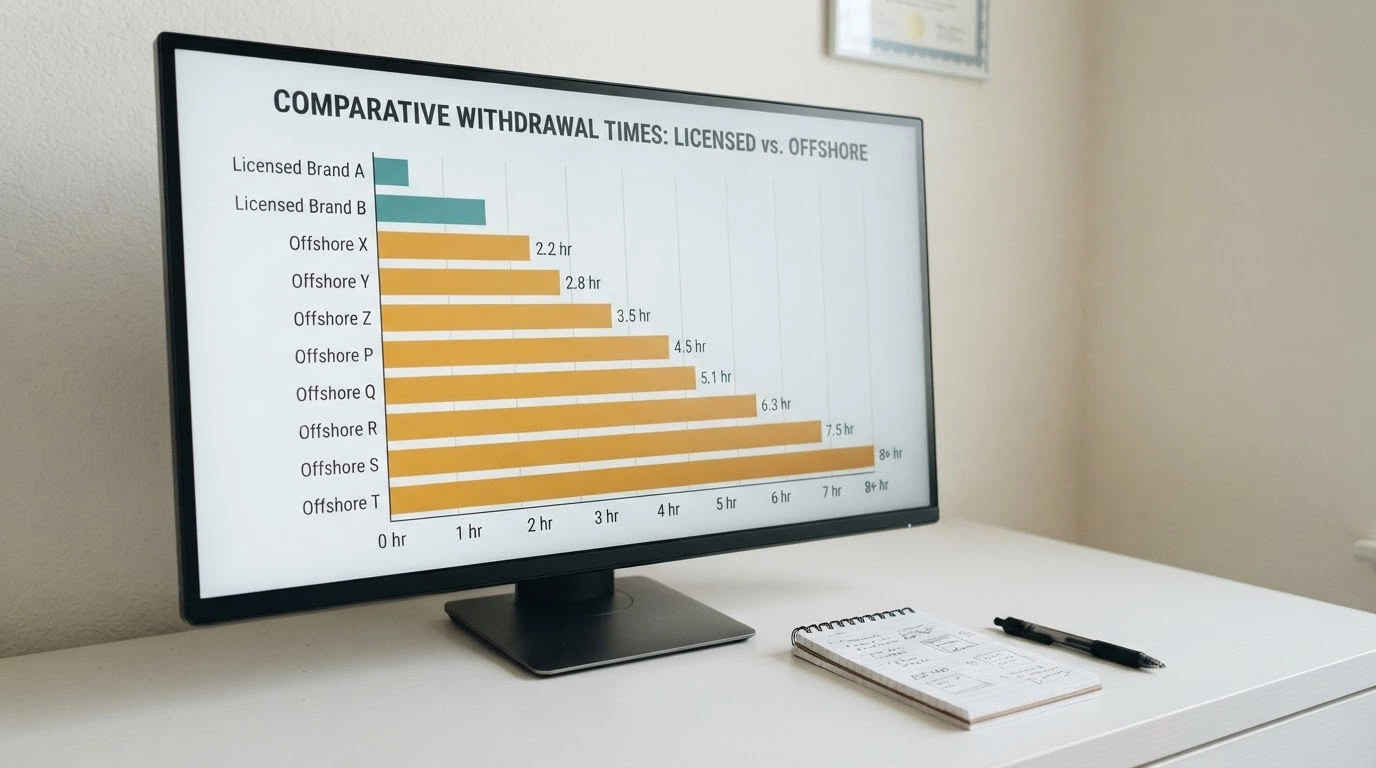
How We Compared Withdrawal Speed Across Ten Casinos
The speed figures above come from third-party test pages that actually moved money: Betsquare for the WestAce, SpinBoss and SkyCrown PayPal and tested-withdrawal figures, OnlineCasinosPayPalCA for the Cleobetra, Kingmaker, BetRepublic and Casinova PayPal times and the bonus and minimum-deposit data, PayoutVerdict for the Stake crypto figures, PokiesAustralia for PayID deposit and withdrawal times, and Slotspeak for the PayID, BTC Lightning and USDT-TRC20 rail speeds. The ACMA register was the check for whether an operator was locally licensed.
A tested time is what the page reports and what the ranking sorts by. An operator’s marketing claim is what the cashier screen says, and the gap between the two is often large — a request submitted at 11 pm may sit “pending review” until the next business day, and no amount of “instant” branding changes that. Bonus terms and KYC timing are excluded from the raw speed figure but surface in the operator write-ups below, because a thirty-minute withdrawal means something different when there is a wagering requirement still to clear.
The Offshore-Licensed Split: What It Changes for Your Payout
A licence registered in Anjouan or Curaçao is not the same as a licence registered in the Northern Territory under the Australian framework, and the difference shows up the moment a payout goes wrong. ACMA enforcement has had 1,564 illegal gambling and affiliate websites blocked by Australian ISPs since November 2019, and offshore operators do not come with Australian consumer protection, an Australian complaints body, or a register that will exclude a self-excluded player.
The practical risks for a payout are concrete: an operator can refuse a withdrawal, void a win, close an account, or simply go dark. The site can be DNS-blocked in Australia while a balance is still held in the cashier. None of those outcomes has an Australian remedy, because the regulator that could compel a refund is the regulator that does not cover the operator. The speed is the same speed; the recourse behind it is not.
SportsBet — The Local Bookmaker’s Payout Speed as a Baseline
SportsBet is an Australian-licensed wagering service, registered on the ACMA register as of 10 July 2026. There is no legal online casino offering in Australia, so there is no SportsBet online casino product to review. The brand appears on this page for one reason: it is the licensed-track benchmark against which the offshore set is measured, and a player who wants to compare a regulated payout against an unregulated one needs a regulated point to compare against.
A licensed wagering payout follows the same rails the rest of the licensed market follows — debit card, bank transfer, PayID/Osko and BPAY — and those rails settle inside the window that PayID and Osko make possible. A tested SportsBet payout time was not sourced for this comparison, so the comparison it enables is qualitative rather than numerical: the licensed track runs on Australian payment infrastructure, while the offshore track runs on whatever the operator’s cashier accepts.
Bet365 — Australian-Licensed Wagering Benchmark
Bet365 sits on the same ACMA register entry as SportsBet, with the same update date of 10 July 2026, and the same absence of a legal Australian online casino product. The brand is one of the larger online bookmakers globally and one of the more recognised wagering names in Australia, which is what makes it a useful second reference point in a comparison that would otherwise benchmark offshore speed against nothing.
The same qualification applies as for SportsBet: the licensed track delivers payouts through Australian rails, and those rails are fast on PayID. A tested Bet365 payout time was not sourced for this run. A reader who wants a number rather than a description can cross-reference the PayID and PayPal rail times in the payment-method table further down this page, because the rail is the rail regardless of which licensed operator runs the cashier.
WestAce — 58-Minute PayPal Withdrawal, No Extra KYC
WestAce is the fastest tested PayPal casino in the comparison, and the fastest tested pokie withdrawal in the dataset. The tested cashout — a fifty-eight-minute PayPal withdrawal on an A$120 amount — came from Betsquare, and WestAce did not request extra KYC during the tested payout, which is the single largest reason that figure is short. Most offshore casinos in the comparison trigger verification at the withdrawal stage, and the time that takes is built into the test number.
WestAce operates offshore and lacks an Australian online casino licence. The fifty-eight-minute number is real, and the protection gap behind it is equally real. A player who wants the fastest tested pokie withdrawal in the dataset will find it here, and a player who wants Australian consumer protection will not.
SpinBoss — 1h 18m Tested Withdrawal, KYC at Cashout
SpinBoss tested at one hour eighteen minutes on a withdrawal reported by Betsquare, which puts it inside the sub-90-minute band but with the catch that verification kicks in at the withdrawal stage rather than at sign-up. The payment method for that test was not specified, which is the kind of gap the reader should know about: a one-hour-eighteen-minute number on PayID reads differently from the same number on a bank transfer, and the underlying rail matters for any future estimate.
SpinBoss is offshore and unlicensed for online casino in Australia. The tested time is the time it took for that specific cashout under those specific conditions. A player who plans to deposit and withdraw with the same method the test used will see a comparable figure; a player who picks a different method is reading a different operator.
SkyCrown — 1h 44m First-Payout Tested
SkyCrown’s first withdrawal tested at one hour forty-four minutes, with KYC completed at the first-payout stage rather than carried over from sign-up. That ordering — KYC triggered by the withdrawal request rather than by the original deposit — is the commonest first-cashout pattern across the offshore set, and the one hour forty-four minutes already includes the verification window.
SkyCrown is offshore and unlicensed for online casino in Australia. The first-payout figure is the worst case for this brand on a tested basis; repeat cashouts should be faster because KYC does not rerun. The payment method used in the test was not specified, so any rail-specific comparison has to wait for the operator’s own cashier to tell the player which methods are available to them.
Cleobetra — Under 2-Hour PayPal, A$1,500 Welcome Bonus
Cleobetra sits at the top of the PayPal group: under two hours on a tested PayPal withdrawal, with the headline bonus carrying A$1,500 and 350 free spins at a 30x wagering multiplier. The minimum deposit is A$15, which is the lowest in the comparison alongside BetRepublic. Cleobetra holds an Anjouan or Curaçao licence — offshore and unlicensed for online casino in Australia.
The welcome offer is sizeable, and the wagering multiple sits at the lower end of the offshore set. 30x on A$1,500 is A$45,000 of required turnover, which is the figure the next section of this page works through. The fast PayPal and the low minimum deposit make Cleobetra a reasonable choice for a player who wants both the speed and the bonus, with the offshore caveat fully in view.
Kingmaker — 2–4 Hour PayPal, 35x Wagering on A$750 Package
Kingmaker tests at two to four hours on PayPal — the middle of the offshore group — with a smaller welcome offer of A$750 and 25 free spins at a 35x wagering multiplier. The minimum deposit is A$30. Kingmaker holds an Anjouan or Curaçao licence, and like the rest of the offshore set it is unlicensed for online casino in Australia.
The wagering multiple here is higher than Cleobetra’s and the bonus is smaller, which means the required turnover is lower in absolute terms but higher as a multiple of the bonus amount. A player who picks Kingmaker is paying slightly more time on the bonus for a slightly slower PayPal cashout. The trade-off is a real one, and it shows up in the next section’s calculation.
BetRepublic — 3–5 Hour PayPal, A$1,500 Package at 40x Wagering
BetRepublic sits further down the speed ranking with a three-to-five-hour PayPal window, but the headline bonus matches Cleobetra at A$1,500 plus 350 free spins. The catch is the wagering multiple: 40x, the highest in the comparison. A$1,500 at 40x is A$60,000 of required turnover, and the minimum deposit is A$15. BetRepublic holds an Anjouan or Curaçao licence.
The package is generous in dollar terms and punitive in turnover terms. A player who wants the bonus amount but not the weeks of play the wagering implies is better off with Cleobetra on the same headline number. A player who plans to play through the requirement regardless will see the speed difference between a 30x and a 40x turnover as a small fraction of the total time.
Casinova — 4–8 Hour PayPal, Up to A$3,000 Welcome Package
Casinova carries the largest bonus headline in the comparison — up to A$3,000 — paired with the slowest tested PayPal window of four to eight hours and a 30x wagering multiplier. The minimum deposit is A$30. Casinova holds an Anjouan or Curaçao licence, and is offshore and unlicensed for online casino in Australia.
A$3,000 at 30x is A$90,000 of required turnover, which is the highest absolute figure in the comparison even at the lower wagering multiple. A player drawn to the headline number should read it alongside the PayPal window and the offshore licence status, because the same package that looks largest also takes the longest to clear and offers the least recourse if the cashout stalls.
Stake — 1–4 Hour Crypto Payouts, No Fiat Cashier Tested
Stake is the outlier in the comparison. The tested speed is one to four hours on crypto, reported by PayoutVerdict, and the operator runs on a crypto-native model without a traditional welcome bonus. No PayPal or PayID test data is available for Stake, and the offer structure is not the deposit-triggered package that defines the other offshore brands.
The one-to-four-hour range is wider than the PayPal windows at the top of the comparison because it includes operator processing time on top of the rail. BTC Lightning settles in under ten seconds on the rail itself, and USDT-TRC20 in one minute forty seconds at best — the gap between those rail speeds and Stake’s tested one-to-four hours is what the operator’s own queue and approval flow add. The speed is real. The bonus-free, crypto-only shape is what defines it.
When a Welcome Bonus Becomes Your Biggest Withdrawal Roadblock
A welcome bonus is the operator’s first contact with the player, and it is also the first place a fast withdrawal starts to slow. The chain runs from bonus amount to wagering multiplier to required turnover to play time, and every link in that chain adds days before any of the bonus money becomes withdrawable cash. The numbers in the comparison above are not abstract — a 30x wagering multiple on A$1,500 is A$45,000 of turnover, and at A$1 per spin that is forty-five thousand spins.
The bonus you claim is the bonus that decides when you can actually cash out. Cleobetra’s thirty-times, Kingmaker’s thirty-five-times, BetRepublic’s forty-times and Casinova’s thirty-times all sit in the same shape — the headline number is the headline number, and the multiplier is what converts it into a workload. Max-cashout caps and game-eligibility rules sit inside the bonus terms and quietly reduce what a player can actually withdraw after the wagering is done, even when the wagering is cleared.
Wagering Requirements: The Fine Print That Locks Your Winnings
A wagering multiplier is the number a player multiplies their bonus by to find the required turnover. Cleobetra’s 30x on A$1,500 is A$45,000. BetRepublic’s 40x on A$1,500 is A$60,000. Kingmaker’s 35x on A$750 is A$26,250. Casinova’s 30x on a package up to A$3,000 is up to A$90,000. Those figures are the wagering requirement in its raw form, and they are the figures a player needs to compare before they pick a bonus on size alone.
A non-sticky bonus — the kind that lets a player withdraw their original deposit plus any winnings from it before the bonus portion is touched — clears faster in practice than a sticky bonus, which mixes the deposit and the bonus into one balance that has to be wagered through together. Pokies usually contribute one hundred per cent to wagering, while table and live games typically contribute less, which is why most bonus-clearing strategy is built around slots. Tracking progress on live roulette therefore requires significantly more total turnover than on pokie games to reach the same withdrawal-ready balance.
The Cost of a Welcome Bonus in Spins and Hours
Cleobetra’s A$1,500 welcome bonus at 30x wagering is A$45,000 of required turnover. At A$1 per spin on an online pokie — a reasonable stake for an AU player clearing a bonus — that is 45,000 spins. At a five-second interval per spin, that is 225,000 seconds, or 62.5 hours of continuous play. The wagering multiplier is what produces the figure; the stake size and spin interval are the assumptions that turn it into time.
A player who treats bonus clearing as a single session will not finish it in a session. A player who treats it as a week of regular play will see the time spread across evenings, with the bonus clearing somewhere between a long weekend and two working weeks depending on how often they log in. The calculation above is a statistical estimate — an average over many spins under the stated assumptions, not a guaranteed outcome for any single player. It tells a reader how long to clear the bonus, not how much the payout will be worth.
Payment Methods Ranked by Real-World Withdrawal Speed
| Payment Method | Deposit Speed | Typical Withdrawal Speed | Best Tested Time | Key Limitation |
|---|---|---|---|---|
| PayID / Osko | Under 60 seconds | 10–40 minutes | 28 minutes (Goldenbet) | Limited offshore casino support |
| PayPal | Instant at supported operators | 2–8 hours after KYC | 58 minutes (WestAce, A$120) | Operator-by-operator availability |
| BTC Lightning | Near-instant | Under 10 seconds | Under 10 seconds | Few operators support Lightning specifically |
| USDT-TRC20 | Near-instant | 5–15 minutes | 1 minute 40 seconds | Smaller operator pool than Bitcoin |
| Bank Transfer | 1–3 business days | 1–5 business days | — | Slowest rail in the comparison |
The method matters more than the brand for raw speed. PayID sits on the New Payments Platform’s Osko infrastructure, which is why deposits credit in under sixty seconds and withdrawals settle in minutes rather than hours. PayPal is the dominant e-wallet in the comparison, with the fastest tested withdrawal at fifty-eight minutes on an A$120 cashout and the slowest offshore PayPal window at four to eight hours. BTC Lightning is the fastest rail by a wide margin, with under-ten-second settlements and fees under A$0.05, though few operators in the comparison support it specifically.
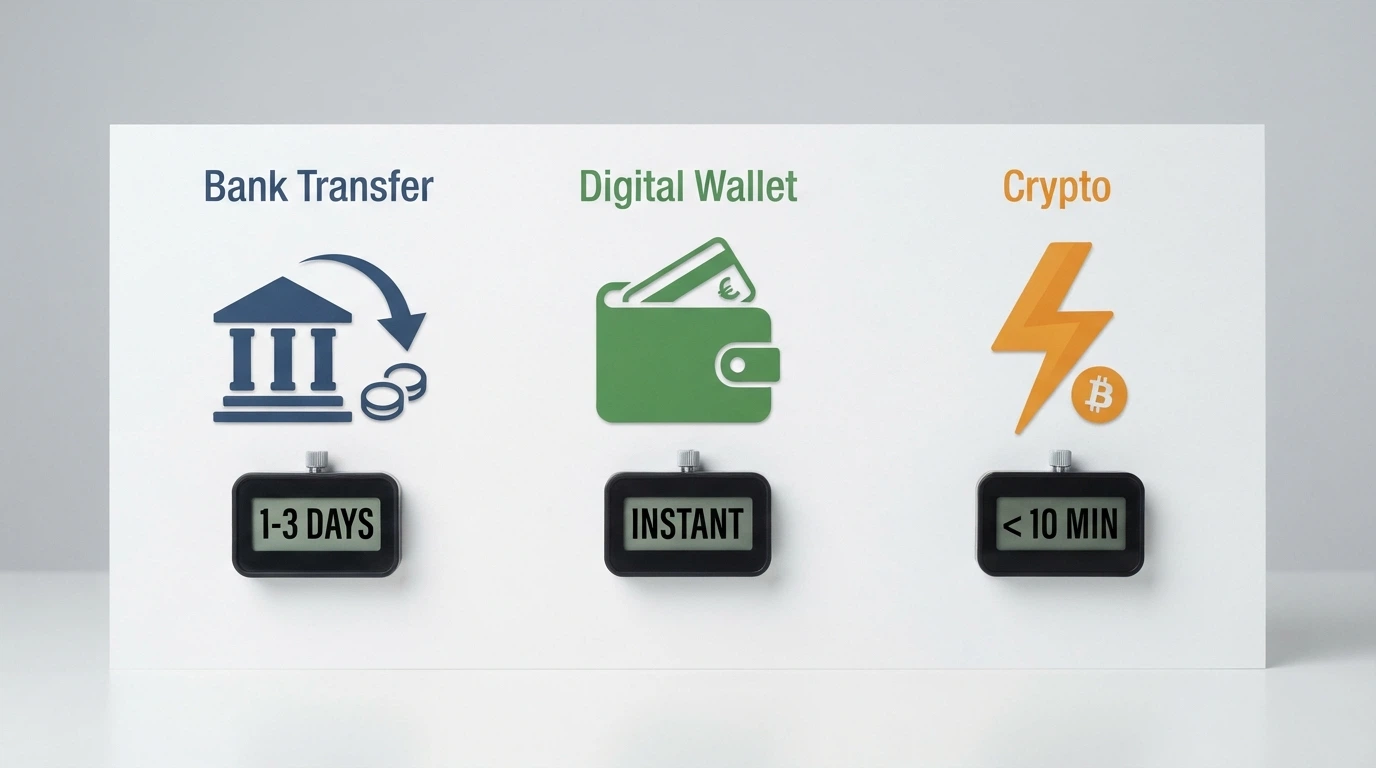
PayID and PayPal: The Fastest AU-Friendly Rails Compared
PayID is the fastest fiat rail in the comparison, and it is also the rail that fewer offshore casinos support. Deposits credit in under sixty seconds at every verified casino tested, and tested PayID withdrawals have run as fast as twenty-eight minutes at Goldenbet and thirty-five minutes at Lucky7. Slotspeak’s wider top-ten test reported a typical PayID withdrawal window of ten to forty minutes, with four hours as the worst case. A player who has PayID available at their chosen casino is looking at minutes, not hours.
PayPal is the rail the offshore set defaults to, and the tested range is wider. WestAce’s fifty-eight-minute PayPal cashout is the fastest in the dataset; the OnlineCasinosPayPalCA tests reported a two-to-eight-hour average after KYC. The difference between the two rails is the difference between a payment method that runs on Australian real-time infrastructure and a payment method that runs on the operator’s own approval queue plus the PayPal network. A player who can use PayID should; a player who cannot should expect PayPal.
Mobile Withdrawals: Your Phone Isn’t the Bottleneck
The device a player uses to request a withdrawal is not what slows the withdrawal down. Mobile browser and app cashiers run on the same backend rails as the desktop cashier, and the approval queue that gates the request is the same queue regardless of whether the request came from a browser tab or a native app. The minor friction points — uploading KYC documents from a phone camera, redirecting to a mobile wallet for PayID/Osko confirmation — are seconds-long steps that do not change the hours-or-minutes decision the rest of the withdrawal turns on.
A “mobile instant withdrawal” offer is about the payment method, not the device. A player withdrawing via PayID on a phone will see the same ten-to-forty-minute window a desktop player sees, and a PayPal withdrawal will run the same two-to-eight-hour average. Where the mobile experience does change the outcome is in how easily a player can complete KYC ahead of time — uploading a driver’s licence and a recent utility bill from a phone camera is faster than finding a scanner, and that step alone can shave a first-payout verification window.
Crypto Payouts: The Privacy-for-Protection Trade-off
Crypto is the fastest rail in the comparison by a margin that no fiat method closes, and it is also the rail that takes a player furthest from Australian consumer protection. BTC Lightning at under ten seconds and USDT-TRC20 at one minute forty seconds are real rail speeds. The licensed Australian framework — which bans crypto as a payment method for wagering from 11 June 2024 — does not bind an offshore casino. The privacy that crypto offers is real. The protection it removes is equally real.

Crypto Withdrawal Speeds: What the Tested Data Shows
The raw rail numbers are the strongest part of the case for crypto. BTC Lightning averages under ten seconds per transaction, with fees under A$0.05 and a small but growing operator pool. USDT-TRC20 settles in one minute forty seconds at best and five to fifteen minutes in typical top-ten conditions. Both rails move faster than any fiat option, and the fees on Lightning are low enough to ignore for any reasonable withdrawal size.
The gap between those rail speeds and the tested operator numbers is what processing adds. Stake, the only crypto-tested operator in this comparison, reported one to four hours on crypto withdrawals. The one-to-four-hour range is the rail plus the operator’s approval flow plus any AML screening the operator runs on the wallet receiving the funds. A player who picks crypto for speed is getting the rail speed, not the operator speed; the operator speed is what an honest comparison reports.
No-KYC Casinos: What You Gain in Speed and What You Lose in Protection
The appeal of a no-KYC casino is the first cashout without the verification window. The reality is that even the lightest-touch operators in the comparison run some form of identity or wallet screening — AML review is the term that covers most of it, and it is the same kind of delay that verification causes, applied at the wallet level rather than the document level. Compliance triggers can still flag a transaction and pause a withdrawal even when no KYC was requested at sign-up.
The Australian protection gap does not close because the operator skips KYC. There is no BetStop coverage offshore, no ACMA recourse if a withdrawal is refused, and no Australian complaints body to appeal to. A player who values speed above all else and is comfortable operating outside the licensed system will find no-KYC and crypto-friendly casinos faster than the licensed track; a player who values protection will find no way to recover those protections once they have left the system.
High-Payout Pokies Worth Your Time at Fast-Cashout Casinos in 2026
| Pokie Title | RTP | Provider | Volatility | Max Win |
|---|---|---|---|---|
| Mega Joker | 99.00% | NetEnt | — | — |
| Book of 99 | 99.00% | Relax Gaming | — | — |
| Big Bass Bonanza | 96.71% | — | Medium/high | — |
| Razor Shark | 96.70% | — | — | 50,000x |
| Sweet Bonanza (highest setting) | 96.51% | — | High | — |
| Sweet Bonanza (lowest setting) | 91.51% | — | High | — |
| Wanted Dead or a Wild | 96.38% | — | — | 12,305x |
| Fire in the Hole xBomb | 96.06% | — | — | 60,000x |
| Book of Dead | 94.25%–96.21% | — | — | — |
RTP — return to player — is the share of wagered money a slot returns over a large number of spins, and the gap between a 99.00% title and a 91.51% version of the same game is the single largest variable a player can control at the pokie screen. The top of the table is Mega Joker and Book of 99, both at 99.00% and both available to Australian players at Wild Fortune. Big Bass Bonanza at 96.71% and Razor Shark at 96.70% sit close behind as widely available high-return alternatives.

The Highest-RTP Pokies Available at Fast-Payout Casinos
The 99.00% RTP figure at the top of the table is the kind of number the marketing copy loves and the fine print undercuts. Mega Joker and Book of 99 sit at that return level, which is exceptional among online slots and the reason they appear on every high-RTP list. The next cluster — Big Bass Bonanza at 96.71%, Razor Shark at 96.70% — is the return level most modern slots cluster around, and the difference between a 96.71% title and a 99.00% title is the difference between a slot that returns roughly seventy cents on the dollar over distance and one that returns roughly ninety-nine.
The Sweet Bonanza RTP trap is the single most important thing a player can check before they spin. Sweet Bonanza ships in at least four RTP versions: 96.51%, 95.45%, 94.51% and 91.51%. The 91.51% version returns roughly nine cents on the dollar less per A$100 wagered than the 96.51% version, and most players never check which version they are spinning. Book of Dead is similarly version-dependent, ranging from 94.25% to 96.21% depending on the operator’s configuration. A high-RTP title at the wrong setting is a marketing promise the cashier quietly breaks.
Staying Safe: Where to Get Help When Gambling Hurts
The help infrastructure for Australian players runs from a single phone number up through a national register and a counselling service, and it is the one part of this page that does not change based on which casino a player has chosen. The National Gambling Helpline — 1800 858 858 — is free, confidential and staffed twenty-four hours a day, seven days a week. Gambling Help Online extends the same support into chat and email. BetStop — the National Self-Exclusion Register — covers every Australian-licensed online and phone wagering service in a single registration, and by 31 July 2026 held 67,480 registrations with 41,290 exclusions still active.

The honest limit on these tools is the one this page has named before. BetStop covers licensed wagering. An offshore casino sits outside that coverage, and a self-excluded person can still deposit and play at one. About 2.1% of Australian adults — roughly 430,000 people — experience problem gambling, and the Australian Institute of Health and Welfare put high-risk gambling at 1.8% in 2022. The numbers are real, and the gap between the licensed and offshore tracks is where the support tools stop reaching.
BetStop, the National Helpline and the Tools That Actually Work
BetStop registration is a single step that excludes a person from every Australian-licensed online and phone wagering service, and licensed operators must not accept deposits or marketing from a registered person. The National Gambling Helpline and Gambling Help Online are free, confidential, available twenty-four-seven and reachable without going through any operator. On licensed platforms, deposit limits, take-a-break tools and activity statements give a player the controls they need to set their own boundaries.
The Dr Kei Sakata observation that captures the gap is the one that belongs on this page: despite an estimated five million wagerers nationwide, including 400,000 high-risk gamblers, just 30,000 individuals had active exclusions through BetStop at the time of the figure. The tools exist. The proportion of players who reach for them is smaller than the proportion who could benefit.
Why Offshore Casinos Sit Outside Every Australian Safety Net
BetStop does not cover offshore casinos. The ACMA cannot recover player funds from an offshore operator. There is no Australian consumer protection regime and no Australian complaints body for offshore disputes. A self-excluded player can still deposit at an unlicensed casino and lose money they intended to stop playing with, and the site can be blocked while a balance is still on it. The Tabcorp penalty of $112,680 for BetStop breaches illustrates the enforcement regime that exists for licensed operators, and the absence of any equivalent regime for offshore operators is what makes the same conduct on the other side of the divide unenforceable.
A player who wants every Australian safeguard working for them stays on the licensed wagering track, accepts that the product set excludes casino games and pokies, and uses BetStop plus the deposit limits and activity statements the licensed operator offers. A player who wants casino games and pokies leaves the licensed track and leaves every safeguard behind, including the helpline number that the offshore operator does not surface on its own cashier page.
How We Picked and Ranked These Fast-Payout Casinos
The ranking above sorts by tested withdrawal speed as the primary criterion. Licensing status appears on every row because it changes what a fast payout is worth, and it is checked against the ACMA register as of 10 July 2026. Payment-method coverage is reported in the method table because the rail is the rail and the operator difference is the operator difference, and either one can dominate the other in a given cashout.

What the ranking does not measure is also part of how it works. Operator marketing claims are excluded where test data exists, because “instant” is what the cashier says and the tested time is what the cashier does. Bonus value is excluded as a ranking input because it sits on the wrong axis — a larger bonus with a higher wagering multiplier is not a faster cashout, and the calculation above shows why. Subjective UX ratings are excluded because the test pages that supplied the speed figures did not supply comparable UX data. What is left is a list that ranks by the one dimension the tested data can rank by, with everything else surfaced in the write-ups.
Your Fastest Cashout Route: What the Tested Data Actually Says You Should Do
The fastest tested route in this comparison is PayID at an operator with a sub-two-hour tested time, or BTC Lightning at an operator that supports it specifically. The next-fastest is PayPal at WestAce on the fifty-eight-minute test. The slowest tested offshore PayPal window is Casinova at four to eight hours. The fastest possible rail — BTC Lightning at under ten seconds — sits inside an operator range of one to four hours because the rail is not the bottleneck.
The single biggest controllable delay is KYC, and the way to remove it is to complete identity verification before requesting a withdrawal rather than at the withdrawal stage. The second biggest controllable delay is bonus wagering, and the way to remove it is to skip the welcome offer if speed is the only goal — a 30x wagering requirement adds days of play before any of the bonus money becomes withdrawable. The third is payment method choice, and the way to manage it is to pick PayID where it is available and accept that PayPal adds hours.
The bottom line is the one this comparison returns to in every section: offshore casinos pay fast, and they leave every Australian protection behind. The speed is real — the fifty-eight-minute PayPal at WestAce and the twenty-eight-minute PayID at Goldenbet are real numbers, measured by test pages, not invented by marketing. The safety is not. A player who wants speed above all else has the data to pick the fastest tested option. A player who values both protection and speed must navigate the licensed market, where the two are not paired in the same way as in the Australian market as it stands in 2026.
Frequently Asked Questions
Are instant withdrawal casinos legal in Australia?
Online casino-style games and online pokies are prohibited for providers to offer to Australian customers under the Interactive Gambling Act 2001, and there is no Australian online casino licence. The casinos that advertise “instant withdrawal” to Australian players are offshore operators, licensed in jurisdictions such as Anjouan or Curaçao, and are not connected to BetStop or to any Australian consumer protection regime. Australian-licensed wagering services can offer fast payouts on PayID and other approved rails, but cannot legally offer online casino games.
What is the fastest withdrawal method for Australian online casinos in 2026?
BTC Lightning is the fastest rail in the comparison, settling in under ten seconds on average with fees under A$0.05, though few operators support it specifically. PayID is the fastest fiat rail, with tested withdrawals of ten to forty minutes typical and a best-tested time of twenty-eight minutes at Goldenbet. PayPal ranges from fifty-eight minutes at WestAce on an A$120 cashout to a four-to-eight-hour offshore window at Casinova, and the operator’s approval queue accounts for most of the difference.
Do fast payout casinos in Australia require ID before the first withdrawal?
KYC verification is the universal first-payout brake at every operator in this comparison, with WestAce the tested exception that did not request extra documentation during the tested cashout. SkyCrown’s first-payout time of one hour forty-four minutes already includes the KYC window, and SpinBoss triggers verification at the withdrawal stage. A player who completes identity verification before requesting a first withdrawal removes the largest single delay they can control.
Which crypto method clears the fastest at Australian online casinos?
BTC Lightning is the fastest, at under ten seconds average with fees under A$0.05. USDT-TRC20 is the next-fastest, at one minute forty seconds at best and five to fifteen minutes in typical top-ten conditions. Stake is the only operator in this comparison with tested crypto payout data, at one to four hours — the operator processing time is what makes that figure longer than the rail itself would suggest, and a player who picks Stake on crypto is getting rail speed plus approval flow.
How do I know whether an online casino is licensed to operate in Australia?
The ACMA register of licensed interactive gambling providers is the official check, last updated on 10 July 2026 with 222 entries. Every Australian-licensed wagering service appears on the register; online casino games and pokies are prohibited and no Australian operator holds a licence for them. A casino offering roulette, blackjack or pokies to Australian players is not on the register because it cannot be, and the offshore licence it holds instead — Anjouan or Curaçao in this comparison — does not carry Australian consumer protection.
Does BetStop cover offshore online casinos?
No. BetStop — the National Self-Exclusion Register — covers every Australian-licensed online and phone wagering service, and a single registration excludes a person from all of them. Offshore casinos are not connected to the register, and a self-excluded person can still deposit and play at one. The ACMA cannot recover player funds from an offshore operator, there is no Australian complaints body for offshore disputes, and a self-excluded player who chooses to gamble at an offshore casino is doing so without any Australian safeguard working on their behalf.
No-Deposit and Free-Spin Offers: Can They Still Pay Out Fast?
Free-spin offers and no-deposit bonuses carry the same wagering chain as deposit bonuses, applied to the winnings rather than to a bonus amount. The 350 free spins at Cleobetra and BetRepublic, and the 25 at Kingmaker, are each subject to whatever wagering multiplier the operator attaches to the spin winnings, and most packages also include a maximum cashout cap that limits what the bonus can ever pay out. Free spins do not shortcut the wagering requirement; they shrink the win that the wagering applies to.
The path from a free-spin win to a cleared cashout still runs through the operator’s approval flow, and the max-cashout cap inside the bonus terms is the silent ceiling on what the whole exercise is worth. Research for this comparison did not surface per-operator max-cashout figures, so the honest framing is structural: free-spin offers lead to real cashouts only when the wagering clears and the cap is high enough to cover the win. A player who plans to claim free spins as their main route to a withdrawal should read the terms before they read the headline.
Crypto vs Fiat: Which Gets Your Money Out Quicker?
Crypto is faster than fiat at the rail level by an order of magnitude. BTC Lightning settles in under ten seconds on average, with fees under A$0.05 per transaction. USDT-TRC20 settles in one minute forty seconds at best and five to fifteen minutes in typical top-ten conditions. Neither figure is what an operator like Stake reports at the cashier, because the operator’s processing time sits on top of the rail — Stake’s tested one-to-four-hour crypto range is the rail plus the approval queue, not the rail alone.
The Australian legal catch sits on the licensed-wagering side of the divide. From 11 June 2024, credit cards and crypto are banned as payment for licensed wagering, with non-compliance penalties of up to $247,500. The ban does not apply to offshore casino operators, which is why Stake can offer crypto to Australian players while SportsBet cannot. A player who picks crypto for speed is also picking the rail that takes them outside the licensed payment system, and the trade-off is the one this comparison returns to in every section that follows.
Mobile Browser vs Downloadable App: Does Either Delay Your Payout?
The difference between a browser-based cashier and an app-based cashier is, for payout purposes, cosmetic. Both send the withdrawal request to the same backend, both go through the same approval queue, and both clear on the same rail once the approval is signed off. A progressive web app (PWA) — a website that installs to a phone home screen and behaves like an app — sits in the same position as either, because the cashier logic is identical.
The mobile wallet redirect is where the device-specific friction shows up. PayID/Osko on a phone confirms inside the user’s banking app in a few seconds, and the redirect back to the casino cashier is automatic. A player who is mid-KYC-upload on a poor mobile connection will see the document upload step drag, but that step is verification, not payout, and it happens before the withdrawal is requested rather than during it. The rail is the rail, on every device.
Live Dealer vs RNG: Does the Game Type Change Your Payout Speed?
The game format does not change the cashout speed. The operator’s approval queue and the payment rail are the same regardless of whether the winnings came from a live blackjack table or a random number generator, and the time the cashier takes to approve a withdrawal does not depend on what the player was playing. What the game type does change is the bonus contribution rate — most live dealer games contribute less to wagering requirements than pokies, which means a live-game player clearing a bonus is working through more total turnover for the same progress.
The implication for a speed-focused player is simple: pick the game format that maximises wagering contribution if a bonus is in play, and pick the format that maximises enjoyment if it is not. The payout itself does not care which one was used. A player who plans to clear a welcome bonus on roulette rather than pokies is paying a hidden time penalty in turnover, and the same payout takes longer to reach the withdrawable stage for reasons that have nothing to do with the cashier.