The Smart Australian’s Guide to Casino Deposits and Withdrawals in 2026
 Available in AU
PayID looks like the obvious answer to anyone comparing casino deposit methods in Australia. It is fast, bank-linked and usually fee-free, but speed is only one part of the decision. The method also changes privacy, cash-out reliability and, most importantly, whether the transaction is being made inside or outside Australian gambling rules.
Current as of 18 October 2026; licence and status claims were checked against ACMA, Licensing NT and the Curacao Gaming Board of Control register.
Table of Contents
- Why Your 2026 Casino Deposit Is a Bigger Decision Than You Think
- Every Casino Payment Method Australians Actually Use in 2026
- The Hidden Infrastructure That Moves Your Casino Money
- What Australian Law Actually Says About Casino Payments
- Safe Casino Payments in Australia: More Than Just Encryption
- The Offshore Casinos Australians Are Depositing At in 2026
- How We Evaluated Each Casino’s Payment Setup
- What Your Casino Deposit Choice Actually Costs You — and Which Method to Pick
- Frequently Asked Questions
Why Your 2026 Casino Deposit Is a Bigger Decision Than You Think
The payment button is the smallest part of a casino transaction. A bank transfer, PayID payment, card charge or crypto transfer may look similar in a cashier, yet each one moves through a different chain of permission, identity checks, settlement rules and legal obligations. A deposit is a request to move money into an account. A withdrawal is a request for the operator to return it. The first can arrive before the operator has learned much about the player. The second is where terms, identity checks and payment controls usually matter.
That distinction explains why a method that feels effortless on deposit can become slow or awkward on withdrawal. It also explains why the best casino payment method for one Australian player may be unsuitable for another. A private e-wallet can keep bank details away from a casino while still attracting a fee or losing bonus eligibility. Crypto can deliver money quickly while carrying the sharpest legal and recourse risks. A familiar card is easy to understand, but gambling merchant blocking can turn it into a declined payment at the point of use.
The Australian setting makes the decision more serious than a routine shopping comparison. The Interactive Gambling Act 2001 prohibits providers from offering online casinos, online pokies and in-play sports betting to people in Australia. There is no Australian online casino licence. The wagering businesses that are licensed in Australia operate in a narrower market, while the casino brands accessible to Australian players sit offshore and do not hold an Australian online casino licence.
The result is not a minor technical distinction. A licensed wagering operator is connected to Australian identity, advertising and self-exclusion systems. An offshore casino is not given the same Australian protections merely because it accepts Australian dollars or displays an Australian flag. The method that works at the cashier does not move the operator inside the local regime.
Payment choice therefore has four dimensions: speed, privacy, cost and legal exposure. Speed covers both deposit arrival and withdrawal completion. Privacy concerns how much banking information reaches the operator or intermediary. Cost includes platform fees, network fees and receiving-bank charges. Legal exposure concerns what the payment says about the operator, which consumer protections apply and what happens if the site disappears, closes the account or refuses a payout.
A useful comparison also needs to separate what is confirmed from what merely appears in a cashier. A method can be advertised, accepted once or labelled “instant” without guaranteeing every later transaction. Likewise, a fast rail cannot remove an operator’s pending period or identity review. A player choosing payment methods for online casinos is really choosing how much uncertainty to accept at each stage.
What Casino Payment Methods Actually Are
A casino payment method is a service that moves money between a player, an operator and a financial or blockchain network. The visible icon in a cashier is only the entry point. Behind it sit a gateway, a payment processor, an acquiring bank or crypto network, fraud systems and the operator’s own release process. PayID uses Australia’s New Payments Platform, often through Osko, to link a player’s bank account to a PayID alias. A card travels through card networks and merchant-acquiring systems. Crypto travels across a blockchain and requires network confirmations.
The difference between deposit and withdrawal begins with who controls the next action. On deposit, the player authorises money to move toward the casino. The rail can be fast because the transfer is largely between financial systems. On withdrawal, the operator has to approve the payment, complete any required checks and then release funds. The same rail may work quickly, yet the operator can hold the transaction before it reaches that rail.
This is why “instant withdrawal” needs careful reading. It can mean that the payment reaches a wallet within minutes after approval. It can also be used loosely by a casino even when an account review, pending period or identity document check comes first. A responsible comparison treats approval separately from settlement. The first belongs to the operator. The second belongs to the payment service. Both affect when money is usable.
Casino payments differ from ordinary online purchases because the transaction is legally and operationally high risk. The operator must contend with chargebacks, bonus abuse, account takeover, stolen cards, identity mismatch and money laundering concerns. Those controls can be invisible on a smooth deposit, then material on the first withdrawal. The cashier may show a card, PayID or e-wallet, but the risk engine behind it is deciding whether to let the transaction continue.
A payment rail should also be distinguished from a payment account. Visa and Mastercard are card networks. PayID is a bank-account addressing service operating over the NPP and Osko ecosystem. PayPal, Skrill and Neteller are e-wallet accounts. Neosurf and CashtoCode are prepaid vouchers. Crypto is a bearer-style digital asset transfer. Each has a different privacy profile, settlement path and ability to receive a return payment.
That language matters because “e-wallet” and “digital wallet” are not interchangeable in Australian rules. The ban on credit-related products, including digital wallets, applies in the licensed wagering setting, while an offshore casino may present an e-wallet as a neutral privacy tool. The label in a cashier does not change the legal category behind it. Players need to read both the payment description and the operator’s status.
How Australians Pay at Online Casinos in 2026
PayID is the dominant bank-linked rail used by Australian players at offshore casinos. It settles as a peer-to-peer transfer through the NPP and Osko to a PayID alias, which makes it feel more like a normal bank payment than a card purchase. The connection to an existing Australian bank account is its practical advantage. Many players already understand the system, and deposits are usually available immediately after the transfer is made.
The rise of PayID is partly a response to card blocking. Australian card issuers use merchant category code 7995 to identify gambling transactions, and the blocking associated with that category extends to offshore casino deposits. A card that worked previously can therefore be declined. Account-to-account payments, particularly PayID, bypass the card decision point. The money still has to pass fraud and account controls, but the player is not asking a card network to approve a gambling merchant payment.
The other prominent alternative is cryptocurrency. It is not the largest share of Australian iGaming payment volume, but it attracts outsized regulatory attention because licensed operators face significant reputational and compliance risk from integrating it. Offshore casinos can accept Bitcoin, Ethereum, USDT and other tokens, which gives crypto a larger visible role in offshore cashier lists than its overall market share would suggest.
Credit cards, credit-related products and digital currencies have been banned as payment for licensed online wagering since 11 June 2024. The ban applies to the licensed Australian regime, not as a description of every payment button shown by an offshore casino. A site asking an Australian player for credit or crypto is therefore giving away more than a funding preference. It is operating beyond the set of payment methods available to licensed local wagering businesses.
E-wallets occupy the middle ground. PayPal, Skrill, Neteller and similar services can separate the casino from the player’s bank account and can support rapid wallet transfers. Their limitation is not always speed. Some operators exclude particular e-wallets from bonus eligibility, and some platforms charge for deposits, withdrawals or currency conversion. A convenient wallet can therefore be a poor choice when the player values an offer more than payment privacy.
Bank transfer, BPAY and prepaid vouchers remain available as specialist routes. Bank-linked methods are slower but familiar. BPAY deposits and withdrawals move over banking windows rather than the always-on NPP. Prepaid vouchers serve a narrower purpose: they can protect a bank account from the operator, but they cannot return winnings to the voucher. Apple Pay and Google Pay appear at some casinos as card-proxied options, so their treatment depends on the card and merchant behind them.
The practical landscape is therefore not “PayID versus every other method”. It is a choice between a fast bank rail, privacy-oriented intermediaries, volatile digital-asset networks, increasingly unreliable card acceptance and slower conventional banking. The more important dividing line is local regulation. A licensed wagering cashier offers a controlled set of deposit routes. An offshore casino may accept a broader range because it is not operating under the same local payment rules.
What Makes a Payment Method the “Best” for You
No single payment method wins every comparison. The right question is which compromise matches the player’s priority and tolerance for risk. A person who values immediate deposits and a simple bank connection will usually find PayID easier to manage than crypto. A person who wants the casino to see as little banking information as possible may prefer PayPal, provided the wallet’s terms and possible bonus exclusion are acceptable. Neither choice makes an offshore operator locally licensed.
Speed needs to be measured over the full withdrawal journey. A PayID deposit can be immediate while a cash-out takes 24–48 hours end to end at many tested offshore operators. Of that period, around 12–18 hours is operator-side processing, with the remainder shaped by the bank’s incoming PayID batch window. Crypto can remove much of that banking wait, but network confirmation, token choice and operator review still determine the actual result.
Cost is broader than a casino’s claim of “no fees”. A no-fee deposit can still carry an e-wallet charge, currency conversion cost, receiving-bank fee or blockchain network fee. International wires can take several business days and attract receiving-bank fees of A$25–40. E-wallet fees of 1–3% appear on some platforms. The cheapest displayed method is not necessarily the cheapest completed transaction.
Privacy also needs an honest limit. PayID links a payment to a bank account and necessarily involves the player’s financial institution. PayPal keeps bank details private from the casino, but gambling transactions may not be covered in the same way as ordinary online purchases. Crypto can avoid a traditional intermediary, yet the public address and transaction record remain visible on the blockchain. Every method exposes some information to somebody.
Withdrawal reliability is the factor most likely to be forgotten during a deposit. A method should be judged by whether a clean, fully verified account can receive money back through it. Minimum withdrawal amounts, weekly limits, pending times and identity checks can make a nominal return route impractical. Fair Go, for example, has a A$100 minimum withdrawal and a A$7,500 weekly cap, while its stated pending time is 48 hours. Those conditions matter as much as the available logos.
The final dimension is legal. If offshore casino access is unacceptable, no payment method fixes the underlying problem. Switching from a credit card to PayID may make the transaction faster, but it does not turn a prohibited casino into a licensed Australian business. The honest choice is between a locally regulated wagering environment, with its product limits, and an offshore casino, with broader game access but no Australian consumer protection.
For a player who nevertheless accepts that offshore setting, PayID is the strongest default because it combines speed, bank familiarity and relatively low cost. Crypto is for someone who treats speed as more important than the sharpest regulatory and recourse risk. E-wallets suit a player prioritising separation from bank details, but only after checking fees and bonus terms. Cards are a familiar backup, not a dependable plan. Bank transfer is the last-resort route when reliability matters more than urgency.
Every Casino Payment Method Australians Actually Use in 2026
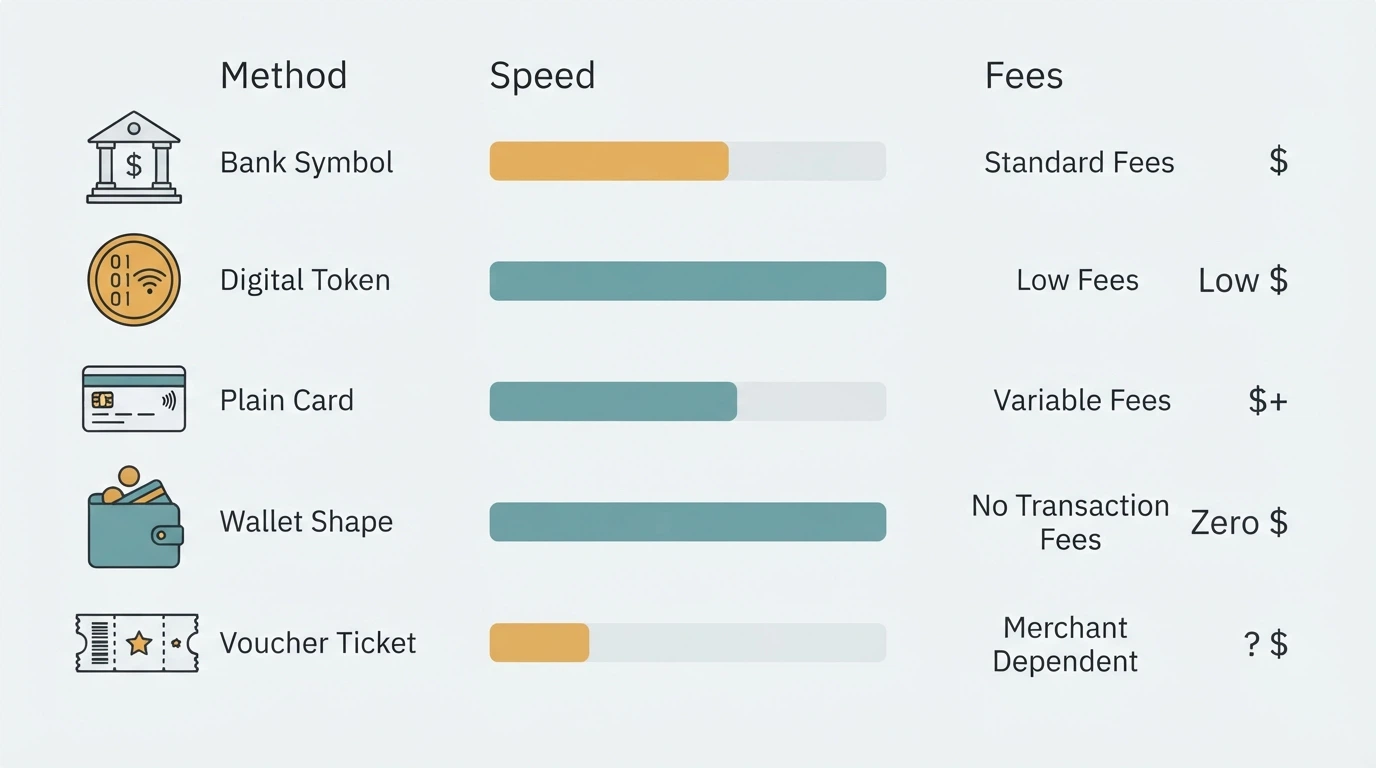
The method-by-method picture is more useful than a single “best” label. Each rail answers a different need, and the one that wins a deposit comparison may lose a withdrawal comparison. The table below keeps those stages separate and shows where the supplied information stops.
| Payment Method | Deposit Speed | Withdrawal Speed | Typical Fees | Available at (Featured Operators) |
|---|---|---|---|---|
| PayID | Instant; typical minimum A$15–20, with some casinos setting A$30 | Instant to 24 hours after approval; tested end-to-end times of 24–48 hours at most offshore operators | Usually fee-free; a common per-casino pattern is a A$30 minimum deposit and A$4,000 daily withdrawal limit | Skycrown; Royal Reels; Betfair Australia |
| Cryptocurrency | Network-dependent; USDT on Tron confirms in 1–3 minutes, while ETH commonly takes 6–8 hours | Operator results range from instant to roughly 10 minutes at Rainbet and 1–2 hours in tested Stake withdrawals | USDT on Tron network fees are under A$2; ETH varies with gas and network load | RocketPlay; WinSpirit; Stake; Fair Go; Rainbet |
| Debit cards | May be instant, but issuer MCC 7995 blocking can decline the transaction | 3–5 business days at offshore casinos; Betfair Australia states 2–5 days for cards | — | RocketPlay; Skycrown; Royal Reels; WinSpirit; Fair Go; Rainbet; Betfair Australia |
| E-wallets | PayPal deposits tested at 5–8 seconds; other e-wallet deposits are generally instant | Usually 24–48 hours; Betfair Australia can complete e-wallet withdrawals in up to 4 hours and other tested PayPal withdrawals can reach a wallet in 58 minutes | 1–3% on some platforms | RocketPlay; Skycrown; WinSpirit; Betfair Australia; Rainbet |
| Bank transfer and BPAY | BPAY takes 1–2 business days; international transfers are slower | BPAY takes 3–5 business days; international wires range from 4–10 business days | International wires can attract receiving-bank fees of A$25–40; BPAY is usually fee-free | RocketPlay; Royal Reels; WinSpirit; Fair Go; Rainbet; Betfair Australia |
| Prepaid vouchers | Available for deposits; speed not confirmed in the supplied data | Not supported | — | RocketPlay; Fair Go |
The strongest overall pattern is PayID for routine use, crypto for speed and e-wallets for privacy. Cards remain familiar, but issuer blocking makes them less predictable. Bank transfer and BPAY are slower rather than unsafe. Prepaid vouchers solve a deposit problem, not a withdrawal problem.
PayID & Osko — The Dominant Australian Rail
PayID is the default answer for most Australian players who want a bank-linked casino payment without entering card details. It works through the NPP and Osko as a peer-to-peer transfer to a PayID alias. The user’s bank account remains the source of funds, but the casino does not receive the underlying account details in the same way it would through a card payment. That balance between familiarity and separation is why PayID has overtaken older payment habits.
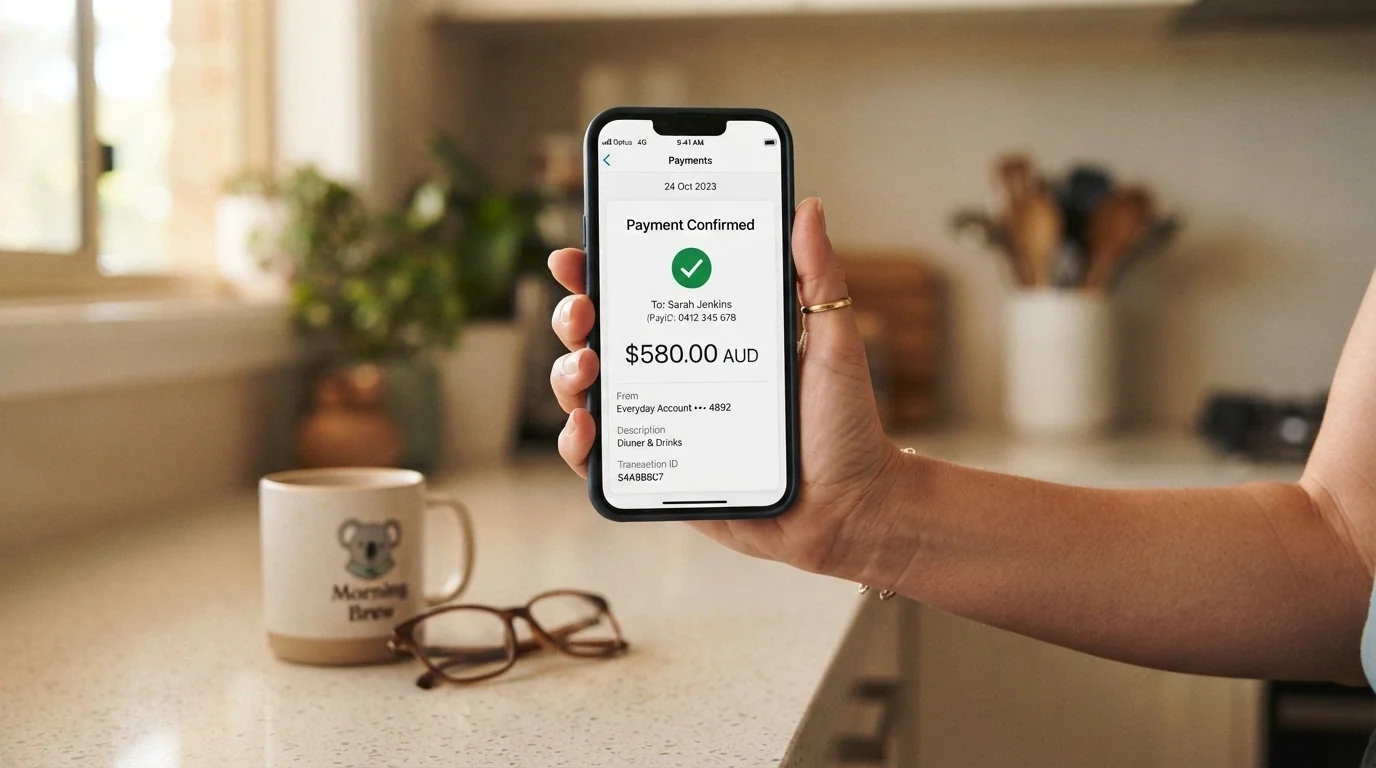
Deposits are generally instant, with typical minimums ranging from A$15–20 and a common per-casino figure of A$30. The practical deposit process is short: the player chooses PayID, enters the amount, follows the operator’s reference instructions and authorises the transfer in the banking app. The exact display can vary, but the rail is the same. Players should still check that the recipient details and payment reference match the casino account before approving anything.
Withdrawal timing needs more care. The method can be instant to 24 hours after approval, while tested end-to-end PayID cash-outs at many offshore operators take 24–48 hours. Approximately 12–18 hours is consumed by operator-side processing. The remaining time sits largely in the bank’s incoming PayID batch window. The transfer rail is not the whole clock.
A typical daily withdrawal ceiling is A$4,000, although the limit is set per casino rather than by PayID as a universal rule. Minimum withdrawals commonly sit between A$25–50. These figures are useful for comparison, but the operator’s stated limit overrides the general pattern. A large bank balance does not help if the casino applies a lower daily or weekly ceiling.
The difference between the deposit and withdrawal wording matters. “Instant” after approval is not the same as instant from the moment the cash-out button is pressed. If a request enters a pending queue for a day, PayID’s speed begins only when the operator releases it. Anyone comparing payout claims should ask what counts as the start time.
PayID is also not available at every offshore casino in the featured set. Skycrown, Royal Reels and Betfair Australia list it; the other offshore operators do not have a confirmed PayID route in the supplied data. Absence from a cashier is not evidence that the method is universally unavailable, but it does mean a player should not assume it exists. A payment method is only useful when the chosen operator supports the player’s country and account.
For most readers, PayID remains the soundest first choice among the offshore options because it is instant on deposit, connected to a familiar bank and commonly free. It does not make the casino licensed. The transfer may also expose account activity to the bank. The result is a fast payment with a visible banking trail, not anonymous play and not local legal protection.
Cryptocurrency — Fastest Withdrawals, Highest Regulatory Risk
Crypto is the speed leader when the operator completes its review. It also carries the clearest warning label. The Interactive Gambling Act setting prohibits online casino provision, while the credit and digital-currency payment ban applies to licensed wagering. An offshore casino’s decision to accept crypto puts it outside the local payment rules that apply to licensed Australian wagering. Faster money does not make the transaction locally compliant.

USDT on the Tron network, using TRC20, is the fastest specifically measured option. Confirmations take 1–3 minutes and network fees remain under A$2. Rainbet states that approved crypto cash-outs can reach the wallet in roughly 10 minutes, with the process described as instant at the fastest end. Those figures describe the network and that operator; they are not a promise attached to every coin or every casino.
Ethereum shows why token choice matters. ETH withdrawals commonly take 6–8 hours because gas confirmations vary with network load. Stake’s tested crypto withdrawals take 1–2 hours across its supported cryptocurrency options, a separate operator-level result from the USDT network benchmark. The distinction is useful: a fast blockchain can still be delayed by a slow operator, while a quick operator can be held up by a slow network.
Crypto changes privacy without making a player invisible. A bank or card processor is replaced by a blockchain address and a record that can remain publicly visible. A person may not provide a casino with bank details, but the transaction can still be traced across the network. The privacy gain is real, yet it is incomplete. It is technical separation rather than legal anonymity.
The cost language also needs precision. Rainbet charges zero platform withdrawal fees, but that does not remove a blockchain network fee. USDT on Tron is inexpensive in the supplied comparison, while Ethereum gas varies with network conditions. Players should check the withdrawal coin, network and fee payer before moving funds. Sending or receiving the wrong network can create a support problem that no fee comparison predicts.
Crypto is most defensible for a player who already holds digital assets, understands wallets and accepts a volatile asset class alongside gambling losses. It is a poor fit for someone who wants a simple Australian-dollar cash flow, local banking visibility or a clear Australian complaints route. The player may receive funds faster and still have no effective remedy if the operator refuses.
The marketing word here is “instant”. Crypto can make a completed withdrawal feel instant, but approval, account checks and the chosen network still sit in front of settlement. For a player who deliberately prioritises speed and can absorb the legal and operational risk, crypto remains the fastest path. For everyone else, PayID is easier to live with.
Debit Cards — Familiar but Increasingly Blocked
Debit cards are the method most Australians recognise. They are straightforward at ordinary merchants, easy to cancel and widely understood. That familiarity is also their weakness in casino payments. Issuers apply merchant controls to gambling transactions, and MCC 7995 blocking can extend to offshore casino deposits. A valid card with available funds can still be declined because the merchant category, not the card balance, triggered the decision.
The Australian ban on credit cards and credit-related products has applied to licensed online wagering since 11 June 2024. That distinction is essential. A debit card remains one of the legal deposit routes for licensed wagering. An offshore casino that offers a credit card is serving a person outside that licensed Australian arrangement. A credit card option is therefore a signal about the operator’s status, not merely a bonus feature.
Deposits through a debit card may be instant when approved, but approval is no longer dependable. Players who rely on a card as their only funding route can find themselves unable to enter a game or complete a planned deposit. Keeping a second method available is not indecision. It is basic redundancy in a market where the merchant category is actively monitored.
Card withdrawals are slower than PayID or crypto. At offshore casinos, Visa and Mastercard withdrawals commonly take 3–5 business days, and the first cash-out always triggers enhanced KYC. Betfair Australia states a 2–5-day card-withdrawal range, which reflects its regulated wagering setting rather than an offshore casino. The first withdrawal can be slower than the method’s normal published window because identity review is layered on top.
Mandatory KYC is not a defect unique to cards. It is a common anti-fraud and anti-money-laundering control. The card route simply makes the check more likely to be prominent at the first cash-out. Players should expect the operator to verify identity, account ownership and payment source rather than treating a deposit approval as the end of verification.
Cards retain value as a familiar backup. They are not the best foundation for an Australian withdrawal plan. If a card deposit succeeds, the player should not assume the same card will receive a return without additional checks or delay. PayID is stronger on settlement speed; e-wallets offer more privacy; crypto is faster but riskier. The card’s advantage is familiarity, not reliability at the gambling-company boundary.
E-Wallets — PayPal, Skrill, Neteller & the Bonus Catch
E-wallets sit between a bank account and the casino. The player funds a wallet, then uses the wallet balance at the cashier. That arrangement can keep bank details private from the casino and can support fast deposits and withdrawals. It also adds another account, another set of terms and another place where a fee or exclusion can appear.
PayPal has the strongest tested deposit result. Deposits have been measured at 5–8 seconds, while withdrawals typically reach a PayPal wallet within 24 hours. The fastest observed result reached the wallet in 58 minutes. Skycrown’s separate test took 1 hour 44 minutes. The range is a reminder that a platform benchmark and an individual operator result are not interchangeable.
The privacy benefit has conditions. PayPal does not need to disclose a bank account to the casino in the same way as a direct card payment, but gambling transactions may not be covered in the same way as normal online purchases. Players should read the wallet’s terms and understand what is protected if a transaction is disputed. Privacy is not the same as a guarantee.
Skrill and Neteller are commonly available, especially at WinSpirit and Betfair Australia, but some casinos exclude them from bonus eligibility. The same can apply to other e-wallets. This is a material trade. A player can choose a wallet for privacy and then find that the welcome package is unavailable, while a direct PayID deposit would qualify. The cashier method can change the value of the offer before the first spin.
Fees make the comparison less tidy. Some e-wallet platforms charge 1–3%, and currency conversion or wallet-to-bank transfer costs may sit outside the casino’s own fee line. An operator can advertise a free deposit while the e-wallet charges for funding or withdrawing. The final cost is the fee stack, not the first zero.
For a player who values separation from a bank, PayPal is the cleanest measured option, but it is not universally available. Skrill and Neteller offer broad coverage and can be quick after processing, with a meaningful bonus-exclusion risk. An e-wallet is worthwhile when its privacy advantage matters more than promotional eligibility and its total cost is understood.
Bank Transfer & BPAY — Slow but Reliable
Bank transfer and BPAY are the fallback rails. They do not offer the instant deposit experience of PayID or crypto, and they do not have the same privacy profile as an e-wallet. They do use familiar banking systems and can work when a card or specialist wallet is unavailable. Reliability here means a durable route, not a fast one.
BPAY deposits take 1–2 business days, while withdrawals take 3–5 business days. Typical minimum deposits are A$20–30, and the method is usually fee-free. The delay is a product of banking windows. A player who needs to fund an account immediately should not choose BPAY for speed. A player who values a conventional bank trail may accept the wait.
International bank wires are slower still. Tested withdrawal times range from 5–7 business days at Wild Fortune to 4–10 business days at Stake and BC Game. Receiving-bank fees can add A$25–40 per wire. A transfer that appears free at the sending end can therefore become expensive at the receiving end. The amount is not the only cost.
POLi once occupied this space but is no longer a live solution. ANZ decommissioned POLi on 30 September 2023, and the service is no longer available at any casino. PayID and Osko replaced the domestic account-to-account convenience that POLi offered. The change is not a minor interface update; a stale listing should not be treated as a usable payment route.
Some operator pages still list POLi, including the Skycrown data used in the operator comparison. That listing conflicts with the service’s recorded decommissioning. The practical conclusion is to treat POLi as historical, not as a dependable current option. PayID is the domestic alternative, while BPAY and bank transfer cover conventional banking needs.
Bank transfer is best reserved for a player who has no better supported route or is dealing with a large amount and accepts the delay. It is not a way around casino rules or identity checks. The bank will still see the transfer, and the operator will still control approval. Slow money is not protected money.
Prepaid Vouchers & Alternative Methods
Neosurf and CashtoCode let a player fund an account without giving the casino direct bank or card details. A voucher is purchased or funded separately, then its value is entered at the casino. That makes vouchers useful for a player whose main concern is keeping financial credentials away from the operator. Fair Go accepts both, and RocketPlay accepts CashtoCode.
The limitation is absolute. Neosurf and CashtoCode are available for deposits at several offshore casinos but cannot be used for withdrawals. A player who deposits with a voucher must choose a separate return route before the first cash-out. That is not an inconvenience unique to one operator. It is the structure of the voucher system.
RocketPlay sets a A$25 minimum for CashtoCode deposits. Fair Go also accepts Apple Pay and Google Pay alongside Neosurf and CashtoCode. Those mobile wallets are card-proxied options rather than a separate cash-out rail. A player who sees Apple Pay or Google Pay in a cashier should still verify the underlying card, merchant acceptance and withdrawal route.
The absence of a withdrawal path makes vouchers a poor default for a player who expects to move money in both directions. They can be sensible for a small, isolated deposit or for someone who refuses to expose a bank account. They cannot solve the central problem of receiving winnings.
The marketing word is “alternative”. In practice, a voucher narrows the first step while leaving the second unresolved. Treat it as a deposit instrument, not a complete payment method. If no independent withdrawal option is available and clearly explained, the voucher should not be the only funding plan.
The Hidden Infrastructure That Moves Your Casino Money
Every visible payment method depends on infrastructure. The gateway collects transaction details from the casino cashier. The processor routes those details through a payment network. An acquiring bank or other settlement provider moves the funds. The player’s bank or wallet completes the other side. Crypto replaces much of that chain with a blockchain, but it does not remove the operator’s review.
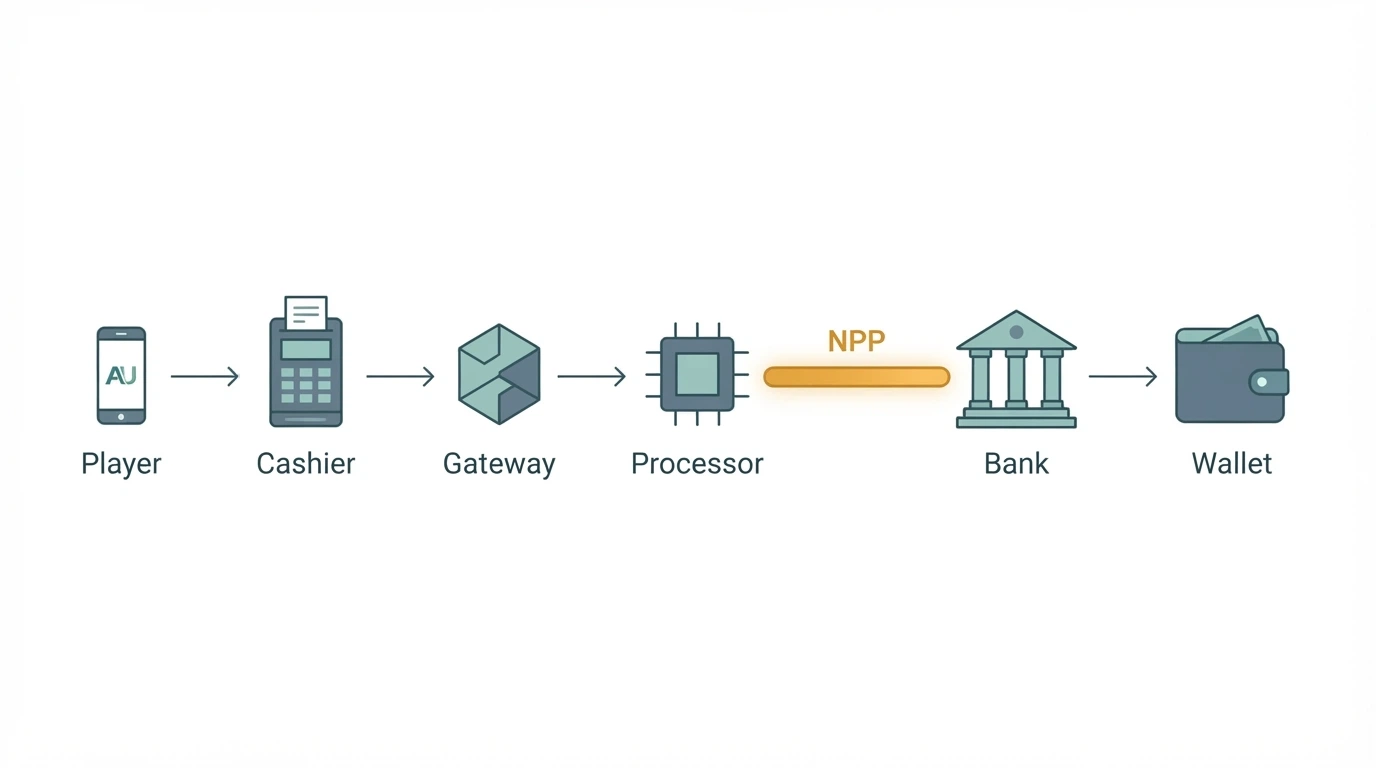
The gateway is the casino’s interface. It collects the amount, currency, account details and return messages, then sends the request to the processor. The processor is the service that handles the route and communicates the result. Neither component decides the game’s outcome, and neither is the same thing as the operator’s bank. A slow payment can originate at any one of them.
Casinos are treated as high-risk merchants because chargebacks, fraud, bonus manipulation and account takeover are persistent concerns. The risk system can compare device, account, payment identity, location and transaction history before approving a deposit. A new payment method, a changed deposit pattern or a mismatch between the account name and payment owner can add review. The same controls may run again on withdrawal.
This is why payment integration is not simply a software installation. The cashier must handle deposits, withdrawals, reversals, failed payments, chargebacks, refunds, identity status and customer messages. An older integration may send a withdrawal through a slower internal queue even when the underlying rail is instant. A newer account-to-account integration can shorten the route, but it cannot instruct an operator to approve a disputed account.
Australia’s Consumer Data Right framework is emerging as an open-banking option for iGaming payments. Early adopters report faster settlement and fewer disputes than traditional debit-card rails. The attraction is direct, consented access to banking data rather than a card-based request that the merchant must classify. It is an integration opportunity, not a guarantee that every casino has adopted it.
The NPP’s PayTo service adds a pull-payment model. A payer can pre-authorise a payment agreement directly from a bank account, allowing the operator to initiate a payment that settles near real time. The distinction from a standard PayID transfer is important: PayTo starts with an agreement and permission, while PayID is commonly used for a direct transfer to an alias. Both rely on Australia’s bank infrastructure, but they integrate differently.
For the player, this infrastructure explains the gap between “supported” and “fast”. A casino can list a method while its queue, risk engine or processor remains slow. PayID withdrawals at most tested offshore operators take 24–48 hours end to end, with 12–18 hours on the operator side. Fair Go adds a 48-hour pending time, and WinSpirit can hold a request for up to 48 business hours. The rail may be ready before the casino is.
Payment Gateways & Processors — the B2B Layer
A payment gateway is the technical door through which a casino receives and sends transaction requests. It packages the amount, currency, token or bank reference, checks the response and passes the result to the cashier. A processor sits behind it and connects the casino to a payment network or acquiring institution. The terms are often used loosely, but the functions are distinct.
The gateway can also be where anti-fraud signals are assembled. It sees whether the request came through the expected device and whether the payment method has been used before. The processor then asks the relevant bank, card network or blockchain whether the transfer can settle. A decline can therefore be a gateway decision, an issuer decision or a network response.
For Australian players, MCC 7995 is a useful example. Card issuers use the code to identify gambling transactions, and the resulting blocking can reach offshore casino payments. A gateway cannot force a card issuer to accept a payment that its category controls reject. This is one reason account-to-account options such as PayID have become more prominent.
The B2B layer also determines how much information reaches the casino. PayID uses a bank alias and a transfer reference. PayPal keeps bank details private from the casino but introduces wallet-specific terms. A card exposes the card network and merchant information. Crypto publishes a transaction record on a public network. The infrastructure has a privacy consequence even when the cashier looks equally simple.
Players do not need to name the gateway to make a decision, but they should understand its limits. A fast blockchain can be held up by a slow processor. A fast bank rail can be held up by a casino queue. Asking whether a method is genuinely available means asking whether the complete path is working, not whether an icon appears in the deposit menu.
How Casino Payment Integration Actually Works
The normal sequence starts when the player submits a deposit. The cashier creates a transaction, the gateway validates the request and the processor routes it. The payment network or blockchain confirms settlement. The gateway then tells the casino to credit the account. A withdrawal reverses the direction: the player requests a cash-out, the operator reviews it, and the same infrastructure sends money back.
The sequence exposes where delays occur. Deposit delays are usually network, fraud or payment-method failures. Withdrawal delays usually begin inside the operator’s own controls: pending status, KYC, source-of-funds questions, bonus completion or a manual review. Only after approval does the gateway and processor become the main timing factor.
PayTo is designed to change the integration model. Its pre-authorised pull-payment capability settles near real time and is becoming more practical for iGaming deposits in the current market. A casino can use a direct account-to-bank permission instead of asking a player to complete a manual transfer each time. The trade-off is that the operator needs a compliant bank connection and a clear payment agreement.
Open banking through the Consumer Data Right takes the data layer further. It can provide consented banking information that supports account verification and payment decisions without relying solely on card details. Early adopters report faster settlement and lower dispute rates than traditional debit-card rails. Those benefits are industry observations, not a promise that an offshore casino has already implemented the technology.
Older cashier systems may use separate plug-ins for cards, vouchers, e-wallets and bank transfers. A failure in one plug-in can leave a deposit accepted but the balance unreconciled. Older operators also tend to add manual queues when a payment name, account or withdrawal amount does not match. The visible result is a slower “payment method” even when the underlying bank rail is not slow.
This is why a player’s practical test should include the return path. Check the minimum withdrawal, the daily or weekly cap, the pending period, the accepted account name and the KYC documents before funding. The deposit button tests only half the infrastructure. A method that cannot return money cleanly is not a complete choice.
Risk Management & Fraud Prevention in Casino Payments
Casino payments are high risk because the operator must protect against stolen cards, account takeover, bonus abuse, money laundering and withdrawals to a third party. Automated systems score the transaction, but a flagged payment can still require a person to review it. The result is not arbitrary delay by default. It is a control system operating at the point where money is most exposed.
KYC is the clearest withdrawal bottleneck. A player may deposit quickly, then face enhanced KYC on the first card cash-out or any later request that falls outside the account pattern. Identity documents, address evidence or payment ownership may be required. A source-of-funds question can be more involved than a routine identity check, and an operator can pause a withdrawal while the answer is assessed.
PayID illustrates the split. Tested cash-outs take 24–48 hours end to end at most offshore operators, with approximately 12–18 hours of operator-side processing. The bank’s incoming PayID batch window accounts for much of the remainder. The payment method is not being held solely because PayID is slow; the casino’s queue is already consuming a substantial part of the clock.
The same pattern appears in operator policies. Fair Go has a 48-hour pending time before its e-wallet, card and bank-transfer windows are measured. WinSpirit states that standard processing can take up to 48 business hours, after which e-wallets may be instant or same-day while cards and bank transfers can take 3–7 business days. A method advertised as instant begins at the wrong point if the request is still pending.
Risk controls can also affect which account should be used. Depositing from a card or wallet that does not belong to the account holder can make verification harder. A withdrawal to a new payment account may be treated as a change-of-payment risk rather than a routine return. The cleanest transaction sequence is to use a payment method in the player’s name from the first deposit and keep its details consistent.
The sharp point is that a fraud check can protect both sides without guaranteeing a payout. It can stop stolen money from entering the platform, yet it cannot ensure that an offshore operator will release legitimate winnings. Encryption and compliance reduce transaction risk. They do not replace the legal protection and complaints route discussed in the section on Australian law.
What Australian Law Actually Says About Casino Payments
Australian law is not a background footnote to this comparison. It is the reason the payment list splits in two. The Interactive Gambling Act 2001 makes it illegal for providers to offer online casinos, online pokies and in-play sports betting to people in Australia. The Act targets the provider. The individual player is not prosecuted under it, but that does not create a local licence or a local remedy for an offshore loss.
Licensed Australian wagering is a different product. Operators may accept debit cards, bank transfers, PayID or Osko and BPAY. Credit cards, credit-related products and digital currencies have been banned for licensed online wagering since 11 June 2024. The ban is a method restriction, not a universal statement that an offshore casino can never display a credit or crypto option. The offshore site is simply making its status visible.
The payment method is therefore a clue, not a defence. A casino accepting PayID is not necessarily licensed, and an operator listing a debit card is not necessarily offering a locally regulated casino product. The product, licence and payment route have to be judged together. A fast and familiar transfer cannot convert an offshore operator into a local wagering business.
The practical legal conclusion is uncomfortable but clear. Anyone seeking an Australian online casino licence is looking for something that does not exist. Anyone choosing an offshore casino is choosing a service outside the Australian consumer-protection perimeter, even when the site accepts Australian dollars and offers a familiar payment button.
The IGA and Why Online Casino Is Prohibited in Australia
The Interactive Gambling Act 2001 prohibits a provider from offering online casino games, online pokies and in-play sports betting to a person in Australia. The Commonwealth framework is enforced by the Australian Communications and Media Authority, which can investigate complaints, issue warnings, bring civil penalty proceedings and ask internet service providers to block illegal services.
The enforcement record shows how active that perimeter is. As of March 2026, ACMA blocking requests had led Australian ISPs to block 1,564 illegal gambling and affiliate websites. More than 225 illegal gambling services had withdrawn from the Australian market since enforcement was strengthened in 2017. These figures describe provider-facing action. They are not a claim that every inaccessible offshore site has been removed.
A site can be blocked while a player still has a balance. Blocking does not reverse a payment or transfer the account to a local operator. It can interrupt access at the exact moment a player wants to check a withdrawal. The threat is not theoretical: a site outside the local regime can close, change its terms or be blocked without an Australian complaints body being able to recover the player’s money.
The Act’s target is deliberately narrow. The individual player is not prosecuted under the IGA. That protects a player from the criminalisation of use, but it leaves the commercial relationship in the offshore environment. There is no Australian consumer-protection guarantee, no ACMA route to recover a refused withdrawal and no BetStop coverage at the offshore casino.
The advertising position follows the same structure. An offshore casino advertising a welcome bonus to Australians is breaking the IGA prohibition itself, not merely breaching a local advertising guideline. The provider cannot avoid the underlying product prohibition by framing the inducement as harmless marketing. Payment choice does not change that analysis.
This is why a page comparing “Australian casinos” must be precise. The featured offshore brands accept Australian players, but they are not Australian online casino licences. Betfair Australia is different because it is a licensed wagering exchange, not an online casino. Treating the two as interchangeable would make the payment comparison legally misleading.
Licensed Wagering vs Offshore Casinos — Two Completely Different Payment Worlds
Licensed Australian wagering accepts a controlled set of payment routes: debit cards, bank transfer, PayID or Osko and BPAY. Identity verification is required. Customer-set deposit limits and activity statements can also apply under state or territory conditions. The product is wagering, not an online casino, and the surrounding consumer framework is materially different.
Offshore casinos accept a broader mixture because they do not operate inside that local wagering framework. The featured set includes Visa, Mastercard, PayID, PayPal, Skrill, Neteller, BPAY, bank transfer, prepaid vouchers and multiple cryptocurrencies. Some also list POLi, although the service was decommissioned in 2023. Breadth is not evidence of local acceptability.
The difference becomes stark when a site offers credit or crypto. A licensed Australian wagering operator cannot use those methods for the relevant transactions under the ban that began on 11 June 2024. An offshore casino can advertise them because it is not bound by the licensed Australian payment regime. The choice is not “credit card versus debit card” in isolation. It is one clue to which regulatory world the player is entering.
BetStop makes the divide visible in another way. The National Self-Exclusion Register covers approximately 150 licensed wagering providers in Australia. Offshore casinos are not connected to it and will keep accepting deposits from a self-excluded person. A payment button can therefore continue to work after a player has taken a step intended to stop gambling, because the offshore service is outside the register.
Licensing is a state and territory matter, with the Northern Territory Racing and Wagering Commission administered through Licensing NT acting as the de facto national licensor for large online bookmakers. Betfair Australia’s NTRC licence is useful as a local benchmark. It does not turn its exchange into a casino, and its payment list should be read as a wagering example, not as a model for an offshore casino.
For a player who wants a regulated Australian payment environment, the correct answer is a licensed wagering service, not an offshore casino dressed up with a different cashier. For a player who still wants casino games offshore, the payment choice can improve speed or privacy, but it cannot supply the missing licence, local complaints process or self-exclusion coverage.
What the 2026 Reforms Change From 1 January 2027
The Interactive Gambling Amendment (Gambling Reform) Bill 2026 passed Parliament on 19 August 2026, and its measures commence on 1 January 2027. This is enacted reform with a future start date, not a proposal to be treated as already binding. The government announced the wider gambling reforms on 2 April 2026, including measures to reduce harm and expand financial counselling services.
The most direct payment change is authority for banks and payment providers to block transactions to illegal gambling operators from 1 January 2027. A PayID transfer, card payment, bank transfer or crypto route that an offshore site accepts today may face a different banking response after the reforms commence. The payment method may remain visible in a cashier while the underlying bank becomes less willing or expressly authorised to stop it.
The advertising changes are broader than payment blocking. From 1 January 2027, direct marketing of wagering inducements is prohibited for 14 days after a customer signs up, for three months after a person deregisters from BetStop and indefinitely for customers identified as being at risk of gambling-related harm. The framework also introduces the wider advertising limits recorded in the reform package, including a cap of three wagering ads per hour during the relevant daytime period and restrictions around live sport, influencers and inducements.
The credit-card and crypto ban for licensed wagering is also subject to an effectiveness review two years after commencement, after June 2026. A review is not a repeal. It is a check on how the existing restriction is operating. The present rule remains the context for any payment method shown by a licensed wagering operator.
For casino payments, the 2027 horizon raises a practical question: which offshore transactions will banks continue to process? A player should not assume that a method remaining in a cashier today will remain frictionless tomorrow. Speed comparisons made now are not a promise about the payment environment after commencement. The safest assumption is that illegal-operator transactions face greater scrutiny, not less.
Safe Casino Payments in Australia: More Than Just Encryption
Payment security has two layers. The first is the rail: encryption, authentication, account permissions, fraud monitoring and network controls. The second is the operator: identity, withdrawal approval, complaint handling and the legal environment in which the business operates. Strong encryption on the first layer cannot repair a weak second layer.

PayID relies on a regulated Australian banking rail. Cards use card-network controls, although MCC 7995 can block a gambling transaction. E-wallets add an account and a private operator. Crypto uses cryptography and network validation, but the public ledger remains traceable. Each rail can be technically secure while still leading to an offshore business with no Australian recourse.
BetStop and the National Consumer Protection Framework are therefore part of payment safety, not optional extras. The framework includes ten measures: prohibition of lines of credit, payday-lender restrictions, customer verification, restrictions on inducements, account closure, voluntary opt-out pre-commitment, activity statements, consistent gambling messaging, staff training and a national self-exclusion register. Those controls are built for licensed wagering, not offshore casino access.
The minimum age for commercial gambling in Australia is 18. Offshore status does not change that age requirement. It does change the enforcement and protection environment in which an underage or otherwise vulnerable person may be asked to deposit.
The practical test is not “does the website have encryption?” It is “what happens if the payment is wrong, the account is closed or the payout is refused?” Without an Australian complaints body or a local licensing remedy, the player may be left with a bank record, a wallet record or a blockchain transaction and no effective way to compel payment.
How Safe Casino Payments Actually Are
The payment rails themselves can be secure. PayID uses bank-grade controls, cards use established payment networks, and crypto uses cryptographic validation. The risk changes at the other end: the business receiving the money may be outside Australian law. A safe transaction is only partly about whether the funds arrive. It is also about whether the player can obtain help if they do not.
PayPal demonstrates the distinction. It keeps bank details private from the casino, but gambling transactions may not be covered in the same way as normal online purchases. The privacy benefit is useful, but it is not a substitute for an Australian consumer-protection route. A wallet can reduce what the casino sees while leaving the player dependent on offshore terms.
Offshore operators also have no local guarantee of payout. A site can change its payment rules, close an account or refuse a withdrawal. ACMA can enforce the Australian prohibition and direct blocking, but it cannot recover an individual player’s money through an Australian complaints process. BetStop does not cover the site. The player may have no practical route to compel payment.
The problem can become more acute when a site is blocked. Australian ISPs had blocked 1,564 illegal gambling and affiliate websites as of March 2026. A balance can remain on a site while access is interrupted. The payment rail may still function, but the operator is no longer reachable in Australia. That is not a remote technical event; it is a risk of operating outside the local system.
A player who nevertheless uses an offshore casino should minimise the exposure. Verify the operator’s legal status and payment terms before depositing. Keep deposits separate from essential money. Use a payment method whose source and return path are understood. Do not assume a successful deposit validates the withdrawal process. A blocked site can still leave a player with a balance, and a verified payment can still end in a disputed cash-out.
The marketing word is “secure”. Encryption can protect data in transit; it cannot promise that an offshore operator will release funds. Safety ends where local enforceability ends. PayID, PayPal and crypto are payment rails, not Australian licences.
Responsible Gambling & Payment Controls — What Actually Exists
BetStop, the National Self-Exclusion Register, launched on 21 August 2023. By the end of the first quarter of the 2025–26 financial year, 49,382 people had registered. As of 30 September 2025, 31,838 people had active exclusions. The minimum exclusion period is three months and the maximum is a lifetime. A person cannot apply to be removed during the first three months.
That system covers approximately 150 licensed wagering providers in Australia. Offshore casinos are not connected to it and will keep accepting deposits from a self-excluded person. This is the most concrete safety difference between the two environments. A self-exclusion can stop a licensed account from accepting money while leaving an offshore cashier open.
The age profile shows how widely self-exclusion is used. About 78% of BetStop registrants were under 40, and 38% chose lifetime exclusion. Those figures describe registered users, not every person harmed by gambling. They do, however, show that self-exclusion is a substantial control rather than a symbolic setting.
The National Gambling Helpline is 1800 858 858. It is free, confidential and staffed 24 hours a day, seven days a week, with online chat and counselling through Gambling Help Online. It is available regardless of which payment method was used. A problem with a payment rail is a problem worth discussing, but it is not a reason to delay seeking support.
Gambling-harm data makes the need for controls concrete. Risky gambling rose from 13.7% in 2024 to 19.4% in 2025, an increase of more than five percentage points and close to a doubling since the COVID-19 lockdowns of 2020–2021. Overall participation declined slightly to 58.8% in 2025, while 56.1% of people who gambled mainly participated online in the previous 12 months. Approximately 5.9% of Australian adults reported harm from another person’s gambling.
The figures are not a prediction about an individual player. They describe a population in which online activity and risky behaviour coexist. About 2.1% of Australian adults, roughly 430,000 people, experience problem gambling, while AIHW put high-risk gambling at 1.8% in 2022. The difference between a payment method and a protection system is that one moves money; the other can stop a harmful pattern or connect a person with help.
Practical controls are simple. Set a deposit limit before funding an account, keep an activity record, take a break when the pattern changes and never treat a fast withdrawal as evidence that a loss has been recovered. Never deposit more than you are prepared to lose at an offshore casino. If self-excluding, use BetStop for licensed wagering and assume an offshore casino remains outside the block. That gap is not a technicality.
The Offshore Casinos Australians Are Depositing At in 2026
The ten operators below are not a list of locally licensed online casinos. Australia prohibits online casino provision, and no operator in this set holds an Australian online casino licence because no such licence exists. The ranking compares payment-method breadth and withdrawal performance as an editorial tool, with Betfair Australia retained as a licensed wagering benchmark rather than misrepresented as a casino.
| Operator | Legal Status in Australia | Payment Methods Accepted | Fastest Withdrawal Speed |
|---|---|---|---|
| RocketPlay | Offshore; no Australian licence | Visa/Mastercard; MiFinity; CashtoCode; BTC/BCH/LTC/ETH/DOGE/USDT; bank transfer | Crypto and MiFinity: instant; bank transfer: 3–7 business days |
| Skycrown | Offshore; no Australian licence | Visa; Mastercard; POLi; PayID; PayPal; Skrill | PayPal tested in 1 hour 44 minutes; other e-wallets up to 24 hours |
| Royal Reels | Offshore; no Australian licence | Mastercard and Visa; PayID; BTC; USDT; bank transfer | — |
| WinSpirit | Offshore; no Australian licence | Visa; Mastercard; Skrill; Neteller; ecoPayz; prepaid cards/vouchers; bank transfers; cryptocurrency | Up to 48 business hours of processing; e-wallets instant or same-day after processing |
| Stake | Offshore; Curacao-licensed description; no Australian licence | BTC; ETH; LTC; USDT and other cryptocurrency; no PayID, card or bank transfer | Crypto withdrawals tested at 1–2 hours |
| Fair Go | Offshore; Curacao licence 1668/JAZ; no Australian licence | Visa; Mastercard; American Express; bank transfer; Apple Pay; Google Pay; Neosurf; CashtoCode; eZeeWallet; BTC; Bitcoin Lightning; ETH; BCH; LTC | E-wallets: 24 hours; 48-hour pending time |
| Rainbet | Offshore; no Australian licence | 25 cryptocurrency tokens; cards; bank transfer; e-wallets; gift cards; AstroPay | Crypto: instant to roughly 10 minutes |
| Betfair Australia | Licensed wagering exchange under the NTRC; not an online casino | Debit cards including Visa, Mastercard and Maestro; Apple Pay; PayPal; Paysafecard; MuchBetter; POLi; PayID; direct bank transfer; Skrill; Neteller | E-wallets: up to 4 hours; PayID: same day in the stated comparison |
| Scream Casino | Offshore; no Australian licence; details unconfirmed | — | — |
| Bizzo Casino | Offshore; no Australian licence; details unconfirmed | — | — |
RocketPlay leads the offshore set on the combination of method breadth and the claim of instant crypto or MiFinity release. Fair Go and Rainbet follow with broad rails, while WinSpirit’s breadth is offset by a long stated processing queue. Betfair Australia sits beside the offshore operators only as a legal and operational benchmark. Scream Casino and Bizzo remain unranked for payment utility because their methods and speeds were not confirmed.
RocketPlay — 100% up to A$1,000 + 100 Free Spins, Crypto-Friendly
RocketPlay accepts Australian players offshore and has no Australian licence. The supplied operator record does not confirm a separate overseas licence, so its legal status should be read as offshore rather than inferred from a logo or a game provider. That distinction matters because the payment list is broad but sits outside the local consumer framework.
Its first-deposit package is a 100% match up to A$1,000 plus 100 free spins. The wagering requirement is 40 times the bonus amount, the bonus validity period is five days and the maximum bet during wagering is A$7.50. The free spins are delivered as 20 per day for five days on Aztec Magic by BGaming, with a A$300 maximum win from the spins. The headline amount is large because the clear-down requirement is large too.
The payment list is more useful than the headline. Visa and Mastercard deposits have a A$25 minimum; MiFinity has a A$30 minimum; CashtoCode has a A$25 minimum; and bank transfer has a A$30 minimum. Bitcoin, Bitcoin Cash, Litecoin, Ethereum, Dogecoin and Tether are also accepted. That is a genuine choice between card, voucher, e-wallet and several crypto routes, but it is breadth across different risk categories rather than a single level of safety.
RocketPlay states that crypto and MiFinity withdrawals process instantly, while bank transfer takes 3–7 business days. All withdrawals are described as fee-free. The instant wording still needs the usual qualification: it begins once the operator has approved the withdrawal. A player should not read it as a guarantee that a new account skips KYC or bonus review.
The payment comparison points to RocketPlay as a high-flexibility option, but the bonus is the sharper warning. A$1,000 at 40 times requires A$40,000 of turnover, or 40,000 spins at a A$1 stake. At a five-second interval, that is about 55.6 hours of play, assuming only the bonus amount is wagered. The calculation uses the supplied 96% slot scenario, but it does not promise a return.
RocketPlay is worth understanding for its unusually broad crypto and fiat mix, not for treating the largest advertised amount as free money. The five-day window and A$300 free-spin ceiling do more work than the “100%” headline. Fast rails are useful. They do not shorten the obligation attached to the bonus.
Skycrown — 100% up to A$500 + 50% Reload, PayID & PayPal Accepted
Skycrown is offshore and has no Australian licence. Its payment list is relevant because it combines PayID and PayPal, two of the more useful Australian-facing routes, while also listing Visa, Mastercard, Skrill and POLi. Deposits are stated to be instant. The POLi entry deserves caution: ANZ decommissioned POLi on 30 September 2023, so a listed option should not be treated as a current rail without confirmation.
The welcome structure is a 100% match up to A$500 on the first deposit plus a 50% reload up to A$500 on the second. Wagering is 30 times the bonus amount and the bonus expires after seven days. The free-spin schedule is 20 per day for three days after registration, totalling 60, although the supplied terms do not establish a bonus cashout ceiling or a maximum wagering bet. Those unconfirmed controls matter before treating the package as value.
The strongest payment evidence is PayPal. A Skycrown test produced a withdrawal in 1 hour 44 minutes. The wider PayPal benchmark has reached a wallet in 58 minutes, so Skycrown sits inside a fast but not uniquely instant range. Other e-wallets are stated to pay within 24 hours, while bank and card withdrawals take 3–5 business days.
The method breadth is not equal in legal quality. PayID and PayPal offer practical access for Australian players, but neither changes Skycrown’s offshore status. POLi’s stale listing shows why a cashier can preserve an old integration even after a domestic payment service has gone. PayID is the more dependable Australian bank comparison, and PayPal is the measured privacy route.
Skycrown’s value lies in a relatively moderate bonus requirement and a tested PayPal result. The 30-times obligation is materially lighter than RocketPlay’s 40-times rule, but the seven-day expiry still rewards prompt play. The unverified bonus cashout and maximum-bet conditions are a reason to read the current terms before valuing the offer. A fast wallet is a good measuring instrument. It is not a local licence.
Royal Reels — A$2,500 Welcome Pack Across Three Deposits, PayID from A$10
Royal Reels is an offshore casino with no Australian licence. It does not have a confirmed overseas licence in the supplied operator record, and its withdrawal speed is not confirmed. The absence is not filled with an estimate here. The honest comparison is that the deposit list is clear, but the return path remains an open question.
The welcome pack totals A$2,500 plus 50 free spins across three deposits: 100% up to A$500, then 75% up to A$750, then 100% up to A$1,250. Wagering is 35 times the bonus amount only, and the maximum bet during clear-down is A$5. Bonus validity and a bonus cashout ceiling were not confirmed. Those conditions should be established before treating the three-part headline as a single usable balance.
Deposits are fee-free across the listed methods. Mastercard and Visa have a A$30 minimum, PayID has a A$10 minimum, Bitcoin and USDT each have a A$10 minimum, and bank transfer has a A$50 minimum. The low PayID floor is useful for a player who wants to test a small deposit rather than commit a larger bank transfer.
Crypto and PayID both accept a A$10 minimum in the listed data, but they are not equivalent in speed or legal exposure. A PayID deposit is direct to an Australian bank-linked alias. BTC and USDT move through blockchain networks and require wallet and confirmation management. Bank transfer has a higher floor and a likely longer processing path. The method should match the player’s reason for using it.
For the first-deposit calculation, A$500 at 35 times requires A$17,500 of turnover, or 17,500 spins at A$1 each. At five seconds per interval, that is about 24.3 hours, assuming only the bonus amount is wagered. This is a play-time estimate, not a forecast of winnings or a reason to claim the offer. The later deposits are more valuable as a description of the structure, not as evidence that the whole A$2,500 can be cleared under one simple condition.
Royal Reels is worth considering for a player who specifically wants a low PayID minimum and a staged bonus, because the deposit data is unusually clear. It is not a finished value comparison without verified withdrawal timing and the missing bonus conditions. A small entry route is useful. It is not the same as a verified cash-out.
WinSpirit — Broad Payment Mix, 48-Hour Processing Window
WinSpirit accepts Australian players offshore and has no Australian licence. Its method set is broad: Visa, Mastercard, Skrill, Neteller, ecoPayz, prepaid cards or vouchers, bank transfers and cryptocurrency. The range covers the main Australian payment families, which makes WinSpirit a useful contrast with the crypto-only model.
The weakness is timing. Standard withdrawal processing can take up to 48 business hours from the request. After processing, e-wallets are usually instant or same-day, while bank transfers and cards can take 3–7 business days. A fast underlying rail therefore does not remove the initial queue. A player should expect two clocks: the operator’s processing clock and the bank’s or wallet’s settlement clock.
The prepaid wording needs care. The supplied data confirms that Neosurf and CashtoCode are deposit-only, not that every prepaid product accepted by WinSpirit can never support a return. A player should not use a broad “prepaid” label as evidence of a withdrawal route. The separate withdrawal terms need to name the exact service.
WinSpirit’s welcome package was not confirmed, so there is no reliable basis for comparing its bonus turnover or validity against the other offers. That is not a small omission. A payment method can be transparent while the promotional cost remains unknown. The fair treatment is to judge the method on its own terms rather than invent a bonus value.
The result is a mixed payment proposition. Method breadth is high, but the stated 48-business-hour processing period is the longest clear operator-side window in the set. E-wallets are the sensible route for speed after approval, while cards and bank transfers suit someone who accepts several additional business days. If speed and predictable processing times matter, WinSpirit’s long pending window is a clear drawback that other operators avoid.
Stake — Crypto-Only, No PayID, No Cards
Stake is an offshore crypto casino with no Australian licence. The operator record describes it as Curacao-licensed but does not confirm that licence in the verification record, so “Curacao-licensed” should be treated as an operator description rather than an independently established fact. Its payment proposition is simpler than most: cryptocurrency only, including Bitcoin, Ethereum, Litecoin and Tether, with no PayID, card or bank transfer.
That narrow gate is deliberate. A player without crypto cannot use an ordinary Australian dollar bank route. A player already holding crypto can avoid the card and PayID decision points, but still has to manage a wallet, network, token and operator review. The method is not anonymous in the broad sense. Blockchain records are public even when the casino does not receive conventional bank details.
Stake’s tested crypto withdrawal time is 1–2 hours. The network-level result for USDT on Tron is faster, at 1–3 minutes with fees under A$2, but that is a rail benchmark rather than a guarantee for every Stake withdrawal or every supported token. Ethereum can take 6–8 hours when gas confirmations vary. A generic “crypto instant” label would be too crude.
The choice is stark. Stake suits a crypto-literate player who already accepts digital-asset exposure and wants a narrow payment menu. It does not suit a player who wants a small AUD entry, a bank-linked fallback or a locally regulated complaints process. The welcome package is not confirmed, so the value of any promotional terms cannot be established.
Stake’s payment design is its clearest truth. There is no card convenience to hide behind and no bank transfer fallback. The speed can be excellent, but the gate is narrowest in the set. For a player unwilling to hold crypto, the correct conclusion is exclusion. For a player already using crypto, the remaining question is whether an offshore casino is acceptable at all.
Fair Go — Curacao-Licensed, A$5 Bitcoin Lightning Minimum
Fair Go is the clearest offshore licensing example in the featured set. It operates under Curacao licence 1668/JAZ and has no Australian licence. Its deposit menu is broad: Visa, Mastercard, American Express, bank transfer, Apple Pay, Google Pay, Neosurf, CashtoCode, eZeeWallet, Bitcoin, Bitcoin Lightning, Ethereum, Bitcoin Cash and Litecoin.
The standout entry point is Bitcoin Lightning, with a A$5 minimum deposit. The ordinary bank-transfer minimum is A$45. That low floor can make a small first deposit look easy, but the withdrawal side is less forgiving. The minimum withdrawal is A$100 and the weekly cap is A$7,500. A small deposit cannot be treated as a small, low-risk way to test the full return process.
Fair Go states that e-wallet withdrawals take 24 hours, cards take 1–3 days and bank transfers take 3–5 days. A 48-hour pending time applies before the route-specific clock. The effective wait is therefore not the e-wallet headline in isolation. The pending period is a substantial part of the total.
The methods cover privacy, cards and crypto, but they do not all offer the same outcome. Neosurf and CashtoCode protect bank details on deposit but cannot be used for withdrawals. Apple Pay and Google Pay are useful mobile entry points, yet the underlying card and withdrawal route still determine the result. A broad list is not a promise of a common cash-out destination.
Fair Go is worth considering for a player who specifically needs a very small crypto deposit, Apple Pay, Google Pay or a Curacao licence record. It is not the easiest option for a small bankroll that needs a quick return: the A$100 minimum withdrawal and weekly cap are restrictive. The “A$5” figure belongs only to Bitcoin Lightning deposits, not to the cash-out test.
Rainbet — 25 Cryptocurrencies, Zero Platform Fees
Rainbet accepts Australian players offshore and has no Australian licence. No separate overseas licence is confirmed in the supplied record. Its payment offering is built around breadth: 25 cryptocurrency tokens for deposits and withdrawals, alongside cards, bank transfer, e-wallets, gift cards and AstroPay.
The stated minimum deposit and withdrawal is approximately A$23 equivalent. Platform withdrawal fees are zero, and approved crypto cash-outs move from review to wallet in instant to roughly 10 minutes. Fiat routes take 1–5 business days. The distinction between “zero platform fees” and network fees is important: the operator’s charge is nil, but a blockchain transaction can still carry a network cost.
Rainbet’s crypto menu is the widest confirmed in the featured set. USDT on Tron can confirm in 1–3 minutes with network fees under A$2, while Ethereum commonly takes 6–8 hours when network load changes gas confirmations. A 25-token list therefore gives a player options, not one uniform speed. The fastest supported route still has to be selected for the actual withdrawal.
The data expressly confirms crypto for deposits and withdrawals. It does not establish that every listed fiat, gift-card or e-wallet method can receive a return. A player should not assume that a method shown as a deposit option is a withdrawal option. That gap is especially important when the deposit is small and the player wants a full test.
Rainbet is the strongest payment fit for a crypto-first player who values token choice, low platform withdrawal fees and rapid review-to-wallet settlement. Its fiat routes are the slowest in the set at 1–5 business days, so it is not the best answer for a player who wants a bank-linked default. Fast crypto is the proposition. High legal exposure is the price.
Betfair Australia — NT-Licensed Wagering Exchange, Not a Casino
Betfair Australia is not an online casino. It is a wagering exchange licensed by the Northern Territory Racing Commission, and its place in this comparison is as the Australian regulatory benchmark. Online casino games and in-play sports betting are not the same product as pre-event wagering, so its payment list should not be presented as a licence for offshore casino play.
Its confirmed methods are debit cards including Visa, Mastercard and Maestro, Apple Pay, PayPal, Paysafecard, MuchBetter, POLi, PayID, direct bank transfer, Skrill and Neteller. The list shows what a locally licensed wagering operator can support, including the PayID and e-wallet routes discussed throughout this page. It does not include credit or crypto under the licensed-wagering rules.
The withdrawal comparison is strong. E-wallet withdrawals can be completed in up to 4 hours, PayID and POLi are described in one operator data set as being as quick as the same day, bank transfers take 2–4 business days and cards take 2–5 days. POLi’s same-day figure must be read alongside its 2023 decommissioning; PayID is the current domestic route, while the POLi entry is a stale or inconsistent listing.
Betfair’s value is not a faster casino cash-out. It is a clear demonstration of the difference between a licensed Australian wagering operator and an offshore casino. The National Consumer Protection Framework, BetStop, Australian identity verification and local wagering rules sit around that payment system. They do not reach an offshore casino merely because the same logos appear.
For readers comparing methods, Betfair is the best benchmark for an Australian-dollar bank-linked payment environment, not a casino substitute. Its presence prevents the table from treating offshore breadth as the only definition of “good”. A licensed product can be narrower because the legal and protection framework is stronger. That is a feature, not a missing payment icon.
Scream Casino — Offshore, Payment Details Not Confirmed
Scream Casino accepts Australian players, but it has no Australian licence. Its payment methods, withdrawal speed and any separate overseas licence were not confirmed. Nothing in the supplied record supports filling those gaps with an assumed card, PayID or crypto route. The absence of a confirmed method is itself the relevant fact.
A player can only make a payment decision from known rails. Without a minimum deposit, accepted currency, withdrawal method, processing window or limit, the casino cannot be compared fairly with RocketPlay, Rainbet or Betfair Australia. A cashier that changes after registration is also difficult to evaluate before funds are moved.
The offshore status adds the general protection gap described in the section on Australian law. A familiar logo would not supply an Australian complaints body or local self-exclusion coverage. Until the operator’s terms and payment schedule are independently clear, the practical conclusion is to exclude it from a payment-method shortlist. Unverified is not the same as unsafe in every possible circumstance, but it is not enough information to justify sending money.
Bizzo Casino — Offshore, Payment Details Not Confirmed
Bizzo Casino accepts Australian players, but it has no Australian licence. Its payment methods and withdrawal speeds were not confirmed, and the supplied record does not establish a separate overseas licence. Unlike operators with a verified payment list and a stated processing window, Bizzo offers no dependable basis for comparing deposit speed, return speed or cash-out limits.
That does not prove that Bizzo accepts no payment methods. It means the evidence is missing. A player should not infer “fast” from a generic withdrawal label or “fee-free” from a promotional page when the method, account conditions and settlement route are unknown. The first question is not whether a logo looks familiar. It is whether the money can be returned through a named, usable rail.
Bizzo’s value in this comparison is as a boundary. An offshore operator can appear in a list because it serves Australian players without being a usable payment-method recommendation. Without confirmed methods and speeds, it cannot be ranked beside Rainbet’s crypto window, Betfair’s PayID benchmark or Fair Go’s A$100 minimum withdrawal. The missing data is not a hidden advantage.
For a player prioritising an actionable comparison, Bizzo is better left out of the decision than treated as a mystery alternative. The same conclusion applies to any offshore casino whose deposit floor, withdrawal account rules, pending period or fee schedule cannot be established before payment. Silence is not a feature.
How We Evaluated Each Casino’s Payment Setup
The comparison draws on the ACMA register and enforcement material, Licensing NT’s framework for licensed wagering, operator terms and payment pages, tested cash-out data from PayoutVerdict, PayPal testing from Betsquare, Australian iGaming payment analysis from iGaming Payment Solutions, Gaming Australia’s payment-systems trends, PlayCasino’s Fair Go review, the ANU POLIS gambling participation study and related operator reviews. Sources were used to establish the facts; the ranking and conclusions are editorial judgments about what those facts mean for an Australian player.
The operator set was selected because each brand accepts Australian players and was verified as active at review time. Offshore casinos were included because they are the casino sites relevant to the question, while Betfair Australia was included as a licensed-wagering comparison. No operator was treated as holding an Australian online casino licence. A separate offshore licence is stated only where the supplied evidence supports it; otherwise it remains unconfirmed.
The ranking considers payment-method breadth first, then stated withdrawal performance, fee transparency, licence or status clarity and the burden of promotional wagering. Rainbet’s 25-token list and rapid crypto window place it near the top for crypto users, while RocketPlay’s mix of cards, e-wallet, voucher, bank and crypto gives it broad utility. Fair Go scores well for breadth but its A$100 minimum withdrawal and A$7,500 weekly cap reduce its cash-out flexibility. WinSpirit’s broad list is weakened by its 48-business-hour processing period. Betfair Australia remains a benchmark, not a casino entrant.
Bonus terms influence the ranking only where the supplied evidence is clear. A large advertised amount without a confirmed wagering period or withdrawal condition is not converted into a value judgment. That is why RocketPlay’s 40-times requirement is discussed alongside its A$1,000 maximum, while Skycrown’s 30-times requirement is not treated as the only measure of its offer. Royal Reels’ verified deposit floors are compared, but its withdrawal speed remains an em dash rather than a guess.
The same rule applies to payment methods. A general PayID or crypto benchmark is labelled as a benchmark, while an operator-specific result is labelled as a test. “Instant” is not stretched to mean “instant from the request button”. “No fee” is not stretched to mean that a bank, wallet or blockchain cannot charge. Those distinctions are small in a cashier and decisive in a full transaction.
The evaluation is intentionally incomplete where the source record is incomplete. Scream Casino and Bizzo Casino do not receive inferred rails or withdrawal times. A missing condition is not announced as a fact, but its effect is described: the operator cannot be ranked on a field the evidence does not support. That is a limitation, not a failure to fill a table cell with a plausible number.
What Your Casino Deposit Choice Actually Costs You — and Which Method to Pick
PayID is the best default for an Australian player who accepts an offshore setting and wants the cleanest balance of speed, simplicity and cost. Deposits are usually instant, the method links to a bank account and the wider withdrawal experience is measured in hours rather than days. The cost is a visible banking trail and no local protection beyond the rail. PayID can move money efficiently; it cannot make an offshore casino safe.
E-wallets are the privacy choice. PayPal keeps bank details private from the casino and has tested deposits of 5–8 seconds, with withdrawals generally reaching the wallet within 24 hours. Skrill and Neteller broaden the route, but some operators exclude them from bonus eligibility and some platforms charge 1–3%. Choose an e-wallet when separation matters more than the welcome package, and read the wallet’s gambling-transaction terms before relying on it.
Crypto is the speed choice and the highest-risk choice. USDT on Tron confirms in 1–3 minutes with network fees under A$2, and Rainbet reports approved crypto cash-outs in roughly 10 minutes. The legal and recourse position remains the sharpest in the comparison. Use crypto only if you already understand wallets, networks and the possibility of irreversible transfers, and only if offshore casino access is a decision you can stand behind.
Cards are familiar but increasingly unreliable. MCC 7995 blocking can decline an offshore casino deposit, while card withdrawals commonly take 3–5 business days and enhanced KYC on the first cash-out. A debit card can be a useful backup or a legal route for licensed wagering, but it should not be the foundation of a withdrawal plan. Familiarity is not the same as dependable casino settlement.
Bank transfer and BPAY are the fallback. BPAY takes 1–2 business days to deposit and 3–5 to withdraw; international wires can take 4–10 business days and attract receiving-bank fees of A$25–40. They work when a direct bank trail is worth more than speed. They are not an answer to a blocked offshore site. A slow transfer can still end with no local route to recover it.
Vouchers are the narrowest privacy tool. Neosurf and CashtoCode keep direct bank details out of a deposit, but neither can receive a withdrawal. Apple Pay and Google Pay can make a card-funded deposit more convenient, yet the underlying card and return route still decide the result. Do not fund an account with a method that has no verified path back unless that limitation is deliberate.
Before depositing, establish four things: the exact accepted method, the account name required, the withdrawal minimum and cap, and the processing or pending period. Check whether KYC documents are needed before the first cash-out. If a bonus is part of the decision, convert the wagering requirement into turnover, spins and time. A$1,000 at 40 times means A$40,000 of turnover, 40,000 spins at A$1 and about 55.6 hours at five seconds per spin. A$500 at 35 times means A$17,500, 17,500 spins and about 24.3 hours. These are estimates under the stated assumptions, not predictions of a win.
The legal limit is the one no payment method can move. Online casino provision is prohibited under the IGA, and the individual player is not prosecuted under that Act because the target is the provider. That protection from prosecution is not a protection for the bankroll. ACMA can enforce the prohibition and seek site blocking, but it cannot recover a refused withdrawal from an offshore operator. The offshore protection gap is not repaired by a faster rail.
From 1 January 2027, banks and payment providers gain express authority to block transactions to illegal gambling operators. The reform is a date to take seriously, not a future detail to ignore. A method that works today may face greater scrutiny after commencement. Direct-marketing restrictions also tighten, including a 14-day inducement ban after sign-up, three months after BetStop deregistration and an indefinite restriction for at-risk customers. The market’s payment picture is scheduled to become less forgiving.
The answer is therefore conditional. Choose PayID for speed and bank simplicity, an e-wallet for privacy, crypto for maximum speed with the highest legal exposure, and bank transfer when a conventional fallback is worth the wait. Cards are a backup, and vouchers are deposit-only instruments. Whatever method wins, verify the terms before sending money, never deposit more than you are prepared to lose offshore, and use the available support systems early if gambling stops feeling controlled.
Frequently Asked Questions
Can I use a credit card to deposit at an online casino in Australia?
No. Credit cards and credit-related products, including digital wallets under the licensed-wagering rules, are banned for licensed online wagering in Australia. The ban commenced on 11 June 2024. An offshore casino may offer credit, but that puts the transaction outside the licensed Australian regime and leaves the player exposed to the offshore protection gap.
Is cryptocurrency legal for casino deposits in Australia?
Cryptocurrency is banned for licensed online wagering in Australia, but offshore casinos can still accept digital currencies. The distinction is critical: using crypto at an offshore casino does not make the casino locally licensed. Crypto can be fast, with USDT on Tron confirming in 1–3 minutes, yet it also carries the highest regulatory, privacy and recourse risk in this comparison.
Why was POLi shut down and what replaced it for casino payments?
POLi was decommissioned by ANZ on 30 September 2023, so it is no longer available at any casino. Its domestic account-to-account role has been largely replaced by PayID and Osko, which provide bank-linked transfers through the NPP. A current PayID listing is useful, but a POLi logo should be treated as a stale integration until verified.
What is the minimum deposit at Australian online casinos?
There is no single Australian minimum across the featured operators. PayID commonly starts around A$15–20, while some casinos set a A$30 minimum. Royal Reels lists A$10 through PayID, RocketPlay lists A$25–30 depending on method, and Fair Go lists A$5 through Bitcoin Lightning. Always check the exact operator and payment method before funding.
What fees do Australian casinos charge for deposits and withdrawals?
Fees vary by route and platform. PayID and BPAY are usually fee-free, while some e-wallets charge 1–3%. International wires can attract receiving-bank fees of A$25–40, and crypto network fees vary by token. Rainbet charges zero platform withdrawal fees, but that does not remove a blockchain fee. Check the full payment chain.
How long do PayID withdrawals take at Australian casinos?
After approval, PayID withdrawals can be instant to 24 hours, but tested end-to-end times at most offshore operators are 24–48 hours. Around 12–18 hours of that period is operator-side processing, with the remainder shaped by the bank’s incoming PayID batch window. The method is fast at the rail level; the operator’s queue still decides the real start time.
Published by the Free Spins No Deposit AU team.