
What “highest payout” actually means at an Australian-accessible casino in 2026
“Highest payout casino” sounds like a number — 97%, 98%, 99% — and players tend to read it as the share of their stake they will eventually get back. The number exists, but it is not a guarantee and not the only thing “payout” can mean. A casino can advertise the highest-RTP pokie in the catalogue and quietly load a lower-RTP version of the same game. A casino can pay withdrawals inside an hour and run a game library where every other title pays back 94%. And every casino on this page is offshore, because Australia does not issue a licence for the product itself.

This page breaks down what those numbers actually represent, ranks the operators Australians actually reach on the evidence that is publicly available, and lays out the law and the help services a player in Australia needs to know about. The aim is to make the marketing word do some work — and to show where it does not.
Data current as of 22 November 2026 and verified against the ACMA register and publicly available operator terms.
Table of Contents
- Why “highest payout casino” means less than you think
- Every casino on this list is offshore — here is what that costs you
- The highest-RTP pokies Australian players can actually access in 2026
- The one casino game that gives you the best chance of winning
- Online casino is prohibited in Australia — what the law actually says
- Protecting yourself when the safety net has holes
- How we chose and ranked every operator on this page
- What you should actually do with this information
- Frequently asked questions for Australian online casino players
Why “highest payout casino” means less than you think
The phrase has two meanings, and an operator can pick whichever one flatters it most. A return rate is what a game pays back across millions of spins. A payout speed is how long a withdrawal takes to land. Australian players comparing brands mix the two and end up choosing on the wrong axis. The maths is honest; the framing is the part to watch.
Return rate versus cashout time: two different promises
Return to player (RTP) is a theoretical long-run figure. It is calculated over the millions of spins a game will see in its lifetime, not the session you happen to have on a Tuesday night. The industry average for online pokies sits at around 95.7% — meaning a dollar wagered across the whole pokie market returns roughly 95.7 cents over time, with the remaining 4.3 cents being the house edge. Land-based pokies in New South Wales have to return at least 85% and Victorian machines at least 87%, which is why online is the cheaper way to lose money, even when both forms feel similar in the moment.
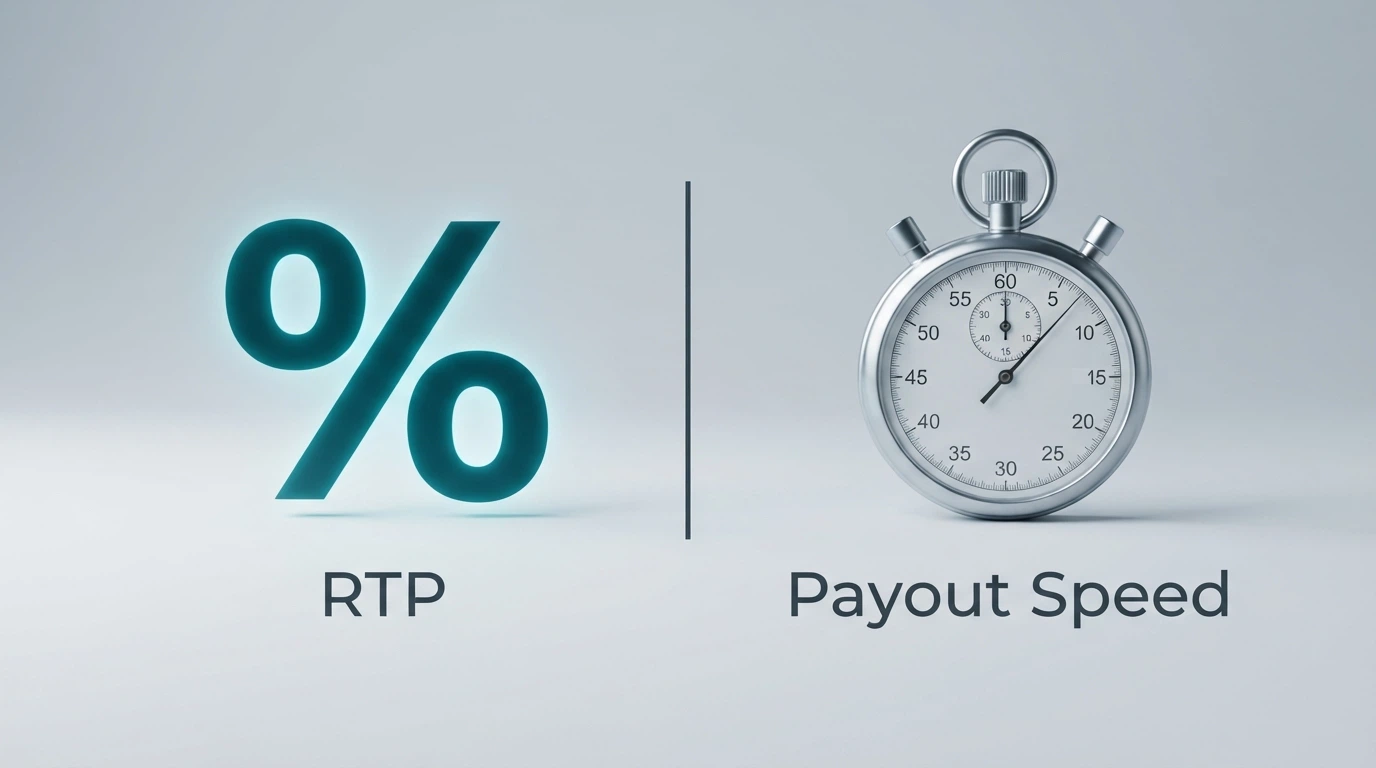
Payout speed is the wall-clock time between requesting a withdrawal and the money arriving. A casino running e-wallet withdrawals inside 24 hours is delivering a different promise to one paying out in three to five business days. Neither promise says anything about how much the games pay back. A fast-paying casino can still ship a library of low-RTP games. A slow-paying casino can still be running titles that return 98%.
The marketing trick is to attach the word “payout” to whichever of these the operator does well, and leave the other one to the small print. Players looking for the highest payout need to hold both numbers in their head at once and refuse to be flattered by either one alone.
How house edge shapes every game you play
House edge is the mirror of RTP — for any given game, the two add up to 100%. A pokie with a 95.7% RTP carries a 4.3% house edge. A blackjack game with 99.5% RTP carries a 0.5% house edge. The figure is the casino’s long-run profit per dollar wagered, baked into the rules before anyone sits down.
The gap compounds. A 0.5% house edge and a 5% house edge are ten times apart on paper, but the real difference shows over hundreds or thousands of hands. Over A$10,000 wagered, a 0.5% edge costs A$50 in expected loss. A 5% edge costs A$500 over the same volume. The longer a session runs, the more certain that loss becomes — variance can throw a single session in either direction, but the maths is patient and the house is always collecting its share.
European roulette with its single zero runs a 2.70% house edge. American roulette, which adds a double zero, almost doubles it to 5.26%. The two games look identical at the table — same wheel layout, same betting options — and a player who does not check which version is in front of them is paying roughly twice as much per spin for the privilege. Video poker at the full-pay 9/6 Jacks or Better paytable, played with optimal strategy, returns 99.5% — a 0.46% house edge that puts it ahead of every pokie in this guide and most table games besides.
What a “high payout” casino actually delivers
An operator can advertise a single high-RTP pokie and run a library where the rest of the catalogue pays back considerably less. Sweet Bonanza is the textbook example. Pragmatic Play ships the title in at least four RTP versions — 96.51%, 95.45%, 94.51% and 91.51% — and the casino chooses which one to load. A casino running the 91.51% version and putting the 96.51% figure on its marketing page is making a true statement that is also a misleading one.
The same pattern repeats across most of the major studios. Pragmatic Play’s wider catalogue ships in three configurations — 96.5%, 95.5% and 94.5% — and Book of Dead from Play’n GO has a default 96.21% RTP and a reduced 94.25% version. Starburst from NetEnt has a default 96.09% with reduced variants running around 94.05% and 92.01%. The casino picks. The player, without checking, plays whatever version the operator chose to load.
The point is that “highest payout casino” is a per-game claim at best, and unverifiable without checking the specific title at the specific operator. A brand cannot honestly call itself the highest payout casino on the strength of a single 99% pokie when the rest of its library runs at the industry average or below.
The Australian payout landscape in 2026
The Australian landscape is the one that makes this harder than it looks elsewhere. No state or territory issues a licence for online casino, online pokies or in-play sports betting — the Interactive Gambling Act 2001 prohibits the provision of those products to anyone in Australia outright. That means there is no Australian RTP benchmark to point to, no local regulator testing the games, and no consumer protection framework that reaches the offshore brands Australians actually use.
What exists is the ACMA’s enforcement record. Since November 2019 the regulator has had 1,564 illegal gambling and affiliate websites blocked by Australian internet service providers. More than 225 illegal services withdrew from the Australian market once the 2017 amendment closed the loopholes and gave the ACMA its blocking powers. The result is a market where the product is banned, the operators are offshore, and the player is the one left holding the gap.
A licensed RTP figure for an Australian-accessible casino is therefore a curious thing. The figure exists — the games run, the maths runs — but the verification that would let a player trust it sits with a regulator in Malta, Curaçao or another jurisdiction that does not have the standing to test outcomes the way an Australian regulator could. “Highest payout casino Australia” is a phrase with no local anchor. The player has to build the anchor themselves.
Every casino on this list is offshore — here is what that costs you
Every brand on this page operates outside Australian law. None holds an Australian casino licence because such a licence does not exist for the product they sell. The IGA prohibits the provision of online casino to a person in Australia; the operator is the target, not the individual player, but the practical consequence is that the protections a player would expect in a regulated market are simply not in place.
BetStop, the National Self-Exclusion Register, covers approximately 150 licensed wagering providers. An offshore casino is not among them. ACMA cannot recover a disputed withdrawal, the Australian Financial Complaints Authority does not have standing over a Curaçao-licensed operator, and the payment-method ban that came in on 11 June 2024 means a credit card or crypto deposit itself signals that the site is operating outside Australian rules. The trade is real: Australians access offshore casinos, and the price of that access is the consumer framework they would otherwise sit inside.
The offshore reality: no Australian casino licence exists
The IGA was passed in 2001 and amended in 2017 to close the loopholes offshore operators had been using to reach Australian customers. The 2017 amendment gave the ACMA the power to issue formal warnings, pursue civil penalty proceedings and direct Australian ISPs to block illegal sites. The result, in numbers, is 1,564 blocked sites since November 2019 and 225-plus services that withdrew rather than face enforcement.
What this means in practice is that an Australian player has a defined set of offshore brands to choose from — the ones that stayed. The withdrawal speed, bonus terms and game library of those brands are what this page compares. The local licence a player might assume is there, the way it is in the UK or in many European markets, is not available, and the comparison has to be made on the operators’ own terms rather than on a regulator’s word.
Operator comparison at a glance
The table below sets out what is publicly confirmed for each brand in the comparison set. Cells where research could not confirm a figure carry an em dash; the absence is the data point, and a brand is not assumed to be stronger than the row’s weakest confirmed cell.
| Operator | Holds Australian casino licence | Withdrawal speed |
|---|---|---|
| Rocket Play | No (offshore) | E-wallets within 24 hours |
| Skycrown | No (offshore) | Within 24 hours |
| Royal Reels | No (offshore) | Among the fastest in the set |
| Stake | No (offshore) | — |
| FairGO | No (offshore) | 24–48 hours |
| WinSpirit | No (offshore) | — |
| Rainbet | No (offshore) | — |
| Scream Casino | No (offshore) | — |
| Bizzo Casino | No (offshore) | — |
| Wolf Winner | No (offshore) | Crypto within 24 hours |
The spread of confirmed data is itself the story. Two operators publish a withdrawal window and a third is referenced as fast; six brands do not have a public withdrawal-speed figure that research could verify. A reader who picks on speed alone is picking from three rows, not ten.
Rocket Play
Rocket Play’s welcome offer is a 100% match on the first deposit, up to the equivalent of A$1,000, with a minimum deposit of A$30. The wagering requirement sits at 40x on the bonus amount, the maximum bet while a bonus is being cleared is A$7.50 per spin, and the bonus is valid for five days from the moment it is credited. The five-day clock is the figure most likely to surprise a player who treats the bonus as free money — 40x on a A$1,000 bonus means A$40,000 in wagering, and five days is the window the casino gives to do it.
The cap on no-deposit bonus winnings is A$75 — a small absolute number that becomes a hard ceiling on any free play the brand runs alongside the main welcome offer. E-wallet withdrawals clear within 24 hours, which is the figure that earns Rocket Play its place near the top of any speed comparison. The offer is competitive on size but ordinary on terms; the wagering multiple is the industry-standard 40x and the bonus validity is shorter than several peers in the set.
Skycrown
Skycrown runs a five-deposit welcome package worth up to A$8,000 in bonus funds, with the first deposit at 100% up to A$300 plus 100 free spins. Each subsequent deposit carries its own bonus stage, and the 40x wagering applies across all of them rather than resetting at each stage. The minimum first deposit is A$30, and the bonus validity window is not publicly confirmed.
The withdrawal window sits at around 24 hours. The brand’s selling point is the headline A$8,000 across the package; the trade-off is that the player has to commit to five deposits and clear 40x at each stage to reach it. For a player who would only deposit once, Skycrown’s effective offer is the A$300 plus 100 free spins on the first deposit — not the full A$8,000.
Royal Reels
Royal Reels is referenced as one of the faster withdrawal operators in the comparison set — the confirmation comes through a third-party comparison that places it ahead of peers on cashout time. What the brand does not publish, and what research could not confirm, is the bonus terms: wagering multiple, bonus validity, maximum bet while a bonus is being cleared and the size of any welcome offer are not publicly available for this brand in 2026.
A reader who picks Royal Reels is choosing on one verified dimension — withdrawal speed — and accepting that the rest of the offer is unverified. The speed is real; the rest is a gap. That trade is honest to flag but it is not a trade most players consciously make.
Stake
Stake is a globally recognised brand with significant market presence outside Australia, and the brand recognition carries weight in any list. What is not publicly confirmed for an Australian player is the AU-specific welcome offer, the wagering terms attached to it, and the withdrawal window a player in Australia can rely on. The brand exists in the comparison set because players reach it; it sits in this ranking on footprint rather than on verified AU-facing terms.
A reader considering Stake on brand familiarity alone is making the same trade as with Royal Reels — picking on a dimension that is verified (footprint) and accepting that the offer specifics are not. The brand’s overall profile is well known; the AU-facing details are the gap.
FairGO
FairGO markets itself to an Australian audience and is referenced as paying withdrawals out in 24 to 48 hours. The AU-facing positioning is the brand’s clearest confirmed strength; it is the kind of detail a player weighing offshore brands can actually use. What is not publicly confirmed is the welcome offer size, the wagering requirement, the bonus validity, the maximum bet while a bonus is being cleared, and the licence jurisdiction the brand operates under.
The withdrawal window is the verified figure. The bonus side of the comparison is a gap, and a reader who needs the welcome offer to be specific before they deposit will find this row thin.
WinSpirit
WinSpirit has an AU-facing market presence that puts it in the comparison set, and that is the verified figure. Bonus terms, wagering requirements, withdrawal speed and licence jurisdiction are not publicly confirmed in sources available to this review. The brand is in the ranking on reach rather than on offer detail.
A reader who needs the comparison to be complete before deciding will find this row thin, and that is the honest reflection of what is publicly known. A reader who is willing to treat the brand on footprint alone will find the same trade-off that Stake and Royal Reels present.
Rainbet
Rainbet has a publicly listed presence that confirms the brand as AU-facing, and the comparison set includes it on that basis. Welcome bonus, wagering multiple, withdrawal speed and licence jurisdiction are not publicly confirmed in 2026 for an Australian-accessible account. The brand is in the ranking because it reaches Australian players; the offer specifics are a gap rather than a confirmed row of data.
Scream Casino
Scream Casino is AU-facing in the comparison set, and that is the verified detail. Bonus size, wagering terms, withdrawal speed and licence jurisdiction are not publicly confirmed for this brand. The row reflects what the public sources carry, which is the brand’s market presence and not the offer behind it.
Bizzo Casino
Bizzo Casino sits in the comparison set as an AU-facing brand without publicly confirmed welcome-bonus terms, wagering requirements, withdrawal speed or licence jurisdiction in the sources available to this review. The brand is named because Australian players reach it; the offer behind the name is a gap.
Wolf Winner
Wolf Winner’s welcome package is worth up to A$5,500 plus 125 free spins, with a deposit required to trigger it. The game library runs to more than 1,800 titles from 20-plus providers, which is the largest confirmed catalogue in the comparison set. Crypto withdrawals clear within 24 hours, putting the brand in the same speed tier as Rocket Play and Skycrown.
The welcome package is larger than either of the two brands ahead of it on offer size — A$5,500 versus Skycrown’s A$8,000 spread across five deposits, but reachable in fewer stages. The wagering multiple was not publicly confirmed in sources available to this review, and a reader who needs that figure before depositing will find this row thin on that one specific.
How much the bonus actually costs at Rocket Play
A welcome bonus is not a gift. The Rocket Play offer of 100% up to the equivalent of A$1,000 with 40x wagering on the bonus means a player who takes the maximum bonus has to wager A$40,000 before any of it can be withdrawn. Across the industry-average online pokie RTP of 95.7%, the expected loss on that turnover works out to roughly A$1,720 in total — that is what the offer statistically costs the player before the bonus is cleared.
The figure is an average. A single session can run hot or cold; the maths is patient and the house collects its share over many spins. What the calculation gives a player is the real price of the “free” money before signing up, and the comparison to make is whether A$1,000 in bonus funds is worth A$1,720 in expected loss. Most players who read the wagering requirement never run the second half of that comparison. The marketing word is “bonus”; the arithmetic calls it a purchase.
The highest-RTP pokies Australian players can actually access in 2026
A pokie’s RTP is the single most important number on the game screen, and it is the number most players never look at. The industry average sits at 95.7%, which means the typical pokie returns 95.7 cents per dollar wagered across millions of spins. A “high-RTP” pokie, by convention, runs above 97%. The gap between average and high is the difference between a game that costs A$4.30 per A$100 in expected loss and one that costs closer to A$2 to A$3.
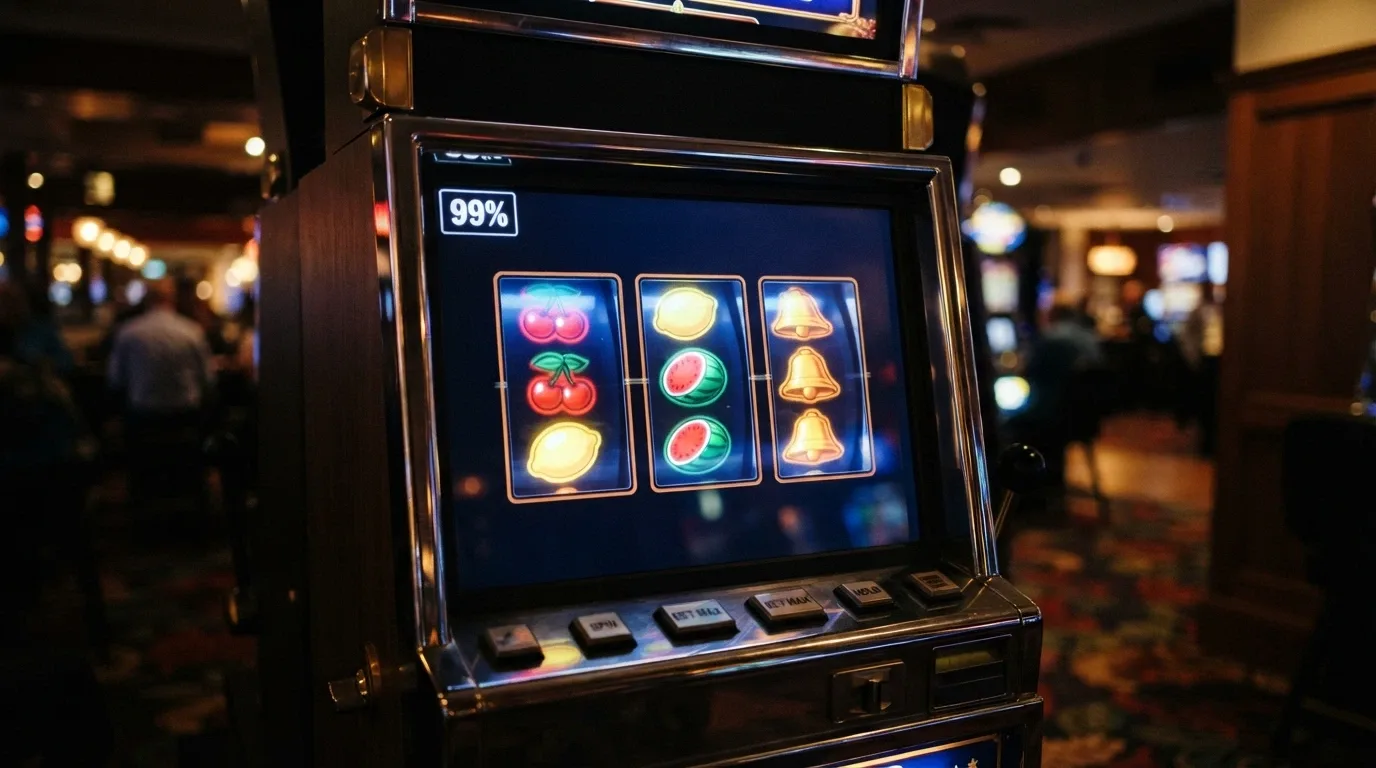
The titles below are the ones that verified sources place at the top of the accessible Australian-facing pokie market. The figures are the published RTPs, the volatility class where research carries it, and the maximum win where research carries it. Where volatility or max win was not confirmed, the cell carries an em dash rather than a guessed figure.
Why RTP is the number that matters for pokies
A pokie session is the most expensive game in any casino by house edge, and the gap between an average pokie and a high-RTP pokie is wider than the gap between most table games. The industry-average 4.3% house edge on a 95.7% RTP pokie is roughly twice the 2.70% edge of European roulette, and roughly ten times the 0.5% edge of a blackjack game played with basic strategy.
A single session of A$100 wagered at the industry average is A$4.30 in expected loss. The same A$100 at a 98% RTP pokie is A$2. The same A$100 at blackjack with basic strategy is A$0.50. Over hundreds of sessions the gap is what separates a player who can fund their play from one who is paying the casino’s rent. Mega Moolah, the famous progressive jackpot pokie, runs a base-game RTP of roughly 88–92% — below the industry norm, with the progressive jackpot funded out of that lower return. Players chasing the headline jackpot are paying for it on every spin that does not hit.
High-RTP pokies available to Australian players
| Pokie | Provider | RTP | Volatility | Max win |
|---|---|---|---|---|
| Mega Joker | NetEnt | 99.00% | — | — |
| Book of 99 | Relax Gaming | 99.00% | High | 12,075x |
| Jackpot 6000 | NetEnt | 98.86% | Medium | 2,000x |
| 1429 Uncharted Seas | Thunderkick | 98.60% | Low | 670x |
| Marching Legions | Relax Gaming | 98.12% | High | 5,000x |
| Blood Suckers | NetEnt | 98.00% | Low | 900x |
| Jokerizer | Yggdrasil | 98.00% | Medium | 6,000x |
| Starmania | NextGen | 97.87% | Low-medium | 1,250x |
| White Rabbit Megaways | Big Time Gaming | 97.72% | High | 13,029x |
| Dead or Alive 2 | NetEnt | 96.82% | Very high | 111,111x |
| Money Train 4 | Relax Gaming | 96.10% | — | 150,000x |
Mega Joker and Book of 99 are tied at 99% RTP — the joint highest of any widely available pokie at the AU-facing offshore brands in this comparison. Mega Joker’s 99% applies in Supermeter mode; the base game returns considerably less, and the headline figure is conditional on the mode the player is in. Book of 99’s 99% is unconditional, paired with a 12,075x max win and high volatility — meaning longer dry spells between wins, with bigger payouts when they land.
The right end of the table is not a list of safe picks. Dead or Alive 2 and Money Train 4 carry 111,111x and 150,000x max wins respectively, but they sit at the lower end of the RTP range here, with very high volatility. A high max win at lower RTP is a different proposition from a high RTP at low volatility; the player is being paid for the chance, not the steady return.
The RTP trap: why the same pokie pays differently at different casinos
Two casinos listing the same pokie can offer two different returns. Pragmatic Play’s multi-configuration shipping is the norm rather than the exception across the major studios. Book of Dead has a default 96.21% RTP and a reduced 94.25% version. Starburst has a default 96.09% with reduced variants running around 94.05% and 92.01%. The studio builds both versions; the operator picks which one runs.
A “highest payout casino” claim that does not specify which RTP version of which game is being measured is unverifiable. A casino running the 91.51% version of Sweet Bonanza can advertise the 96.51% figure on its marketing page without lying; the player who deposits is on the lower configuration. The audit is per-game, per-operator, and without it the headline number is a story rather than a measurement.
The one casino game that gives you the best chance of winning
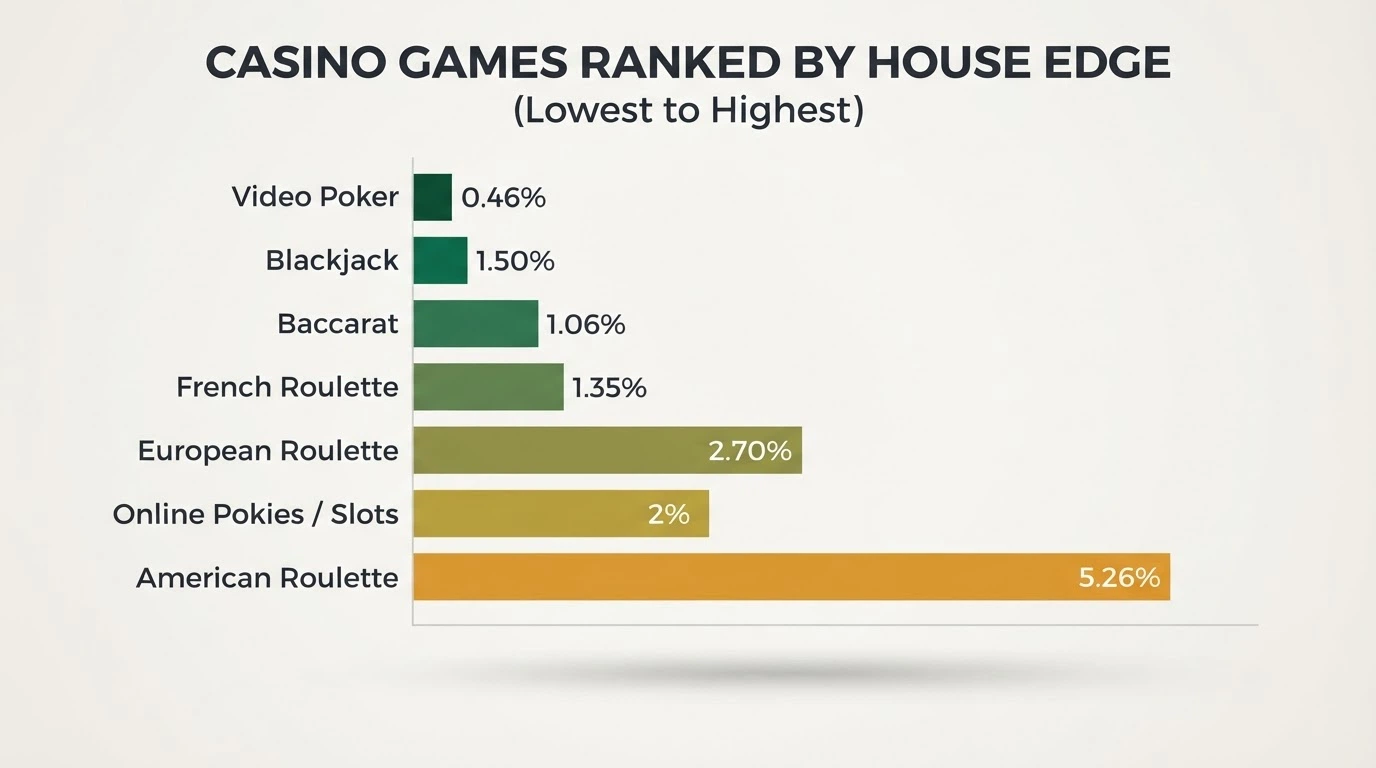
The gap between the best and worst game in a casino is wider than most players realise. Blackjack at 0.5% house edge and American roulette at 5.26% are ten times apart. The game the player picks is the single biggest decision they make on a given spin of the wheel, and most players pick on theme rather than on the maths.
House edge by game: the full comparison
| Game and variant | House edge | RTP |
|---|---|---|
| Video poker (Jacks or Better, full-pay 9/6, optimal strategy) | 0.46% | 99.5% |
| Blackjack (basic strategy, 3:2 payout) | 0.5% | 99.5% |
| Baccarat (Banker bet) | 1.06% | 98.94% |
| French roulette (La Partage, even-money bets) | 1.35% | 98.65% |
| European roulette (single zero) | 2.70% | 97.30% |
| American roulette (double zero) | 5.26% | 94.74% |
| Online pokies (industry average) | 4.3% | 95.7% |
The table runs from video poker at the top — 99.54% RTP with optimal play, the highest return of any standard casino game — down to American roulette at 94.74%. The pokies sit in the middle of the pack, not the top, despite being the volume leader in any online casino lobby. The average pokie player is paying more per spin than the average blackjack or baccarat player, and the difference is built into the rules before anyone sits down.
The game with the lowest house edge — and the conditions that keep it there
The two games at the top of the table are conditional. Video poker’s 99.54% requires the full-pay 9/6 paytable and optimal strategy — meaning the player holds the right cards on the right draws, and the casino has not stripped the paytable down to a lower-paying variant. A 8/5 or 7/5 Jacks or Better paytable drops the RTP several percentage points and pushes the game down toward the average pokie. The 99.54% is achievable; it is not automatic.
Blackjack at 0.5% requires basic strategy and a 3:2 payout on a natural blackjack. A 6:5 blackjack table — common at lower-stakes floors and increasingly online — nearly triples the house edge to around 2.2%, even with perfect basic strategy. A player who finds themselves at a 6:5 table is paying roughly four times as much per hand as a player at a 3:2 table, and the difference is the payout on the one hand every player hopes to get.
Baccarat’s Banker bet is the simplest low-edge wager on the floor. The 1.06% house edge requires no strategy beyond betting on the Banker; the 5% commission on Banker wins is already priced into the figure. The Player bet is slightly worse at 1.24%; the Tie bet is the worst standard wager in the casino at well over 14% house edge. A baccarat player who bets Tie once per session for the bigger payout is paying for that one bet across every other hand they play.
Online casino is prohibited in Australia — what the law actually says
The Interactive Gambling Act 2001 prohibits the provision of online casino games to a person in Australia. The 2017 amendment closed the loopholes offshore operators had been using and gave the ACMA the enforcement and blocking powers it now exercises. Online sports betting in-play, online pokies and online casino table games are all prohibited products. What remains permitted is wagering on races and sport placed before the event begins, plus lotteries and keno through state and territory licensed operators.
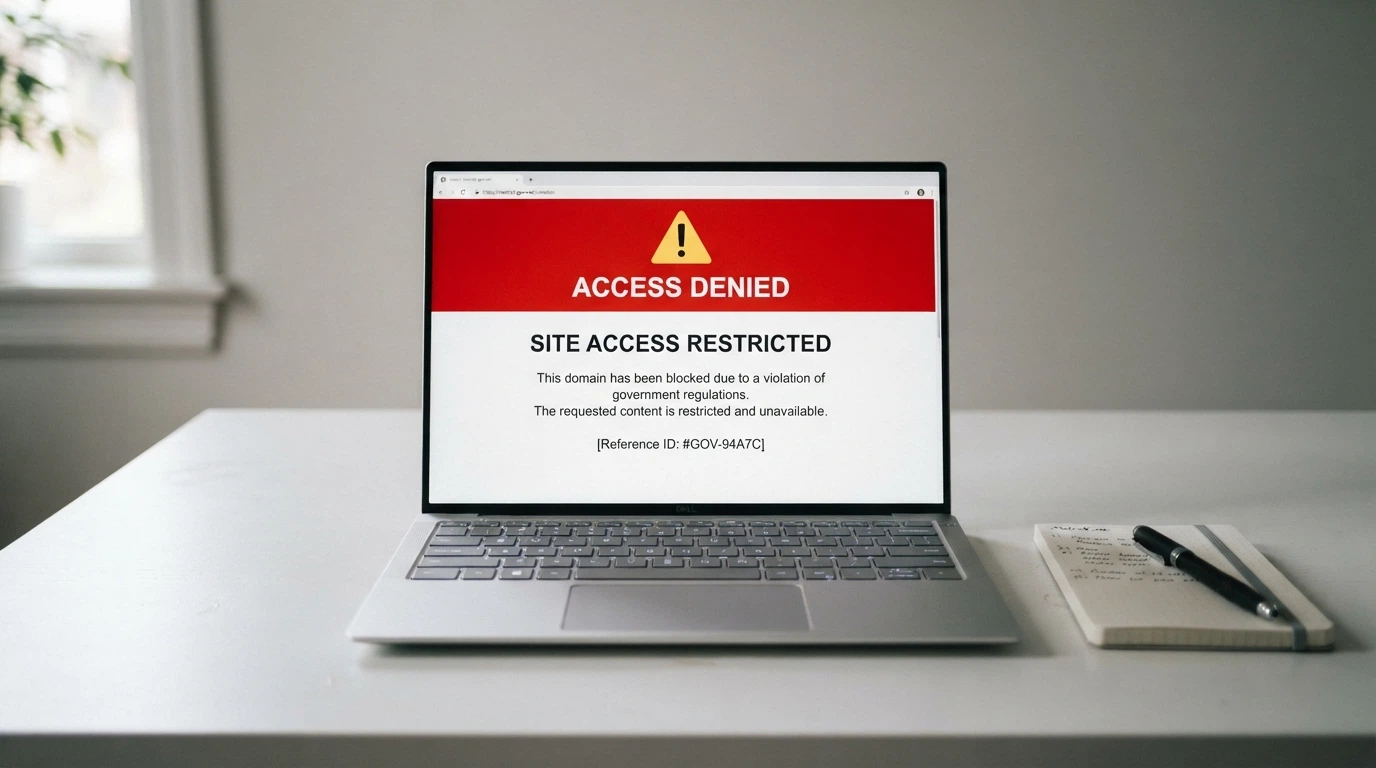
The individual player is not prosecuted. The IGA targets the provider — the operator that takes the Australian customer’s deposit — not the person who makes the deposit. The practical consequence is that the Australian framework of consumer protections does not reach an offshore casino. There is no Australian ombudsman with standing over a Curaçao-licensed operator, no Australian complaints body a player can escalate to, and no mechanism for recovering a balance if the site is blocked or the operator refuses to pay.
The Interactive Gambling Act: what it actually bans
The IGA covers three product types: online casino (table games and live dealer), online pokies, and in-play sports betting. All three are prohibited from being provided to a person physically in Australia. Pre-event wagering on races and sport is permitted through licensed operators, with Licensing NT and the Northern Territory Racing and Wagering Commission holding the bulk of the federal online wagering licences. Lotteries and keno are permitted through state and territory operators. The minimum age for any licensed wagering product is 18.
The 2017 amendment extended the prohibition to cover any “interactive gambling service” offered to an Australian customer, regardless of where the operator is based. Before the amendment, offshore operators argued the prohibition applied only to operators based in Australia. The amendment closed that reading, and the ACMA’s blocking powers are the mechanism that has produced the 1,564 blocked-site count since November 2019.
ACMA enforcement: 1,564 sites blocked and counting
The ACMA directs Australian internet service providers to block illegal sites under section 313 of the Telecommunications Act 1997. The first blocking request went out in November 2019. As of March 2026, 1,564 illegal gambling and affiliate sites have been blocked, and more than 225 illegal services withdrew from the Australian market once enforcement was strengthened in 2017.
When a site is blocked, the player’s existing balance at that site does not necessarily come back. The block prevents new Australian customers from reaching the site through mainstream ISPs; existing customers with active balances have no Australian mechanism for recovering the funds. The operator is the party the ACMA can pursue; the player’s deposit is a separate question that sits with the operator’s own jurisdiction.
The 2026 reform: what changes from 1 January 2027
The Interactive Gambling Amendment (Gambling Reform) Bill 2026 passed Parliament on 19 August 2026 and its measures commence on 1 January 2027. It does not legalise online casino. The reform layers new restrictions on licensed wagering operators and gives new tools to the regulators, but the product itself remains prohibited.
The advertising restrictions cap wagering advertising at three ads per hour between 6:00 am and 8:30 pm, with a live-sport blackout from 15 minutes before a live event until 5 minutes after it ends. Inducement marketing is prohibited for 14 days after a customer signs up and for three months after a person deregisters from BetStop. Athletes and influencers are barred from promoting wagering products. Banks and payment providers gain express authority to block transactions to illegal gambling operators from the same commencement date.
The reform is funded through a cost-recovery levy on licensed interactive wagering service providers — a measure that recovers the ACMA’s enforcement costs from the operators the regulator is policing, rather than from the public purse. For an offshore casino customer in Australia, the practical effect of the bank-blocking authority is that deposits to illegal operators may become harder to place through normal banking channels. The deposit itself remains in a grey zone for the player; the friction around it is what changes.
How to tell if a site operates outside Australian rules
Three checks reveal whether a casino is operating within or outside Australian rules. The first is the payment method. Credit cards, credit-related products and digital currency (crypto) have been banned as payment for online wagering since 11 June 2024. An operator that breaches the ban faces penalties of up to A$247,500. A site that asks for a credit card deposit or a crypto transfer is, by that ask alone, signalling that it is operating outside the Australian framework.
The second is the licence. No state or territory issues a licence for online casino in Australia — the product is prohibited federally. A claim of an “Australian licence” for online casino is a claim of something that does not exist.
The third is the ACMA register. The regulator maintains a list of licensed interactive wagering services, and the absence of a brand from that list is consistent with offshore status. The list covers wagering operators, not casinos, because no casino can be licensed for the Australian market.
What happens when an offshore casino refuses to pay
An offshore casino can refuse a withdrawal, void a win or close an account, and the Australian player has no domestic legal remedy. The ACMA enforces against the provider, not for the player; the Australian Financial Complaints Authority does not have standing over a Curaçao-licensed operator; the small-claims tribunal in the player’s state or territory does not have jurisdiction over a company registered overseas.
The payment-method ban adds a second layer. A deposit made by credit card or crypto, which is itself a breach of the Australian rules, cannot be reversed through the player’s bank the way a fraudulent transaction can be. The bank-blocking authority that comes in on 1 January 2027 will make this harder going forward, but a player who has already deposited through a banned method has fewer protections, not more.
The practical recourse a player has is the operator’s own complaints process and the licensing jurisdiction the operator sits under — typically Curaçao or Malta, neither of which has a consumer-friendly reputation for player disputes. A player who picks an offshore brand on the strength of its bonus offer is buying that bonus with the absence of the framework that would normally back the purchase.
Protecting yourself when the safety net has holes
The Australian responsible-gambling infrastructure is among the strongest in the world. The catch is that none of it reaches an offshore casino. BetStop covers the 150 or so licensed wagering providers. The National Gambling Helpline is free, confidential and staffed 24/7. The Department of Social Services expanded financial counselling services for gambling harm on 2 April 2026. None of it touches a brand operating outside Australian law, and the player at an offshore casino is in the gap.

How much Australians really lose: the numbers
About 2.1% of Australian adults — roughly 430,000 people — experience problem gambling. The Australian Institute of Health and Welfare put high-risk gambling at 1.8% in 2022. BetStop, the National Self-Exclusion Register, has 67,480 registrations as of 31 July 2026, with 41,290 exclusions still active; 78% of registrants are under 40, and 38% chose lifetime exclusion.
The age skew is the figure that does the most work. Problem gambling in Australia is concentrated in the demographic that grew up with online access, and the offshore casino market is the product that reaches them most directly. The licensed-wagering safeguards — pre-event wagering, deposit limits, self-exclusion — apply to sports and race betting. Online casino sits outside that framework by design, and the players who find it are the ones the framework was built to protect.
BetStop: what it covers and what it does not
BetStop is the National Self-Exclusion Register, live since August 2023. A single registration excludes a person from every Australian-licensed online and phone wagering service in one step. The exclusion options start at a minimum of three months, with longer periods up to a lifetime exclusion available. The register covers approximately 150 licensed wagering providers in Australia.
What BetStop does not cover is any offshore casino. An Australian who has registered for self-exclusion and then visits an offshore casino has no protection from that register — the casino does not connect to it, and the casino is under no obligation to honour the exclusion. A self-excluded player who wants to keep gambling has offshore casinos as the unguarded door.
The support every Australian player can access today
The National Gambling Helpline is 1800 858 858 — free, confidential and staffed 24 hours a day, every day. Gambling Help Online at gamblinghelponline.org.au offers free 24/7 chat and email counselling. The Department of Social Services announced an expansion of specialised financial counselling services for gambling harm on 2 April 2026, increasing the number of counsellors trained to work with gambling-related debt.
The first call is the hardest, and it is the call most people do not make. The service is set up to receive it; the conversation does not require the caller to have decided anything in advance. For a player who is reading this page to compare bonuses, the support line is the place to start if the comparison has become something else.
How we chose and ranked every operator on this page
The ten operators in this comparison are the AU-facing offshore brands that research could confirm through tracked traffic data and search visibility — Rocket Play at the top on market share, Wolf Winner and Skycrown on offer size, Stake on global footprint, and a long tail of brands whose AU-facing presence is confirmed but whose offer specifics are not publicly available. The ranking is on the evidence that is publicly available, not on any commercial relationship and not on any operator’s marketing.

The evaluation looked at three things in this order. First, the bonus terms where they were publicly available — wagering multiple, bonus validity, maximum bet while a bonus is being cleared, and the maximum winnings cap on no-deposit offers. Second, the withdrawal speed where research could confirm it — verified windows from the brand’s own terms page or from independent comparison sources. Third, the transparency of the terms themselves — the brands that publish clear, specific bonus and withdrawal terms rank above the brands that do not.
Where research could not confirm a figure — bonus terms for six of the ten brands, withdrawal speed for six, licence jurisdiction for every brand — the gap is shown as an em dash rather than a guessed value. A row with several em dashes is a row where the comparison is thinner than the others; the ranking reflects that. The ACMA register was consulted to confirm that no operator in the set holds an Australian casino licence, which is consistent with the prohibition.
What you should actually do with this information
The maths, the law and the risk all point in the same direction. The house edge is the house edge — the longer the session, the more certain the loss, and the highest-RTP game on the highest-payout casino still returns less than 100% over time. The legal framework that protects Australian players from licensed wagering operators does not extend to offshore casinos, and the consumer protections a player would expect are simply absent in that space. The tools that do work — BetStop for licensed wagering, the National Gambling Helpline, Gambling Help Online — are the ones built for Australian players and the ones worth using first.

A player who has decided to deposit at an offshore casino should check the specific RTP of the specific game at the specific operator before putting money in, because the same pokie can run at a different return at a different brand. A bonus should be treated as a product the player is buying with wagering requirements, not as free money — the calculation in the Rocket Play section of this page gives the real cost. A withdrawal window should be checked against independent confirmation rather than the brand’s own marketing.
The best decision starts with knowing what the offer is worth in real terms — the maths, the law, the actual cost. The page carries the figures; the decision is the player’s.
Frequently asked questions for Australian online casino players
How do I check the real RTP of a pokie before I play?
The game information or help screen inside the pokie itself carries the published RTP, usually under a “?” or “i” icon. The figure is what the developer has set for that configuration of the game; it is not necessarily what the casino is running. Studios like Pragmatic Play ship titles in multiple RTP versions, and the operator picks which one to load. The safest check is to ask the casino’s live support which configuration of the specific title is running on real-money mode, and to compare that figure against the game’s published default. If the casino cannot answer the question, that is itself information.
Do offshore casinos connected to BetStop protect self-excluded Australian players?
No. BetStop covers approximately 150 Australian-licensed wagering providers and does not connect to any offshore casino. A player who has registered with BetStop is excluded from every licensed wagering service in the country, but an offshore casino is under no obligation to honour the exclusion and the register has no mechanism to enforce it on an offshore operator. Self-exclusion is a structural protection that ends at the licensed market’s edge.
Are crypto deposits accepted at licensed Australian gambling sites?
No. Credit cards, credit-related products and digital currency (crypto) have been banned as payment for online wagering since 11 June 2024, with penalties for non-compliance up to A$247,500. A licensed Australian wagering operator cannot accept a crypto deposit. A site asking for one is operating outside the Australian framework, and a player using crypto to deposit is using a payment method the regulator has explicitly prohibited.
How does the 2026 gambling reform affect online casino players in Australia?
The reform that passed on 19 August 2026 and commences on 1 January 2027 does not legalise online casino. It restricts advertising, bans inducement marketing, and gives banks authority to block transactions to illegal gambling operators. The practical effect on an offshore casino customer is that deposits through normal banking channels may become harder after the commencement date. The product itself remains prohibited, and the prohibition is what the reform is built on.
What is the difference between RTP and payout speed?
RTP is the theoretical long-run return of a game — the share of wagered money the game pays back across millions of spins. Payout speed is the wall-clock time between requesting a withdrawal and the money arriving. A casino can have a high-RTP pokie library and a slow payout, or a fast payout and a low-RTP library. The two numbers measure different things and a “highest payout” claim can refer to either; the player needs both to compare.
Free play versus real money: does the RTP change?
Demo mode can run a different RTP from real-money mode. Studios ship games in multiple configurations because operators want flexibility, and a demo environment has its own reasons to set the looser version — players who feel the game is paying out well in demo mode are more likely to switch to real money. Pragmatic Play ships its catalogue in 96.5%, 95.5% and 94.5% configurations. Sweet Bonanza ships in at least four versions, from 96.51% down to 91.51%.
The real-money RTP is the figure that matters. The casino loads whichever configuration it has chosen, and a player who checked the demo version and trusted that figure is making a decision on the wrong number. The check that matters is the one a player runs on the real-money game after logging in — and most platforms make that check harder than it needs to be, because the looser configuration is the easier sell.
RNG versus live dealer: does the payout actually change?
The RTP is set by the rules, not the delivery method. A RNG blackjack game and a live-dealer blackjack game running the same rules — same number of decks, same payout on a natural, same double-down and split options — return the same theoretical percentage to the player. The difference between the two is the experience, not the maths.
The rules do not always match. A live-dealer blackjack table can run 6:5 payouts while the RNG equivalent at the same casino runs 3:2. A live-dealer roulette can be American with a double zero while the RNG table next to it is European with a single zero. The RTP gap in those cases comes from the rules, not from the camera. A player who picks a live-dealer table without checking the rules is paying whatever the live table charges — sometimes more, sometimes less, and never assumed.