
Best 7-Reel Pokies Australia: What They Are, Where to Play, and What the Welcome Bonus Actually Costs
 Available in AU
Seven-reel pokies exist in a category most Australian players have never seen named out loud. They are not 5-reel pokies with two extra reels bolted on. They are a different format built around a wider grid, cluster pays instead of paylines, cascading wins that chain through a single spin, and a volatility profile that punishes a quiet session and rewards it suddenly. Every title on this page lives behind an offshore casino, because Australia does not license online casino products at all — and that single fact shapes every decision that follows.

Verified against ACMA, BetStop statistics and the Interactive Gambling Act 2001 as of 18 October 2026.
Table of Contents
- 7-Reel Pokies Are a Different Beast — Here’s What Makes Them Tick
- Play 7-Reel Pokies for Free Before You Risk a Cent
- Real-Money 7-Reel Pokies — What Changes When You Put Cash Down
- Why Your 2026 7-Reel Bonus Is Smaller Than It Looks
- The Best Offshore Sites for 7-Reel Pokies, Ranked
- Playing 7-Reel Pokies in Australia — What the Law Actually Says
- Staying in Control on High-Volatility 7-Reel Pokies
- How We Ranked the Best 7-Reel Pokies — Our Methodology
- 7-Reel Pokies and the Australian Player — Where You Stand in 2026
- Frequently Asked Questions
7-Reel Pokies Are a Different Beast — Here’s What Makes Them Tick
The AU pokie scene runs overwhelmingly on the 5-reel video format. Walk into any review site, any offshore casino lobby, any “best pokies” list, and the 5×3 grid is the default. Seven-reel pokies slip past that lens entirely. They are not in the AU search results at all. They are not framed as a category on any local page. They are sitting in the corner of provider catalogues, played by a small minority of Australian punters who have stumbled across Sugar Rush 1000 or Reactoonz in a lobby and noticed the grid is not what they are used to.
That absence is the gap this page fills. Seven-reel pokies are a genuine format with their own mechanics, their own volatility profile, their own studio roster, and their own bonus structure. They are not better than 5-reel pokies in some universal sense — they are a different risk shape, and the player who understands the difference chooses them for a reason rather than by accident.
The grid format is what makes them work. A 7-reel pokie usually runs a 7×7 layout — seven vertical reels, seven rows of symbols — though some variations use 7 vertical reels with anywhere from 4 to 8 rows. The cluster-pays mechanic replaces the fixed-payline pattern of a standard pokie: a win is any group of matching symbols that touch each other, not a line drawn from left to right. Cascading reels — also called tumbling wins — drop the winning symbols off the grid and let new ones fall in their place, potentially triggering another win on the same paid spin. A single A$1 spin can chain through several wins before it ends.
For an Australian punter, this is the moment the format stops being exotic and starts being a calculation. The win frequency on a high-volatility 7-reel pokie is lower than a medium-volatility 5-reel equivalent. The win size, when it lands, is larger. The session feels longer. The bankroll needs to be larger. None of that is hidden in the math — it is the math — and a player who walks in expecting the rhythm of a 5-reel pokie will burn through a deposit before the first big cascade.
The 7×7 grid — how the reels actually work
The 7×7 grid is the format’s signature. Seven reels, four to eight rows, depending on the title. Paylines on these games start at 50 and, on Megaways-style variants, climb into the thousands. A traditional pokie pays when matching symbols land on a designated line — left to right, sometimes both directions, on a fixed number of patterns drawn into the game code. A 7-reel cluster-pays pokie pays when a group of five or more matching symbols touches, horizontally or vertically, anywhere on the grid. Adjacency is the rule; the payline is gone.
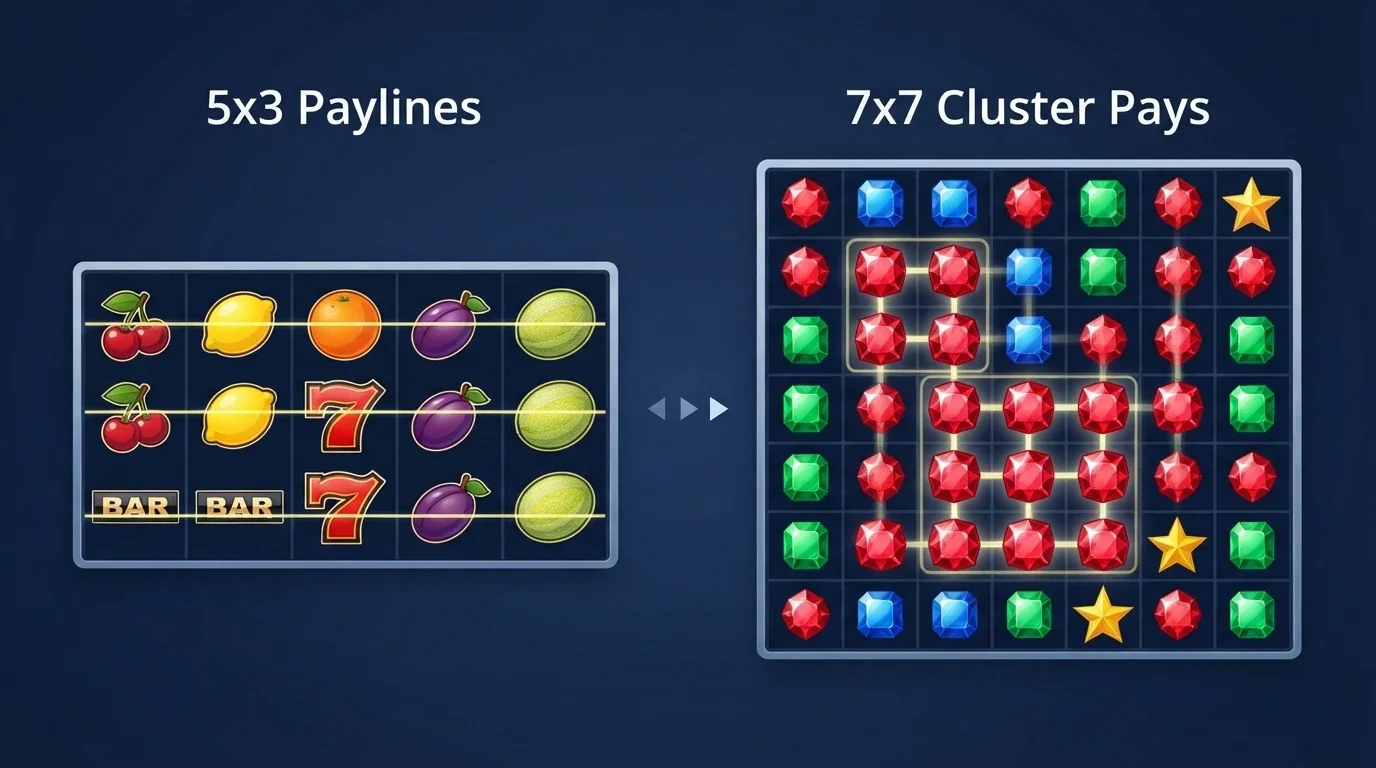
Cascading reels are the second pillar. After a winning cluster pays out, those symbols disappear. New symbols drop into the empty spaces. A new cluster can form. The game keeps paying until no new cluster forms, all on the one stake. Sugar Rush 1000, a Pragmatic Play flagship, runs this mechanic with multiplier spots that build across cascades — every consecutive win on the same spot increases the multiplier, and a chain of five or six cascades in one spin is not unusual. Reactoonz, the Play’n GO title that effectively defined the genre, layers a charge meter on top of the cascading mechanic, with four alien Quantum features that trigger as the meter fills.
The grid shape is not always a perfect square. WMS Gaming’s Zeus III runs an irregular layout — six reels, but the row counts step up from 2 to 7 across the playfield: 6×2×3×4×5×6×7. That asymmetry gives the game 192 fixed paylines, plus stacked Zeus Wild symbols that fill entire reels. The point is not the exact geometry — it is that 7-reel pokies use the wider canvas to break out of the payline pattern entirely. Once you have seen a cluster-pays game pay out on a single spin through three cascading wins in a row, the standard payline game starts to look like a different sport.
How 7-reel pokies differ from classic 3-reel and 5-reel pokies
The reel count is not just a number — it changes the structure of the game underneath.
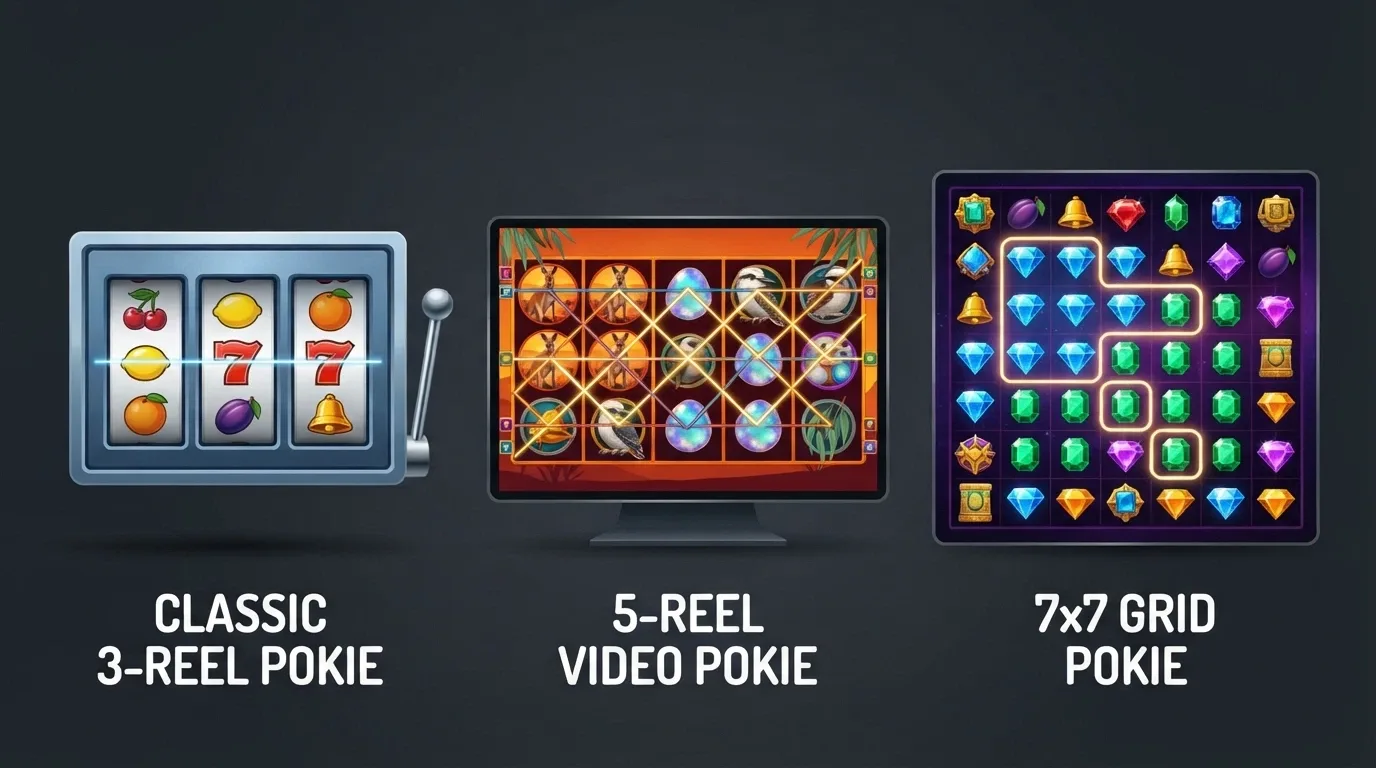
Classic 3-reel pokies are the original format: three reels, one payline (sometimes three), fruit symbols or bar-and-seven icons, low-to-medium volatility, RTP in the 92%–95% range. They are the digital descendants of the mechanical one-arm bandits, and they are simple by design. A 3-reel pokie does not need a bonus round, a cascade mechanic, or a paytable longer than a postcard. It pays small amounts, often. The session is steady.
Video 5-reel pokies are the AU standard. RTP sits in the 94%–97% range, volatility varies from low to high depending on the title, and bonus features — free spins, pick-me games, expanding wilds — are layered on top of the base game. This is the format most Australian players mean when they say “pokies” without qualifying. Sweet Bonanza, Gates of Olympus, Big Bass Bonanza — all 5-reel (or, more precisely, 5-reel with a tumbling mechanism). Pragmatic Play built most of its AU-facing catalogue on this format.
Seven-reel pokies push further. Compared to a 5-reel pokie, the 7-reel format offers more ways to win, more elaborate bonus features with interactive layers, and higher peak payouts when the cluster chains fire. The trade-off is higher volatility — fewer wins per spin, larger amounts when the wins do land — and higher minimum bets. Where a 5-reel video pokie can take A$0.20 per spin on a wide range of titles, many 7-reel grid slots start at A$0.40 or A$0.50 and scale up faster. High-roller territory, by design.
Progressive jackpot pokies are a separate tier. They are usually 5-reel, sometimes 7-reel, but they are built around a jackpot pool that grows with every spin across the network. RTP sits lower — 88%–94% — because a slice of every wager feeds the jackpot meter. A player is not buying a high base-game return; they are buying a shot at a jackpot that runs into the millions.
High-RTP specialty slots round out the format map. These are titles that push the return-to-player figure into the 97%–99% band, often through stripped-back bonus features and a tighter mathematical model. They are not common. Where they exist, they are popular with grinders who care about the long-run number.
Why 7-reel pokies almost always run high volatility
The grid format and the volatility profile are linked by design. A 7×7 grid with cluster pays has hundreds of thousands of possible symbol combinations per spin. The number of winning combinations is mathematically higher than a 5×3 payline game, but the size of any individual win is concentrated — most combinations pay nothing, and the winning combinations pay larger amounts. The game’s RTP sits in that 95%–97% band like any other, but it is delivered through fewer, larger events.
For the player, the practical difference is session rhythm. A medium-volatility 5-reel pokie pays out something most spins, even if the amount is small. A high-volatility 7-reel pokie may go twenty, thirty, forty spins without a meaningful win. Then a cascade chain fires and the same spin pays out 50x, 100x, several hundred times the stake. Sugar Rush 1000’s theoretical max win is 25,000x — a A$1 spin could, in the rarest of runs, pay out A$25,000. That number is the long-tail upper bound. The realistic experience is more like: a quiet session of A$1 spins for half an hour, a single 200x cascade that resets the bankroll, more quiet spins, and then either a bigger cascade or a walk-away point.
The bankroll that supports this pattern is larger than the bankroll that supports a 5-reel equivalent. A player who treats a 7-reel pokie as a casual low-stakes game will run out of money before the cluster chains hit. A player who treats it as a high-volatility format with a defined session length and a hard loss cap is playing the format it actually is.
The studios building the best 7-reel pokies
Four providers dominate the 7-reel format. Each brings a distinct design philosophy.
Pragmatic Play is the volume leader in the cluster-pays 7×7 space. Sugar Rush 1000, Sweet Bonanza, Fruit Party — all 7×7 grid slots, all with cascading wins and multiplier mechanics. Sugar Rush 1000 is the flagship: a 97.50% RTP, high volatility, 25,000x max win, tumbling wins that build multiplier spots on the grid. Pragmatic Play ships more 7-reel titles than any other studio in the AU-facing offshore catalogues, and the format is one of the things the studio is best known for.
Play’n GO wrote the genre with Reactoonz. The 7×7 grid, the cascading alien symbols, the Quantum features that trigger from the charge meter — Reactoonz is the title that established the cluster-pays grid slot as a category. Its 96.51% RTP and 4,570x max win are mid-pack by today’s standards, but the game is still in heavy rotation on offshore casinos and is the reference point for every 7-reel grid slot that followed.
Hacksaw Gaming and Nolimit City are the high-volatility specialists. Hacksaw built its reputation on bonus-buy mechanics and brutal volatility profiles; Nolimit City went further with xMechanics, xBomb, xNudge and a string of titles with max wins above 50,000x. Neither studio focuses exclusively on 7-reel formats, but both contribute flagship grid slots to the cluster-pays and tumbling category. Their titles show up across the multi-provider offshore casinos in the comparison block below, and they are the studios a player chases when they want the highest volatility the format offers.
The slot titles table below covers the verified data research surfaced. Most 7-reel pokies in active rotation across the AU-facing offshore catalogues do not have their RTP figures publicly verified in the same datasets, which is why the table is short — not because the catalogue is short, but because verified RTP is only confirmed for a handful of titles.
| Slot Title | RTP | Provider | Volatility | Max Win |
|---|---|---|---|---|
| Sugar Rush 1000 | 97.50% | Pragmatic Play | High | 25,000x |
| Reactoonz | 96.51% | Play’n GO | High | 4,570x |
Play 7-Reel Pokies for Free Before You Risk a Cent
Every 7-reel title worth playing has a demo mode. The offshore casinos that carry these games — RocketPlay, Royal Reels, SkyCrown, Bizzo Casino, Fair Go Casino — all run their pokies in HTML5, which means demo mode loads in a browser tab without a download. At some operators the demo runs without registration. At others, a player signs up for an account first and gets access through the logged-in lobby. Either way, the play-money balance is real enough to learn the game on.

Demo mode teaches the grid mechanics. It shows how cluster pays trigger, how cascading chains build, how the bonus round fires, how often the multiplier spots increment. It also exposes the volatility profile — a player can run 200 demo spins and see whether they get a steady drip of small wins or a long quiet stretch followed by a single large cascade. That information is useful. It is not the same information real-money play delivers.
The real-money session adds a layer demo mode cannot simulate: the psychological weight of a loss. A A$100 demo balance dropping to A$15 is a number on a screen. A A$100 real-money balance dropping to A$15 is the same number, and it changes the player’s behaviour. Tilt, chasing losses, abandoning the loss limit — these are real-money problems, and demo mode trains for the grid mechanics without training for the discipline the grid mechanics demand. A player who has set a hard loss cap before opening the real-money game is not the same player as one who decided mid-session that A$50 more would turn it around. Understanding that psychological disconnect is essential for anyone moving from demo mode to real-money play.
Demo mode — try every 7-reel title without spending a cent
Demo mode availability varies by operator. RocketPlay runs demo mode without registration for some providers — a player lands on the site, picks Sugar Rush 1000, and the game opens with a play-money balance. Royal Reels runs demo mode after account creation. SkyCrown runs demo mode in the logged-in lobby. Bizzo Casino offers demo mode without registration across most of its catalogue. Fair Go Casino’s demo access depends on the RTG integration.
What demo mode reveals is the game’s behaviour curve. Sugar Rush 1000 has a different session rhythm to Reactoonz, which has a different session rhythm to a Nolimit City grid slot. A demo session of 200–500 spins on each title gives a player a feel for how often the base game pays, how the cascading mechanic builds, how the bonus round triggers, and how long the dry stretches can run between meaningful wins. The player who plays 50 demo spins and concludes that a game is “boring” or “cold” has not played enough to see the variance settle.
What demo mode does not reveal is whether the player can handle the format. A high-volatility 7-reel pokie on demo mode is a slow afternoon. A high-volatility 7-reel pokie on real money is a different game. The decision to play for real should happen after the demo session, not in the middle of one — and the loss limit for the real-money session should be set before the first spin lands, not after the first cascade fails to fire.
No-download free play — instant browser access, no account needed
The AU-facing offshore casino market runs on instant-play. Modern online pokies are built in HTML5, which means they load directly in a browser tab — Chrome, Safari, Firefox, Edge — without a download, an executable, or an app install. A player with a browser and an internet connection can have Sugar Rush 1000 running in under a minute.
The practical reality is that this is the standard delivery method for any online pokie worth playing in 2026. There is no reason to install a casino client. The instant-play lobby is the casino. Demo mode, real-money mode, deposit, withdrawal, bonus activation — all of it runs through the browser.
The catch is site access. The ACMA has directed Australian ISPs to block 1,564 illegal gambling and affiliate websites since November 2019. A player who finds their usual offshore casino suddenly unreachable has hit an ACMA block — the site is on the list. Access can sometimes be restored with a VPN, but a VPN that masks the player’s location for the purposes of circumventing an Australian regulator’s enforcement direction is a step worth thinking about before taking. The site can be re-blocked at any time. If the player has a balance on it when that happens, the balance is on a server the player can no longer reach.
Real-Money 7-Reel Pokies — What Changes When You Put Cash Down
The mechanics do not change. The RTP, the volatility, the cluster-pays algorithm, the cascading reel mechanic — all of it is identical between demo mode and real-money mode. The game does not know whether the stake is play money or real money. The math is the math.
What changes is everything around it. A real-money deposit activates the welcome bonus eligibility, the wagering requirements, the maximum cashout caps, the validity windows. A real-money session has a cost the demo session does not — not the stake cost, which is identical, but the time cost of meeting the wagering requirement before the bonus becomes withdrawable. A real-money session also has recourse implications: the deposit is real, the balance is real, and the offshore operator holding it has no Australian licence to lose if it decides to refuse a withdrawal.
How real-money wagering works on a 7-reel grid
The mechanics of a real-money spin on a 7-reel pokie are not different from a 5-reel pokie. The player selects a stake per spin, hits the button, the grid resolves. The difference is the volatility profile: more symbols in play, cluster-pays replacing paylines, a higher chance of an empty spin, a higher chance of a multi-cascade win.
Stake selection matters. Where a 5-reel video pokie often accepts A$0.20 or A$0.10 per spin, many 7-reel grid slots start at A$0.40, A$0.50, or higher, and the wagering requirements on a welcome bonus can carry a maximum bet cap (Royal Reels caps clear-down at A$5 per spin, RocketPlay caps at A$7.50). The player who sets their spin size below the max-bet cap and above the minimum usually runs the wagering requirement without the bonus being voided.
The payment flow for AU-facing offshore casinos runs through PayID for most players. PayID deposits at these operators process in under 60 seconds — the player sends the funds from their bank account via the PayID identifier, the operator credits the casino wallet, the bonus activates if eligible, and the player is in the lobby. It is the fastest payment route most Australian players have access to, and it is the route that makes the offshore casino experience feel close to the licensed-wagering experience in terms of friction.
What PayID does not do is change the legal reality. The deposit clears into an offshore wallet. The bonus terms apply. The wagering requirement applies. The validity window applies. And the ACMA can direct an ISP to block the operator at any time, with the balance still on the server.
Why Your 2026 7-Reel Bonus Is Smaller Than It Looks
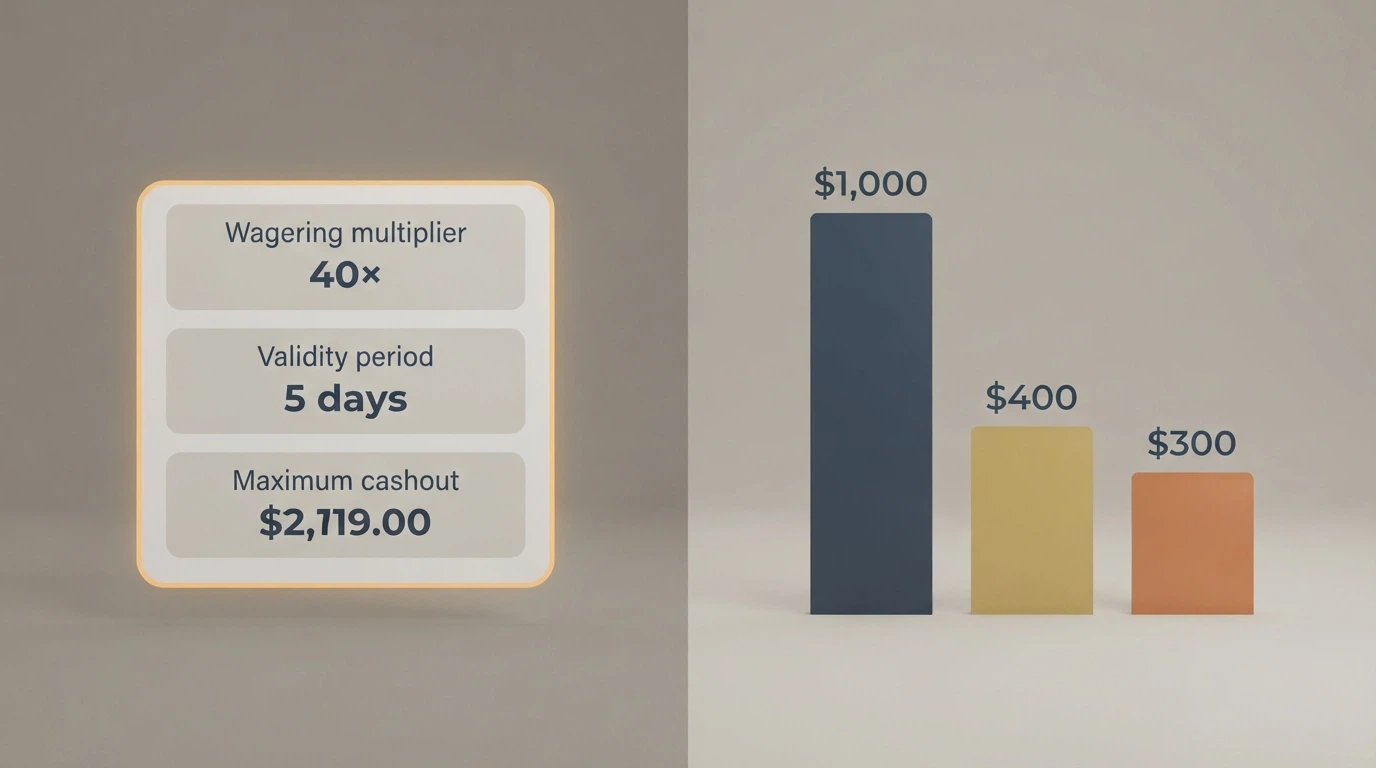
The headline number on an offshore welcome package — A$1,000, A$2,500, A$8,000 — is the number the operator wants the player to read. It is not the number the player keeps. The wagering requirement is the real price tag. The win cap is the real ceiling. The validity window is the real clock. A A$1,000 welcome bonus with 40x bonus-only wagering and a 5-day validity is a different proposition from the same headline number with 35x wagering and 30 days to clear.
The AU offshore bonus market in 2026 sits at the harsher end of the global spectrum. The fairer end runs at 35x bonus-only — meaning the player wagers 35 times the bonus amount, not the bonus plus the deposit, before any winnings become withdrawable. The hostile end runs at 50x or higher on deposit plus bonus — meaning the player wagers 50 times the sum of both, which roughly doubles the turnover required. Average welcome bonus wagering in the market is 40x. Average no-deposit bonus wagering is 55x.
Licensed Australian wagering operators cannot offer a sign-up bonus at all. The National Consumer Protection Framework prohibits it. The bonus is the offshore casino’s competitive lever — it is what makes the offshore offer look better than the licensed alternative, even when the licensed alternative is the only one with Australian consumer protection behind it. A player who is comparing a 35x bonus-only offshore welcome against a no-bonus licensed product is not comparing apples to apples. They are comparing a bonus that costs them time and expected losses against a product that costs them nothing extra.
Welcome deposit bonuses — the headline numbers vs what you keep
A A$1,000 welcome bonus sounds generous. Here is what A$1,000 actually means in wagering terms at each of the major operators in the comparison block.
RocketPlay’s welcome package is two-deposit. First deposit: 100% match up to A$1,000 plus 100 free spins on Aztec Magic — 20 spins immediately, 20 per day for the next four days. Second deposit: 200% match up to A$1,000. Total headline value: up to A$2,000 in bonus cash plus 100 free spins. Wagering requirement: 40x on the bonus amount only — so on a A$500 first deposit, the player wagers A$500 × 40 = A$20,000 in qualifying play before the bonus converts to withdrawable cash. The free spin winnings are capped at A$300. Maximum win from the deposit bonus is A$5,000. Maximum bet during wagering is A$7.50. Validity is 5 days from the moment the bonus credits — five days to clear the A$20,000 turnover on a 96% RTP pokie, which is the session structure the maths imposes.
Royal Reels offers a three-deposit welcome package: 100% up to A$500 on the first, 75% up to A$750 on the second, 100% up to A$1,250 on the third. Total headline value: A$2,500. Wagering: 35x bonus-only — the lowest in this comparison — with an A$5 per-spin cap during the clear-down. That A$5 cap is the constraint a player has to plan around. Stake below A$5 means more spins to clear the same turnover. Stake above A$5 means the bonus is voided. The 35x rate is friendlier than the 40x at every other operator in the table, but the per-spin cap turns the clear-down into a long grind rather than a sprint.
SkyCrown runs the largest headline welcome in the market: four deposits, A$8,000 total plus 400 free spins. First deposit 120% up to A$1,200 plus 125 free spins (minimum deposit A$30). Second 100% up to A$1,300 plus 75 free spins. Third 80% up to A$1,500 plus 50 free spins. Fourth 150% up to A$4,000 plus 150 free spins (minimum deposit A$50). Wagering requirement: 40x across all tiers. The headline figure is the largest in the AU offshore market, but every tier of it carries the same 40x turnover load, and cryptocurrency deposits do not qualify for the welcome bonus at all. A crypto-funded SkyCrown player is depositing into the same lobby but missing the headline welcome entirely.
Bizzo Casino’s welcome is four deposits up to A$4,750 plus 175 free spins, with the free spin winnings uncapped — a contrast with RocketPlay’s A$300 free spin ceiling. PayID is supported for Australian deposits. The wagering multiple for AU-specific terms was not surfaced in the review data this research run pulled, which is worth knowing before depositing: a player who signs up without checking the current terms page is accepting a wagering rate they have not verified. The casino’s help page or live chat is the place to confirm the current figure before claiming.
The pattern across these four operators is consistent. Headline figures are ceilings. The wagering multiple and the validity window set the real terms. A A$1,000 welcome with 40x bonus-only wagering and 5 days validity is not a A$1,000 gift — it is a 5-day session of high-volume play with a hard win cap at the end of it.
Free spins on 7-reel pokies — what they’re actually worth
Free spins are the bonus currency of online pokies, and they almost never land on the title the player actually wants to play.
RocketPlay’s 100 free spins are locked to Aztec Magic, a BGaming title that is not a 7-reel pokie. The free spins pay out at the slot’s own rate, the winnings are capped at A$300, and the player gets them whether they wanted them or not. The cap is the constraint: a A$300 ceiling on 100 free spin winnings is a real ceiling, not a marketing number, and a player who hits a bonus round on Aztec Magic during the free spin allocation is paid out at A$300 regardless of the actual win size.
SkyCrown’s 400 free spins are spread across the welcome package — 125, 75, 50 and 150 on the four deposits. The game they are locked to varies by tier. SkyCrown also runs a no-deposit free spin offer, the Meet & Spin: 20 free spins on Aztec Clusters by BGaming, credited after profile completion, with 25x wagering and a A$40 maximum win. The no-deposit free spin is the closest thing on this page to a risk-free trial — no deposit, no commitment, 20 spins on a 7-reel grid slot, A$40 the maximum amount a player can walk away with if the spins hit.
Royal Reels offers a A$10 no-deposit bonus after phone verification — not free spins, but the same idea. A small play-money amount credited to a new account to let the player try the platform before committing a deposit. The A$10 is its own kind of free trial, separate from the welcome package, and it is one of the few offers on this page where the player can find out whether the casino works for them without risking their own money.
The game restriction is the central problem. A player who wants to play Sugar Rush 1000 with a free-spin bonus finds that no operator in this comparison offers free spins on Sugar Rush 1000. The free spins are on Aztec Magic, Aztec Clusters, or other titles the operator has partnered with — usually 5-reel or specialty slots, not the 7-reel grid format the player came for. The free spin bonus is a marketing tool, not a product match.
Wagering requirements — the one number that decides if a bonus is worth claiming
The wagering multiple is the bonus’s true price. Everything else — the headline number, the free spin count, the maximum win cap — is decoration around it.
A 35x bonus-only wagering requirement on a A$500 bonus means A$17,500 in qualifying play before any winnings from the bonus convert to withdrawable cash. At A$1 per spin on a 96% RTP pokie running 600 spins per hour, that is 17,500 spins and 29 hours of continuous play. The expected loss over that play, on a 96% RTP game, is A$700. The player who clears a A$500 bonus has paid A$700 in expected losses to do it — the bonus is a negative-EV proposition from the moment the wagering requirement attaches.
This is the calculation the bonus headline does not invite the player to run. The wagering multiplier looks like a hurdle. The expected loss shows it is a cost. A player who treats the welcome bonus as a profit source is misreading the offer. A player who treats it as a session-extender — more spins for the same deposit, with a chance at a payout at the end — is reading it correctly.
The no-deposit bonus is sharper. A no-deposit bonus at SkyCrown, the Meet & Spin, comes with 25x wagering — meaning a A$20 win from the free spins needs to be wagered 25 times (A$500) before it becomes withdrawable. The maximum win on the Meet & Spin is A$40, so the player is converting at most A$40 in raw winnings to a A$500 turnover requirement, then paying an expected loss on that turnover. The free spins are not a profit source. They are a way to look at the casino before depositing.
Average no-deposit bonus wagering in the AU offshore market is 55x. Average welcome bonus wagering is 40x. A player who sees a “55x NDB” headline and a “A$20 free chip” offer is looking at A$1,100 in turnover for a A$20 ceiling. The expected loss on a 96% RTP pokie at A$1 spins is A$44 — the bonus loses money on average before the player has touched it. Welcome bonuses at 40x are friendlier, but they still carry a negative-EV structure on average, which is why the market works the way it does.
The Best Offshore Sites for 7-Reel Pokies, Ranked
The ranking pool is ten AU-accessible offshore casinos carrying 7-reel pokies. Every operator on this list is offshore — no Australian online casino licence exists, federally or in any state or territory, and the ACMA has the power to direct ISPs to block these sites at any time. The ranking weighs game-library depth, provider count, bonus terms, AU payment support, and the practical reality of depositing and withdrawing from Australia. Operators 7–10 returned no usable review data this run and are carried transparently.

| Operator | AU Legal Status | Welcome Offer Headline | Game Providers | Payment Methods |
|---|---|---|---|---|
| RocketPlay | OFFSHORE — no Australian licence | 100% up to A$1,000 + 100 FS; 200% up to A$1,000 (2nd dep) | 91 providers: Pragmatic Play, Play’n GO, Nolimit City, Hacksaw Gaming, NetEnt, Yggdrasil, Big Time Gaming, Push Gaming, BGaming | PayID, Visa/Mastercard, Bitcoin, crypto, Neosurf, e-wallets |
| Royal Reels | OFFSHORE — blocked by ACMA | A$2,500 across 3 deposits (100%/75%/100%) | 40+ providers: Pragmatic Play, Evolution, NetEnt, Microgaming, Play’n GO, Nolimit City, Hacksaw Gaming, Push Gaming, Thunderkick, Yggdrasil, BGaming | PayID, crypto, Visa/Mastercard |
| SkyCrown | OFFSHORE | A$8,000 + 400 FS across 4 deposits | Multiple: Pragmatic Play, BGaming, Evolution, Hacksaw Gaming, Nolimit City, NetEnt, Play’n GO | PayID, Visa/Mastercard, crypto (excluded from welcome bonus), Neosurf, e-wallets |
| Bizzo Casino | OFFSHORE | Up to A$4,750 + 175 FS across 4 deposits; FS winnings uncapped | 120+ providers: Pragmatic Play, BGaming, Hacksaw Gaming, Nolimit City, 3 Oaks, NetGame, Belatra, Playson, Felix Gaming, Evolution, Playtech Live | PayID, Visa/Mastercard, crypto, e-wallets |
| Stake | OFFSHORE | — | Multiple: Pragmatic Play, Hacksaw Gaming, Nolimit City, Evolution, Push Gaming, Relax Gaming | Crypto (primary), limited fiat |
| Fair Go Casino | OFFSHORE | 100% up to A$1,000 across 5 deposits | RealTime Gaming exclusively | Visa, Mastercard, Bitcoin, Neosurf, Litecoin |
| WinSpirit | OFFSHORE | — | — | — |
| Scream Casino | OFFSHORE | — | — | — |
| Rainbet | OFFSHORE | — | — | — |
| Rocket Casino | OFFSHORE | — | — | — |
RocketPlay — 91 studios and a 40x bonus-only welcome package
RocketPlay runs the widest provider roster in the featured set: 91 studios across more than 3,000 slot titles. Pragmatic Play, Play’n GO, Nolimit City, Hacksaw Gaming, NetEnt, Yggdrasil, Big Time Gaming, Push Gaming and BGaming are all in the catalogue — which is the four studios that built the 7-reel format, plus the studios that built the Megaways mechanic, plus a long tail of smaller providers covering every volatility profile. For a player who wants every 7-reel grid slot in one place, this is the operator.
The welcome package is a two-deposit structure. First deposit: 100% match up to A$1,000 plus 100 free spins on Aztec Magic by BGaming — 20 spins immediately, 20 per day for four days after that. Second deposit: 200% match up to A$1,000. Total headline value: A$2,000 in bonus funds plus 100 free spins. The terms sit at the standard market rate: 40x bonus-only wagering, A$300 free spin win cap, A$5,000 maximum win from the deposit bonus, A$7.50 maximum bet during wagering, 5-day bonus validity. Demo mode is available without registration at some providers.
The 5-day validity is the constraint that shapes the session. Five days to clear the wagering requirement is enough for a focused player who runs the spins at A$1 a pop, but it is tight enough that a player who lets the bonus sit unused for three days and then tries to clear it in the remaining two will be running extended sessions at high spin volume. The A$7.50 maximum bet allows for a faster clear-down than Royal Reels’ A$5 cap, but it still caps the speed.
Verdict: RocketPlay is the right choice for a player who values provider variety above all else — the 91-studio roster is wider than any other operator on this page, and the 7-reel grid slots are all in one lobby. The 40x wagering and 5-day validity are at the market standard, not above or below it.
Royal Reels — 5,400+ pokies with a 35x wagering rate
Royal Reels runs the largest pure-pokies library in the featured set: more than 5,400 pokies from over 40 providers. Pragmatic Play, Evolution, NetEnt, Microgaming, Play’n GO, Nolimit City, Hacksaw Gaming, Push Gaming, Thunderkick, Yggdrasil and BGaming are all on the provider list. The catalogue covers the full 7-reel grid slot range plus the broader 5-reel video pokie market, and the pure-pokie count — without the live casino and table games that inflate competitors’ headline figures — is genuinely larger than any other AU-facing offshore in the comparison.
The welcome is a three-deposit package: 100% up to A$500 on the first, 75% up to A$750 on the second, 100% up to A$1,250 on the third — total A$2,500 across three deposits. The wagering requirement is 35x bonus-only, which is the lowest in the featured set. The catch is the A$5 per-spin cap during clear-down. Where RocketPlay allows up to A$7.50 per spin, Royal Reels holds the line at A$5 — meaning the clear-down takes more spins, more time, and longer sessions to complete the same turnover.
Royal Reels also offers a A$10 no-deposit bonus after phone verification — a small free-trial amount that lets a player look at the casino before committing a deposit. The 10-tier VIP program with cashback is a longer-term retention feature, useful for high-volume players, less relevant for the casual punter clearing a welcome.
The ACMA has Royal Reels on its blocked list. Australian ISPs are directed to block access to the site. A player who reaches Royal Reels is using a workaround, and the site can be re-blocked at any time — including, potentially, with a balance still on it. That risk is a real cost, and it is one Royal Reels carries on top of every other term.
Verdict: Royal Reels is the right choice for a player who prioritises the lowest wagering multiple in the market and the largest pure-pokies library. The A$5 cap is a constraint, the ACMA block is a recurring access risk, and the player who accepts both gets the friendliest turnover rate available.
SkyCrown — the 7,200-game library with a four-deposit A$8,000 package
SkyCrown carries the largest total game library in the comparison: more than 7,200 games across pokies, live casino, and table games. The 7-reel grid slots from Pragmatic Play, Play’n GO, Hacksaw Gaming and Nolimit City are all in the catalogue, and the multi-provider depth means the lobby is broader than the pure-pokies count suggests.
The welcome package is the largest headline in the market: four deposits, A$8,000 total plus 400 free spins. First deposit 120% up to A$1,200 plus 125 free spins (minimum A$30 deposit). Second deposit 100% up to A$1,300 plus 75 free spins. Third deposit 80% up to A$1,500 plus 50 free spins. Fourth deposit 150% up to A$4,000 plus 150 free spins (minimum A$50 deposit). Wagering: 40x across all four tiers.
The critical fine print is the cryptocurrency exclusion. SkyCrown’s welcome bonus is not available to players depositing via cryptocurrency. A crypto-funded SkyCrown player is depositing into the same lobby, on the same games, with the same providers — but missing the headline welcome entirely. The Meet & Spin no-deposit offer — 20 free spins on Aztec Clusters by BGaming, 25x wagering, A$40 maximum win, available after profile completion — is an opportunity to test the platform without a deposit; note that offshore operators provide no deposit guarantee or payout guarantee, nor do they offer the consumer protections or local legal venue found with a licensed service.
Demo mode is available in the logged-in lobby. The wagering terms match the market average at 40x. The headline figure is the differentiator, and it is a real differentiator for players who can fund four deposits at the qualifying minimums.
Verdict: SkyCrown is the right choice for a player who wants the biggest welcome package in the market and can fund four qualifying deposits. The 40x wagering applies to every tier, the crypto exclusion is a hard rule for crypto-funded players, and the Meet & Spin offers a real no-deposit trial before any of that kicks in.
Bizzo Casino — 120+ providers and PayID for Australian players
Bizzo runs the widest provider count in the featured set: more than 120 studios. Pragmatic Play and BGaming are the headline partners, with Hacksaw Gaming, Nolimit City, 3 Oaks, NetGame, Belatra, Playson, Felix Gaming, Evolution and Playtech Live filling out the catalogue. The total game count sits above 4,000 across pokies, live casino and table games. Demo mode is available without registration across most of the catalogue.
The welcome package is four deposits up to A$4,750 plus 175 free spins, with the first deposit at 125% up to A$2,500. Free spin winnings are uncapped — a meaningful difference from RocketPlay’s A$300 free spin ceiling. PayID is supported for Australian deposits, which makes the deposit flow fast.
The wagering multiple for AU-specific terms was not surfaced in the review data this research run pulled. This is a real gap. A player signing up to claim the welcome bonus without checking the operator’s current terms page first is accepting a wagering rate they have not verified. The casino’s terms page or live chat is the place to confirm the current figure before depositing.
Verdict: Bizzo is the right choice for a player who wants the widest provider count and uncapped free spin winnings. The wagering rate is the unknown — confirm it from the operator’s own terms page before claiming.
Stake — crypto-first platform with a massive slot database
Stake is a crypto-native operator with a slot database tracked at more than 35,000 titles. Pragmatic Play, Hacksaw Gaming, Nolimit City, Evolution, Push Gaming and Relax Gaming are all on the provider list. AU market share sits at 1.28% per the operators skill — a meaningful footprint for a crypto-only platform.
The crypto orientation means fiat payment options are limited. The credit-card ban that applies to licensed Australian wagering (in effect since June 2024) is irrelevant to a crypto-funded player. The crypto ban for licensed wagering does not reach offshore casinos. AU-specific welcome bonus data was not surfaced in this research run’s snippets. The current offers page is the source for any player considering the platform.
Verdict: Stake is the right choice for a crypto-funded player who wants the largest slot database in the offshore market. The fiat payment gap rules out most AU bank-funded deposits, and the welcome bonus terms need confirmation from the operator’s own promotions page.
Fair Go Casino — RTG-only library built for the Australian punter
Fair Go runs on RealTime Gaming exclusively. The catalogue includes iconic RTG titles — Cash Bandits 3, Diamond Fiesta, Aztec’s Millions progressive jackpot — and the operator’s identity is built around an Australian-facing product. Fair Draw and Koala Monday promotions are part of the brand. Comp Points loyalty programme converts to wager-free cash.
The welcome is a 100% match up to A$1,000 spread across the first five deposits. Payment methods are Visa, Mastercard, Bitcoin, Neosurf and Litecoin — broad fiat coverage with crypto and prepaid options.
The RTG limitation is the constraint. RealTime Gaming’s catalogue runs fewer 7-reel grid slots than the multi-provider competitors above. The 7-reel format is a Pragmatic Play and Play’n GO specialty, and RTG’s stable sits more heavily on the 5-reel progressive jackpot end. A player who specifically wants Sugar Rush 1000 or Reactoonz will not find them here.
Verdict: Fair Go is the right choice for a player who wants an RTG-focused library, Australian-friendly branding, and a five-deposit welcome structure. The 7-reel grid slot selection is the trade-off — the format is not what this operator is built around.
WinSpirit — AU market presence with limited public review data
WinSpirit holds 1.55% AU market share — the largest of the four operators in the bottom tier of the ranking. The market share is real traffic and revenue, not licence status. WinSpirit is offshore, with no Australian online casino licence, and operates outside the ACMA’s regulatory perimeter.
No bonus, game-library, provider or payment data surfaced in this run’s search calls. The data gap is real, and it is carried transparently. Prospective players should weigh that lack of verified data against their own appetite for operating on an unlisted platform.
Scream Casino — AU market presence with limited public review data
Scream Casino holds 0.99% AU market share. The figure places it from the middle of the bottom tier — ahead of Rocket Casino, behind WinSpirit and Rainbet. Offshore, no Australian online casino licence, no ACMA authorisation.
No review data surfaced this run. The gap is real. The operator exists in the market — the market share figure says so — and what is known about it fits the standard offshore profile, nothing more.
Rainbet — AU market presence with limited public review data
Rainbet holds 1.28% AU market share, identical to Stake’s AU footprint. Offshore, no Australian online casino licence. No review data surfaced this run. The market-share figure places it from the top of the bottom tier of the ranking, ahead of WinSpirit, Scream Casino and Rocket Casino, but the absence of review data means a player choosing it is choosing on traffic alone.
Rocket Casino — AU market presence with limited public review data
Rocket Casino holds 0.57% AU market share — the smallest footprint in the featured set. Offshore, no Australian online casino licence. No review data surfaced this run. The market-share figure places it at the bottom of the ranking on traffic alone, with no other differentiator surfaced.
Playing 7-Reel Pokies in Australia — What the Law Actually Says
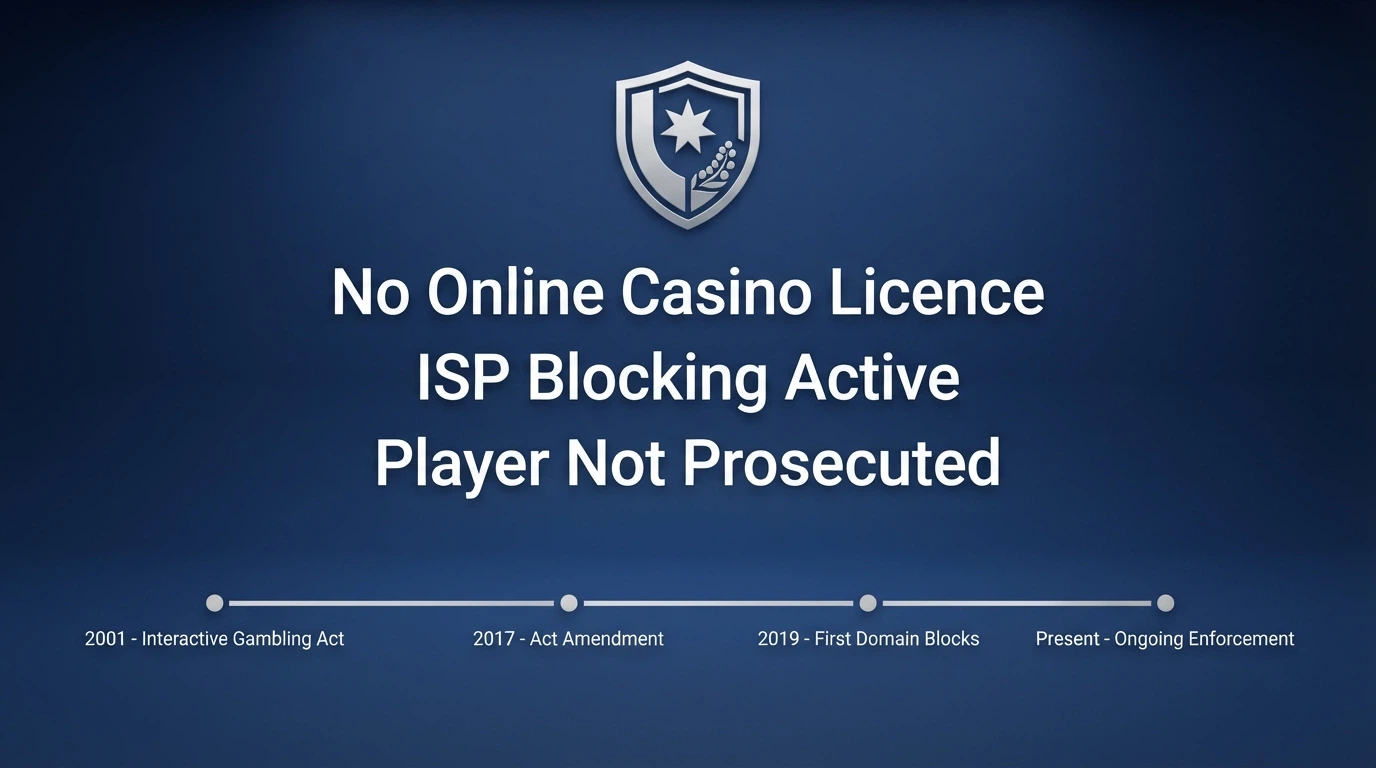
Online casino games, online pokies and in-play sports betting are prohibited in Australia under the Interactive Gambling Act 2001. There is no licence for online casino anywhere in the country — not federally, not in any state or territory. This is not a grey area, not a regulatory gap waiting to be closed, not a question of operator registration. The product is prohibited in terms.
What is licensed: wagering on races and sport placed before the event begins, predominantly licensed through the Northern Territory Racing and Wagering Commission. Lotteries and keno. Land-based casinos — Crown, The Star, others — at the state level. The 18-year minimum age applies to all commercial gambling.
The ACMA enforces the prohibition. Since November 2019, the regulator has directed Australian ISPs to block 1,564 illegal gambling and affiliate websites, and more than 225 illegal services have withdrawn from the Australian market since enforcement was strengthened in 2017. Civil penalties for providing prohibited interactive gambling services can run up to A$2,475,000 per day for an individual and A$12,375,000 per day for a corporation.
The individual player is not prosecuted. The IGA targets the provider, not the customer. That is the legal position. The practical position is that “not illegal for you” is not the same as “safe for your money” — and the offshore-consequences section below lays out exactly what that means.
The IGA prohibition — why no online casino licence exists anywhere in Australia
The Interactive Gambling Act 2001 makes it an offence to provide an online casino, online pokies or in-play sports betting to a person in Australia. The 2017 amendment closed the loopholes offshore operators had used to reach Australian players and gave the ACMA its enforcement and blocking powers. There is no licence for online casino games anywhere in the country — not federally, not in any state or territory.
The enforcement record is large. 1,564 illegal gambling and affiliate websites blocked since November 2019. More than 225 illegal services withdrawn from the Australian market since 2017. Civil penalties up to A$2,475,000 per day for individuals and A$12,375,000 per day for corporations providing prohibited services. Recent enforcement includes Entain Group, parent of Ladbrokes AU and Neds AU, which entered an 18-month court-enforceable undertaking after ACMA found more than 500 breaches of national self-exclusion rules. Tabcorp paid a penalty of A$112,680 for BetStop breaches and agreed to a third-party review of its customer verification processes.
The prohibition is structural. It is not waiting to be updated or amended. The 2026 reform — the Interactive Gambling Amendment (Gambling Reform) Bill 2026, which passed Parliament on 19 August 2026 — does not change it. The reform tightens the perimeter. It does not open the door.
Offshore sites and what using one really means for an Australian player
Every operator on this page is offshore. There is no Australian-licensed alternative. Using one means four things no marketing page will tell the player.
No Australian consumer protection. The ACMA cannot recover a player’s money from an offshore operator. There is no Australian complaints body, no Australian ombudsman, no Australian legal recourse. The ACMA can block the site and pursue the operator for civil penalties. It cannot force a withdrawal.
No BetStop coverage. BetStop excludes a person from every Australian-licensed wagering provider in a single registration. Offshore casinos are not connected to the register. A self-excluded person who registers with BetStop can still deposit and play at any operator on this page.
No recourse if the operator refuses a withdrawal or closes the account. An offshore operator’s terms of service govern. Australian consumer law does not reach them. The player who disputes a voided win or a closed account has the operator’s internal process and nothing else.
The site can be blocked at any time, with the balance still on it. The ACMA has directed 1,564 blocks since November 2019. A new block on an operator where the player holds a balance leaves the balance on a server the player can no longer reach.
The individual player is not prosecuted. The IGA targets the provider. But “not illegal for you” is not the same as “your money is safe” — and that distinction is the practical reality of using an offshore casino from Australia.
The payment-method ban is a separate matter. Credit cards, credit-related products and digital currency (crypto) are banned as payment for online wagering in Australia, with the ban commencing 11 June 2024. The ban applies to licensed wagering operators. Offshore casinos are outside the framework, which is why PayID, Visa/Mastercard, Bitcoin and other crypto options remain available at the operators on this page.
The 2026 reform — what changes on 1 January 2027
The Interactive Gambling Amendment (Gambling Reform) Bill 2026 passed Parliament on 19 August 2026. Its measures commence 1 January 2027. The reform does not change the core prohibition. It tightens the perimeter around it.
Advertising caps: no more than three wagering ads per hour between 6:00 am and 8:30 pm. Live-sport blackout window: 15 minutes before to 5 minutes after the event. Broadcasting sporting odds is banned outright. Athletes, celebrities and influencers are barred from promoting wagering products. Wagering ads are banned inside sports venues and on player uniforms. Radio ads are barred during school drop-off and pick-up times.
Banks and payment providers gain express authority to block transactions to illegal gambling operators from 1 January 2027. The implication for an Australian player using an offshore casino is direct: the bank or payment provider can decline a transaction the player is trying to make, and the player has no recourse on that decision. PayID, debit card, BPAY — all of them run through Australian banks, and all of them become subject to the new blocking power.
Direct marketing of inducements is prohibited for 14 days after a customer signs up, for three months after a person deregisters from BetStop, and indefinitely for customers identified as at risk of gambling-related harm. Offshore casinos are not bound by the National Consumer Protection Framework the way licensed wagering operators are, but the marketing restrictions affect how Australian-facing operators reach Australian players — and the bank-blocking power affects whether deposits clear.
The core prohibition is unchanged. Online casino games remain prohibited in Australia. The 2026 reform does not licence them, regulate them, or open them. It gives the regulator sharper tools to enforce the existing prohibition.
Staying in Control on High-Volatility 7-Reel Pokies
A 7-reel pokie at high volatility is not a casual game. A medium-volatility 5-reel pokie pays small amounts most spins, the bankroll depletes slowly, the session extends. A high-volatility 7-reel pokie can go twenty, thirty, forty spins without a meaningful win, and the bankroll can halve in the time it takes a 5-reel pokie to limp along on small wins. The session length needs to be planned, the loss limit needs to be set before the first spin lands, and the walk-away point needs to be defined before the cluster chain fires and the temptation to chase more arrives.
About 2.1% of Australian adults — roughly 430,000 people — experience problem gambling. The Australian Institute of Health and Welfare put high-risk gambling at 1.8% in 2022. These figures predate the offshore casino boom and the cluster-pays 7-reel format. The number of Australians playing high-volatility offshore pokies in 2026 is not in the research, but the number of Australians who would benefit from the help infrastructure is unchanged.
Setting limits you can actually stick to
Deposit limits and activity statements are the practical tools. Licensed Australian wagering operators must offer them under state and territory conditions — a player sets a deposit ceiling, the operator enforces it, an activity statement shows what was deposited, wagered and lost over a chosen period. The framework exists for the licensed market.
Offshore casinos are not bound by it. Some offer responsible-gambling tools in their account settings — deposit limits, session timers, time-out periods — but the enforcement is voluntary, and the player who closes their account to bypass a self-imposed limit can reopen it the next day. The burden sits with the player.
For a high-volatility 7-reel session, the practical limits are: set a hard loss cap before opening the game, not after the dry spell starts. Set a session time limit and stop when the timer ends, regardless of whether the cluster chain is mid-fire. Set a win target and bank a portion of it when the target is hit, rather than letting the balance ride back into the volatility. None of this is sophisticated. All of it is harder to do in the middle of a session than before it starts.
Self-exclusion — BetStop works, but only for licensed services
BetStop is Australia’s national self-exclusion register. It launched on 21 August 2023 and lets a person exclude from every Australian-licensed online and phone wagering service in a single registration. As of 31 March 2026, 59,830 people had registered and 37,247 had active exclusions. Minimum exclusion period is three months; maximum is lifetime. Registering requires a mobile phone number, an email address, and either an Australian driver’s licence or a Medicare card.
BetStop binds the approximately 150 licensed wagering providers in Australia. It does not bind offshore casinos. A person who has self-excluded from BetStop can still deposit and play at every operator on this page. The exclusion is a real protection against the licensed market and no protection at all against the offshore market.
For a player who recognises the early signs of harm — chasing losses, lying about play, borrowing to fund deposits — the licensed market is the place to start. Offshore casinos add a layer of friction that makes self-exclusion less effective.
Where to get help — free, confidential, 24/7
The support services exist, are free, are confidential, and are staffed around the clock.
- National Gambling Helpline — 1800 858 858, free, confidential, staffed 24 hours a day, 7 days a week
- Gambling Help Online — gamblinghelponline.org.au, online chat and counselling
- BetStop — betstop.gov.au, the National Self-Exclusion Register (live since August 2023)
Harm prevalence in Australia sits at about 2.1% of adults (roughly 430,000 people) experiencing problem gambling, with 1.8% at high-risk per the Australian Institute of Health and Welfare’s 2022 data. The recent enforcement record shows the regulator takes breaches seriously: Entain Group entered an 18-month court-enforceable undertaking after ACMA found more than 500 BetStop breaches, and Tabcorp paid A$112,680 for BetStop self-exclusion breaches and agreed to a third-party review of customer verification processes.
The offshore casino market is outside all of this. The BetStop registration does not reach it. The Helpline and Gambling Help Online are not offshore-specific — they are Australian harm-minimisation services, and the counsellors who answer understand the offshore context because the offshore context is what a large share of Australian problem gambling looks like in 2026.
How We Ranked the Best 7-Reel Pokies — Our Methodology
The ranking rests on publicly available data. ACMA official data for enforcement actions, BetStop statistics and the legislative record. Operator review data from Casino.Guru, PlayCasino.com, AustralianGamblers.com, CasinoAudit.net, Tech-Insider.org and PokieListings.net. Provider RTP data from Slottomat and SlotRandomizer. Game-mechanics data from VegasSlotsOnline, BestSlotsJournal, OnlinePokiesNZ and GambleVerdict.
Every operator on this page was checked against the ACMA register and the IGA prohibition. Every one of them is offshore. The ranking does not promote any operator as safe or recommended; it orders the set by the criteria below.
The ranking criteria, in order of weight: game-library depth (provider count and total slot titles), bonus fairness (wagering multiple, win caps, validity windows), AU payment support (PayID, fiat options, withdrawal reliability), and transparency of terms. No weightings or percentages are assigned to the criteria. The ranking reflects a qualitative assessment across these dimensions.
Operators 7 through 10 in the featured set — WinSpirit, Scream Casino, Rainbet and Rocket Casino — returned no usable review data in this research run. They are included in the ranking with their market-share data carried transparently and the data gap stated openly. A player choosing one of these operators is choosing on the market-share figure and nothing else.
The two operators in the middle tier — Stake and Fair Go Casino — have partial data. Stake’s AU-specific welcome bonus was not surfaced; Fair Go’s wagering multiple was not surfaced. Both gaps are stated in the relevant operator write-ups.
The methodology is conservative. Where the data does not exist, the page does not invent it. Where the legal status is offshore, the page says so. Where the wagering rate is unknown, the page says that too. A reader who acts on this page is acting on what is known, not on what sounds plausible.
7-Reel Pokies and the Australian Player — Where You Stand in 2026
Seven-reel pokies are a genuine category. They are not a marketing label or a gimmick. Cluster pays, cascading wins, multiplier spots, the 7×7 grid — these are real mechanics built by four studios into a format with verified RTPs up to 97.50% on Sugar Rush 1000, max wins of 25,000x, and a volatility profile that punishes patience and rewards it suddenly. The format is real. The mathematics underneath it is real. The titles are well-engineered.
For an Australian player, the format is one layer of a larger problem. Every title sits behind an offshore casino. There is no Australian online casino licence — not federally, not in any state or territory — and the Interactive Gambling Act 2001 makes providing the product to an Australian an offence. The ACMA enforces. The ISPs block. The 2026 reform tightens further, with bank-blocking powers and advertising caps, but does not change the prohibition.
The bonus trade-off sits at the same structural layer. A 35x bonus-only wagering requirement on a A$500 bonus means A$17,500 in qualifying play, 17,500 spins at A$1, 29 hours of play, and an expected loss of A$700 on a 96% RTP game. The bonus headline is A$500. The bonus cost is A$700. The player who clears the wagering requirement has paid more than the bonus was worth to clear it. This is the arithmetic the welcome page does not run. It is the arithmetic every player on this page should run before claiming.
The legal reality shapes everything. Using an offshore casino is not prosecuted at the player level. That is true. It is also true that no ACMA recourse exists if the operator refuses a withdrawal, that BetStop does not reach the offshore site, and that the ACMA can block the site at any time with the player’s balance still on the server. The risk sits entirely with the player.
A player who chooses to play 7-reel pokies from Australia in 2026 is making a decision with real trade-offs. The format itself is well-built. The studios are reputable. The titles are verifiable. The offshore operator landscape is what it is — the only landscape the Australian player has access to. The welcome bonus is a session-extender, not a profit source. The demo mode is the place to learn the game before risking real money. The hard loss cap is the discipline the format demands.
This page does not and cannot recommend any single operator as a place to play. The legal reality forbids it, the data gaps in the bottom tier of the ranking forbid it, and the structural uncertainty of using an offshore casino forbids it. What the page does is describe the format, the titles, the operators, the bonus terms, the legal framework, and the help infrastructure — and leave the decision to the player who has read it.
Frequently Asked Questions
What are the best 7-reel pokies with the highest RTP?
Sugar Rush 1000 by Pragmatic Play leads the verified RTP table at 97.50%, with high volatility, a 25,000x max win and the cluster-pays 7×7 grid plus tumbling wins and multiplier spots. Reactoonz by Play’n GO sits at 96.51% RTP, also high volatility, with a 4,570x max win on the same grid format. These two are the verified titles; most other 7-reel pokies in rotation across AU-facing offshore casinos do not have publicly verified RTP figures in the same datasets.
Do Australian online casinos offer 7-reel slots with free spins bonuses?
Offshore casinos do — SkyCrown runs 400 free spins across its welcome package and a 20-spin no-deposit offer on Aztec Clusters, RocketPlay bundles 100 free spins with its welcome, Bizzo Casino includes 175 free spins with uncapped winnings. Licensed Australian wagering operators cannot offer sign-up bonuses at all under the National Consumer Protection Framework. The catch: free spin allocations are almost always tied to specific titles that are not 7-reel grid slots, so the free spins do not land on the format the player came for.
What payment methods can Australians use at offshore casinos with 7-reel slots?
PayID is the fastest route for most operators — deposits clear in under 60 seconds at the AU-facing offshore casinos. Visa and Mastercard are widely supported. Bitcoin and other cryptocurrencies are accepted at most operators, though SkyCrown’s welcome bonus is not available to crypto depositors. Neosurf prepaid is supported at some operators but is excluded from welcome bonus eligibility at several. The credit-card and crypto ban that applies to licensed Australian wagering (since 11 June 2024) does not reach offshore casinos.
Are 7-reel slots fair — how does the RNG work on grid-based pokies?
The random number generator on a 7-reel grid slot works the same way as on any other online pokie — the outcome of each spin is determined before the reels resolve, by a certified RNG that produces a result independent of the previous spin. Cluster-pays and cascading reels do not change the RNG. The grid format and the cluster mechanic change how wins are calculated from the RNG’s output, but the underlying randomness is the same as a 5-reel payline game. Provider RTP figures — Sugar Rush 1000 at 97.50%, Reactoonz at 96.51% — are long-run statistical averages verified by independent testing laboratories.
What is the maximum win potential on popular 7-reel slots like Sugar Rush 1000?
Sugar Rush 1000’s theoretical maximum win is 25,000x the stake — a A$1 spin could, in the rarest of runs, pay out A$25,000. Reactoonz’s max win is 4,570x. Nolimit City and Hacksaw Gaming titles in the 7-reel grid space push the figure higher — some Nolimit City slots carry max wins above 50,000x. These figures are the long-tail upper bound of the mathematics, not the realistic session outcome. A high-volatility 7-reel session is more likely to feature extended quiet stretches punctuated by occasional larger wins than the theoretical max.
Created by the ”Free Spins No Deposit AU” editorial team.