
Best 5-Reel Pokies Australia: What Actually Pays in 2026
 Available in AU
The five-reel pokie is the workhorse of online gambling, and it dominates the catalogues of every offshore casino an Australian player is likely to find. Seventeen of them, drawn from current provider data, return 95% to 99% of every dollar wagered over their lifetime. The spread between the top of that range and the bottom is what rewrites session outcomes. A pokie at 98% RTP and a pokie at 95% RTP look identical on screen. Over a few hundred spins, the house edge difference is roughly A$3 for every A$100 wagered. Over a weekend of chasing a bonus, it is the difference between a slow bleed and a quiet one.

This page is built around that number. It ranks 17 five-reel pokies by return-to-player, gives the volatility and maximum win for each, explains what the layout choices (standard grid, Megaways, cluster pays) actually do to the maths, and then sets them against the offshore operator landscape Australians actually face. That landscape has a hard legal edge: the Interactive Gambling Act 2001 prohibits providing online pokies to anyone in Australia, and no licence for online casino exists anywhere in the country. Every operator compared in this article is offshore. The section on offshore reality explains what that means in practice.
For players who want the games without the risk, the free-play section explains how demo mode works and where to find over 41,000 no-download, no-registration pokies. For players who need to think about the cost, the bonus-terms section works through the wagering-requirement arithmetic on a real headline offer. And for anyone who feels their play is sliding, the final section sets out the free, confidential 24/7 support infrastructure available right now.
Data current as of 18 October 2026. Licence and offshore-status claims verified against ACMA registers and provider materials.
Table of Contents
- What a 5-Reel Pokie Actually Is — and Why the Format Took Over
- The Best 5-Reel Pokies Australian Players Are Spinning in 2026
- How to Play 5-Reel Pokies Free — No Download, No Deposit
- Why Your 2026 Bonus on 5-Reel Pokies Is Smaller Than It Looks
- Where Australians Play 5-Reel Pokies — and the Offshore Reality Behind Every Option
- Rocket Play: A Five-Tier Welcome Package Across 30+ Providers
- Skycrown: The Biggest Headline Bonus Among the Listed Operators
- Royal Reels: A No-Deposit Entry Point and 2,000+ Games
- WinSpirit: A 200% Match — the Highest Headline Rate Listed
- Stake: No Welcome Bonus — a Rakeback Model Instead
- Rainbet: Slim Data, Same Offshore Reality
- Scream Casino: What the Data Can Confirm
- FairGO: RTG-Only, AU-Targeted, and Blocked by the ACMA
- Bizzo Casino: Formal ACMA Warning for Prohibited Services
- Rocket Casino: Multiple Domains Blocked by the ACMA
- Are Online Pokies Legal in Australia? The 2026 Reality Check
- Playing 5-Reel Pokies Without Losing Control
- How We Picked the Best 5-Reel Pokies for This List
- Know Before You Spin: The 2026 5-Reel Pokies Bottom Line
- Frequently Asked Questions
What a 5-Reel Pokie Actually Is — and Why the Format Took Over
A five-reel pokie is a slot machine built on five spinning reels arranged in rows, with symbols landing on a grid and winning combinations paid according to fixed paylines or “ways to win” patterns. The format became standard in the 1990s when digital video slots replaced electro-mechanical cabinets. Three reels, three rows, a single payline across the middle: that was the old design, inherited from Charles Fey’s Liberty Bell in 1899 and copied into every pub and club machine for the next century. Five reels did not arrive because players demanded more spinning columns. They arrived because the digital medium could carry more, and the maths of bonus features needed more space to exist.
The standard modern pokie is a five-reel, three-row grid with twenty to twenty-five paylines. Megaways variants, licensed from Big Time Gaming, drop the fixed payline model entirely: each reel can show a variable number of symbols per spin, and the total number of possible winning combinations can reach 117,649. Cluster-pays games throw out the payline concept: any group of matching symbols touching horizontally or vertically counts as a win. These layouts are not cosmetic. A 5×3 grid with 20 paylines offers one set of hit frequencies; a Megaways grid with 117,649 ways offers another. The math behind a spin is different, the variance profile is different, and the feel of the game is different.
Return-to-player percentages for five-reel pokies sit between 94% and 97% for the bulk of the catalogue. That range is the practical middle of the market. Below it, the house edge is punishing; above it, the game is either a low-volatility workhorse (Blood Suckers at 98%, Mega Joker in Supermeter mode at 99%) or a deliberately generous flagship (Book of 99 at 99%). The catalogue later in this article sorts by that number, because over a session, RTP is the only figure that does not depend on luck.
From the One-Armed Bandit to the Five-Reel Grid
The mechanical pokie could not do five reels economically. A three-reel mechanism was the physical ceiling: each reel needed a stepping motor, a symbol strip, and a payout detector, and the engineering cost of doubling the assembly for two extra reels was rarely justified by the payout structure. The three-reel machine also mapped cleanly to a poker-hand ranking system that gamblers already understood. Three cherries, three bars, three sevens: the grammar of the game was one of triples, and the cabinet was built around that grammar.
Digital video pokies removed those constraints. Storage was cheap, screens could display any number of columns, and the payout logic moved from a physical cam-and-switch assembly to a random number generator running in software. The five-reel layout became the natural frame because it gave designers room to layer two features that three reels could not really carry: a separate scatter symbol paying anywhere on the grid, and a free-spins bonus round with its own symbol set. The shift also opened the door to multiple paylines. A three-reel machine might offer a single horizontal line plus a handful of diagonals. A five-reel machine could draw twenty or twenty-five lines across the grid, multiplying the hit frequency and creating the long, flat session play that suited online play and pub play alike.
In Australia, the migration from mechanical to video pokie happened in pubs and clubs first, with Aristocrat and IGT cabinets replacing the older three-reel machines through the 1990s. Online, the migration happened in the 2010s as flash and then HTML5 browsers carried the same video format into the home. Today, the five-reel layout is the default in every major online casino an Australian player reaches. Three-reel classics still exist, mostly as nostalgia slots. The catalogue that follows is built entirely on the five-reel format and its variants.
5 Reels, 3 Rows, and Everything In Between: What the Layout Actually Means
The standard five-reel, three-row grid, drawn on screen as a 5×3 rectangle, is the reference point. Most titles in the catalogue below use it. Twenty to twenty-five paylines, drawn as fixed lines across the grid, are the usual count. Gonzo’s Quest uses 20 fixed paylines at 95.97% RTP. Wolf Gold uses 25 at 96.50%. Blood Suckers uses 25 at 98.00%. The 5×3 grid is the format that gives players the cleanest mental model: count the symbols on a payline, check the paytable, decide whether to keep spinning.
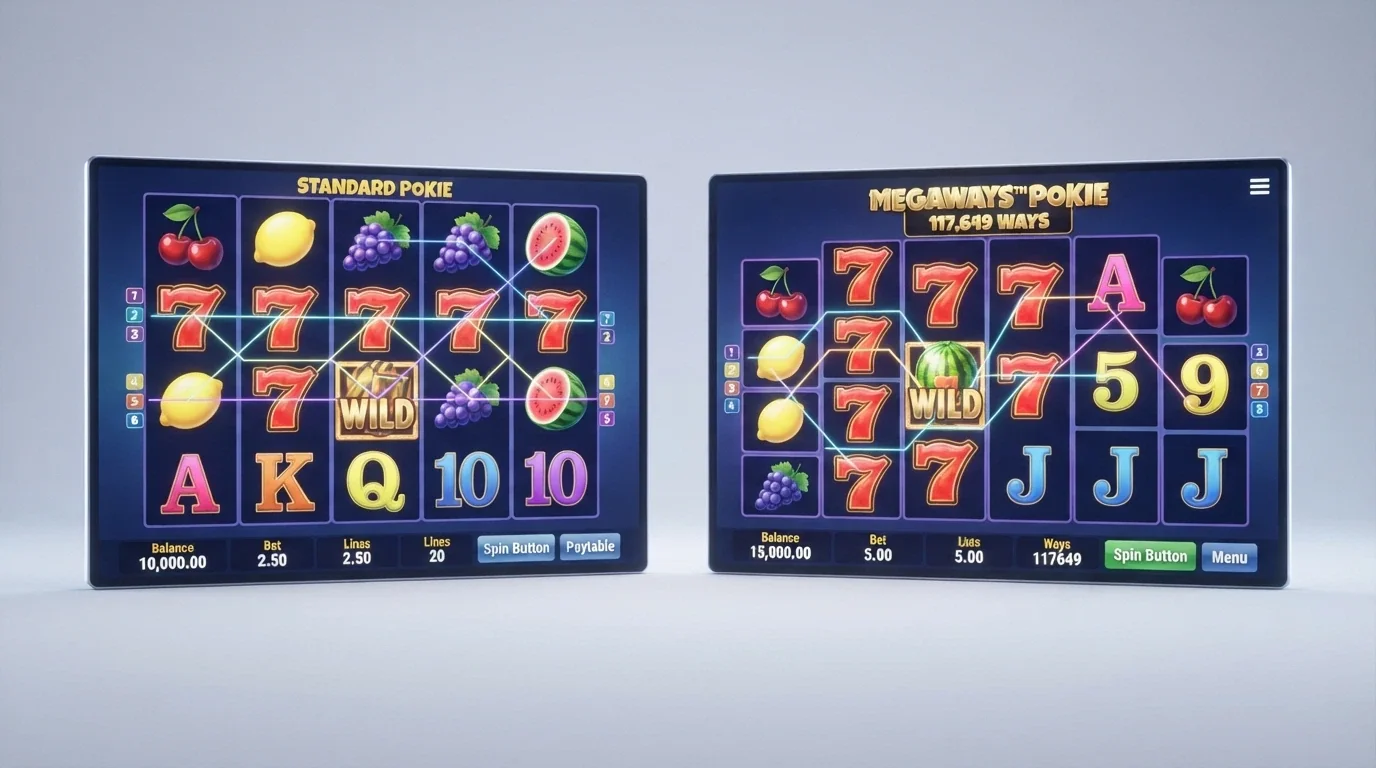
The 243-ways-to-win layout drops the payline model. On a 5×3 grid, every left-to-right combination of three, four, or five adjacent symbols counts as a win regardless of the specific line. That gives 3×3×3×3×3, or 243, possible combinations. Immortal Romance uses 243 ways at 96.86% RTP. 5 Dragons uses 243 paylines at 95.17%. The hit rate is typically higher than a 20-payline game because every adjacent symbol is a potential win, but each individual win pays less because the payout is spread across more combinations.
Megaways is the variable-row-height version of 243-ways. Each reel can show two, three, four, five, six, or seven symbols depending on the spin, and the total number of ways is the product of the rows on each reel. Six reels, each showing up to seven symbols, can produce up to 117,649 ways. White Rabbit Megaways, the highest-RTP Megaways title in the catalogue at 97.72%, is the standout. The variable row height creates a different kind of volatility: spins range from a handful of ways to a near-maximum grid, and the big wins cluster at the upper end of that range.
Cluster-pays games throw out the payline and the left-to-right pattern entirely. Sweet Bonanza uses a 6×5 grid at 96.51% RTP where any group of eight or more matching symbols touching horizontally or vertically pays out, regardless of position. Gates of Olympus, the same studio’s flagship, runs the same cluster-pays logic on a 6×5 grid at 96.50% RTP with multipliers up to x500. The hit rate is high, the base-game payouts are modest, and the bonus round is where the money is meant to be made.
These layouts are not interchangeable. A 5×3 20-payline game pays on a fixed pattern; a Megaways game pays on a shifting one; a cluster-pays game pays on a shape. The volatility profiles that follow in the catalogue reflect the layout choices, and a player who prefers long, flat sessions will be more comfortable on a 5×3 20-payline game than on a cluster-pays title where the bonus round carries the variance.
The Best 5-Reel Pokies Australian Players Are Spinning in 2026
Seventeen titles. RTPs from 95.17% to 99.00%. Volatility from low to extreme. Max wins from 900x to 111,111x. The table sorts by RTP descending. The prose below it explains what the spread actually means for session outcomes and what each range of the catalogue is best suited to.

| Title | Provider | RTP | Volatility | Max Win |
|---|---|---|---|---|
| Book of 99 | Relax Gaming | 99.00% | High | 10,000x |
| Mega Joker | NetEnt | 99.00% | Medium | 2,000x |
| Blood Suckers | NetEnt | 98.00% | Low | 900x |
| White Rabbit Megaways | Big Time Gaming | 97.72% | High | 13,029x |
| Immortal Romance | Microgaming | 96.86% | High | — |
| Dead or Alive 2 | NetEnt | 96.82% | Very High | 111,111x |
| Big Bass Bonanza | Pragmatic Play | 96.71% | Medium-High | 2,100x |
| Burning Reels | Wazdan | 96.63% | Adjustable | 5,000x |
| Stampede Gold | Betsoft | 96.62% | High | 10,127x |
| Sweet Bonanza | Pragmatic Play | 96.51% | High | 21,100x |
| Gates of Olympus | Pragmatic Play | 96.50% | High | 5,000x |
| Wolf Gold | Pragmatic Play | 96.50% | Medium-High | 2,500x |
| Money Train 3 | Relax Gaming | 96.40% | Extreme | 100,000x |
| Book of Dead | Play’n GO | 96.21% | High | 5,000x |
| Mental | Nolimit City | 96.08% | Extreme | 66,666x |
| Gonzo’s Quest | NetEnt | 95.97% | Medium-High | 37,500x |
| 5 Dragons | Aristocrat | 95.17% | Medium-High | — |
A 3.83-percentage-point spread runs from 5 Dragons at the bottom to Book of 99 at the top. Over a session of A$1,000 in wagers, that spread costs or returns roughly A$38. Over a session of A$10,000, it is A$380. RTP does not guarantee a return in any single session: a high-RTP game can still deliver a brutal run of losses, and a low-RTP game can still hit a feature bonus. The number is a long-run average across millions of spins. It is the only number on the page that does not depend on the specific sequence the reels produce.
The max-win figures tell a different story. Dead or Alive 2 can pay 111,111 times the stake; Money Train 3, 100,000x; Mental, 66,666x. These are headline ceilings that almost no player will ever see. They are real, in the sense that a single spin of A$1 could return A$111,111 if the right combination lands. The odds of that combination landing are roughly the same as the RTP would suggest: very low, but not zero. The volatility column is the practical read on how often those ceilings are approached. A low-volatility game like Blood Suckers pays 900x at most and pays it often. An extreme-volatility game like Money Train 3 pays 100,000x and pays it almost never.
Why RTP Is the Number That Matters Most When Picking a Pokie
Return-to-player is the share of every dollar wagered that the pokie returns to players across its full lifetime. A 96% RTP pokie returns A$96 of every A$100 wagered, on average, over millions of spins. The house keeps the other A$4. The percentage is set by the game’s design and cannot be changed by the casino hosting it; what changes between casinos is the specific version of the game being run. Some providers ship multiple RTP configurations, and a casino can choose to run the lower one. Blood Suckers, for example, has been released in 98% and lower-RTP variants. Players who care about the number should check the paytable before they start.
The 94% to 97% range that covers most five-reel pokies is where the practical decisions get made. A 94% pokie has a 6% house edge; a 97% pokie has a 3% house edge. The 3-percentage-point difference sounds small. Over 1,000 spins at A$1 each, the expected loss at 94% RTP is A$60, and the expected loss at 97% RTP is A$30. Over the lifetime of a typical bonus playthrough at A$0.20 per spin, the difference runs into thousands of dollars. The house edge compounds because the volume compounds: a low-edge game played for a long session costs less than a high-edge game played for a short one.
RTP does not predict any individual session. The number is a long-run average, and a long run is, in the language of statistics, an arbitrarily large sample. In a sample of a few hundred spins, anything can happen. A 96% pokie can produce a 30% return, and a 99% pokie can produce a 50% loss. The player who judges a pokie by what happened in their last session is not using the right instrument. The player who judges it by the published RTP, knowing that the number is a population statistic and not a personal one, is making the only honest read available.
The Providers Behind the Reels: Who Builds Australia’s Favourite 5-Reel Pokies
The catalogue above draws on six studios. NetEnt contributes four of the seventeen titles, with an average RTP across its 392-game catalogue of 96.39% and 83% of those games sitting at 96% or above. Pragmatic Play contributes four, with a catalogue-wide average of 95.61% across 639 titles and 45% at 96% or above. Big Time Gaming’s catalogue average is 96.25% with 91% at 96% or above. Relax Gaming, Play’n GO, Microgaming, Nolimit City, Wazdan, Aristocrat and Betsoft each contribute one or two titles.
The studio-level average is a useful reference point because it captures a philosophy. NetEnt’s 96.39% average is high because the studio is willing to ship flagship titles above 97%, and the catalogue skews toward medium-to-high volatility with deep bonus features. Pragmatic Play’s 95.61% average is lower because the studio’s catalogue is large and includes a long tail of simpler, higher-margin games; the 45% figure for titles at 96% or above means most Pragmatic games are paying below 96% RTP, but the studio’s flagship Megaways and cluster-pays titles push higher. Big Time Gaming’s 96.25% average and 91%-above-96% figure indicate a tighter, more uniformly generous catalogue centred on the Megaways format the studio invented.
Aristocrat is the Australian exception. The studio is a land-based heritage developer, and its online catalogue is smaller and more selective. 5 Dragons, the 243-payline game in the catalogue, sits at 95.17% RTP: lower than the NetEnt and Big Time Gaming averages, but typical of a land-based pokie that was ported online without rebalancing. Australian players who grew up playing Aristocrat cabinets in pubs will recognise the studio’s house style, which tends toward medium-to-high volatility, fixed-payline or 243-ways layouts, and Asian-themed free-spin rounds with selectable volatility modes.
The provider is not the only factor that matters, but it sets the range. A Pragmatic Play flagship and a Pragmatic Play catalogue filler are different games in the same wrapper, and the published RTP is the only honest way to tell which is which.
Volatility Decides Whether You Win Often or Win Big
Volatility, also called variance, is the size and frequency of payouts independent of the RTP. A low-volatility pokie pays out often, in small amounts. A high-volatility pokie pays out rarely, in large amounts. Both can return 96% RTP across a million spins. The difference is the path between the start and the end of that million-spin sample.
Blood Suckers, at 98% RTP and low volatility, is the steady-play example. A session of a few hundred spins will usually return something close to the published RTP, with small wins on most spins and the free-spins round paying out modestly. The session feels flat. The bankroll lasts a long time. The pokie will not produce a screenshot-worthy payout, but it will not produce a 50% session loss in twenty minutes either.
Money Train 3, at 96.40% RTP and extreme volatility, is the high-risk example. The base game is mostly dead spins punctuated by tiny wins. The bonus round is where the action is, and the bonus round is rare. A session of a few hundred spins can be over before it begins, with most of the bankroll returned to the house and a small chance of a payout large enough to recover it. The 100,000x max win is a real ceiling, not a marketing figure, but the probability of approaching it is roughly one in several million spins. Players who choose Money Train 3 are paying for a lottery ticket with most of their stake.
Burning Reels, by Wazdan, is a rare case: a pokie with adjustable volatility. The player can choose between Low, Standard, and High volatility modes before each spin, with the RTP staying at 96.63% across all three. The format is unusual enough to mention because it gives the player a direct control over the session shape that no other title in the catalogue offers.
The practical read on volatility is bankroll. A A$50 bankroll on Blood Suckers will last a long session of small, frequent wins. The same A$50 on Money Train 3 will last a few minutes and either vanish or, against long odds, multiply many times over. Neither is wrong, but they are not the same game.
How to Play 5-Reel Pokies Free — No Download, No Deposit
Over 41,624 free slot games are available to play online without download or registration on aggregator sites, and the bulk of them are five-reel pokies from the providers above. Demo mode is built into the game client itself: the provider’s website, the studio’s marketing page, and most affiliate review sites offer an instant-play version that loads in a browser, gives the player a play-money balance, and lets them spin without registering, depositing, or downloading software. The same HTML5 wrapper that runs the real-money version runs the demo version; the only difference is the source of the bankroll.

For Australian players, demo mode is the only way to play a five-reel pokie without using an offshore casino, because the offshore casino is the only place a real-money version is offered. Demo mode is also a useful tool for evaluating a pokie before committing a deposit: the RTP, volatility, and bonus-trigger frequency are identical in demo and real-money modes, and a few hundred demo spins will give a player a clear read on whether a game is worth their bankroll.
The limits of demo play are also worth knowing. A demo session does not produce the emotional state of a real-money session. The wins do not feel like wins, the losses do not sting, and the play is uncalibrated to any personal stake. A pokie that feels “fine” in demo can feel unplayable with real money, and vice versa. Demo play teaches the mechanics. It does not teach the player.
Demo Mode vs Real-Money Mode: What Changes When the Cash Is Fake
The mechanics are identical. The random number generator runs the same algorithm, the paytable is the same, the bonus features trigger at the same frequency, and the RTP is the same number. What changes is the player. A demo spin costs nothing, and a nothing-cost spin can be repeated indefinitely without consequence. A real-money spin costs the stake, and the cost lands on a bankroll that the player is responsible for.
The practical difference is in how a session unfolds. A demo session tends to be exploratory: the player tests the bonus round, scrolls through the paytable, and abandons the game when interest fades. A real-money session tends to be goal-oriented: the player is trying to clear a wagering requirement, hit a feature, or recover a loss. The pokie responds the same way to both. The player does not.
A winning streak in demo mode does not translate to real-money play. The reels do not remember what happened in the previous session, and the bonus triggers are not “due” because the player has been spinning for twenty minutes without one. The independence of each spin is the property that makes the RTP a long-run average rather than a session one. Demo play is useful for learning the rules of a pokie, the shape of its bonus round, the volatility profile in practice, and the visual design. It is not useful for predicting what will happen the next time real money goes in.
What demo play is genuinely useful for, beyond rule-learning, is comparing two pokies. A player deciding between Book of Dead and Gates of Olympus can spend twenty minutes in each demo, at the same play-money stake, and get a clear read on which game holds their attention and which one feels flat. That read is personal, but it is informed, and it is the read that RTP and volatility figures alone cannot supply.
Where to Find Free 5-Reel Pokies Without Signing Up
Provider demo libraries are the first stop. NetEnt, Pragmatic Play, Big Time Gaming, Play’n GO, Microgaming and Nolimit City all host instant-play demos of their flagship titles on their own websites. The pokie loads in the browser, no registration is required, and the play-money balance refreshes when it runs out. Aggregator sites like VegasSlotsOnline catalogue over 41,000 of these demos in one place, searchable by provider, theme, and feature. Affiliate review sites that cover the Australian market also host demo versions, usually embedded in the review itself.
The honest read on a no-registration claim is to check what the site is actually asking for before the game loads. A legitimate demo spins up with no email entry, no phone verification, and no deposit prompt. A site that asks for an email “to send you bonuses” or a phone number “to verify your region” is collecting data, not offering a free game. The cleanest demos are the ones that load before any form has been filled in.
For Australian players, the same offshore-status caveat that applies to the real-money casinos applies to the demo aggregators. A demo does not require a deposit, but the site hosting the demo is, in most cases, an offshore operator whose real-money product is prohibited under the IGA. The demo itself is not illegal. The data the site collects is the player’s responsibility to manage. Playing a demo on an aggregator site is not the same as depositing at a casino, and the legal exposure of the two acts is not the same either.
Why Your 2026 Bonus on 5-Reel Pokies Is Smaller Than It Looks
A welcome bonus on a five-reel pokie is a deposit match plus, often, a bundle of free spins. The headline figure on the offer page is the upper bound of the match: 100% up to A$2,000 means a A$2,000 deposit produces a A$2,000 bonus. A A$300 deposit produces a A$300 bonus. The actual cost of converting that bonus into withdrawable cash is the wagering requirement, and the wagering requirement is where the bonus stops looking like the headline.
The standard wagering multiplier in the offshore casinos covered later in this article is 40x. Rocket Play carries 40x wagering on the deposit-match bonus and on free-spin winnings, with a 7-day validity window. Skycrown carries 40x on the deposit match and 30x on free-spin winnings, with a 14-day validity window and an A$5 max bet while the bonus is active. Royal Reels carries 30 to 40x. WinSpirit carries 40x. The free-spin batch at Rocket Play is delivered 20 per day over five days and expires 24 hours after each batch drops, which means a player who signs up on a Wednesday and skips Friday loses those spins.
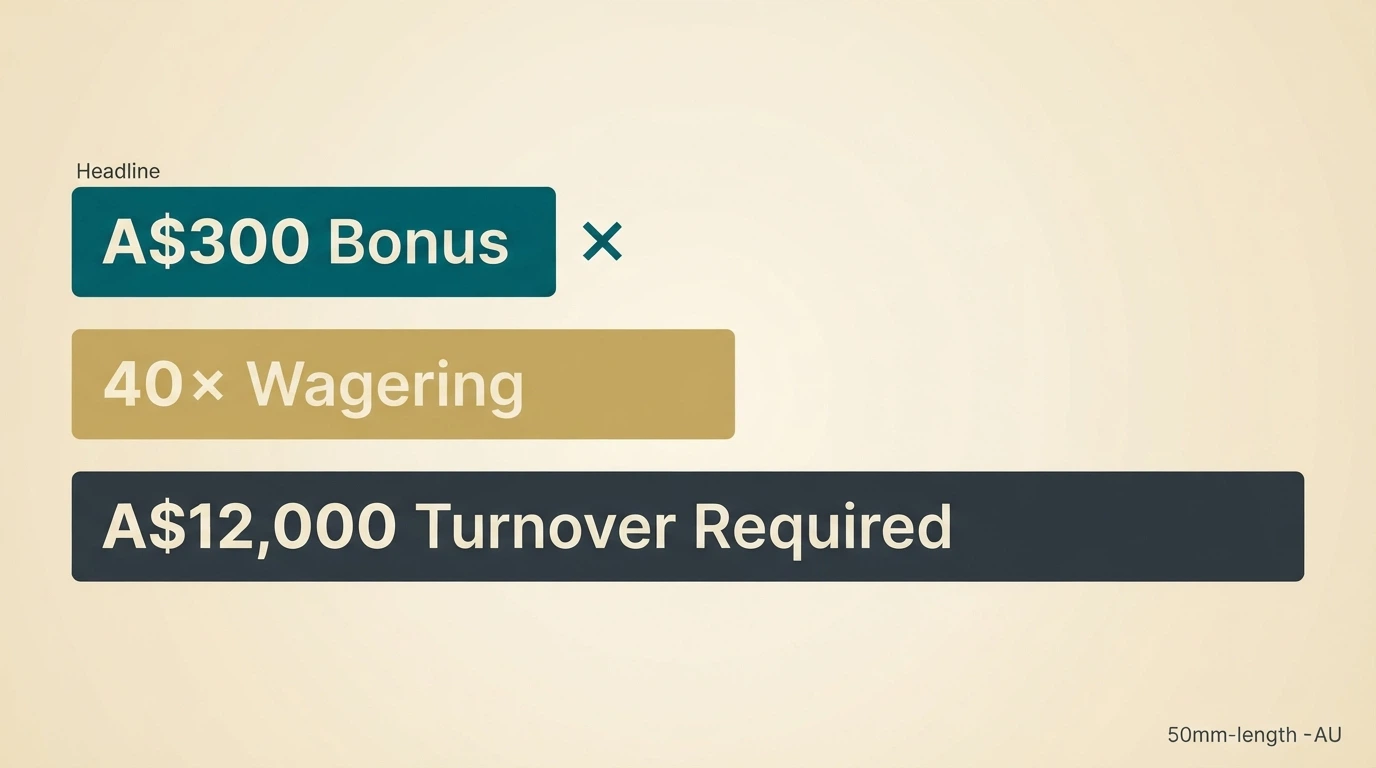
A worked example makes the cost visible. A A$300 deposit match at 40x wagering requires A$12,000 in turnover before the bonus converts to withdrawable cash. At a A$0.20 stake per spin, that is 60,000 spins. At a 5-second interval per spin, that is 300,000 seconds, or 83.3 hours of continuous spinning. The bonus is worth A$300 if the player grinds through the wagering requirement. The cost of the bonus, in time, is more than two full work weeks of unbroken play. The free-spin bundle attached to the same offer adds 100 spins at A$0.20 each, with winnings capped at A$300 and a 40x wagering on those winnings. The cap is the second pinch: a player can hit a feature that pays A$1,000 in the free spins, and walk away with A$300.
The “free” in free spins is a marketing word, and the wagering requirement is what it does not mean. A free spin is a spin the player does not pay for. The winnings from that spin are subject to the same wagering requirement as the deposit match, capped at a multiple or a dollar ceiling, and tied to a validity window measured in hours or days. The honest read on a free-spin offer is to look at the cap, the wagering multiplier on the winnings, and the validity window. The headline count of spins and the spin value are the least important numbers on the page.
Free Spins on 5-Reel Pokies: How Much They Are Actually Worth
A typical free-spin offer on a five-reel pokie delivers 100 spins on a named title, with a spin value of A$0.10 to A$0.20. Skycrown’s 100 free spins on Book of Dead at A$0.20 each is at the upper end of the spin-value range. Rocket Play’s 100 free spins on Aztec Magic, also at A$0.20 each, matches it. The 20-per-day cadence, 100 spins over five days, is the standard delivery pattern in this market. A player who skips a day loses that day’s spins.
The wagering requirement on free-spin winnings is where the value is compressed. Skycrown applies 30x wagering to free-spin winnings and caps those winnings at 10x the total value of the free spins received. For 100 free spins at A$0.20, the total free-spin value is A$20, and the cap on winnings is 10× that, or A$200. A player who hits a 50x win on a single free spin and then runs the winnings through 30x wagering can still walk away with no more than A$200. Rocket Play applies 40x wagering on free-spin winnings and caps the winnings at A$300 outright. The cap is a hard ceiling: the casino will not pay more than A$300 on the free-spin bundle, no matter what the reels produce.
The short validity window is the third constraint. Skycrown’s free spins are delivered 20 per day over five days; Rocket Play’s expire 24 hours after each 20-spin batch is delivered. A player who does not log in on day two loses those 20 spins. A player who logs in on day five, plays the 20 fresh spins, but ignores the day-one batch that is now expired loses those too. The validity window is the mechanism that converts “100 free spins” into “however many you actually claim in time.”
The honest read on a free-spin offer: take the spin value, multiply by the spin count to get the headline value, apply the win cap, divide by the wagering multiplier, and check the validity window. The resulting figure, in expected withdrawable cash, is usually a small fraction of the headline.
Where Australians Play 5-Reel Pokies — and the Offshore Reality Behind Every Option
Ten operators appear in this section. All ten are offshore. None holds an Australian casino licence because no such licence exists in Australia. The Interactive Gambling Act 2001 prohibits providing online casino games, including online pokies, to anyone in Australia. The Australian Communications and Media Authority has directed Australian ISPs to block 1,788 illegal gambling and affiliate websites since November 2019, and over 230 illegal services have withdrawn from the Australian market since 2017. The table below compares what each operator offers, not what it is licensed to provide.

| Operator | Status | Welcome Offer | Game Providers |
|---|---|---|---|
| Rocket Play | Offshore (Curaçao) — no AU licence | 100% up to A$300 + 100 FS; five-tier up to A$4,000 + 400 FS | 30+ (Pragmatic Play, NetEnt, Microgaming, BGaming, Evolution Gaming, Nolimit City) |
| Skycrown | Offshore (Curaçao) — no AU licence | 100% up to A$2,000 + 100 FS; four-tier up to A$8,000 + 400 FS | 300+ games (Evolution Gaming, Pragmatic Play, NetEnt) |
| Royal Reels | Offshore — no AU licence | A$10 no-deposit + 100% up to A$500 | 2,000+ games from 30+ providers |
| WinSpirit | Offshore — no AU licence | 200% + 25 FS | — |
| Stake | Offshore (Curaçao) — no AU licence | No traditional welcome bonus; rakeback/VIP | Pragmatic Play, Evolution Gaming, Hacksaw Gaming, Nolimit City |
| Rainbet | Offshore — no AU licence | — | — |
| Scream Casino | Offshore — no AU licence | — | — |
| FairGO | Offshore — no AU licence; ACMA has blocked multiple fairgo domains | — | RTG (RealTime Gaming) |
| Bizzo Casino | Offshore — no AU licence; ACMA formal warning July–September 2025 | — | — |
| Rocket Casino | Offshore — no AU licence; ACMA has blocked multiple casinorocket domains | — | — |
The welcome-offer and game-provider columns carry em dashes where the research could not confirm specifics. The table does not invent numbers to fill those gaps. A player comparing options needs to know which specifications are verified and which are not, and the gaps are the information.
How the Operator List Is Built: What Counts and What Does Not
The ten operators in this section are the brands Australian players actually reach through search results, affiliate review pages, and offshore casino aggregators. They were selected on the basis of game-library breadth, welcome-offer clarity, AU-dollar deposit support, and ACMA enforcement history. An operator whose welcome offer could not be confirmed in current operator materials was kept on the list with a blank offer cell, because the brand exists in the Australian search landscape and a reader is likely to encounter it. A brand that surfaced only in passing and could not be tied to verifiable game providers or bonus terms was excluded.
No promo codes are routed in this page. The welcome-offer figures are drawn from the operators’ own terms pages as published, and they describe the structure of the offer rather than any token a player would enter at the cashier. A reader who arrives at one of these operators will see the offer, the wagering requirements, and the validity windows in the terms box, and that is the information this page is built to help interpret.
The licensed-AU-wagering alternative is the TAB, the major bookmakers (Sportsbet, Ladbrokes, Bet365 AU, Neds, PointsBet), and the lotteries. None of those offers online pokies, because no Australian licence permits online pokies. The offshore operators in the table are the only places an Australian player can find a real-money five-reel pokie, and the legal status of that arrangement is the subject of the next section.
The Offshore Reality: Every Brand on This List Sits Outside Australian Law
There is no Australian online casino licence. The Interactive Gambling Act 2001 prohibits providing online casino games, online pokies, and in-play sports betting to anyone in Australia . The offence is committed by the provider, not the player: the IGA targets the operator offering the service, and the individual player is not prosecuted. What this means in practice is that an Australian player using an offshore casino does not face criminal charges, but also has no Australian consumer protection, no access to the BetStop self-exclusion register, and no recourse if the operator refuses a withdrawal or voids a win.
The Australian Communications and Media Authority is the federal body that enforces the online prohibition. ACMA investigates complaints, issues formal warnings, brings civil penalty proceedings, and directs Australian ISPs to block illegal services. As of the most recent published figures, 1,788 illegal gambling and affiliate websites have been blocked since November 2019, and over 230 illegal services have withdrawn from the Australian market since 2017. The blocking is ongoing: ACMA publishes lists of newly blocked sites, and the operators in the table whose names appear on those lists (FairGO, Bizzo Casino, Rocket Casino) are documented enforcement targets.
BetStop, the National Self-Exclusion Register, covers the approximately 150 Australian-licensed wagering providers and excludes a self-excluded person from every one of them in a single step. It does not cover offshore casinos. A player who has registered with BetStop and then logs into an offshore casino will not be blocked by the operator, because the operator is not connected to the register. This is the single most important practical limitation of BetStop for a player considering offshore play, and it is the reason the responsible-gambling section of this article comes back to offshore-specific guidance rather than relying on BetStop alone.
The financial risk of offshore play is borne entirely by the player. If the casino refuses a withdrawal, the player has no Australian regulator to complain to. If the casino voids a win on a bonus-term technicality, the player has no Australian dispute resolution service to appeal to. If the casino is blocked by ACMA with a balance still in the account, the player has no Australian authority that can compel the operator to refund. The offshore operator’s terms of service govern the relationship, and those terms are drafted in a jurisdiction the player does not live in.
The legal status of online pokies in Australia is not ambiguous. Providing the service is banned. Playing it is not criminal. The player who chooses to play anyway accepts the full financial and consumer-protection risk of doing business with an unlicensed operator in a prohibited market.
Rocket Play: A Five-Tier Welcome Package Across 30+ Providers
Rocket Play carries a Curaçao licence and operates a 30-plus provider library including Pragmatic Play, NetEnt, Microgaming, BGaming, Evolution Gaming, and Nolimit City. The first-deposit offer is 100% up to A$300 plus 100 free spins, and the welcome package extends across five deposits to a total of A$4,000 in matched funds plus 400 free spins. The minimum deposit is A$30, the wagering requirement is 40x on the deposit match and 40x on free-spin winnings, and the bonus validity is 7 days.
The 100 free spins are credited on BGaming’s Aztec Magic, delivered 20 per day over five days at A$0.20 per spin, with winnings capped at A$300 and a 24-hour validity on each 20-spin batch. The cap is the key constraint: a player who hits a high-value feature on the free spins and exceeds the A$300 ceiling will see the excess removed at withdrawal. The 7-day bonus validity is also tight: a player who deposits, walks away, and returns on day nine will find the bonus expired and any winnings from it voided.
Rocket Play is a useful choice for a player who wants the broadest provider mix in the featured set: Pragmatic Play and Nolimit City under one roof is a meaningful catalogue, and the 30+ provider count is the highest in the table. The trade-off is the wagering requirement, which is at the high end of the offshore market, and the bonus validity, which is at the short end. The free-spin bundle is structured to deliver value only to a player who logs in daily.
Skycrown: The Biggest Headline Bonus Among the Listed Operators
Skycrown is operated by Hollycorn N.V. under a Curaçao licence and carries 300-plus games from Evolution Gaming, Pragmatic Play, and NetEnt. The first-deposit offer is 100% up to A$2,000 plus 100 free spins on Play’n GO’s Book of Dead, and the four-tier welcome package extends to A$8,000 in matched funds plus 400 free spins, the largest headline total among the featured operators. The bonus carries 40x wagering on the matched funds and 30x on free-spin winnings, with a 14-day validity window and an A$5 maximum bet while the bonus is active.
The 100 free spins on Book of Dead are delivered 20 per day over five days at A$0.20 per spin, with winnings capped at 10x the total free-spin value. For 100 spins at A$0.20, the free-spin value is A$20, and the cap is A$200. The 30x wagering on free-spin winnings is lower than Rocket Play’s 40x, which compresses the time cost of clearing the free-spin bundle, and the 14-day validity is twice as long as Rocket Play’s 7-day window.
The A$5 max bet while the bonus is active is the most restrictive bonus-play constraint in the table. A player who is used to betting A$10 or A$20 per spin will need to drop to A$5 for the duration of the playthrough, and any spin above the cap risks having the bonus and the winnings voided. Skycrown is a strong fit for a player with a large bankroll who can stomach the A$5 cap in exchange for the largest bonus ceiling on the page. For a player with a smaller bankroll or a preference for higher-stake spins, the cap is a meaningful constraint.
Royal Reels: A No-Deposit Entry Point and 2,000+ Games
Royal Reels is the only featured operator offering a no-deposit bonus: A$10 credited to a new account on sign-up, with no deposit required. The deposit-match offer is 100% up to A$500 with a A$30 minimum deposit and 30 to 40x wagering. The catalogue lists 2,000-plus games from 30-plus providers including Pragmatic Play, Evolution Gaming, Yggdrasil, and Hacksaw Gaming. The licence jurisdiction was not confirmed in current operator materials.
The no-deposit bonus is a useful trial: a player can register, claim the A$10, and play a few hundred spins on a five-reel pokie with no commitment. The catch is in the wagering requirement, which runs 30 to 40x depending on the specific promotion, and on the maximum withdrawable amount from a no-deposit bonus, which is usually capped at a few times the bonus value. A A$10 no-deposit bonus with 40x wagering and a A$100 max cashout is a useful test drive, not a path to a payout.
The 2,000-game library is broader than Skycrown’s 300-plus and the largest confirmed catalogue in the table. Free spins are not specified as a standalone offer in the welcome package; the A$10 no-deposit bonus and the A$500 deposit match are the named components. The licence jurisdiction gap is worth noting: a player who wants to verify the regulatory framework before depositing will need to do that work themselves, because the operator materials do not state it.
WinSpirit: A 200% Match — the Highest Headline Rate Listed
WinSpit carries a 200% welcome bonus plus 25 free spins, with 40x wagering. The 200% match is the highest headline rate in the featured set: a A$100 deposit produces a A$200 bonus, a A$500 deposit produces a A$1,000 bonus. The specific eligible title for the free spins, the bonus validity window, the licence jurisdiction, and the full provider list were not confirmed in current operator materials.
The 200% rate is a meaningful structural difference. At 40x wagering, a A$200 bonus on a A$100 deposit requires A$8,000 in turnover, while the same A$100 deposit at 100% match at 40x requires A$4,000. The higher match percentage doubles the bonus amount and roughly doubles the turnover required, but the player’s deposit-to-bonus ratio shifts: a 200% match means a smaller deposit produces the same bonus, which extends the bankroll but also extends the time cost of clearing the wagering.
The gaps in the confirmed specifics are the main caveat. A 200% bonus with 40x wagering is a strong headline, but the conditions attached to it (eligible games, max bet, validity window, max cashout from the free spins) are not visible in the operator materials currently available, and a player who deposits on the strength of the 200% figure alone is depositing without the full terms in hand.
Stake: No Welcome Bonus — a Rakeback Model Instead
Stake operates under a Curaçao licence and runs a crypto-native model with no traditional deposit-match welcome bonus. The site offers cryptocurrency payments and carries Pragmatic Play, Evolution Gaming, Hacksaw Gaming, and Nolimit City titles. The promotional structure is a rakeback and VIP system that returns a percentage of house edge to active players on an ongoing basis, rather than a one-time welcome match. BetStop does not apply because Stake is not an Australian-licensed wagering provider.
The absence of a welcome bonus is a structural difference, not a flaw. A player who would otherwise claim a A$300 deposit match at 40x wagering and grind through 60,000 spins to clear it is, on Stake, depositing a A$300 bankroll and playing through it on their own terms, with the rakeback rebate running in the background. The rakeback rate is not always visible to non-VIP players, and the rebate is calculated on house edge rather than on turnover, so the actual return depends on the games played and the volume.
The crypto payment model intersects with Australian law. Since 11 June 2024, credit cards, credit-related products, and cryptocurrency have been banned as payment methods for online wagering in Australia. The ban applies to Australian-licensed wagering providers; Stake is not an Australian-licensed wagering provider. The legal status of an Australian player funding a Stake account with cryptocurrency is the player’s exposure, not Stake’s, and the offshore-status caveat that applies to every operator in this table applies with extra force to a crypto-funded account.
Stake is a fit for a player who has decided to play offshore, prefers the rakeback model to a one-time bonus grind, and is comfortable with cryptocurrency. The lack of a welcome bonus is the point: the model is built for ongoing play, not bonus-hunting.
Rainbet: Slim Data, Same Offshore Reality
Rainbet is an offshore operator with no confirmed specifics in current research: its licence jurisdiction, bonus terms, game providers, and wagering requirements remain unverified. It shares the same offshore status as other operators in the table, and the legal exposure for an Australian player is the same.
An operator with no verifiable welcome offer and no confirmed provider list is, in practical terms, an operator a player should treat as unknown. The catalogue on Rainbet may be excellent; the bonus terms may be generous; the licence may be reputable. None of that is visible in the materials available. A player who arrives at Rainbet through a search result or an affiliate link and chooses to deposit is depositing on the strength of the operator’s own claims, not on any third-party verification.
The honest read on Rainbet is that it is an offshore casino like every other operator in the table, with the same offshore risk profile, and with specifications that the research could not confirm. A player who wants verified bonus terms, a confirmed game library, and a known licence jurisdiction will find stronger evidence in the entries above.
Scream Casino: What the Data Can Confirm
Scream Casino is an offshore operator with no confirmed specifics: licence, welcome bonus, free spins, wagering, bonus validity, and game providers are all unverified in current research. The offshore status is the same as every other operator in the table, and the IGA prohibition on providing online pokies to Australians applies in the same way.
A player evaluating Scream Casino on the basis of current research has no specific data to evaluate beyond the offshore status. The brand exists, the site can be reached, and the games are likely to be five-reel pokies from mainstream providers, because that is the default for offshore casinos targeting the Australian market. None of that is verified.
The honest read on Scream Casino is the same as the honest read on Rainbet: an offshore operator with unconfirmed specifics, and the same offshore risk profile as the rest of the table. A player who wants to evaluate the site should do that evaluation directly, because the research has nothing to report.
FairGO: RTG-Only, AU-Targeted, and Blocked by the ACMA
FairGO is a long-standing Australian-facing offshore operator running exclusively on RealTime Gaming (RTG) software, with multiple domains blocked by the ACMA over the enforcement history: Fairgo.com, fairgo.info, Fairgo.casino, and others appear in published blocking lists. Specifics regarding its licence, bonus structure, and wagering requirements were not confirmed in current research. The RTG-only catalogue is unusual in the table: every other operator with a confirmed provider list carries multiple studios, while FairGO carries one.
The RTG restriction has practical consequences. RealTime Gaming’s catalogue skews toward land-based-ported titles and Asian-themed pokies, and the studio’s average RTP is below the NetEnt and Big Time Gaming benchmarks. The five-reel format is well represented in the RTG library, but the headline RTP figures on RTG titles tend to land in the 95% to 96.5% range rather than the 96.5% to 99% range covered by the catalogue earlier in this article. A player who is committed to FairGO is also committing to the RTG catalogue, and the choice of games is narrower than at Skycrown, Royal Reels, or Rocket Play.
The ACMA blocking history is a concrete risk signal. An operator whose domains have been blocked multiple times is an operator ACMA has identified as a prohibited service. New domains can be created and reach Australian players, but the blocking is ongoing. A player who keeps a balance at FairGO when a new domain is blocked may find that balance stranded on a domain the player’s ISP can no longer reach.
Bizzo Casino: Formal ACMA Warning for Prohibited Services
Bizzo Casino is operated by Consolutetish SRL and received a formal ACMA warning in July through September 2025 for providing prohibited interactive gambling services to Australians. The warning names National Casino and Bizzo Casino together as the subjects of the action. Like other listed offshore operators, its licence, bonus terms, and wagering specifics are unconfirmed.
The formal warning is the strongest enforcement signal in the operator table. A formal warning is a step above an ISP blocking request: it is a direct communication from ACMA to the operator identifying the legal exposure and putting the operator on notice that further enforcement action, including civil penalty proceedings, may follow. An operator that has received a formal warning is an operator that ACMA has specifically targeted, and the ACMA enforcement record is public.
A player who deposits at Bizzo Casino is depositing at an operator ACMA has formally identified as providing prohibited services to Australians. The offshore risk profile of every other operator in the table applies, with the added exposure that the operator is already on ACMA’s enforcement radar. New domains can be created, but the warning is part of the operator’s record.
Rocket Casino: Multiple Domains Blocked by the ACMA
Rocket Casino is an offshore operator with multiple casinorocket domains blocked by ACMA: Casinorocket4.com, Casinorocket5.com, Casinorocket8.com, and others appear in published blocking lists. Like other operators on this list, its licensing, bonus terms, and wagering conditions were not confirmed in current research.
The multiple-domain blocking pattern is consistent across the operator table. An offshore casino whose primary domain is blocked typically responds by registering new domains and continuing to operate. The ACMA blocking is ongoing, and the same brand can accumulate a long list of blocked domains over time. A player using Rocket Casino is using a brand that has been identified, repeatedly, as a prohibited service.
The absence of confirmed bonus terms, game providers, and licence jurisdiction leaves the operator on the same evidentiary footing as Rainbet, Scream Casino, and Bizzo Casino. The blocking history is a concrete risk signal, but the rest of the operator profile is unverified.
Are Online Pokies Legal in Australia? The 2026 Reality Check
The Interactive Gambling Act 2001 makes it an offence for a provider to offer online casino games, online pokies, and in-play sports betting to a person in Australia. The Australian Government lists the prohibited products explicitly: online roulette, blackjack, poker, craps, and online pokies. The offence is committed by the provider, not the player: the individual player is not prosecuted under the IGA. What is licensable in Australia is wagering on races and sport placed before the event begins, lotteries, and keno (though online keno is being banned from 1 January 2027 under the 2026 reform).

The Australian Communications and Media Authority enforces the prohibition. ACMA investigates complaints, issues formal warnings, brings civil penalty proceedings, and directs Australian ISPs to block illegal services. As of the most recent published figure, ACMA has had 1,788 illegal gambling and affiliate websites blocked by Australian ISPs since November 2019, and over 230 illegal services have withdrawn from the Australian market since 2017. The blocking is ongoing, and ACMA publishes lists of newly blocked services on its website.
The 2026 reform changed the framework. The Interactive Gambling Amendment (Gambling Reform) Bill 2026 passed Parliament on 19 August 2026. Its measures commence on 1 January 2027. The reform bans online keno (“pocket pokies”) and foreign-matched lotteries, introduces wagering advertising restrictions, and gives banks authority to block transactions to illegal operators. The advertising restrictions include a three-ad-per-hour cap between 6:00 am and 8:30 pm, a live-sport blackout from 15 minutes before to 5 minutes after an event, and a ban on wagering advertising in sports venues and on uniforms. Athletes, celebrities, and influencers are barred from promoting wagering products.
The payment-method ban has been in place since 11 June 2024. Credit cards, credit-related products, and cryptocurrency are prohibited as payment methods for online wagering in Australia, with penalties of up to A$247,500 for non-compliance. The ban applies to Australian-licensed wagering providers. An Australian player using a credit card to fund an offshore casino account is operating in a legally ambiguous space: the credit card ban targets the licensed provider, not the player, but the bank may still decline the transaction.
What Happens to the Player: Offshore Risk, Not Criminal Risk
The IGA targets the provider, not the player. An Australian player who uses an offshore casino does not face criminal prosecution under the IGA. What the player does face is the absence of every Australian consumer protection that a domestic transaction would carry. There is no Australian dispute resolution service to appeal to if the operator refuses a withdrawal. There is no Australian regulator to complain to if the operator voids a bonus win on a technicality. There is no Australian authority that can compel an offshore operator to return a balance stranded when a domain is blocked.
BetStop, the National Self-Exclusion Register, is the most visible gap. BetStop covers the approximately 150 Australian-licensed wagering providers and excludes a self-excluded person from every one of them. It does not cover offshore casinos. A player who has registered with BetStop and then logs into an offshore casino will not be blocked by the operator, because the operator is not connected to the register. The self-exclusion that binds an Australian-licensed bookmaker does not bind an offshore casino. This is the single most important practical limitation of BetStop for any Australian player considering offshore play.
The financial consequences of a blocked site are also worth being clear about. ACMA blocks domains at the ISP level. The player’s internet service provider stops resolving the domain, and the player can no longer reach the site. If the player had a balance on the site at the moment of blocking, the balance is on the operator’s server, not on the player’s. The operator may continue to operate on a new domain, and the player may be able to reach the new domain and withdraw the balance. The operator may also decide that any balance held on a blocked domain is forfeit, and the player has no Australian recourse to challenge that decision.
The offshore risk is not a criminal risk. It is a consumer-protection risk, a balance-stranding risk, and a self-exclusion-evasion risk. The player who accepts those risks and chooses to play offshore is the player the IGA was written about, and the framework does not protect them.
The 2026 Reform: What Changes on 1 January 2027
The 2026 reform takes effect on 1 January 2027. From that date, online keno and foreign-matched lotteries are banned, and wagering advertising is subject to federal restrictions: a maximum of three wagering ads per hour between 6:00 am and 8:30 pm, a live-sport blackout running 15 minutes before to 5 minutes after an event, a ban on radio wagering ads during school times, a ban on broadcasting odds, and a requirement that online wagering ads be served only to logged-in, verified 18+ users who have not opted out. Wagering advertising is banned in sports venues and on sports uniforms, and athletes, celebrities, and influencers are barred from promoting wagering products.
The reform also strengthens BetStop and gives banks authority to block transactions to illegal operators. The direct marketing prohibition extends for 14 days after sign-up, three months after BetStop deregistration, and indefinitely for at-risk customers. The bank-blocking authority is the practical change with the most reach: an Australian bank that identifies a transaction to an illegal gambling operator can decline the transaction, and the player has no recourse to compel the bank to process it.
The reform does not legalise online casino. The prohibition on providing online pokies, online roulette, online blackjack, online poker, and online craps to Australians is unchanged. What the reform does is tighten the enforcement perimeter around that prohibition: more ad restrictions, more payment restrictions, more bank cooperation with enforcement, and a stronger self-exclusion register. The offshore casino remains prohibited, and the player who uses one remains outside the Australian consumer-protection framework.
Playing 5-Reel Pokies Without Losing Control
Gambling harm in Australia is not a small number. 15.1% of the Australian adult population, an estimated 3.32 million people, are experiencing some level of harm from their own gambling behaviours or those close to them, as of March 2026. 13.0% of the population, an estimated 2,857,000 people, are experiencing harm from their own gambling. A separate model-based estimate puts the annual affected population at 3.29 million Australians aged 5 and above, including 1.97 million adults classified as having at-risk or problem gambling. The annual health loss associated with gambling harm in Australian adults is estimated at over 400,000 Years Lived with Disability. About 1.1% of Australian adults are problem gamblers, and a further 3.4% are at-risk.
These numbers sit behind every other number on this page. The RTP, the volatility, the bonus terms, the offshore risk, the legal exposure: every calculation in this article assumes a player who is in control of their play. A player who is not in control is not making calculations, and the arithmetic is irrelevant. The support infrastructure that follows is the practical safety net.
The Australian Government has committed A$112.7 million over five years from 2025-26 to reduce gambling harms. The funding includes A$39 million for financial counselling, A$28.7 million for BetStop enhancements, A$22.6 million for wagering advertising enforcement, and A$22.4 million for a national awareness campaign. ACMA will receive A$3.2 million in initial additional funding and A$5.2 million annually from 2026-27 to 2029-30, partly funded through a BetStop cost recovery levy on operators.
BetStop: What the National Self-Exclusion Register Does — and Does Not — Cover
BetStop is the National Self-Exclusion Register, launched on 21 August 2023. A person who registers with BetStop is excluded from every Australian-licensed online and phone wagering service in a single step. The exclusion can be set for a minimum period of three months and extended up to a permanent exclusion. As of 31 March 2026, 59,830 people had registered with BetStop, and 37,247 had active exclusions; 22,583 had completed their exclusion or cancelled early.
BetStop binds approximately 150 Australian-licensed wagering providers. Those providers are required to refuse service to anyone on the register, to close existing accounts, and to withhold marketing. The register is administered by ACMA, and registration is free, confidential, and available online at the BetStop portal. The exclusions apply across every licensed operator: a player who has registered does not need to contact each bookmaker individually, because the register is the single source of truth.
What BetStop does not cover is offshore casinos. The register binds Australian-licensed providers, and offshore casinos are not connected to it. A player who has registered with BetStop and then logs into an offshore casino will not be blocked by the operator, because the operator has no access to the register. The self-exclusion that protects a player from licensed wagering does not protect them from offshore play. This is the limitation that matters most for any Australian player considering an offshore casino, because it is the gap that turns a self-exclusion into a partial protection.
The choice for a player who has registered with BetStop is between honouring the exclusion and finding ways around it. Offshore casinos are the most common way around it. A player who wants the exclusion to hold is a player who needs to commit to not seeking out offshore play, because the infrastructure is built to help licensed wagering and is not built to help offshore play.
Where to Get Help: The Numbers Every Australian Player Should Know
The National Gambling Helpline is 1800 858 858, free, confidential, and staffed 24 hours a day, 7 days a week. The helpline is the first number every Australian player who is worried about their play should save. It is staffed by trained counsellors, and the call is free from any Australian phone. Online chat and email counselling are also available through Gambling Help Online, at gamblinghelponline.org.au. The same counselling is available to family members and friends of someone whose gambling is causing harm, because the harm extends beyond the player.
State-based counselling services are available in every Australian state and territory, and the national gamblinghelponline.org.au portal routes players to the relevant state service. The A$39 million financial counselling expansion announced in the 2026 reform increases the capacity of those services. Financial counsellors help with debt, budgeting, and negotiating with creditors, and they are free.
A player who has decided to stop playing can register with BetStop and close their offshore casino accounts. A player who has decided to keep playing can use deposit limits, session limits, and time-out features where the offshore casino offers them, and can commit to a budget that does not compromise the rent, the bills, or the household. The arithmetic of the bonus section above is the arithmetic of a player in control. A player who is not in control is not making those calculations, and the support infrastructure exists for exactly that moment.
How We Picked the Best 5-Reel Pokies for This List
The catalogue of 17 titles was built from provider RTP data, payout databases, and competitor review. Each title carries a published RTP from the provider or a third-party payout database, and the titles without a verified RTP were excluded. The ranking is by RTP descending, with no weighting on volatility, max win, theme, or provider. The volatility and max-win columns are the same data each provider publishes; they are not normalised or adjusted.
The operator list was built from the brands Australian players actually reach. The criteria were game-library breadth (confirmed by provider count or game count where available), welcome-offer clarity (the offer, the wagering requirement, the validity window, and the eligible game were all visible in operator materials), AU-dollar deposit support (each operator accepted AUD as a deposit currency), and ACMA enforcement history (operators with formal ACMA warnings or repeated domain blocks were kept on the list with the enforcement action noted, because the action is part of the operator’s profile). Operators with no verifiable game providers, no visible welcome offer, and no ACMA enforcement record were excluded.
What was excluded: titles with no verified RTP, titles with multiple RTP configurations where the configuration run by the casino is not specified, and operators with no verifiable game-provider data. No invented weightings or percentages were applied to the ranking. The RTP is the ranking criterion because it is the only number that does not depend on luck, and the volatility and max-win columns are there to let the reader apply their own weight to those numbers.
No demo play was used to generate the catalogue. The catalogue is built from the same provider materials a player would consult directly, and the verification was a matter of cross-referencing sources rather than running sessions. The free-play section earlier in the article is a separate block, and it points to the same provider demo libraries the catalogue is drawn from.
Know Before You Spin: The 2026 5-Reel Pokies Bottom Line
The highest-RTP titles in the catalogue are clear. Book of 99 at 99.00% and Mega Joker at 99.00% sit at the top. Blood Suckers at 98.00% is the steady-play option for players who want long, flat sessions. White Rabbit Megaways at 97.72% is the highest-RTP Megaways title. Every title in the catalogue pays 95.17% or better, and the spread between top and bottom is 3.83 percentage points. That spread is the practical read on the catalogue, and it is the number a player should carry into a session.
The legal landscape is unambiguous. The IGA prohibits providing online pokies to anyone in Australia. No online casino licence exists in the country. Every operator in the comparison table is offshore, every one of them is an enforcement target, and the player using one of them has no Australian consumer protection. The 2026 reform tightens the enforcement perimeter from 1 January 2027, but it does not legalise the offshore product. The legal exposure of offshore play is the player’s exposure, and the framework was not written to protect the player who chooses it.
Demo play is the risk-free way to learn the games. Over 41,000 free pokies are available without download or registration, and the mechanics of demo mode are identical to real-money mode. A player who wants to learn a pokie’s bonus round, volatility profile, and visual design can do that without depositing. The gap between demo and real-money play is in the player, not the game, and the demo is a better preparation than a deposit.
The responsible-gambling safety net is real. The National Gambling Helpline at 1800 858 858 is free, confidential, and staffed 24/7. BetStop is the national self-exclusion register, and it binds every Australian-licensed wagering provider. The offshore casinos are not connected to BetStop, and that gap is the single most important thing a player considering offshore play needs to know before depositing. The support infrastructure exists. The offshore casino does not connect to it.
The final call is the reader’s informed choice. This page is built to inform that choice: the catalogue gives the RTP-ranked list, the bonus section gives the wagering-requirement arithmetic, the operator table gives the comparison, the legality section gives the framework, and the responsible-gambling section gives the safety net. The choice between playing and not playing, and the choice between an offshore casino and not playing at all, belongs to the reader. The numbers on this page are the reader’s evidence, and the support infrastructure is the reader’s safety net.
Frequently Asked Questions
What bonus features do 5-reel pokies typically include?
Free spins are the most common feature, with most 5-reel pokies offering 10 to 25 free games triggered by three or more scatter symbols. Wild symbols substitute for other symbols to complete winning combinations, scatter symbols pay anywhere on the grid regardless of paylines, and multiplier symbols boost line wins or free-spin payouts. Cascading reels, expanding reels, pick-me bonus rounds, and Megaways variable-row formats are common in modern titles. The bonus round is where the math changes, and the hit frequency and maximum payout of the bonus round are the practical difference between a flat pokie and a volatile one.
How do I check the RTP and volatility of a 5-reel pokie before playing?
The RTP is published in the game’s information or paytable, accessible from the game’s main screen, and on the provider’s website. Volatility is usually published in the same information panel and labelled low, medium, high, or with a numerical rating. Third-party payout databases cross-reference the provider figures. A player who cannot find the RTP should assume it is set to a lower configuration, because providers sometimes ship multiple versions and casinos choose the version.
Can I play 5-reel pokies for free without downloading anything in Australia?
Yes. Over 41,624 free slot games are available to play online without download or registration, and the bulk are 5-reel pokies. Provider websites host instant-play demos, aggregator sites catalogue them in searchable libraries, and affiliate review sites embed them in their pages. The mechanics are identical to real-money play, but the bankroll is play money and the wins do not convert to cash. Demo play is the risk-free way to learn a game’s rules and feel.
What is the highest-RTP 5-reel pokie available to Australian players?
Book of 99 (Relax Gaming) at 99.00% RTP and Mega Joker (NetEnt) at up to 99.00% RTP in Supermeter mode are the highest-RTP five-reel pokies in the current catalogue . Blood Suckers (NetEnt) at 98.00% RTP is the highest-RTP low-volatility option. These figures are published by the providers, and the actual RTP at a given casino depends on the version the casino is running.
What are 5-reel pokies and how do they differ from 3-reel classic slots?
A 5-reel pokie uses five spinning reels arranged in rows, typically a 5×3 grid with 20 to 25 paylines. A 3-reel classic uses three reels and a single payline, derived from the mechanical slot machines of the early 20th century. The 5-reel format supports scatter symbols, free-spin bonus rounds, and multiple payline patterns, while the 3-reel format is restricted to a single horizontal line and a limited symbol set. The 5-reel layout dominates modern pokies because the digital format can carry features the mechanical one could not.
Which game providers make the best 5-reel pokies?
NetEnt, Pragmatic Play, Big Time Gaming, Play’n GO, and Nolimit City are the most prominent studios in the current catalogue. NetEnt’s average RTP is 96.39% across 392 titles with 83% at 96% or above. Pragmatic Play’s average is 95.61% across 639 titles with 45% at 96% or above. Big Time Gaming’s average is 96.25% with 91% at 96% or above. Aristocrat is the Australian heritage studio, with 5 Dragons and other land-based-ported titles in the catalogue. The provider is a useful proxy for the RTP range, but the specific game’s published RTP is the figure that matters.
Published by the Free Spins No Deposit AU team.