
A One-Dollar Deposit at an Australian Online Pokie Site — and What It Actually Costs You
 Available in AU
A dollar is the figure an offshore pokie site puts on its banking page. A dollar is rarely the figure an Australian punter actually pays.
The advertised A$1 minimum deposit is a payment threshold, not a safety rating. It does not tell you that welcome bonuses at the same sites are gated at A$20 or A$30 above the dollar, that the withdrawal floor sits a tier higher than the deposit floor, or that the operator holding the balance is not licensed in Australia and cannot be, because online pokies are prohibited under the Interactive Gambling Act 2001. What A$1 actually buys at most offshore pokie sites accepting Australians is a handful of minimum-stake spins on one game, with no bonus active, no Australian complaints body to recover the money, and no guarantee the operator will pay out what the dollar wins. The rest of this page is the gap between that advertised figure and what the cashier eventually demands.
Data current as of 18 October 2026, cross-checked against operator terms pages and ACMA enforcement records.
Table of Contents
- A One-Dollar Deposit Buys Less Than the Advertised Promise
- Why a “$1 Minimum” Is a Marketing Signal, Not a Banking Reality
- The Legal Reality: Every $1 Pokie Site Is an Offshore Operation
- Which Offshore Operators Actually Honour a Micro-Deposit — and Which Just Advertise It
- Welcome Bonuses on a $1 Deposit: What the Fine Print Actually Delivers
- Deposit Methods and Their Real Minimums: The Gap Between Quote and Settlement
- Mobile Pokies at a Dollar: The Same Risks on a Smaller Screen
- Crypto Deposits: A Lower Floor With Different Risks
- How We Selected and Evaluated Every Operator on This Page
- Your Deposit Floor Is Not Your Safety Net: What Matters More Than the Dollar Figure
- Frequently Asked Questions About $1 Deposit Pokies in Australia
A One-Dollar Deposit Buys Less Than the Advertised Promise
What “$1 Minimum Deposit” Actually Means in Dollar Terms
The phrase has done its job before the punter ever reaches the cashier. “$1 minimum deposit” is the line on the homepage, the hook for search results, the headline number the comparison page ranks by. It is not, in most cases, the figure the cashier will accept on the first try through PayID, Neosurf or Visa.
The realistic deposit floor across the offshore pokie sites accepting Australians runs from A$5 to A$30, depending on the payment rail and the operator. A genuine A$1 deposit is a rare edge case — it appears only on a narrow band of crypto or specific card and e-wallet segments, never broadly through PayID or Neosurf. One industry guide puts it plainly: the realistic floor most Aussie players will meet is A$5–A$10. A second goes further, suggesting casinos advertising a one- or two-dollar deposit are most likely scams, since most payment providers do not support such transactions.
The reason the figure lives on the page anyway is that it works as a hook. The dollar attracts the click. The cashier then offers a slightly higher minimum, and the punter who arrived looking for the headline deposit is now depositing the amount the operator was always going to require.
Real-Money Play vs Demo Mode: What a Dollar Unlocks
Even at the operators that genuinely accept A$1, the dollar buys very little play. Minimum stakes on the popular real-money pokies — Big Bass Bonanza, Book of Dead, Sweet Bonanza, Gates of Olympus — start at AU$0.10 per spin. A dollar therefore funds roughly ten real-money spins at the lowest possible stake on a single game, with no bonus active and no guarantee the operator will pay out the win.
Demo mode is the comparison that deflates the dollar further. Every game on an offshore pokie site can be played for free, in the browser, without funding an account, sharing identification or accepting a marketing email. The dollar does not buy the privilege of trying the game. It buys the privilege of trying it for real money, with the same math, the same house edge and none of the consumer protections a real-money account invites the punter to assume.
Demo mode delivers everything the dollar does for a punter exploring volatility, themes or features. As for testing the operator’s cashier, payout pipeline and bonus terms, the dollar remains genuinely useful, even if restricted by withdrawal floors that sit above the deposit minimum.
The AU Dollar Wording: Why “A$1 Deposit” and “$1 Pokies” Aren’t Always the Same Thing
The dollar sign on an offshore cashier does not always mean Australian dollars. Offshore pokie sites accepting Australian players frequently denominate their banking pages in AUD but route the underlying wallet in USD or EUR, then convert at the deposit and again at the withdrawal. The A$1 minimum displayed on the page can therefore settle at a different effective figure once the conversion takes its cut — particularly on micro-deposits, where a flat conversion fee takes a larger share of the principal.
Crypto-denominated cashiers introduce a second ambiguity: a $1 minimum can mean $1 in Bitcoin, in Tether, in Solana or in Dogecoin, each with a different AUD equivalent at the moment of deposit and a different network fee deducted before the credit lands. The exchange spread on a micro-deposit is wider than on a larger one, so the punter who saw A$1 on the page often arrives at a balance worth less than that in playable AUD.
None of this is regulated by an Australian consumer law, because no Australian consumer law applies to an offshore operator. The A$ on the page is a marketing label. The figure the cashier settles at is the one the punter pays.
Why a “$1 Minimum” Is a Marketing Signal, Not a Banking Reality
The Effective Deposit Floor: What You Actually Pay by Method
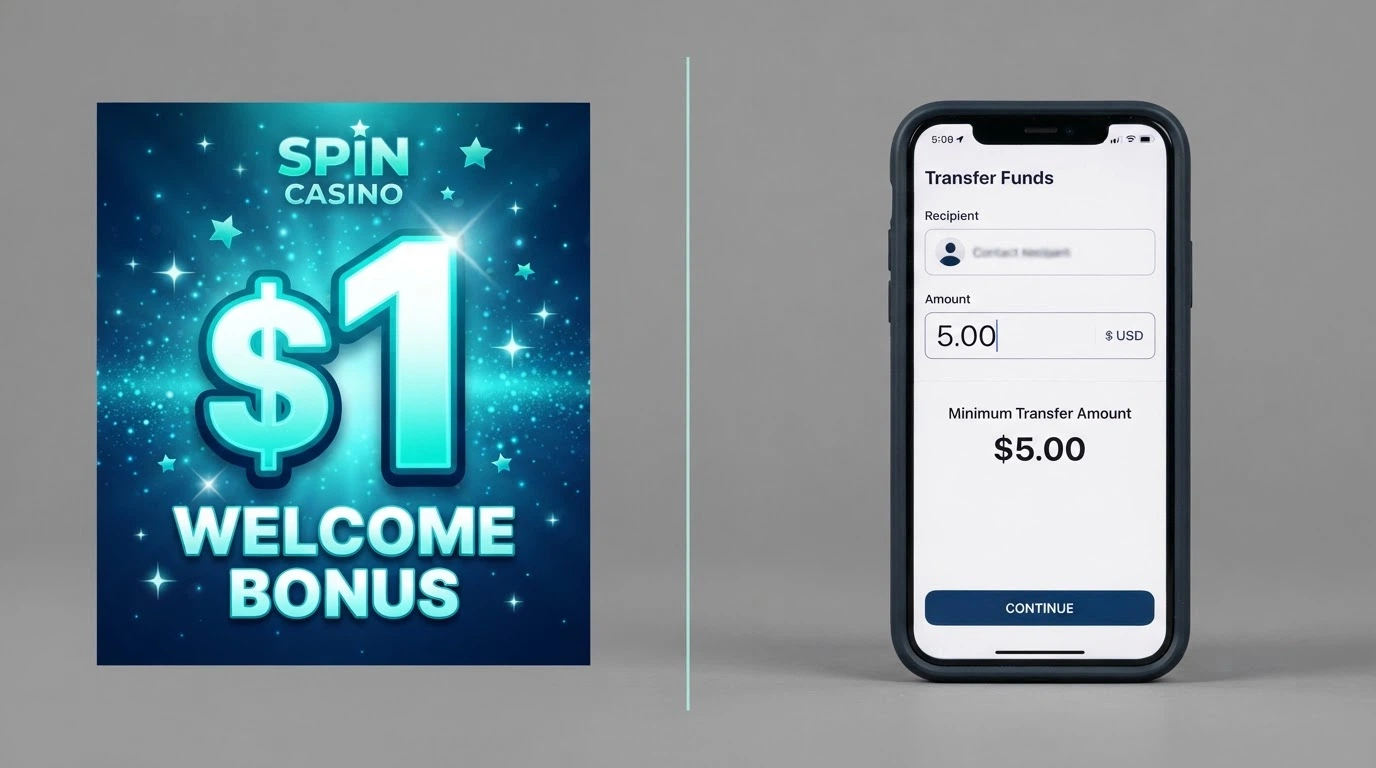
The A$1 headline hides a spread that runs from one method to the next. No common AUD-native rail settles at exactly one dollar; the floor each method imposes is what determines what a punter actually pays to open an account.
| Deposit method | Advertised minimum | Effective minimum (AU$) | Withdrawal rail | Processing time |
|---|---|---|---|---|
| PayID | A$1 (on some sites) | A$10 | Bank transfer (PayID is deposit-only) | 10–30 seconds deposit; 24–72 hours cash-out |
| Visa / Mastercard | A$1 (on some sites) | A$20 | Card refund or bank transfer | Instant to minutes deposit; longer for withdrawals |
| Neosurf / prepaid voucher | A$1 (on some sites) | A$10 | Not typically available | Instant deposit only |
| Cryptocurrency | A$1 (on some sites) | A$15–A$30 depending on coin | Same-coin crypto transfer | 5–30 minutes deposit |
The table explains why no common rail lands at A$1. PayID is the rail Australians search for most, and it is deposit-only — cash-out reverts to bank transfer at 24–72 hours, with a floor that sits above the deposit floor. Visa and Mastercard start at AU$20 across most operators accepting Australian cards, and credit cards are banned outright for licensed Australian wagering since 11 June 2024. Neosurf and similar prepaid vouchers are deposit-only instruments with no withdrawal function. Crypto can reach a A$5 equivalent on low-fee chains like Solana, Litecoin and Dogecoin, but the AUD equivalent after the network fee is closer to A$15–A$30.
The punter looking for an honest A$1 entry therefore has to leave the AUD-native rails entirely. That trade is real, and it is examined in the crypto section further down.
The Withdrawal Trap: When You Can’t Cash Out Your Dollar Win
The deposit floor is the smallest number the cashier publishes. The withdrawal floor is larger, often by a factor of twenty or more, and it is the number that decides whether a dollar-win becomes a withdrawal or a balance stranded on a site the punter can no longer access.
A platform can advertise an A$1 minimum deposit while setting a A$20 minimum withdrawal — a structure that means a punter who wins at the lowest tier cannot cash out until they deposit again. The deposit required to clear the withdrawal floor is itself subject to a bonus that may not exist at that lower amount. The punter who arrived for a dollar trial ends up funding a second deposit at three to thirty times the dollar to access what the first one won.
This is not an oversight in the marketing. It is the structure. The deposit floor attracts the punter through the door. The withdrawal floor keeps the balance in play long enough for the wagering requirements to do their work, or for the punter to either win enough to clear the withdrawal minimum or lose what they brought in. The dollar is the bait. The architecture around it is the trap.
What a Dollar-Deposit Player Gives Up Outside the Licensed Market
The licensed Australian market does not offer online pokies. There is no Australian online casino licence to issue, and no operator offering real-money online pokies to a person in Australia holds one. Every A$1-deposit site an Australian punter can reach is therefore an offshore operation whose relationship to Australian consumer law is the absence of one.
What that absence looks like in practice: no ACMA complaints body to recover money if the operator refuses a withdrawal or voids a win; no BetStop coverage, because BetStop binds Australian-licensed wagering services only — an offshore casino is not connected to the register and will continue accepting a self-excluded person’s deposits; no Australian consumer protection, no chargeback protection on crypto, no local court that will reliably enforce a foreign-licence judgement. The operator is the gatekeeper, the cashier and the final arbiter.
That is the price of the dollar. The punter pays it in protections forgone, and almost none of the pages advertising A$1 minimums name the trade in the same breath as the headline.
The “With $1 or Less” Claim: Where It Holds and Where It Crumbles
The dollar holds only on the narrow band research has identified — a handful of crypto rails and specific card and e-wallet segments — and even there it rarely survives the spread and the network fee. Rainbet, for instance, takes $5 on Solana, Litecoin and Dogecoin, and $15 on Bitcoin, Ethereum and USDT. No PayID, no Neosurf, no card rail in the featured set settles at A$1 once the operator’s own minimum is applied.
Where the claim collapses entirely is on AUD-native rails. PayID is the fastest bank transfer rail in Australia and starts at A$5–A$10. Cards start at A$20 across most operators accepting Australian cards. Prepaid vouchers start at A$10. The dollar figure attached to these methods is the page’s headline, not the cashier’s settlement.
Consequently, the “with $1 or less” claim is, in practical terms, a crypto-only signal from operators built around digital currencies. Users relying on PayID or Visa debit will find the advertised figure rarely matches the bank statement’s settled amount.
The Legal Reality: Every $1 Pokie Site Is an Offshore Operation
The IGA Prohibition: Why Online Pokies Cannot Be Licensed in Australia
Online casino games and online pokies are prohibited interactive gambling services under the Interactive Gambling Act 2001. There is no federal or state online casino licence for real-money pokies anywhere in the country, and an operator cannot lawfully offer them to a person in Australia simply because it accepts AUD, supports PayID or displays an Australian flag.
What Australia does license is wagering on races and sport placed before the event begins, lotteries and keno through operators licensed by a state or territory (primarily via Licensing NT and the Northern Territory Racing and Wagering Commission). Online casino, online pokies and in-play betting on sporting events sit outside that licensed perimeter. Sportsbet, bet365 and Ladbrokes hold Australian wagering licences; none of them offers pokies.
The 2017 amendment to the IGA closed the loopholes the offshore operators had been using and gave the Australian Communications and Media Authority the enforcement and blocking powers it now exercises. The Interactive Gambling Amendment (Gambling Reform) Bill 2026 passed Parliament on 19 August 2026, and from 1 January 2027 banks and payment providers gain express authority to block transactions to illegal gambling operators. The credit card and crypto ban for licensed wagering has been in force since 11 June 2024, with penalties of up to A$247,500 for non-compliance.
The IGA targets the provider. The punter is not in its sights. But the architecture around the IGA — the licensed bookmakers, the BetStop register, the ACMA complaints process, the Australian consumer-law protections — does not extend to the offshore site accepting the dollar deposit either.
ACMA Enforcement: 1,564 Sites Blocked — and Counting
Since its first blocking request in November 2019, the ACMA has had 1,564 illegal gambling and affiliate websites blocked by Australian internet service providers as of March 2026. More than 225 illegal services have withdrawn from the Australian market since enforcement was strengthened by the 2017 amendment. Both numbers are specific snapshots; both keep moving.
Site blocking is not a one-time act. When the ACMA identifies a new illegal service targeting Australians, it can direct Australian ISPs to block the domain and any associated mirror or redirect. The punter with a balance on a blocked site cannot reach the cashier to withdraw it, and ACMA’s own warning is that illegal services can look legitimate, accept deposits and even target Australian customers while lacking the protections attached to licensed services.
The volume of blocks tells a reader two things at once. The first is that the regulator is active and the enforcement architecture works. The second is that 1,564 sites have been worth blocking because they have been accessible — the offshore pokie market is not a small corner of the internet, it is a substantial one that the regulator is still working through.
Your Legal Position as a Player: No Prosecution, No Protection
The IGA is built around the provider, not the punter. No Australian case has prosecuted an individual for using an offshore gambling site. That is the half of the legal position the marketing leans on.
The other half is what the marketing does not mention. The punter gains no Australian consumer protection, no ACMA complaints body to recover money, no BetStop coverage, and no recourse if the operator refuses a withdrawal, voids a win or closes the account. The site can be blocked at any time, with a balance still on it. BetStop, which has 67,480 registrations and 41,290 active exclusions as at 31 July 2026, binds Australian-licensed wagering services only — an offshore casino is not connected to the register and will continue accepting a self-excluded person’s deposits.
“Not illegal for you” is not the same as “safe.” The asymmetry is the entire point. The provider carries the criminal exposure; the punter carries the commercial risk.
Responsible Gambling: Help Resources and the Harm Behind the Headline
The dollar is cheap to enter and expensive to leave. Behind the headline is a prevalence figure worth naming. The Australian Institute of Health and Welfare put high-risk gambling at 1.8% of adults in 2022; roughly 2.1% of Australian adults — about 430,000 people — experience problem gambling. The dollar-deposit structure is not the cause of that harm, but it lowers the cost of testing a compulsion, which is worth naming in the same breath as the offer.
Help exists, and it is free, confidential and reachable around the clock:
- National Gambling Helpline: 1800 858 858 — free, staffed 24 hours a day, 7 days a week
- Gambling Help Online: gamblinghelponline.org.au — online chat and counselling
- BetStop (National Self-Exclusion Register): 67,480 registrations and 41,290 active exclusions as at 31 July 2026, with 78% of registrants under 40 and 38% choosing lifetime exclusion. BetStop covers Australian-licensed wagering services; it does not cover offshore casinos, which is a real gap for someone trying to exclude themselves across both.
The dollar figure is the surface. The harm data is the depth.
Which Offshore Operators Actually Honour a Micro-Deposit — and Which Just Advertise It
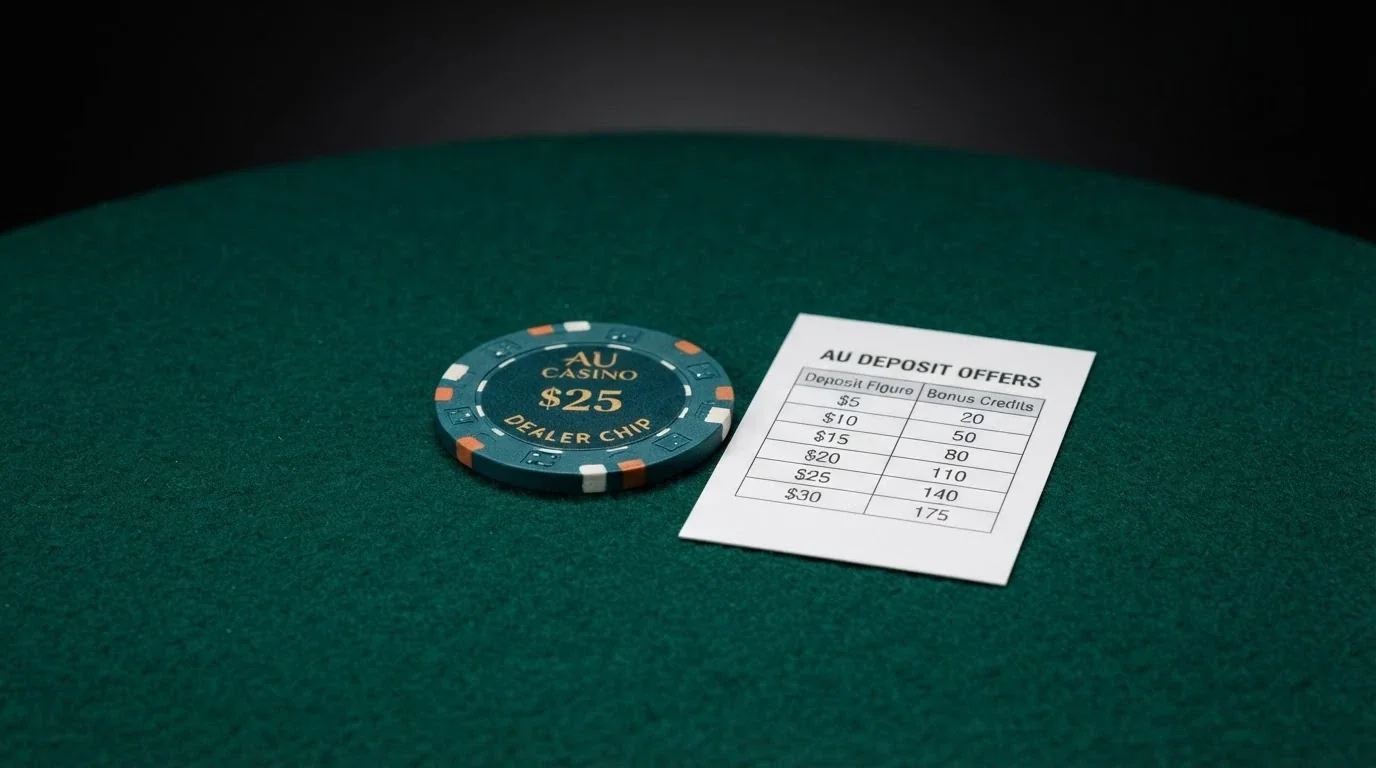
The featured set splits cleanly in two. On one side are the operators whose crypto rails genuinely approach a sub-A$10 entry and whose terms can be cross-checked against primary sources. On the other are the operators whose advertised A$1 minimum hides an A$20–A$30 bonus-qualifying floor, and a small group whose key terms could not be verified at all. The table below ranks all ten by relevance to the dollar-deposit question.
| Operator | Licence jurisdiction | Welcome offer | Wagering multiplier | Min deposit for bonus | Free spins in welcome package |
|---|---|---|---|---|---|
| RocketPlay | Curaçao (unverified this run) | Up to A$1,000 + 100 free spins on first deposit | 40× bonus and free-spin winnings | A$30 | 100 |
| SkyCrown | Curaçao (unverified this run) | A$8,000 + 400 free spins across 4 deposits | 40× bonus / 30× free spins | A$20 | 400 |
| Royal Reels | Curaçao (unverified this run) | 100% up to A$500 + 50 free spins on first deposit | 35× bonus only | A$30 | 50 |
| Bizzo Casino | Curaçao (unverified this run) | Up to A$7,250 + 175 free spins across 4 deposits | 40× on all deposit bonuses | A$30 (terms); A$20 (marketing) | 175 |
| Fair Go Casino | Curaçao (unverified this run) | — | 35× default | — | — |
| Stake | Curaçao OGL (Medium Rare N.V.) | 200% match up to $1,000 plus 3.5% instant rakeback | 40× deposit + bonus; 0× on rakeback | Crypto-only (no fixed AUD minimum) | None in welcome |
| Rainbet | Curaçao (active early 2026) | 250% up to $1,750 + 60 free spins across 3 deposits | 40× | $30 per stage | 60 |
| WinSpirit | Not confirmed this run | — | — | — | — |
| Scream Casino | Not confirmed this run | — | — | — | — |
| Rocket Casino | Curaçao (unverified this run) | Spin-wheel with variable prizes | 45× on some prizes | — | Variable |
The headline figure of every operator in this table is one or more tiers above the A$1 minimum they advertise. The dollar buys the click. The bonus is gated above it.
Rainbet: Crypto-First With the Lowest Effective Entry Point
Rainbet is the operator in the featured set whose crypto rails genuinely approach a sub-A$10 deposit. Twenty-four cryptocurrencies are supported, with minimums from $5 on Solana, Litecoin, Dogecoin, Tron, Stellar, Cardano and XRP, and $15 on Bitcoin, Ethereum and USDT. After the network fee and the exchange spread, the AUD equivalent on the lower-fee chains lands closer to A$10–A$15 than to the headline A$1, but it is the closest the set comes to a dollar entry on a real cashier.
The welcome package is 250% up to $1,750 across three deposits plus 60 free spins at 20 per stage, with 40x wagering, $30 minimum per stage and a 7-day expiry from activation. The bonus cashout is capped at AU$200 per the operator’s terms. Rainbet’s game library runs to 6,500+ titles from 40+ providers — Pragmatic Play, Hacksaw, Nolimit City, Evolution among them — which is broader than most operators in the set.
The catch sits in the terms. Australia is listed among restricted countries in Rainbet’s terms, and the operator reserves the right to void winnings from Australian players. The dollar-equivalent entry on Solana is real; the Australian-punter safety net is not.
A$5 on Solana is the closest the set gets to a true A$1 entry, and the operator’s own terms reserve the right to void Australian winnings.
Stake: Instant Rakeback Without Wagering — but Geo-Blocked in Australia
Stake offers a different shape from the rest of the set. The welcome is a 200% deposit match up to $1,000 at 40x wagering on deposit plus bonus — a steeper requirement than the 35x–40x on bonus alone that most operators apply — paired with a 3.5% instant rakeback on every bet, with zero wagering attached. The rakeback structure is the cleanest of the set: it pays in real money, on the bet, regardless of outcome. The deposit match is a more ordinary offer by comparison.
Stake operates under a Curaçao OGL held by Medium Rare N.V. and has been live since 2017. Mandatory KYC at signup has been in force since 2026. The library centres on 13 Stake Originals — provably fair in-house games — alongside the broader crypto-casino catalogue, with support for 40+ cryptocurrencies.
The structural problem for a reader of this page is that Stake.com is geo-blocked in Australia. The rakeback model is genuinely better than anything in the rest of the set; the operator is not reachable from an Australian IP. A punter who reads the terms, deposits, and plays from a non-Australian connection carries the additional risk that the operator’s Australian policy will catch up with the session later.
The only rakeback model in the set without wagering, attached to the only major operator in the set that is geo-blocked to Australian IPs.
SkyCrown: The Largest Welcome Package Among $1-Advertising Sites
SkyCrown’s welcome is the largest headline figure in the featured set: A$8,000 plus 400 free spins across four deposits, with 40x wagering on the bonus and 30x on the free spins, a 14-day validity per tier and a A$20 minimum qualifying deposit.
The structure dilutes the headline. Four deposits at A$20 each means A$80 paid before the full A$8,000 is even in play, and a 14-day validity per tier means the punter who misses a single stage loses the bonus attached to it. The maximum cashout from free spins is 10x the bonus value; the maximum bet during wagering is A$5 per spin or hand. SkyCrown runs Pragmatic Play and other major providers in its library, though the full provider list was not surfaced this run, and its Curaçao licence was not independently confirmed through primary sources.
For a punter who can commit A$80 across four deposits within the validity windows, the headline figure is real. For a punter who arrived at SkyCrown for the A$1, the A$20 minimum qualifying deposit is the actual entry, and the four-deposit architecture is the structure that gates it.
A$8,000 is the headline; A$20 paid four times within fourteen days is the cost of ever seeing it.
Bizzo Casino: 8,000+ Games, but the Bonus Fine Print Demands A$30
Bizzo runs a marketing-versus-terms inconsistency that is the central problem of the offer. The welcome package is advertised at “from A$20” on the homepage; the terms state a A$30 minimum qualifying deposit. The package itself is large: up to A$7,250 plus 175 free spins plus a bonus game across four deposits, all at 40x wagering. A separate 200% crypto welcome runs up to A$800 on the first deposit, and a no-deposit bonus is available via notification enablement.
The game library is the largest in the set at 8,000+ titles, with Pragmatic Play’s Big Bass Bonanza 1000 confirmed for the bonus round. The crypto welcome offers a lower entry for the punter who has a wallet to fund from; the AUD welcome offers nothing at A$20 because the terms will not honour A$20.
For a punter who reads only the marketing, the entry looks like A$20. For a punter who reads the terms, the entry is A$30, and 50% of the apparent minimum is the bonus’s actual gate. 8,000 games do not narrow a 50% gap between marketing and terms.
Royal Reels: No-Deposit Free Chip Plus a Three-Tier Match
Royal Reels is one of two operators in the featured set offering a no-deposit bonus. The free chip is A$10 at 30x wagering, which lets the punter sample the cashier and the game library without funding an account first — a meaningful feature for a punter trying to verify an operator before committing a deposit.
The three-deposit welcome matches the no-deposit offer with a more ordinary structure: 100% up to A$500 plus 50 free spins on the first deposit, 75% up to A$750 on the second, 100% up to A$1,250 on the third, with 35x wagering on the bonus only and a A$5 per-spin cap during clear-down. The minimum qualifying deposit is A$30; the wagering multiplier at 35x is the lowest in the standard-deposit match segment of the set.
The library runs to 2,200+ pokies across multiple providers, though the full provider list was not surfaced this run. Royal Reels’ Curaçao licence was also not independently confirmed. For a punter who values a real trial without funding first, the no-deposit chip is the offer’s strongest feature; for a punter who arrives at the dollar headline, the A$30 minimum is the actual entry.
The only operator in the set with a no-deposit offer that lets you sample before funding, paired with the lowest standard-deposit wagering multiplier in the set.
RocketPlay: A$1 Advertised, A$30 Required for the Bonus
RocketPlay’s headline is the most generous in the set and the furthest from the cashier’s reality. The first-deposit bonus runs up to AUD 1,000 at 40x wagering with 100 free spins on Aztec Magic (BGaming) delivered at 20 per day for five days, but the minimum qualifying deposit is AUD 30. The maximum win from the free spins is capped at AUD 300, and the maximum bet during wagering is AUD 7.50.
RocketPlay also offers a no-deposit bonus with a maximum withdrawal of AUD 75 — among the lower no-deposit caps in the set. The bonus validity is 5 days from receipt, which is tight against the 7–14 day windows most operators apply. RocketPlay’s Curaçao licence was not independently confirmed through primary sources this run, and the broader BGaming library is the only provider-level information surfaced.
The dollar on the marquee is the marketing promise. The bonus is gated at AUD 30; the no-deposit offer caps what the dollar can win at AUD 75. The gap is the offer.
The A$1 on the marquee is the most generous figure on this page — and the furthest from the cashier’s reality.
Fair Go Casino: RTG Pokies With a 35x Wagering Standard
Fair Go runs an RTG (RealTime Gaming) library — narrower than the multi-provider catalogues at Rainbet or Bizzo but with a stable, recognisable game set. The 35x default wagering multiplier is the lowest in the featured set, applied to bonus terms with a 7-day validity and a A$5 maximum bet during wagering unless otherwise specified. No-deposit bonuses at Fair Go are typically capped at A$50–A$100, which is the middle of the no-deposit range.
What could not be confirmed this run is the welcome bonus structure and the minimum deposit for bonus qualification — a real gap for a punter comparing operators on the dollar question. Fair Go’s Curaçao licence was also not independently verified. For a punter who values lower wagering over library breadth, the 35x multiplier is the strongest feature on the page; for a punter comparing against the 8,000-title catalogues elsewhere, the RTG-only constraint is the cost.
RTG-only is a real constraint on library depth; 35x is a real concession on bonus cost.
Rocket Casino: Spin-Wheel Bonus With a A$75 Cashout Cap
Rocket Casino runs a spin-wheel welcome with variable prizes rather than a fixed deposit match. Some prizes carry 45x wagering; others carry no wagering at all. The maximum withdrawal from free-spin winnings is AU$75, which is a tight ceiling against the unlimited-cashout deposit matches at other operators in the set.
The provider list, minimum qualifying deposit, bonus validity and maximum bet during wagering were not confirmed this run, which makes it difficult to compare Rocket Casino against the better-documented operators in the table. Rocket Casino’s Curaçao licence was also not independently confirmed.
A variable-odds welcome is not a bonus in the ordinary sense; it is a lottery, and the AU$75 ceiling on the prize is the cost of playing it.
A AU$75 cap on free-spin winnings turns a spin-wheel into a roulette ticket.
WinSpirit: Data Too Thin to Evaluate for This Review
WinSpirit’s licence jurisdiction, welcome bonus, free-spin allocation, wagering multiplier, bonus validity, maximum cashout, minimum qualifying deposit and maximum bet during wagering were all unconfirmed at the time of research. The operator’s terms page could not be cross-checked against primary sources for this page.
That absence is itself the answer. A punter who cannot verify the welcome structure, the wagering multiplier or the maximum cashout before depositing is not in a position to evaluate what the dollar buys. The dollar carries an extra risk — the risk of an unverifiable offer — and WinSpirit’s place on this page is to name that risk rather than to recommend around it.
What cannot be verified is the answer the punter needs before they deposit.
Scream Casino: Insufficient Public Terms to Assess
Scream Casino’s situation is the same as WinSpirit’s. Licence jurisdiction, game providers, welcome structure, wagering multiplier, bonus validity, cashout cap, minimum deposit and maximum bet were all unconfirmed through primary sources this run. The operator’s terms did not surface in a form that allowed cross-checking against the rest of the set.
The data gap is the verdict. A punter comparing Scream Casino against the better-documented operators in the table — Rainbet, SkyCrown, Royal Reels, RocketPlay, Bizzo — has nothing to compare on, and that asymmetry is the answer to whether to deposit.
The same data gap that defines WinSpirit defines Scream Casino, and the same caveat applies.
Welcome Bonuses on a $1 Deposit: What the Fine Print Actually Delivers
First-Deposit Bonus Structures: The Numbers Behind the Headlines
The bonus headline and the qualifying deposit are two different numbers, and the gap between them is where the dollar goes to die.

An A$1 deposit is usually not enough to activate a welcome bonus — some casinos require A$10, A$20 or more before bonus money or free spins are triggered. In the featured set, RocketPlay sets AUD 30 as the bonus-qualifying minimum despite the A$1 advertised; SkyCrown sets A$20; Royal Reels sets A$30; Bizzo’s terms state A$30 against marketing that says A$20; Rainbet sets $30 per stage for its three-deposit welcome. Only the no-deposit offers at Royal Reels (A$10 free chip) and the notification-enabled freebie at Bizzo activate without a qualifying deposit, and both carry their own cashout caps.
The dollar therefore buys entry, not the bonus. A punter who wants the headline package is paying three to thirty times the A$1 to reach it, and the package itself is then governed by a wagering multiplier that converts most of the headline value into required turnover before any withdrawal is possible.
Free-Spin Wagering: Why 70x–200x Multipliers Eat Your Winnings
The wagering multipliers on free-spin winnings at dollar-deposit casinos are routinely two to five times the multipliers on standard deposit matches. Free-spin promotions enforce wagering multipliers from 70x to 200x on winnings generated from free spins, compared to standard deposit match bonuses at 35x–40x. The structure exists because free spins are awarded without a deposit, and the multiplier is the operator’s substitute for the deposit as a guard against immediate withdrawal.
The arithmetic works as follows. When an online casino awards 80 free spins for a low deposit, those spins are typically set at A$0.10 per spin, making the face value A$8.00. At 100x wagering — a representative figure in the middle of the 70x–200x range — that A$8.00 face value requires A$800 of turnover before any withdrawal is possible. On a typical 96.51% RTP pokie — Sweet Bonanza’s default — the house edge is 3.49%, and the player’s expected loss on that A$800 of turnover is roughly A$27.92.
That is the bonus’s real cost. The headline number is A$8 of free play; the expected loss in clearing it is more than three times that, before the punter has risked any of their own deposit. A 40x deposit match with a A$20 minimum carries a lower multiplier on a higher base; the math favours the punter who qualifies for it over the punter chasing the dollar-deposit free-spin headline.
The Royal Reels welcome applies a A$5 per-spin cap during clear-down, which is a useful ceiling to know — a cap above the minimum stake keeps the bonus clearing at a normal pace rather than being dragged out by max-stake play.
The Real-Money Trial That Converts: What a $1 Deposit Actually Tests
A dollar deposit has a value no demo mode and no bonus round can replicate: it tests the cashier.
What the dollar confirms, if the cashier accepts it, is whether the deposit pipeline works on a real AUD transaction — whether the operator’s payment processor routes to PayID without an error, whether the bonus terms trigger as advertised (most often they do not), whether the KYC prompt arrives on first deposit or only at withdrawal, and whether the support channel responds in a time frame that survives a real-money question. Those are the four things a punter actually needs to know before committing A$30 to clear a welcome bonus, and the dollar is the cheapest way to find out.
What the dollar does not test is the bonus terms in detail, the payout speed at scale or the dispute path when something goes wrong. The withdrawal floor sits above the dollar, the wagering multiplier is a function of the bonus terms the punter has not yet unlocked, and the dispute path is the part of the operator a dollar deposit cannot reach. The dollar is a sample of the cashier, not a sample of the operator.
For a punter whose goal is to test an offshore operator before committing more, the dollar is genuinely useful — provided the test is read as a cashier test and not as a bonus test.
Deposit Methods and Their Real Minimums: The Gap Between Quote and Settlement
The deposit method a punter chooses determines the real floor, the payout rail and the processing time, and the spread between methods is wider than any of them let on.
| Deposit method | Advertised minimum | Effective minimum (AU$) | Withdrawal rail | Processing time |
|---|---|---|---|---|
| PayID | A$1 (on some sites) | A$10 | Bank transfer (PayID is deposit-only) | 10–30 seconds deposit; 24–72 hours cash-out |
| Visa / Mastercard | A$1 (on some sites) | A$20 | Card refund or bank transfer | Instant to minutes deposit; longer for withdrawals |
| Neosurf / prepaid voucher | A$1 (on some sites) | A$10 | Not typically available | Instant deposit only |
| Cryptocurrency | A$1 (on some sites) | A$15–A$30 depending on coin | Same-coin crypto transfer | 5–30 minutes deposit |
PayID is the fastest AUD-native rail and the one most Australian players search for first; its minimum is A$10 and its withdrawal path reverts to bank transfer at 24–72 hours. Cards start at A$20; prepaid vouchers at A$10; and crypto can reach an A$5–A$15 equivalent depending on the coin. None of them lands at A$1.
PayID: Australia’s Fast Bank Rail — and Why It Never Delivers A$1
PayID is the rail Australians search for when they want to move money in real time. It runs on the New Payments Platform through Osko and settles in 10–30 seconds, which is the fastest AUD-native deposit rail available to an offshore pokie punter.
The floor at the receiving operator is not set by PayID; it is set by the operator. The effective PayID minimum across the offshore pokie sites accepting Australians is A$5–A$10 — typically AU$10 once the operator’s own minimum applies. PayID cannot settle at one dollar because the operators will not accept one dollar, and PayID has no override.
The other constraint is the withdrawal path. PayID is deposit-only at most Australian-facing offshore sites — cash-out reverts to bank transfer, which can take 24–72 hours and which sits above the deposit floor once the operator’s withdrawal minimum applies. The deposit rail and the withdrawal rail are different systems, and the gap between them is where the dollar-deposit punter learns what the dollar really cost.
Card, Bank and Neosurf: The Widely Advertised Rails With Higher Floors
Visa and Mastercard are the most widely advertised deposit rails on offshore pokie sites accepting Australians, and they are the rails with the highest effective floor. The minimum across most operators is AU$20, set by the operator’s own policy rather than by the card network. The credit-card ban for licensed Australian wagering — in force since 11 June 2024, with penalties up to A$247,500 for non-compliance — does not stop offshore sites from accepting credit cards, because the ban applies to licensed operators and the offshore operator is not licensed. The punter who pays a credit-card deposit on an offshore site is using a rail that the licensed market has declared incompatible with consumer protection.
Neosurf and similar prepaid vouchers are deposit-only instruments with no withdrawal function. They start at A$10 across most operators and are useful for a punter who wants to cap a deposit at a fixed amount without exposing a bank account or card. The voucher has no chargeback mechanism and no consumer protection beyond the voucher issuer’s own terms.
Payout Speed and the Cashout Floor: Getting Money Out Costs More Than Getting In
The withdrawal floor is the number that decides whether a dollar-win becomes a withdrawal or a stranded balance, and across the offshore pokie sites accepting Australians it sits almost universally above the deposit floor. A$20–A$50+ is the typical withdrawal minimum; the deposit that wins enough to clear it has to be funded in the first place.
The structural gap is deliberate. The deposit minimum attracts the punter; the withdrawal minimum keeps the balance in play long enough for the wagering requirements to do their work. PayID in, bank transfer out, at 24–72 hours, with a withdrawal floor above the deposit floor — that is the architecture of a dollar deposit on an offshore pokie site, and it is the architecture that makes the dollar feel smaller on the way out than it did on the way in.
Mobile Pokies at a Dollar: The Same Risks on a Smaller Screen
App vs Browser: What the Offshore Operators Actually Offer
Most offshore pokie sites in the featured set run through a mobile browser rather than a native app. Rainbet and Bizzo are browser-first; Stake has a mobile platform but it is geo-blocked to Australian IPs at the network level. The dollar-deposit experience on a mobile browser is functionally identical to the desktop experience at the same operator — the same cashier, the same minimums, the same bonus terms — because the platform does not change the underlying offer.

Where mobile diverges from desktop is in the operator-specific detail. A native app can offer push notifications (and Bizzo uses this to gate a no-deposit bonus), biometric login and an offline cache of recent games. A mobile browser offers none of those, but it does not require a download, which is the dominant model for offshore operators who do not appear in the Australian App Store or Google Play store for Australian-region accounts.
The dollar buys the same real-money spins on mobile as on desktop. The platform changes the delivery mechanism, not the offer.
The $1 Entry on Mobile: What Changes — and What Doesn’t
The deposit minimum is platform-agnostic. A$1 advertised on desktop is A$1 advertised on mobile; A$10 effective on PayID on desktop is A$10 effective on PayID on mobile. The cashier does not adjust for screen size, and the bonus-qualifying thresholds apply regardless of platform.
What mobile does change is the legibility of the bonus terms. The fine print that a desktop punter can expand, screenshot and tab back to is the same fine print a mobile punter has to scroll through on a 6-inch screen with the deposit button sitting one tap away. The temptation to skip the terms is real, and the consequence of skipping them is the same A$30 minimum the desktop punter would have read. The dollar is a screen-size-independent trap.
For a punter whose goal is to verify the cashier before committing, mobile works. For a punter whose goal is to read the bonus terms in detail before claiming, desktop works better.
Crypto Deposits: A Lower Floor With Different Risks
Bitcoin and Altcoin Deposits: What a $5 Crypto Equivalent Actually Costs
Crypto is the only rail in the featured set that genuinely approaches a sub-A$10 entry. Rainbet accepts $5 on Solana, Litecoin, Dogecoin, Tron, Stellar, Cardano and XRP; $15 on Bitcoin, Ethereum and USDT. The advertised minimum is real in crypto terms; the AUD equivalent is where the cost becomes visible.
The on-chain fee and the exchange spread both apply before the deposit credits. A Solana deposit at $5 carries a network fee that is small in absolute terms but meaningful as a share of a $5 deposit; an Ethereum deposit carries a higher fee and a wider spread; a Bitcoin deposit at $15 carries both. The effective AUD equivalent after the fee and the spread is closer to A$15–A$30 on the higher-fee chains, and the punter who saw “$5 minimum” on the page arrives at a balance worth less than that in playable credit.
The lower-fee chains are the real entry point. Solana, Litecoin and Dogecoin settle quickly and cheaply, which is why Rainbet sets them at $5 while keeping Bitcoin and Ethereum at $15. For a punter who has a crypto wallet already funded, the rail works. For a punter buying crypto with AUD specifically to deposit, the exchange spread adds a second cost on top of the network fee.
Anonymity vs the Licensed AUD Route: What You Trade Away
Crypto’s appeal is privacy. No bank statement entry, no PayID trace, no card processor logging the merchant. For a punter who values that privacy, crypto is the only rail in the set that delivers it.
What crypto costs is the entire Australian protection stack. No chargeback on a crypto transaction; no ACMA complaints body to recover money; no BetStop coverage, because BetStop binds Australian-licensed wagering services only and the licensed Australian market has banned crypto entirely as a payment method for wagering since 11 June 2024. The ban signals that the government considers crypto incompatible with consumer protection in the wagering context, and the offshore operator accepts the punter the licensed market will not.
From 1 January 2027, banks and payment providers gain express authority to block transactions to illegal gambling operators. The crypto route will not be closed by that measure — crypto sits outside the banking system by design — but the AUD rails will narrow. The punter on crypto today is on the rail the licensed market considers the least safe, which is itself information.
How We Selected and Evaluated Every Operator on This Page
The featured set is drawn from the operators Australian-facing comparison sites have ranked in their top-10 for A$1 minimum deposits in 2026, cross-checked against the ACMA register of blocked and withdrawn services and against each operator’s own terms pages where those could be reached through primary sources. An operator qualified for inclusion on three criteria: an advertised A$1 minimum deposit claim, AU-player acceptance at the cashier level, and at least one verifiable licence or bonus-terms data point.
The ranking order in the table reflects relevance to the dollar-deposit question — operators whose bonus terms could be verified and whose minimums are closest to A$1 ranked above those whose marketing-versus-terms gap is wider, with the operators whose key terms could not be verified placed last regardless of marketing prominence. The H3 write-ups above follow topical relevance rather than the ranking order: Rainbet and Stake first because their rails genuinely approach a sub-A$10 entry, the larger welcome packages next, and the data-thin operators last because their absence of verifiable terms is itself the answer to whether to deposit.
Three limitations define what this page can claim. First, every operator listed is offshore and unlicensed in Australia — there is no licensed benchmark to anchor against. Second, several Curaçao licences were not independently confirmed through a regulator lookup this run and are marked as such in the table. Third, two operators — WinSpirit and Scream Casino — could not be verified on any of the welcome-bonus, wagering-multiplier, minimum-deposit or game-provider dimensions at the time of research, and their place on this page is to name the gap rather than to recommend around it.
The dollar is the smallest number on this page and the easiest one to compare on. The harder comparisons — licence jurisdiction, bonus-qualifying minimum, wagering multiplier, withdrawal cap, KYC requirement — are the ones that decide whether the dollar is worth depositing.
Your Deposit Floor Is Not Your Safety Net: What Matters More Than the Dollar Figure
The deposit minimum is the least informative number on a casino page. A site accepting A$1 has not automatically proved that withdrawals are reliable, that its licence protects an Australian customer, that its terms are reasonable, or that it is legally authorised to provide online pokies to someone physically in Australia.
The three numbers that matter more than the dollar are the withdrawal minimum, the wagering multiplier and the licence jurisdiction, in that order. The withdrawal minimum decides whether the dollar-win is a withdrawal or a stranded balance. The wagering multiplier decides what the bonus costs in expected turnover before any of it becomes withdrawable. The licence jurisdiction decides whether the punter has any recourse at all if the cashier refuses to play. In the featured set, the withdrawal minimums cluster at A$20–A$50+, the wagering multipliers cluster at 35x–45x, and every licence jurisdiction is offshore.
The irreducible fact is that no online pokie operator holds an Australian licence, because no such licence can be issued. The punter who proceeds anyway is making a real choice with real risks, and the page that does not name those risks is not a page worth reading. The dollar is the entry. The market is unregulated. The protections are absent. The player is not in the sights of the regulator, but the operator is — and the operator’s exposure to enforcement is the punter’s only leverage, not a substitute for consumer protection.
The dollar is cheap to enter. The cost of playing is what follows.
Frequently Asked Questions About $1 Deposit Pokies in Australia
Is it legal to play online pokies with a $1 deposit in Australia?
No licensed online pokie market exists in Australia. Online casino games are prohibited under the Interactive Gambling Act 2001, and every A$1-deposit site an Australian can reach is an offshore operator breaking Australian law. The player is not prosecuted, but gains zero Australian consumer protection and the site can be blocked by ISPs at any time.
Can I actually deposit A$1 using PayID at an offshore online casino?
Almost never. PayID is fast, but the floor is set by the receiving operator, not by your bank. The effective PayID minimum at the offshore pokie sites accepting Australians is A$5–A$10, and the A$1 figure usually refers to a crypto or specific card segment rather than to PayID itself.
Do $1 deposit casinos offer real welcome bonuses, or are they just marketing?
Mostly marketing. An A$1 deposit will not activate most welcome offers — RocketPlay requires AUD 30, SkyCrown A$20, Royal Reels A$30, Bizzo A$30 — and the free-spin packages that run on small deposits carry 70x–200x wagering multipliers that wipe out most of what is won.
What happens if an offshore casino refuses to pay out my winnings from a $1 deposit?
You have very little recourse. ACMA handles complaints against Australian-licensed operators only. Offshore disputes have no Australian consumer-law body, no chargeback on crypto, and no Australian court that will reliably enforce a foreign-licence judgement.
Are crypto deposits a way to get a lower minimum at Australian online casinos?
Sometimes. Rainbet accepts from $5 on Solana, Litecoin and Dogecoin, $15 on Bitcoin and Ethereum — after network fees the AUD equivalent is closer to A$15–A$30. The trade is total loss of Australian protection: no chargeback, no ACMA complaints, no BetStop coverage.
What wagering requirements apply to $1 deposit free spin offers?
Free-spin winnings at dollar-deposit casinos routinely carry 70x–200x wagering, against 35x–40x on standard deposit matches. On 80 free spins at A$0.10 each (an A$8 face value), a 100x multiplier means A$800 of required turnover, and the house edge on a 96.51% RTP pokie takes roughly A$28 of that back.
Does BetStop cover offshore casino sites that accept Australian players?
No. BetStop is the National Self-Exclusion Register for Australian-licensed wagering services — 67,480 registrations, 41,290 active exclusions as at 31 July 2026 — and binds the licensed bookies only. An offshore casino is not connected to the register and will keep accepting deposits from a self-excluded person.
Prepared by the Free Spins No Deposit AU editorial staff.