
How Cashback Bonuses Actually Pay Out for Australian Players in 2026
No Australian licence exists for online casino. Every operator on this page is offshore, which means every cashback percentage and every cap sits outside Australian consumer law. This page ranks the ten highest-cashback brands actually reaching Australian players in 2026 by what the cashback is worth after wagering — not by the headline number — and spells out the legal frame and the responsible-gambling floor that sit around the choice.

Updated: 16 October 2026 · Verified against the ACMA register and blocking list, the operators’ published bonus terms, the AGRC research register, and Betzoid’s 23-site AU cashback testing.
Table of Contents
- What Casino Cashback Actually Is — and Why It’s Different from a Welcome Bonus
- Why Your 2026 Cashback Bonus Is Worth Less Than the Number on the Screen
- The Cashback Casinos We Rated Highest for Australian Players in 2026
- Crypto Cashback — Bitcoin Casino Rebates and How They Work
- The Legal Reality — What the Interactive Gambling Act Means for Your Cashback
- Staying in Control — Responsible Gambling When the Safety Net Doesn’t Reach Offshore
- How We Selected and Ranked These Cashback Casinos
- Is a High-Cashback Offshore Casino Worth the Risk?
- Frequently Asked Questions
What Casino Cashback Actually Is — and Why It’s Different from a Welcome Bonus
A cashback bonus is a rebate on losses, not a freebie on a deposit. Put A$100 in, lose some of it, get a percentage of what you lost back. A welcome bonus is the opposite shape: the casino adds money to your deposit in exchange for a wagering commitment that usually runs to thirty or forty times the bonus before any of it can be withdrawn.
The arithmetic matters more than the labels. Cashback carries the lowest wagering burden of any bonus type in the market. Most cashback offers clear at between one and ten times the bonus, while welcome bonuses typically demand thirty to fifty times. Some of the strongest offers clear at zero — wager-free, paid into real cash, withdrawable on the spot.
That gap explains why cashback has become the dominant retention product across affiliate pages targeting Australian players. Welcome bonuses are acquisition bait — a one-shot lure for new sign-ups. Cashback is a recurring rebate that keeps a player in the game after the welcome package has been chewed through. For a player who plans to make more than one deposit, the cashback over a year can dwarf the welcome bonus once the welcome’s wagering cost is paid.
Defining Casino Cashback — Net Loss, Total Loss and What You Actually Get Back
The base the operator chooses changes the result. Net-loss cashback subtracts withdrawals and current balance from deposits during the cashback window, then multiplies the remainder by the rate. Total-loss cashback counts every dollar wagered, win or lose, multiplied by the rate. The busted-deposit model only pays when a single deposit ends the session at zero — a stricter trigger, but with a higher rate attached.
The percentage range across the market runs from about 5% at the low end to 100% at the marketing ceiling. A 100% cashback capped at A$10 is worth less than a 10% cashback capped at A$500. The percentage is the headline. The cap is the real ceiling. The wagering requirement is what gets taken out of the ceiling after the fact.
Some offers are tighter still. A handful of AU-targeted sites cap weekly returns at A$50, and others attach a 35× wagering requirement to the cashback — a multiplier that, on a slot returning 96% to the player, gives the player roughly A$0.80 of expected value per A$1 of face-value cashback before any cap is applied. The maths only works in the player’s favour when the percentage, the cap and the wagering are read together.
Cashback vs Welcome Bonus — Why the Comparison Isn’t Even Close
The two products are built for different moments. A welcome bonus is a one-shot acquisition tool that lives in the first deposit window. Cashback is a recurring rebate that runs weekly, on weekends, or on every bet, depending on the operator’s model. Frequency is the second axis that sets them apart — a welcome bonus is over after one play cycle; cashback keeps paying.
The real-money distinction matters too. Welcome bonus funds are almost always bonus money — locked, withdrawable only after the wagering requirement clears, and forfeited if the player tries to withdraw early. Cashback varies: at wager-free operators like SkyCrown and Bizzo it lands in real cash; at wagered offers like Wild Tokyo’s 30× weekly it lands in bonus funds that have to be played through again before any withdrawal.
Across the eight best-performing AU-targeted sites, Betzoid found cashback wagering clustered between zero and five times. That is the band where cashback earns its name — a rebate that actually returns cash to the player rather than a second bonus that demands its own playthrough. Welcome bonuses at those same sites ran 30× and up. The two products do not compete on the same field.
The Australian Cashback Landscape — All Offshore, All the Time
Every casino on this page is offshore because there is no Australian licence for online casino to hold. The Interactive Gambling Act 2001 makes it an offence to provide online casino games, online pokies, or in-play sports betting to a person physically in Australia. No licence exists federally. No licence exists in any state or territory. The ACMA is the federal body that enforces the prohibition — directing ISPs to block illegal services, issuing formal warnings, and running civil penalty proceedings against providers.
The enforcement record is real. Since November 2019 the ACMA has directed Australian ISPs to block 1,788 illegal gambling and affiliate websites. More than 230 illegal services have withdrawn from the Australian market since the ACMA tightened its enforcement in 2017. A site that is reachable today can be blocked tomorrow, with player balances and accrued cashback still sitting on it.
That is the shape of the cashback landscape in Australia. The offers exist, the percentages are competitive with anywhere else in the world, and every single one of them is delivered by an operator that has no obligation under Australian consumer law to pay a cent if it changes its mind. The rest of this page ranks what those offers are worth — and what they cost the player who picks one.
Why Your 2026 Cashback Bonus Is Worth Less Than the Number on the Screen
The headline rate is the floor, not the ceiling. Wagering requirements carve a percentage of the bonus back into the house edge. Caps clip the maximum return. Frequency determines whether the player sees the cashback in time to use it, or whether it arrives after the bankroll has already shifted. Fund type — real cash versus bonus funds — decides whether the money is withdrawable on landing.
Each operator on this page picks a different combination of these variables. The wager-free, real-money, weekly-paid offers deliver close to the headline value. The high-percentage, high-wagering, bonus-funds offers deliver a fraction of theirs. Reading the cashback number without the conditions is how the marketing gets you.
How Cashback Is Calculated — Net Loss, Deposits and the Busted-Deposit Model
The three common calculation bases produce three very different payouts from the same session. Take a player who deposits A$500, withdraws A$200, plays through A$1,500 of total wagers, and ends the cashback window with an A$80 balance.
Net-loss cashback — the model RocketPlay publishes in its bonus terms — is (Deposits − Withdrawals − Current Balance) × rate. On the example, that is (500 − 200 − 80) × 15% = A$33.
Total-loss cashback — calculated against turnover, not against the deposit-withdrawal gap — produces A$1,500 × 15% = A$225 on the same session, minus whatever the cap clips.
Busted-deposit cashback — the model Fair Go runs — pays only when a single deposit ends the session at zero. If the A$500 deposit was busted (lost in full before any withdrawal was processed), a 25% rate returns A$125. If A$320 of the deposit was lost but A$180 was withdrawn, nothing is paid on that deposit.
The operator picks the model that costs it least in any given session. The player’s job is to recognise which model is in play before they start playing, because the same session can produce three very different cashback amounts.
Cashback Rates Explained — 5%, 15%, 25%, 100% — What Each Tier Delivers
Across the ten operators on this page, rates cluster into four bands. Low: 5% (Rainbet’s Thursday, RocketPlay’s standard weekly tier below Level 4). Mid: 10% (SkyCrown’s standard weekly, RocketPlay’s live cashback, Royal Reels’ base, Rainbet’s weekly ceiling). High: 15% to 25% (RocketPlay’s slots cashback, Bizzo’s weekend, Royal Reels’ VIP, Fair Go’s standard). Marketing ceiling: 100% — a figure that exists in the affiliate pages but rarely survives a cap of more than A$10 to A$50.
The cap is what gutted the 100% offers. A 100% rebate on losses with a A$10 weekly cap delivers A$10. A 10% rebate with a A$500 weekly cap delivers up to A$500. The headline rate is the noisier number; the cap is the quieter one, and the cap is what decides the offer.
Higher rates tend to come with stricter conditions. Wild Tokyo’s 20% is the highest weekly rate in the featured set and is also the highest-wagered at 30×. Fair Go’s 25% on busted deposits runs without a clear wagering figure but triggers only on full losses. RocketPlay’s 15% slots rate is wager-free, but applies to a narrower base (pokies losses) than a general weekly cashback. The percentage never stands alone.
Daily, Weekly and Instant — The Cashback Calendar
Frequency shapes how the cashback actually plays. A weekly cashback that arrives on Monday morning credits the bankroll in time to fund the next session. A weekend-only cashback that credits Tuesday leaves the player playing through the start of the week without it. A real-time rakeback credits with every bet.
SkyCrown and Bizzo both credit on Monday — SkyCrown weekly, Bizzo for the Friday-to-Sunday weekend window. RocketPlay credits every Thursday at 01:00 UTC. Rainbet runs both: a 5% Cashback Thursday and a separate up-to-10% weekly on Monday. Fair Go pays on busted deposits as they happen, with a Saturday and Sunday rate of 30% instead of the weekday 25%. Stake runs continuous rakeback, credited in real time against the house edge on every qualifying bet.
For regular players the calendar matters as much as the percentage. A weekly Monday credit lines up with the working week and funds the next seven days of play. A Thursday credit lines up with the back half of the week. A real-time credit is a different product again — closer to a discount on every spin than to a periodic rebate — and the section on rakeback covers what that means for value.
The Types of Cashback Bonus — No-Deposit, Live Dealer, On-Losses and More
Cashback is not one product. The standard loss-based cashback is the version most readers picture: a percentage of net losses paid weekly. The no-deposit or busted-deposit cashback, run by Fair Go, pays only when an individual deposit ends at zero — a stricter trigger that earns a higher rate but disqualifies most sessions.
Live-dealer cashback is RocketPlay’s distinction: a 10% rebate on live game winnings — meaning the player gets a share back of what they won at the live tables, not just what they lost. That is a different shape from the slots cashback that runs alongside it, which is on losses. Together, RocketPlay is the only operator in the set running two parallel cashback streams on different bases.
VIP-tier cashback is the escalator. Royal Reels’ Bronze-to-Diamond ladder takes the cashback rate from 2% at the entry tier to 15% at the top. RocketPlay’s VIP cashback opens at Level 4 (Lava) and runs at a 5× wager. SkyCrown’s VIP ceiling is the cap, not the rate: same 10% rate, but A$5,000 weekly instead of A$500. Rakeback, on Stake’s model, is best understood as cashback with no trigger — a share of the house edge on every bet, win or lose.
Wagering Requirements — When Your Cashback Is Not Really Yours Yet
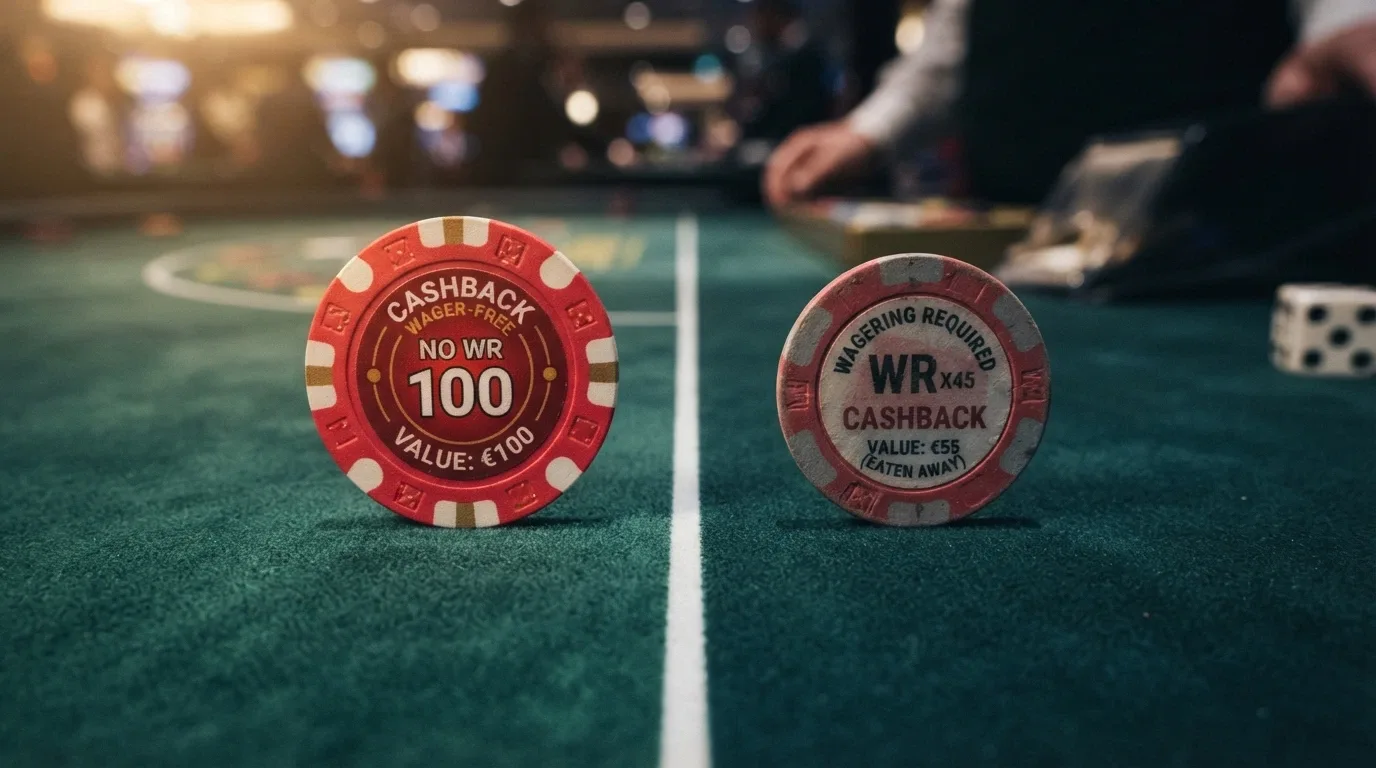
Zero-wagering cashback is the gold standard. SkyCrown, Bizzo, Rainbet’s Thursday tier, and RocketPlay’s Thursday slots and live cashback all credit without a playthrough. The cashback lands, the cashback is real money, the cashback is withdrawable.
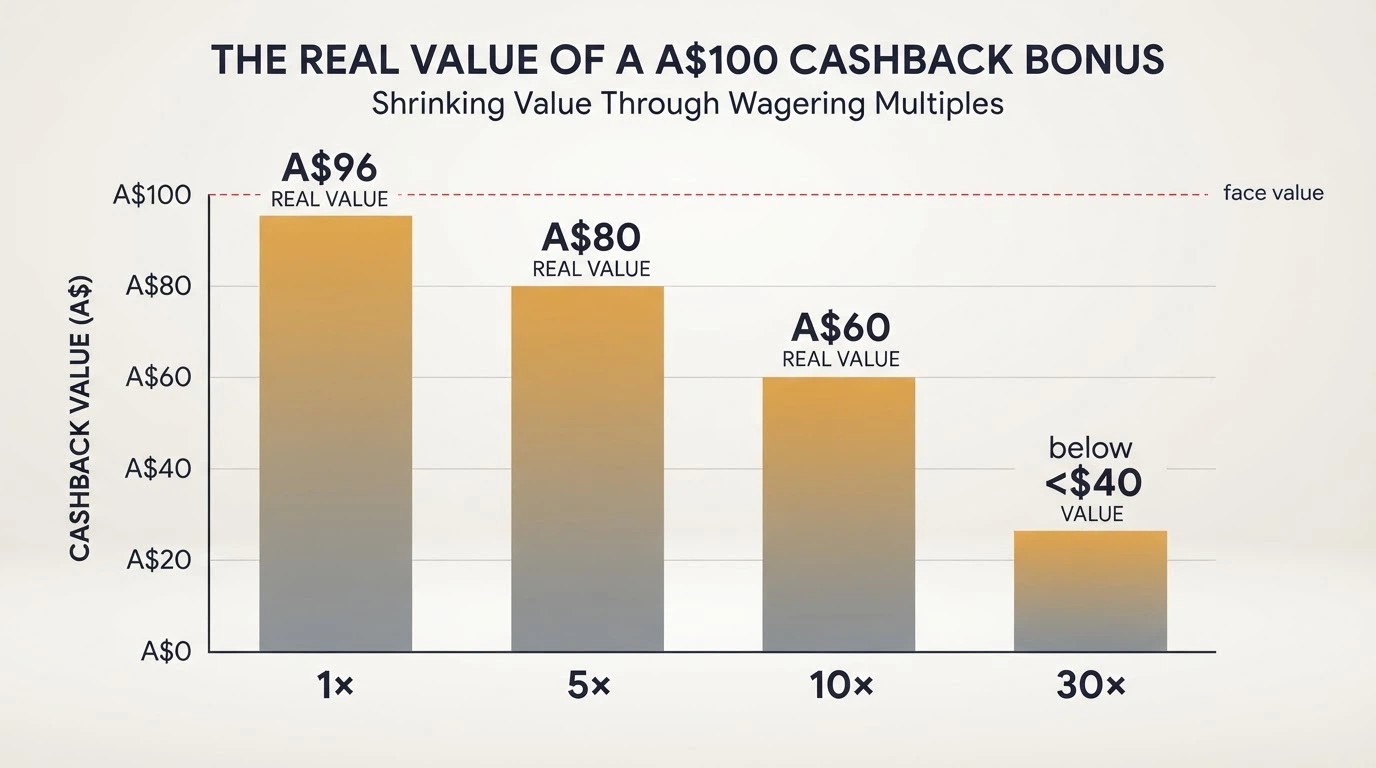
The picture darkens quickly above zero. Every extra turn of the wagering requirement erodes the bonus through expected loss on the games the player wagers it on. Take a A$100 cashback with 5× wagering, played through on a slot returning 96% to the player at A$1 per spin. Required turnover is A$500, which at five seconds per spin works out to roughly 500 spins in 42 minutes. The expected loss during that wagering is A$500 multiplied by (1 − 0.96), which is A$20. The cashback is worth A$80, not A$100. The wagering kept one-fifth of the face value. This is an estimate averaged across many spins, not a guaranteed outcome for any single session.
That math is the same for every multiple. At 10×, the expected loss on the same slot doubles to A$40, and the net cashback value falls to A$60. At Wild Tokyo’s 30×, the expected loss scales to A$120 — meaning a A$100 cashback costs the player A$20 more in expected value than it returns. The bonus has become a deduction dressed as a rebate.
Real Money Cashback vs Bonus Funds — the Difference That Determines Whether You Can Withdraw
The fund type decides whether the cashback is money in the player’s account or money in the casino’s hands. Real-money cashback — what SkyCrown and Bizzo credit at zero wagering — is withdrawable on the spot, with no playthrough, no cap on cashout beyond the standard bonus terms. Bonus-funds cashback — what Wild Tokyo pays at 30×, and what most high-percentage offers convert into — has to be played through before any of it can leave.
The trap is the combination. A high-percentage cashback with a high wagering requirement, paid in bonus funds, often returns less than half its headline value once the expected loss is netted out — and the half that remains still has to clear the wagering before it pays out. Read the wagering field first, then the rate, then the cap. The order is not a preference; it is the order in which the value disappears.
The Cashback Casinos We Rated Highest for Australian Players in 2026
Ten operators. All offshore, no Australian licence for the product any of them sell. Ranked by what the cashback is worth after wagering, with the strongest terms at the top. The legal-status column carries the same answer down every row because the answer is the same for every operator on this page: not licensed in Australia, not licensed anywhere in Australia, because the licence does not exist for online casino.
| Operator | Legal Status in Australia | Cashback Rate | Cashback Wagering | Cashback Frequency | Maximum Weekly Cap |
|---|---|---|---|---|---|
| SkyCrown | Offshore — no AU licence | 10% weekly (up to 20% VIP) | Zero | Every Monday | A$500 / A$5,000 VIP |
| RocketPlay | Offshore — no AU licence | 15% slots + 10% live | Zero (slots / live) | Every Thursday | — |
| Royal Reels | Offshore — no AU licence | 10–15% weekly | Zero | Weekly | A$500 |
| Bizzo Casino | Offshore — no AU licence | 15% weekend (Fri–Sun) | Zero | Monday morning | A$400 |
| Fair Go | Offshore — no AU licence | 25% on busted deposits (30% weekends) | Not specified | On busted deposits | — |
| Stake | Offshore — no AU licence | Rakeback up to 3.5% of house edge | Zero | Real-time | — |
| Rainbet | Offshore — no AU licence | 5% Thursday + up to 10% weekly | Zero (Thursday) | Thursday + Monday | — |
| WinSpirit | Offshore — no AU licence | — | — | — | — |
| Scream Casino | Offshore — no AU licence | — | — | — | — |
| Wild Tokyo | Offshore — no AU licence | 20% weekly | 30× | Weekly | A$500 |
The two “not confirmed” rows reflect operators that appear in AU traffic data without specific cashback terms surfaced this round. The right move for those brands is to verify the rate, wagering, frequency and cap directly with the operator before depositing — the table is not a blank cheque. A dash elsewhere means the operator did not publish a specific maximum in the terms reviewed.
SkyCrown — 10% Weekly Cashback, Zero Wagering, Up to A$5,000 for VIPs
SkyCrown runs the cleanest cashback structure on the page. Ten per cent on weekly net losses, credited every Monday, zero wagering requirement, with a A$500 cap for standard players and a A$5,000 cap for VIPs. The minimum loss to qualify is A$50, so the player has to actually lose something before the rebate kicks in.
The welcome package is the largest in the set: A$8,000 plus 400 free spins across four deposits, with the first deposit matched at 100% to A$500 and 100 free spins on Book of Dead. Wagering on the welcome is 40× the bonus and 30× the free-spin winnings, with a 14-day validity per tier — tight by industry standards and a reminder that the cashback, not the welcome, is where SkyCrown earns its reputation.
The value proposition is the gap between the cashback terms and everyone else’s. Zero wagering on a weekly rebate that caps at A$500 for the average player is hard to beat. The A$5,000 VIP ceiling makes SkyCrown the highest absolute cashback figure on the page.
RocketPlay — Dual Cashback (Slots + Live), Both Wager-Free
RocketPlay is the only operator in the set running two parallel cashback streams. Slots cashback pays 15% on pokies losses; live cashback pays 10% on live game winnings. Both credit on Thursdays, and both carry zero wagering.
The standard weekly cashback opens at Level 4 of the VIP Club, calculated as (Deposits − Withdrawals − Current Balance) × cashback rate, with a 5× wagering requirement and a minimum qualifying difference of A$50. The Thursday slots and live tiers are the player’s best entry point because they skip the VIP gating and skip the wagering.
The welcome is a 100% match up to A$1,000 plus 100 free spins on the first deposit and a 200% match up to A$1,000 on the second, with 40× wagering on the bonus plus free-spin winnings. The free spins credit at 20 per day over five days, which spreads the wagering across a week rather than demanding it all at once.
Two parallel cashback streams on different bases — slots and live, both wager-free — is a structure no other featured operator offers.
Royal Reels — 10–15% Weekly, Wager-Free, with a VIP Ladder
Royal Reels runs a straightforward weekly cashback of 10% to 15% on net losses, with zero wagering and a A$500 cap. The VIP ladder takes the rate from 2% at Bronze up to 15% at Diamond, so the rate itself moves with the player’s loyalty tier rather than waiting on a cap increase.
The welcome bonus is a 100% match up to A$500 plus 50 free spins, with 35× wagering on the match bonus and 30 days to clear. The 2,200+ pokies library is one of the larger libraries among the featured operators, and the claim of 5,000+ total slots puts Royal Reels near the top of the page for game variety.
The base 10% rate is ordinary; the 2%-to-15% VIP ladder is where the value lives.
Bizzo Casino — 15% Weekend Cashback, Zero Wagering, Monday Credit
Bizzo runs a weekend-only cashback at 15% on net losses from Friday through Sunday, credited Monday morning, with zero wagering and a A$400 cap. The structure suits a player who concentrates play into the weekend rather than spreading it across the week — the qualifying window matches the playing pattern, and the Monday credit funds the start of the next week.
The welcome package is up to A$2,500 plus 300 free spins across four deposits at match rates of 100%, 75%, 50%, and 100%. Free spins credit at 75 per deposit, valued at A$0.20 each. Wagering is 35× on deposit plus bonus, with a 21-day expiry — generous on time, demanding on the multiple.
A weekend-only rebate that suits weekend players. For anyone whose play is concentrated Friday to Sunday, Bizzo is a strong fit; for everyone else, the qualifying window disqualifies it.
Fair Go — 25% Cashback on Busted Deposits (30% Weekends)
Fair Go’s model is the most different on the page. The cashback does not run on a weekly net-loss basis. It runs on individual deposits — a 25% rebate if the player loses a deposit of A$10 or more in full, with the rate rising to 30% on Saturdays and Sundays. Cashback is claimed through live chat rather than credited automatically.
The trigger is strict. A deposit that ends the session with anything left in the balance does not qualify. A deposit that is busted — withdrawn to zero before any withdrawal is processed — qualifies for the rebate. The model rewards loss-heavy sessions and ignores everything else, which is the opposite of a net-loss weekly.
The welcome bonus is the largest in percentage terms on the page: a 300% match up to A$3,000 plus 50 free spins on Cash Bandits 2, with 30× wagering on the deposit plus bonus and no maximum cashout on the deposit bonus. RTG powers the games. A higher rate, a stricter trigger — that is the trade Fair Go asks the player to make.
Stake — Rakeback, Not Cashback — Continuous 3.5% on Every Bet
Stake does not run a cashback programme at all. There is no welcome bonus, no weekly rebate, no qualifying window. What Stake offers is rakeback — a real-time return of a share of the house edge on every qualifying game, credited continuously rather than on a schedule.
The mathematics are different. Rakeback pays against the house edge rather than against the player’s loss. Stake’s published figure is 5% of the house edge, equivalent to up to 3.5% effective rakeback on a typical slot. Because every spin carries the same rakeback regardless of whether the player wins or loses, the total paid over a session is uncapped and continuous.
The trade-off is the timing. Real-time rakeback looks small on any individual bet — a fraction of a cent per spin on low-stakes play — and only becomes meaningful across volume. Up to 3.5% effective rakeback, paid on every bet rather than on losses. For high-volume players it is the closest thing on the page to a true rebate, because it is not triggered by losses and it does not depend on the player ending a session in the red.
Rainbet — Cashback Thursday 5% + Weekly Up to 10%, Both Wager-Free
Rainbet runs two cashback streams in parallel. Cashback Thursday returns 5% of net losses with zero wagering; a separate weekly cashback returns up to 10% on a Monday credit. The Thursday tier is the cleaner of the two because the zero-wagering guarantee is explicit.
The game library leans on the studios Australian players recognise: Pragmatic Play, Hacksaw, Nolimit City. The welcome offer splits in two — a standard 100% match up to A$500 plus 50 free spins at 30× wagering, or a wager-lock path of 100% up to A$700 at 40× for players who want a higher match without free spins. Welcome validity is 30 days on the standard path and 7 days on the wager-lock path.
Two streams, two days — the player picks the cadence that matches their week.
WinSpirit — Offshore Presence, Cashback Terms Not Confirmed
WinSpirit appears in AU traffic data at around 1.55% of measured offshore traffic, which is why it sits on the page. What could not be confirmed in this round of research is the operator’s specific cashback rate, wagering requirement, frequency, or cap.
The honest advice is to verify the terms directly with the operator before depositing. A 1.55% share of a market this fragmented is meaningful but not dominant, and the gap between “appears in traffic data” and “publishes cashback terms a player can rely on” is the gap an AU player needs to close on their own before signing up. WinSpirit is offshore, holds no Australian licence, and would be reached by an Australian player through the same offshore channels as every other brand on this page.
Scream Casino — Offshore Presence, Cashback Terms Not Confirmed
Scream Casino sits lower in the AU traffic data at around 0.99%, which is the threshold below which affiliate pages stop listing operators. The brand is included here because the data shows real AU player traffic, but the bonus and cashback terms were not surfaced this run.
The same advice applies as for WinSpirit. Scream Casino is offshore, holds no Australian licence, and offers no Australian consumer protection. Listed by AU traffic share, not by verified bonus terms. If a player chooses to deposit, they should confirm the cashback rate, wagering, frequency and cap directly with the operator’s support before committing funds, and they should not assume the terms match any of the published rates on this page.
Wild Tokyo — 20% Weekly Cashback, the Highest Rate in the Set, but at 30× Wagering
Wild Tokyo publishes the highest weekly cashback rate on the page — 20% — and the highest wagering requirement on cashback at 30×. The two figures move together, and the math that matters is what the cashback is worth after the playthrough.
Run the worked example from the wagering section. A A$100 cashback at 30× wagering, played on a 96% RTP slot at A$1 per spin, requires A$3,000 of turnover. Expected loss during wagering is A$3,000 × (1 − 0.96) = A$120. The cashback costs the player A$20 more than it returns. The headline 20% is real; the value after wagering is negative.
The 8,000+ pokies library is the strongest game-count claim on the page, and the welcome bonus is set at 50× wagering — among the steepest in the featured set. A 20% rate that costs the player money once the wagering is netted out is the page’s worked example of why the percentage never stands alone, and is a worse deal than SkyCrown’s 10% at zero.
Crypto Cashback — Bitcoin Casino Rebates and How They Work
Crypto cashback is the version of the rebate that lives on the crypto-native casinos — Stake, Rainbet, and a handful of others. The mechanics look similar on the surface: a percentage of losses returned to the player’s account. The differences underneath are the speed of credit, the denomination of the payout, and the regulatory frame around the deposit itself.

How Crypto Cashback Differs from Fiat-Currency Cashback Offers
Crypto cashback typically credits instantly and in the same currency as the deposit — BTC, ETH, USDT, or one of the altcoins the operator accepts. Wagering is usually zero, because the crypto-native operators treat the rebate as a margin return rather than a marketing incentive. The deposit method is the bigger difference from fiat cashback, and the bigger problem for an Australian player.
Since 11 June 2024, credit cards, credit-related products and digital currency (crypto) are banned as payment for online wagering in Australia. An Australian player using crypto to fund a casino deposit is transacting through a payment method that is outside the Australian rules from the moment it leaves the bank account. That is a separate risk from the cashback terms — it sits one layer earlier in the transaction, at the deposit stage rather than the withdrawal stage — and it is worth weighing before the cashback percentage is even considered.
Volatility is the other cost. A cashback paid in BTC at a Tuesday price is worth a different number of Australian dollars by Friday. For a player who plans to withdraw in fiat, the cashback is exposed to crypto price moves during the holding period. For a player who plans to wager through and withdraw in crypto, the volatility is absorbed into the play.
Rakeback vs Cashback — Why Stake Took a Different Route
Rakeback is a share of the house edge, not a share of the player’s loss. The distinction matters because the two products measure different things: cashback pays when the player loses, rakeback pays on every bet regardless of outcome.
Stake’s published rakeback is 5% of the house edge on every qualifying game, equivalent to up to 3.5% effective rakeback on a typical slot. The effective rate is uncapped and continuous — credited in real time as bets settle rather than as a scheduled weekly payment. There is no welcome bonus to clear and no qualifying window to meet.
The model suits high-volume players because rakeback accumulates per bet rather than per loss. A player who wins half their sessions and loses half their sessions earns the same rakeback on both — whereas a cashback player earns nothing on the winning sessions. The reverse side is the player who plays occasionally: real-time rakeback on low volume produces a small per-week return that may not register against the cashback alternatives.
The Legal Reality — What the Interactive Gambling Act Means for Your Cashback
Online casino is prohibited in Australia under the Interactive Gambling Act 2001. There is no licence for online casino games anywhere in the country — not federally, not in any state or territory. The provisions on this page are not licensed options; they are offshore operators reaching Australian players through channels the IGA prohibits. This section spells out what that frame means for a player who picks one of them.

| Player Protection | Licensed AU Wagering Provider | Offshore Casino with Cashback |
|---|---|---|
| Australian consumer law applies | Yes | No |
| ACMA can recover funds | Yes | No |
| BetStop covers the operator | Yes | No |
| Mandatory deposit-limit tools | Yes (state rules vary) | Variable, often absent |
| Site-blocking risk | None | Yes (1,788 sites blocked since 2019) |
| Australian complaints body | Yes | No |
| Credit cards and crypto as deposit | Banned since June 2024 | Cannot legally accept AU customers using them |
The right column is the same for every operator on this page. The protections the left column lists do not transfer offshore.
The Interactive Gambling Act 2001 — What It Actually Prohibits
The IGA makes it an offence to provide online casino, online pokies, or in-play sports betting to a person physically in Australia. The provider is targeted, not the player — no Australian has been prosecuted for playing at an offshore casino. The Act covers the supply side and leaves the demand side in a legal grey zone that is nevertheless practically real.
What the IGA does not prohibit is wagering on races and sporting events placed before the event begins, plus lotteries and keno. Those products are licensed at state and territory level. In practice the Northern Territory Racing and Wagering Commission, administered through Licensing NT, is the de facto national licensor — Sportsbet, bet365, Ladbrokes and approximately fifty other online bookmakers hold NT licences. Online casino is not among them.
The enforcement is the ACMA’s job. The Authority investigates complaints, issues formal warnings, runs civil penalty proceedings, and directs Australian ISPs to block illegal services. The blocking list grew to 1,788 sites by August 2026, and more than 230 illegal services have withdrawn from the Australian market since 2017. The current enforcement record is one of the most active in any English-language regulated market.
Offshore Casinos and Your Rights — The Protections You Do (and Don’t) Have
An offshore casino gives a player a cashback percentage and takes away every Australian consumer protection that would have backed it up. There is no Australian complaints body an AU player can escalate to. There is no BetStop coverage — a self-excluded player can still deposit at an offshore casino, because the casino is not on the register and does not check it. There is no deposit guarantee if the site closes or refuses a withdrawal. The ACMA’s own published reminder is blunt: even if a service looks legitimate, it is unlikely to carry the customer protections Australians are used to.
The site-blocking risk is the practical hazard. The ACMA can direct ISPs to block a service on a timeline measured in weeks, and a blocked site can be reached no longer with a player balance — and accrued cashback — still sitting on it. There is no Australian authority that can recover those funds, because the operator is outside Australian jurisdiction.
The credit-card and crypto deposit ban is the other indicator. An offshore casino asking an Australian player for a credit card or crypto deposit is being served by someone operating outside the Australian rules from the deposit stage onward. The fact that the operator is willing to accept those payment methods is itself a signal of where the operator sits in relation to Australian regulation.
The 2026 Gambling Reform — Advertising Bans, Bank Blocks and Inducement Rules
The Interactive Gambling Amendment (Gambling Reform) Bill 2026 passed Parliament on 19 August 2026. Its measures commence on 1 January 2027. As of 2026 they are law but not yet in force; the description below is of what the new rules will require once they take effect.
The advertising restrictions cap wagering advertising on television at three ads per hour between 6:00 am and 8:30 pm, ban live wagering advertising from 15 minutes before a live sporting event until 5 minutes after it ends, and prohibit athletes, celebrities and influencers from promoting wagering. The inducement restrictions prohibit direct marketing of sign-up offers and bonuses for 14 days after a customer signs up, for three months after a person deregisters from BetStop, and indefinitely for customers flagged as at risk of gambling-related harm.
Banks and payment providers gain express authority to block transactions to illegal gambling operators from 1 January 2027. The practical effect for an AU player funding an offshore casino deposit is that the bank — not just the ACMA — can stop the transaction at the payment stage. The reform does not legalise online casino and does not create a licence for it. It tightens the frame around the existing prohibition.
Staying in Control — Responsible Gambling When the Safety Net Doesn’t Reach Offshore
Responsible-gambling tools are designed for the licensed market. Offshore casinos sit outside most of them. The tools that do work regardless of where a player plays — a deposit limit the player sets on themselves, the National Gambling Helpline, Gambling Help Online — are the ones worth memorising before any deposit.
The Self-Exclusion Gap — Why BetStop Cannot Reach an Offshore Casino
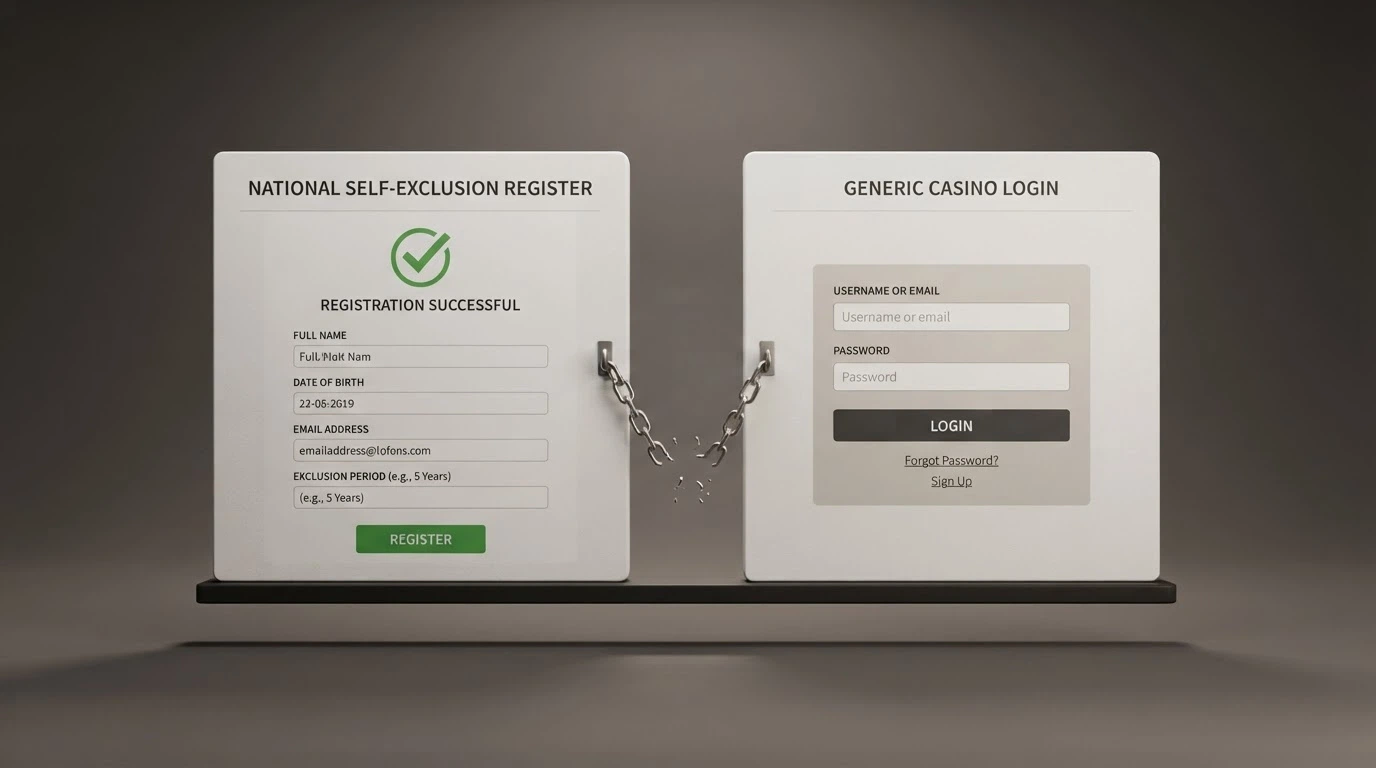
BetStop is Australia’s National Self-Exclusion Register, live since 21 August 2023. One registration excludes a person from every Australian-licensed online and phone wagering service in a single step. By the end of December 2025, 54,859 people had registered, and 35,135 exclusions were active.
The offshore gap is the structural problem. BetStop binds Australian-licensed wagering services only. An offshore casino is not licensed in Australia, is not connected to the register, and does not check it. A player who has self-excluded through BetStop can still deposit at every operator on this page, and the exclusion does not extend. The 33.5% awareness figure — the share of wagerers who know BetStop exists — matters because the people most likely to need the tool are the least likely to know it is there. Younger adults and migrant Australians are over-represented in that gap.
Demographics sharpen the picture. 78% of BetStop registrants were under 40, and 38% chose lifetime exclusion. The pattern is consistent with harm concentrated in the under-40 cohort, which is also the cohort most likely to be reached by an offshore casino through the affiliate channels the AU-targeted search results sit on.
Practical Tools — Deposit Limits, the Helpline and Where to Get Help
The National Gambling Helpline — 1800 858 858 — is free, confidential and staffed 24 hours a day, seven days a week, with online chat and counselling through Gambling Help Online at gamblinghelponline.org.au. The number is the same across the country. It is the one piece of responsible-gambling infrastructure that works regardless of where a player has chosen to play.
Deposit limits are the player’s own tool when the operator’s tools are absent or unreliable. Licensed operators must offer customer-set deposit limits and activity statements under their state and territory conditions; offshore operators may offer either, neither, or only a session-time limit that is bypassed by closing the browser. The practical advice is to set the limit on a banking app rather than on the casino’s site — a bank-side daily transfer cap cannot be raised by the operator.
The harm prevalence data is the reason these tools exist. 15.1% of Australian adults — an estimated 3.32 million people — were experiencing some level of gambling harm as of March 2026. Risky gambling rose from 13.7% in 2024 to 19.4% in 2025, almost doubling over five years. Approximately 1.97 million adults are classified as at-risk or problem gamblers. The numbers are not a sidebar — they are the population the responsible-gambling infrastructure was built for.
How We Selected and Ranked These Cashback Casinos
The ranking is by cashback value after wagering, not by headline rate. An offer that credits at 10% with zero playthrough outranks an offer that credits at 20% with 30× playthrough, because the expected loss during the wagering on the second offer exceeds the face value of the cashback itself. The worked example in the wagering section shows the math: the same arithmetic that ranks these ten operators is the arithmetic a player should run on any new offer.
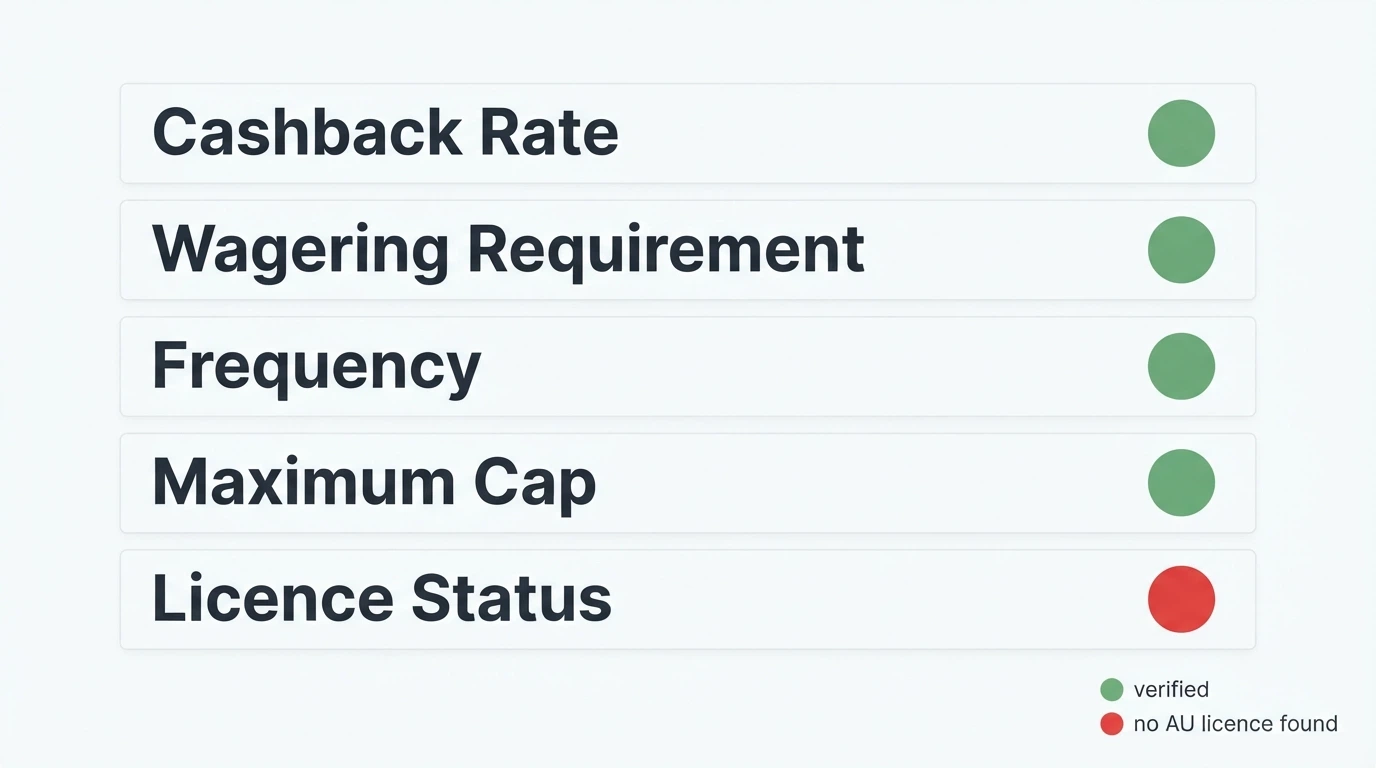
The sources checked were the operators’ published bonus terms pages, the ACMA register and blocking list, the AGRC research register for the responsible-gambling figures, and Betzoid’s 23-site AU cashback testing. Betzoid found that only 11 of the 23 real-money casinos tested paid out within 24 hours without hidden conditions, and that 8 of the 23 ran cashback wagering at zero to five times — the band where the cashback name actually means what it says.
The ACMA whitelist check returned no result. There is no Australian licence for online casino, so no operator can sit on an Australian whitelist for the product. Every brand on this page is offshore, every licence cited is offshore, and the ranking reflects cashback value rather than regulatory standing because regulatory standing is the same — none — for every operator on the list.
Is a High-Cashback Offshore Casino Worth the Risk?
The cashback on offer is real, the percentages are competitive with anything in the licensed market, and the strongest terms on the page — SkyCrown’s 10% weekly at zero wagering, RocketPlay’s dual-stream Thursday rebate, Bizzo’s 15% weekend at zero — are the kind of offers a player would have to look hard to find anywhere else. The wagering cost on the high-percentage operators is the lever that decides whether the offer is worth taking; the 30× on Wild Tokyo’s 20% is the worked example of how a headline rate can cost the player more than it returns.

The risks sit on the other side of the same scale. No Australian consumer protection applies. BetStop does not reach the site. The ACMA cannot recover funds if the operator refuses a withdrawal. The site can be blocked at any time with a balance — and accrued cashback — still sitting on it. The credit-card and crypto deposit ban is the indicator that the operator sits outside the Australian rules from the deposit stage onward.
The verdict for a player who has decided to play offshore: pick a wager-free offer with a clear cap and a withdrawal record a third party has actually verified. Set a deposit limit on the bank app before the first deposit, not on the casino site. Know the helpline number — 1800 858 858 — and use Gambling Help Online at gamblinghelponline.org.au if the limit stops working. The cashback is worth the terms. The player carries the rest.
Frequently Asked Questions
What happens to my cashback if the offshore casino gets blocked by the ACMA?
The ACMA can direct Australian ISPs to block an illegal gambling service at any time, and more than 1,788 sites have been blocked since November 2019. A blocked site cannot be reached by an Australian player through standard channels, which means any balance — including accrued but unwithdrawn cashback — sits on the operator’s server with the player unable to access it. The ACMA cannot recover those funds for the player.
Does BetStop cover offshore casino cashback offers?
No. BetStop, Australia’s National Self-Exclusion Register, binds Australian-licensed wagering operators only. An offshore casino is not licensed in Australia, is not connected to the register, and does not check it. A self-excluded player can still deposit at every operator reviewed on this page, and the exclusion does not extend to the offshore route at all.
Are casino cashback bonuses taxed in Australia?
No, for an ordinary punter. Betting and gambling winnings are not assessable income under section 6-5 of the ITAA 1997, and gambling losses are not deductible under section 8-1. Cashback — being a rebate on losses rather than winnings — is not taxable either. The exception is a person carrying on a business of betting, which is not the situation for a recreational player.
Can the ACMA help me recover cashback from a blocked offshore casino?
No. The ACMA enforces the prohibition on providers, investigates complaints, and directs ISPs to block illegal services. It does not have a fund-recovery function and cannot compel an offshore operator to pay a player. A player who has been refused a withdrawal at an offshore casino has no Australian authority to escalate to, which is one of the structural costs of the offshore route.
What is the difference between casino cashback and rakeback?
Cashback pays a percentage of the player’s losses over a defined window, usually weekly or on a specific event. Rakeback pays a share of the house edge on every bet, win or lose, and is typically credited in real time. Cashback is event-triggered; rakeback is volume-triggered. The two products suit different player profiles — cashback for casual and weekend play, rakeback for high-volume sessions.
What is the difference between a cashback bonus and a deposit match bonus?
A deposit match bonus adds a percentage of the player’s deposit as bonus funds, almost always with a wagering requirement of 30× to 50× before withdrawal. A cashback bonus returns a percentage of the player’s losses, usually at a much lower wagering — zero to 10× in the strongest offers, occasionally 30× or higher on weaker terms. The match is paid forward on entry; the cashback is paid back on loss. They are not the same product.