
Best High Roller Casino With Bonus Australia: What the Headline Doesn’t Tell You
No online casino holds an Australian licence. None can. The Interactive Gambling Act 2001 makes the provision of online casino games, online pokies and in-play betting to a person in Australia a prohibited interactive gambling service, and no Commonwealth, state or territory body has ever issued a licence for one. The brands on this page are offshore, Curaçao-licensed and reach Australian players through payment rails and marketing funnels the regulator is actively trying to shut. Knowing that is the difference between a high-roller decision made with clear eyes and one made on a bonus number that has already been deflated by a wagering requirement, a max-bet rule and a validity window before the first dollar is yours to withdraw.

Current as of 16 October 2026, verified against the Australian Communications and Media Authority (ACMA) public register and the Interactive Gambling Act 2001 as amended.
Table of Contents
- What Separates a High Roller From a Casual Punter
- The Top 10 High-Roller Casinos Taking Australian Players in 2026
- Why Your High-Roller Bonus Is Smaller Than the Advertised Number
- The Pokies and Table Games That Actually Favour the Player
- How Australian High Rollers Move Money Without a Local Licence
- High-Stakes Play on Your Phone — What Works and What Doesn’t
- Offshore and Unlicensed — What Australian Law Actually Says About Online Casinos
- Staying in Control When the Stakes Run High
- How We Ranked These High-Roller Casinos
- What the High-Roller Market Tells You — and What You Should Do With It
- Frequently Asked Questions
What Separates a High Roller From a Casual Punter
A high roller at an offshore casino is not defined by a personality trait or a marketing tier name. The category is operational: a deposit threshold, a withdrawal ceiling, and the account-management perks that follow once a player crosses the line. Most offshore brands catering to Australians begin their VIP or “high roller” framing around a $500 minimum deposit, with serious tier thresholds climbing into the low thousands. That is the same range where standard players move into bonus territory designed for a different kind of bankroll, with bet sizes stretching from $50 up to $200 or more per spin on the highest-limit pokies.
The framing matters because every operator on this list sits entirely outside the Australian licensed framework. There is no AU regulator standing between the player and the casino, no complaints body with jurisdiction, and no BetStop coverage of the kind described further down the page. The “high roller” label is what the offshore brand calls a depositor who has cleared their internal threshold. It is not a consumer protection. It is a marketing segment.
The Deposit Threshold That Opens the VIP Door
The entry point that signals high-roller status at most offshore brands starts at around $500. From there, the tier structure usually runs through five to eight rungs, with each one unlocking progressively faster withdrawals, higher monthly cash-out ceilings, dedicated account management and rebate or cashback rates that scale from roughly 5% at the bottom of the structure to around 20% at the top. One well-documented example of this kind of structure is a seven-tier VIP programme where dedicated account management kicks in from Level 3, with rebates scaling across the higher tiers and a $50,000 monthly withdrawal cap from account registration — a figure that, for a serious high-stakes player, still constrains how fast a balance can move.
The honest version of this picture: tier structures vary widely, and most offshore casinos targeting Australian players do not publish their thresholds or rebate rates publicly. A player who wants to know what sits above the entry deposit has to ask, often after depositing. That asymmetry is structural. The casino knows the thresholds; the player learns them by crossing them.
Beyond the Deposit — Withdrawal Caps, Table Limits and the Real Perks
The features that genuinely matter to a high-stakes player are the ceilings on cashing out and the bet limits at the table, not the marketing tier name. Withdrawal caps in the Australian-facing offshore market commonly sit between $10,000 and $50,000 per month according to the brands prominent in search results — wide enough to be useful for mid-stakes play, tight enough to be a real constraint when a progressive jackpot or a hot run produces a five-figure balance. Live-dealer max-bet ceilings range similarly, from a few hundred dollars per hand at the standard tables up to several thousand at the highest-limit rooms.
Where the real differentiator sits, almost universally, is account management and support speed. A dedicated account manager at the third VIP tier or above is the operator’s signal that they take the player seriously — and the practical effect is faster answers on withdrawal status, faster limit escalations when the player wants them, and a single point of contact instead of a generic support queue. None of these perks changes the fundamental picture: this is still an offshore product, and the protections a high roller would expect at a licensed venue do not apply.
The Top 10 High-Roller Casinos Taking Australian Players in 2026
Every operator in the table below is offshore, unlicensed in Australia and Curaçao-licensed (where the licence jurisdiction is confirmed). None holds an Australian casino licence because none exists. The ranking is by Australian-tracked traffic share — the operators skill’s AU market-share table is the source — and the table carries an em dash for any cell the underlying research does not fill.

| Operator | Licence | AU Market Share |
|---|---|---|
| Rocket Play | Curaçao (offshore) | 9.4% |
| Skycrown | Curaçao (offshore) | 8.55% |
| Royal Reels | Curaçao (offshore) | 2.51% |
| WinSpirit | Curaçao (offshore) | 1.55% |
| Stake | Curaçao (offshore) | 1.28% |
| Rainbet | Curaçao (offshore) | 1.28% |
| Scream Casino | Curaçao (offshore) | 0.99% |
| FairGO | Curaçao (offshore) | 0.80% |
| Bizzo Casino | Curaçao (offshore) | 0.57% |
| Rocket Casino | Curaçao (offshore) | 0.57% |
A reader scanning that table sees ten brands and ten market-share figures. What the table does not show, and the prose below has to carry, is what each of these brands is actually worth to a high-stakes player — and what the figures that the research did not confirm look like when the player meets them at the cashier.
Rocket Play
Rocket Play is the highest-traffic offshore casino reaching Australian high rollers, with a 9.4% share of tracked AU traffic and a Curaçao licence. The brand’s known provider portfolio includes Evolution, Pragmatic Play, BGaming, Nolimit City and Hacksaw Gaming — a spread that covers live-dealer tables, high-volatility slots and the game-mechanic experimentation that has come to define the modern offshore lobby. Bonus terms, free-spin counts and the wagering multiplier attached to its current welcome package were not confirmed this run; a player considering Rocket Play should treat the headline figure on the landing page as a starting point for the cashier conversation, not a finished number.
For a high-stakes player, the combination of traffic share and provider breadth is a signal that the brand can absorb a large deposit and route it into a wide range of titles — but it is not a signal of any consumer protection. The Curaçao licence is a real licence, but it is not an Australian one, and any dispute sits outside ACMA’s reach.
Skycrown
Skycrown sits one rung below Rocket Play in AU traffic share at 8.55%, also Curaçao-licensed and offshore. The bonus terms, free-spin structure and wagering multiplier currently attached to the Skycrown welcome package were not confirmed this run; the provider list is likewise unconfirmed beyond what the standard offshore portfolio would suggest.
A high-stakes player comparing Skycrown to Rocket Play is essentially choosing between two brands of similar scale and similar licence footing, where the differentiator is whichever one has the better current bonus terms at the moment of deposit. None of that is information the player can read on the landing page in advance. As with every operator on this list, the offshore status is the load-bearing fact: Skycrown cannot be licensed in Australia, and a player depositing with the brand is operating outside any AU consumer-protection framework.
Royal Reels
Royal Reels holds a 2.51% share of AU tracked traffic and a Curaçao licence, putting it firmly in the mid-tier of offshore brands reaching Australian high rollers. The provider list, bonus terms, free-spin counts and wagering requirements were not confirmed for Royal Reels this run — the operator’s specifics sit in the same gap as several others on this list.
The qualitative picture for a high-roller player is straightforward: a mid-traffic offshore brand with a loyal Australian following, operating on Curaçao house rules and reaching players through the same payment rails the regulator is scrutinising. The brand’s persistence at this traffic level suggests a working customer base; it does not suggest any change in the underlying legal status. Royal Reels is offshore and unlicensed in Australia in the same way every other operator on this list is.
WinSpirit
WinSpirit is a smaller, persistent offshore operator in the Australian market, holding a 1.55% share of AU tracked traffic under a Curaçao licence. Bonus terms, free-spin counts and wagering multipliers for the current WinSpirit welcome package were not confirmed this run; the provider portfolio is likewise unconfirmed beyond what the standard offshore mix would include.
For a high-stakes player, WinSpirit sits in the lower-traffic tier of brands reaching Australian players. The practical implication is that the brand has a working customer base but a smaller absolute pool of high-stakes depositors than the leaders. None of that changes the licence footing. WinSpirit is Curaçao-licensed and offshore, and a player depositing with the brand accepts the same gap in AU consumer protection that every other operator on this list carries.
Stake
Stake is the outlier on this list. It is a Curaçao-licensed offshore brand with a 1.28% share of AU tracked traffic, and its commercial model is built around rakeback and cashback rather than the traditional deposit-match welcome bonus. The known provider portfolio includes Pragmatic Play, Evolution, Hacksaw Gaming, Nolimit City and Push Gaming — the same kind of high-volatility, live-dealer-heavy mix that defines the modern offshore lobby at the top of the market. There is no traditional welcome bonus, no free-spin welcome package and no wagering multiplier, because Stake’s model replaces those mechanics with a rakeback structure that returns a percentage of house edge or wagering volume to the player over time.
For a high-stakes player, the rakeback model is the relevant contrast against the match-bonus norm that the rest of this list follows. A rakeback structure does not produce a headline bonus number to deflate through wagering; it produces a slower, ongoing return on volume played. The trade-off is that a player who treats rakeback as a substitute for a welcome bonus is essentially comparing a steady stream of small returns against a single large upfront figure locked behind a turnover requirement. Which one is worth more depends on the player’s expected volume and the rakeback percentage attached to their tier.
Rainbet
Rainbet shares Stake’s traffic tier at 1.28% of AU tracked traffic, with a Curaçao licence and offshore status. The bonus terms, free-spin structure and wagering multiplier attached to the Rainbet welcome package were not confirmed this run; the provider portfolio is likewise unconfirmed.
The qualitative read for a high-roller player is that Rainbet sits alongside Stake in the lower-mid traffic bracket with a similar licence footing. The differences between the two brands, for a player choosing between them, sit in details the landing pages do not surface in advance — and the operator’s licence status is identical to every other name on this list.
Scream Casino
Scream Casino holds a 0.99% share of AU tracked traffic and a Curaçao licence, sitting near the bottom of the top-10 of offshore brands reaching Australian players. Bonus terms, free-spin counts, wagering requirements and the provider portfolio were not confirmed this run.
A high-stakes player considering Scream Casino is looking at a niche offshore brand with a working customer base but a smaller absolute pool of high-stakes depositors. The Curaçao licence is the same kind of licence every other operator on this list holds. The qualitative gap — what the brand actually delivers in bonus terms and game variety — is the same gap the player meets at every smaller-traffic offshore brand, and the answer to it sits behind the deposit button rather than in front of it.
FairGO
FairGO is the RTG-exclusive specialist on this list. It holds a 0.80% share of AU tracked traffic under a Curaçao licence, and its entire game library is built around RealTime Gaming — a single-provider catalogue that targets Australian players with a specific taste for the RTG format. Bonus terms, free-spin counts and wagering requirements were not confirmed for FairGO this run.
For a high-stakes player, the RTG exclusivity is the meaningful differentiator. A single-provider casino produces a narrower game selection than a multi-provider brand at the same traffic level, but it produces a more consistent one: the player knows the catalogue, the mechanics and the volatility profile in a way that is harder to achieve across ten different studios. The trade-off is that the highest-volatility and highest-max-win titles Nolimit City and Relax Gaming produce are not in the RTG catalogue, and a player who specifically wants that kind of title is looking at the wrong operator.
Bizzo Casino
Bizzo Casino sits at the lower end of the top-20 offshore brands reaching Australian players, with a 0.57% share of AU tracked traffic and a Curaçao licence. Bonus terms, free-spin structure, wagering requirements and the provider portfolio were not confirmed this run.
A high-stakes player considering Bizzo is choosing among the smallest-traffic offshore brands reaching the Australian market, where the practical effect is a thinner absolute pool of high-stakes depositors and a narrower set of confirmed bonus data. None of that changes the underlying licence status. Bizzo is Curaçao-licensed and offshore, and the protection gap is identical to every other operator on this page.
Rocket Casino
Rocket Casino is the smallest-traffic brand in the featured set at 0.57% of AU tracked traffic, Curaçao-licensed and offshore. It is not to be confused with Rocket Play, which sits at the top of the table at 9.4%. The two brands share a name but not a traffic position, a provider portfolio or any other operational fact confirmed in the research. Bonus terms, free-spin counts, wagering requirements and providers were not confirmed for Rocket Casino this run.
The honest version of the comparison for a high-stakes player is that the name overlap creates a real risk of confusion. A player searching for Rocket Play and landing on Rocket Casino is not looking at the same brand, the same traffic level or the same product. The traffic share alone — Rocket Casino at under 1%, Rocket Play approaching one in ten — tells the player which of the two is the larger operation by a wide margin.
Why Your High-Roller Bonus Is Smaller Than the Advertised Number
The headline number on a high-roller bonus is a deposit-match percentage multiplied by a ceiling, and it is the figure every landing page leads with. It is also the figure that has been deflated the most by the time the bonus becomes withdrawable cash. A 50x wagering requirement on a $2,500 bonus produces a turnover obligation of $125,000 before a dollar can be taken out. A $20 maximum bet during wagering caps how fast that obligation can be cleared. A 14- to 30-day validity window — or, in some market examples, a tighter 5-day deadline on certain welcome packages — sets a hard upper limit on how long the player has to do it. None of these constraints is a fine print detail. Together they are the offer.
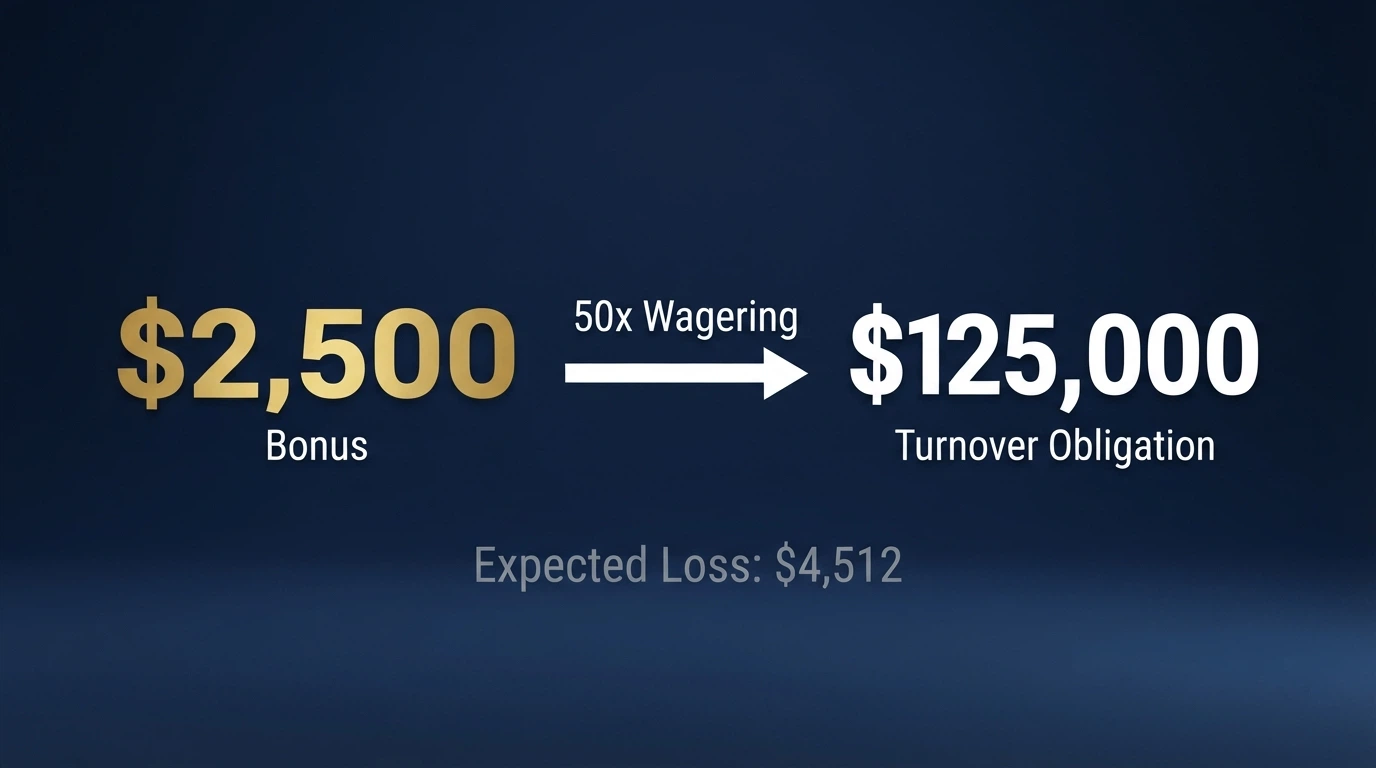
A worked example using market-wide norms: a representative high-roller bonus of AU$2,500 at a 50x wagering multiplier produces a turnover obligation of $125,000. The expected loss from clearing that turnover on a representative high-RTP slot portfolio averaging around 96.39% — NetEnt’s tracked mean across its catalogue — is approximately $4,512. That is the statistical cost, on average over many spins, of converting the advertised bonus into withdrawable cash. It is not a guaranteed outcome for any single player. It is the average the math produces when you multiply the turnover by the house edge at the representative return-to-player rate. A reader who treats that number as the cost of the bonus — rather than the bonus amount — has the comparison the landing page does not provide.
Welcome Bonuses Built for Four-Figure Deposits
The high-roller welcome offer sits in a different bracket from the standard sign-up. Match rates commonly run from 100% up to 300%, and the ceilings stretch into five-figure territory. The structure is usually a single-deposit match with a high minimum deposit — often $500 or above — or a multi-deposit package that splits a $10,000-or-larger headline figure across the first three to five deposits. Either way, the offer is built to absorb a four-figure deposit and return a comparable four-figure bonus, with the wagering requirement sitting in the 30x to 50x range and a validity window measured in days, not months.
What that means in practice: the welcome offer rewards the player for depositing a larger amount, but it converts only a fraction of that deposit into withdrawable cash after the wagering requirement is cleared. The market is full of examples that illustrate the structure. Lets Lucky’s high-roller entry matches 200% up to $6,000 on a $500+ first deposit, with a 60-day VIP trial attached and a tighter 7-day window on the bonus itself. Lucky Dreams structures a $10,000 package plus 500 free spins across five deposits, with the high-roller first deposit alone matching 150% up to $6,000 and a 10% cashback on the back end. LEON BET offers a tiered high-roller bonus worth up to A$4,500. Olympia Casino runs 300% up to $5,000 plus 75 free spins at 50x wagering. Golden Crown layers a 100% match up to AU$15,000 plus 300 free spins on top of a dedicated high-roller bonus of 50% up to AU$1,500. The point is not which of these is the best — none of these brands is in the featured operator set on this page — but what the structure tells a high-roller player about how the offer works. Every one of these packages has a wagering requirement that turns the headline figure into a turnover obligation well into five figures before withdrawal.
Free Spins for High Rollers — Volume Over Gimmick
Free-spin counts at the high-roller level are large — 250, 300, 450 and 500 free-spin packages appear across the market examples — but the spins themselves are a secondary benefit, not the main event. They typically apply to a fixed set of titles, and the winnings feed back into the same wagering requirement that applies to the cash bonus. For a player depositing $500 or more, the value of the free spins is real but secondary to the match. A 250-spin package at low per-spin value is a fraction of the headline cash bonus after wagering is applied; it is welcome, not transformative.
The marketing weight attached to free-spin counts is the giveaway. When a landing page leads with “450 free spins”, the player is being asked to focus on the most visible part of the package rather than the wagering requirement attached to the cash bonus underneath. That is not dishonesty; it is the standard structure of the offer. It is also the part a high-roller player who reads the bonus terms before depositing understands faster than one who reads them after.
Wagering Requirements — the Multiplier That Deflates Every Headline
The wagering multiplier is the single largest determinant of what a high-roller bonus is actually worth. The market range runs from 30x to 50x, applied to the bonus alone or to the deposit plus bonus depending on the operator, with max-bet rules during wagering of $5 to $20 per spin or hand and validity windows of 14 to 30 days. Some packages are tighter than that — certain welcome packages attach a 5-day wagering deadline to the bonus, which is a short window to clear a four- or five-figure turnover obligation at the maximum allowed stake.
The math on a representative package is straightforward. A $2,500 bonus at 50x wagering is $125,000 of turnover before withdrawal. A $20 maximum bet during wagering caps the number of spins at 6,250, and at a 5-second interval that is roughly 8.7 hours of continuous play to clear the bonus — if the validity window allows it, and if the player has the bankroll to sustain it. The cost of clearing the bonus is the expected loss on $125,000 of turnover at the representative RTP of the slot portfolio the player chooses, which at a 96.39% return-to-player produces an expected loss of approximately $4,512. That figure is the price tag the headline number has been hiding.
The Pokies and Table Games That Actually Favour the Player
The games a high-stakes player chooses to clear wagering requirements on are not the games they would choose for entertainment. They are the games where the return-to-player percentage is highest, the volatility is manageable and the bet-size limits align with the max-bet rule during wagering. Across the providers common at offshore casinos reaching Australian players, the published RTPs cluster in a narrow band. NetEnt’s tracked catalogue average is the highest at 96.39%, followed by Big Time Gaming at 96.25% and Push Gaming at 96.15%. Pragmatic Play’s average sits lower at 95.61% with 45% of its games at or above 96%. Play’n GO and Hacksaw Gaming sit at the bottom of the tracked cohort at 94.79% and 94.81% respectively.
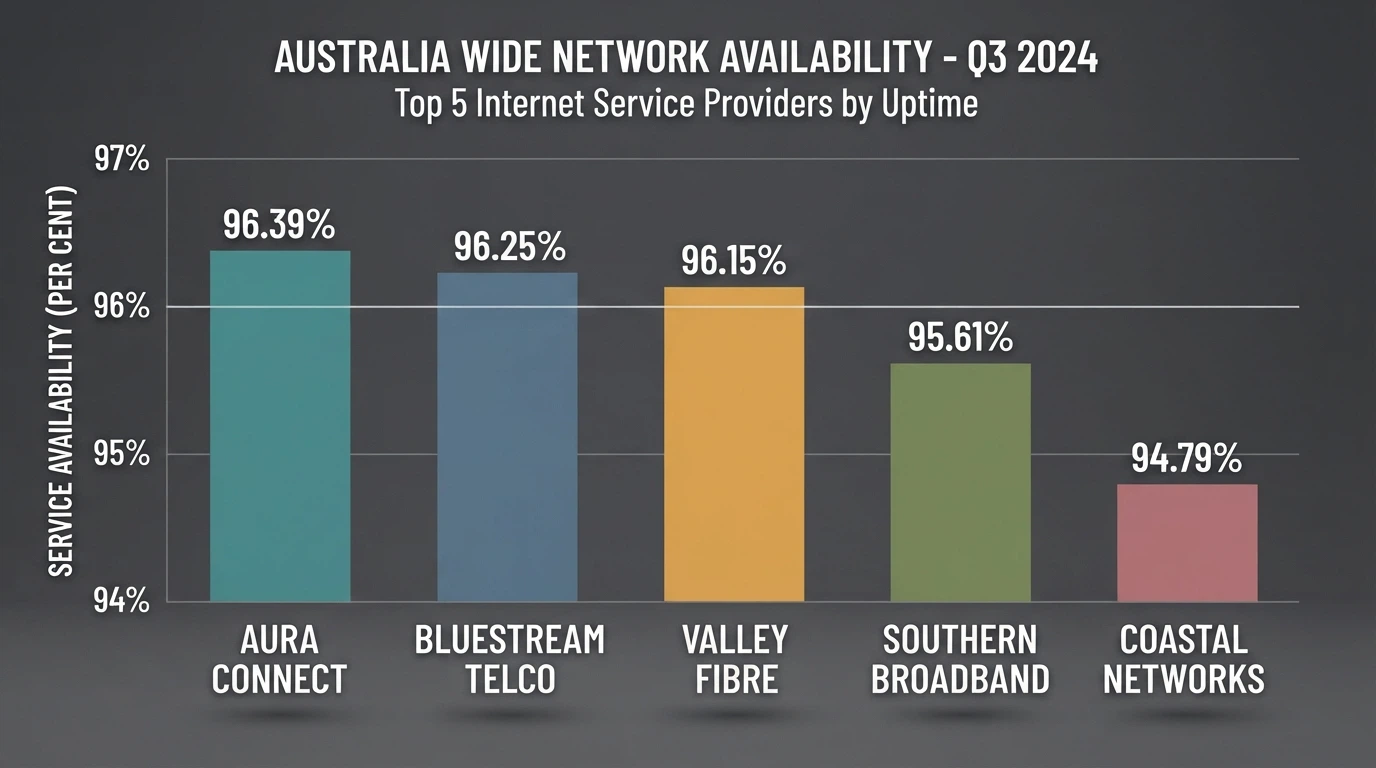
That spread — a 1.6-percentage-point gap between the highest and lowest provider averages — is what a high-roller player can move around in by choosing the right studio for the clearing work. It is not a small gap. On a $125,000 turnover obligation, the difference between a 96.39% RTP slot portfolio and a 94.79% one is roughly $2,000 in expected loss. Provider RTP is an average across the catalogue, and individual titles vary widely above and below it — but the studio-level average is the most useful signal the player has before they sit down at a particular game.
High-Limit Pokies — Where the RTP Meets the Stake
The table below lists the high-stakes pokie titles with a confirmed published RTP. Most titles in the high-roller segment do not have public RTP data; the table carries only those the research verified.
| Title | Provider | RTP | Volatility | Max Win |
|---|---|---|---|---|
| Vegas High Roller | iSoftBet | 95.88% | Medium-High | 2,000x |
| High Roller | Big Wave Gaming | — | — | 2,000x |
| High-Roller Bonanza | (unconfirmed) | 96.32% / 96.04% / 95.59% | Low / Medium / Medium | x500 / x1,000 / — |
The three RTP configurations on High-Roller Bonanza are the version-specific figures the operator publishes: 96.32% at the Low volatility setting, 96.04% at Medium and 95.59% at the higher tier. The version the player sits at is set by the operator, not the player. Vegas High Roller’s 95.88% sits in the middle of the high-roller segment; its 2,000x max win is a fraction of the tier-leading 150,000x from Nolimit City and Relax Gaming but is consistent with a slot designed around a steady return rather than a feature-driven jackpot chase. Bet sizes on these titles range from $50 per spin upward, with minimum wagers north of $100 per spin on the highest-limit configurations.
Progressive Jackpots and the Maximum-Win Chase
The progressive and high-max-win titles are where the offshore lobby departs from a pure RTP game. Nolimit City and Relax Gaming hold the highest tracked max-win tier at approximately 150,000x the bet, and Pragmatic Play’s top end sits at roughly 50,000x. Those numbers describe the ceiling on a single spin, not the expected return across a session. A 150,000x max win on a $100 spin is a $15 million top prize, and the slot has to be structured so that the probability of landing it is small enough to keep the base-game RTP competitive.
For a high-roller player, the practical effect is that the max-win tier and the base-game RTP trade off against each other. The titles at the top of the max-win league have to take a larger house edge to fund the headline prize, and the player who is grinding a wagering requirement should know that chasing max-win potential on a feature-driven slot during a clearing session is, on average, more expensive than sitting at a higher-RTP title with a lower ceiling. The math does not say a max-win slot is a bad game. It says it is a bad tool for the specific job of clearing a turnover obligation at the lowest possible expected cost.
How Australian High Rollers Move Money Without a Local Licence
The payment methods that reach an offshore casino from an Australian bank account are the part of the experience the regulator has most aggressively tried to close. Credit cards and credit-related products have been banned as a payment route for online wagering since 11 June 2024, and digital currencies — crypto — were banned at the same time. Compliance with that ban has been very high; the ACMA has not opened an investigation under the credit-card and crypto provisions, and a March 2025 desktop review of 50 licensed services that still referenced prohibited payment methods in their terms found the references removed by June 2025. The licensed side has been cleaned up.

The offshore side is a different field. PayID/Osko and BPAY are the legal deposit routes for licensed Australian wagering, and PayID is also the fastest AUD route to an offshore casino. The ACMA and AUSTRAC co-chair the Fintel Alliance, a project that specifically targets PayID processors routing payments to illegal services — including the Australian-only PayID arrangements some offshore brands use to make the deposit feel local. From 1 January 2027, banks and payment providers gain express statutory authority to block transactions to illegal gambling operators, which is the next escalation in a regulatory direction that has been tightening for several years.
PayID, POLi and the Payment Routes Under the Most Scrutiny
PayID is the fastest AUD route to an offshore casino because it settles near-instantly through the New Payments Platform, and it is the one the Fintel Alliance watches most closely for that reason. POLi is the legacy alternative, slower and less integrated, but it remains in use at some offshore brands. BPAY is rarer at offshore operators. The deposit experience at most offshore casinos reaching Australian high rollers runs through PayID in practice, and a PayID processor that knowingly accepts deposits for an offshore casino is itself a regulatory target under the Fintel Alliance project.
A blocked transaction is the practical risk. A player whose PayID is routed through a processor the regulator has flagged can see deposits rejected or returned, sometimes without a clear reason given at the bank end. From 1 January 2027, the bank blocking powers turn that risk into a routine enforcement tool rather than a targeted intervention. The offshore casino market is not going to disappear on that date, but the friction on the AUD route into it is going to increase.
High-Stakes Play on Your Phone — What Works and What Doesn’t
The mobile experience at offshore casinos reaching Australian high rollers is overwhelmingly browser-based. Native apps on the iOS App Store or Google Play are rare for offshore brands, in part because the app-store review policies in both ecosystems have historically been unfriendly to real-money gambling apps outside the licensed Australian framework, and in part because the offshore operators have optimised their responsive browser platforms to the point where a native app adds little. A high-stakes session on mobile is functionally identical to the same session on desktop: the same game library, the same bet-size range, the same cashier, the same account-management access.

The trade-off is mostly ergonomic. A responsive browser session on a phone is fine for a high-limit pokie at a $50 spin, less comfortable for live-dealer play where the table layout benefits from a larger screen, and increasingly marginal at the highest bet sizes where a misclick becomes a more expensive event on a touchscreen. None of this is a deal-breaker for any specific game, and a high-roller player who is comfortable on mobile will not lose material functionality. The native-app absence is a real signal — it tells the reader the operator has chosen not to pursue an app-store distribution channel — but it is not a functional limitation in the way a reader might assume.
Offshore and Unlicensed — What Australian Law Actually Says About Online Casinos
The Interactive Gambling Act 2001 prohibits the provision of online casino games, online pokies and in-play sports betting to a person in Australia. There is no licence for online casino anywhere in the country — not federally, not in any state or territory. The prohibition is structural, not a gap that a regulator might close in a future reform. The Interactive Gambling Amendment Act 2017 closed the offshore loopholes and gave the ACMA its blocking and civil penalty powers, and the Interactive Gambling Amendment (Gambling Reform) Bill 2026, which passed Parliament on 19 August 2026, sharpens those powers from 1 January 2027 without changing the underlying prohibition.
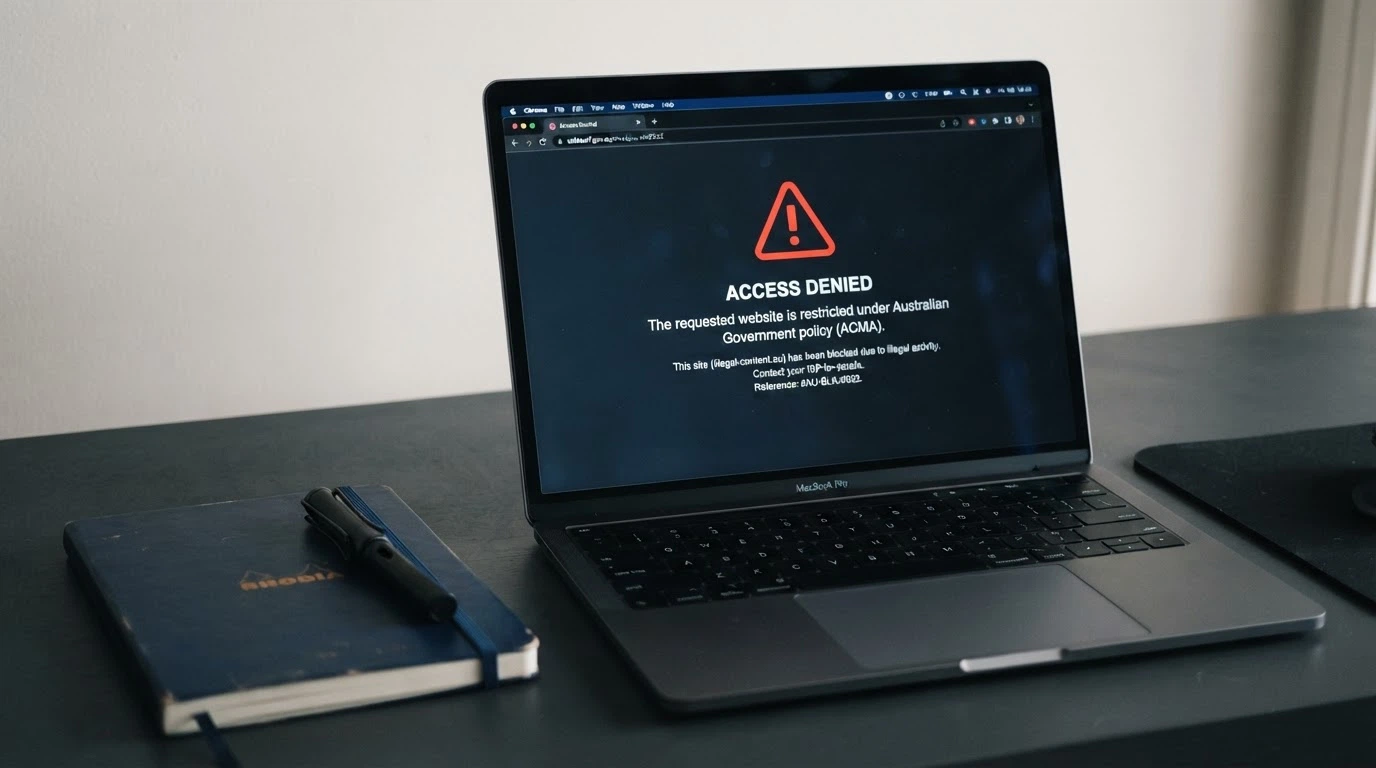
The enforcement record is not theoretical. Since the ACMA’s first blocking request in November 2019, 1,788 illegal gambling and affiliate websites have been blocked by Australian ISPs. Over 230 illegal gambling services have withdrawn from the Australian market since the ACMA began enforcing the 2017 amendments. In Q4 2025 alone, the ACMA investigated 45 gambling sites across 23 investigations, found 69 breaches of the IGA, issued 10 formal warnings and referred 133 websites to ISPs for blocking. Civil penalties for providing a prohibited service can reach $2,475,000 per day for an individual and $12,375,000 per day for a corporation. The ACMA issued eight infringement notices to Tabcorp on 16 January 2026 totalling $158,400 for providing credit to a wagering customer — a licensed operator, not an offshore brand — which tells the reader the regulator pursues the conduct regardless of the licence status.
The Interactive Gambling Act — No Licence, No Exceptions
The IGA targets the provider, not the individual player. There is no Australian offence attached to placing a bet at an offshore casino; the offence sits with the operator providing the prohibited service to a person in Australia. That is why the ACMA’s enforcement is directed at ISPs, payment processors and operators, not at the players themselves. The practical consequence for the player is not prosecution but a complete absence of Australian consumer protection. There is no AU complaints body with jurisdiction over an offshore operator, no AU regulator to escalate a dispute to, no AU statutory guarantee that a winning balance will be paid out. The site can be blocked by an ISP, and a balance sitting on the wrong side of a block is a balance the player may not be able to withdraw in Australian dollars through a routine PayID channel.
The 2017 amendment gave the ACMA the blocking and civil-penalty tools that have produced the 1,788-site enforcement record. The Q4 2025 quarterly report shows the pace has not slowed — 45 investigations, 69 breaches, 133 referrals in a single quarter. The civil-penalty ceiling of $12.375 million per day for a corporation is a figure designed to make continued provision of an illegal service uneconomic for a large operator, and the ACMA has used the infringement-notice pathway as well — the Tabcorp notices totalling $158,400 are a recent example of the regulator using its civil-penalty tools against a licensed operator, which suggests the offshore brands on this page are operating in a regulatory environment that has been actively resourced and is being used.
The 2026 Reform — Advertising Bans, Bank Blocking and What Changes on 1 January 2027
The reform that passed Parliament on 19 August 2026 does not legalise online casino. It tightens the screws on the offshore ecosystem without changing the fundamental prohibition. From 1 January 2027: wagering advertising during live sporting events is banned from 15 minutes before to 5 minutes after the event; TV wagering ads are capped at three per hour between 6:00 am and 8:30 pm; athletes, celebrities and influencers are barred from promoting wagering products; and direct marketing of inducements is prohibited for 14 days after a customer signs up, for three months after a person deregisters from BetStop, and indefinitely for customers identified as at-risk. Online keno and foreign-matched lotteries are banned.
The change that reaches the high-roller experience most directly is the bank payment blocking power. From 1 January 2027, banks and payment providers gain express statutory authority to block transactions to illegal gambling operators. That authority turns the existing Fintel Alliance work on PayID processors into a routine enforcement tool with explicit legal cover, and it increases the friction on the AUD route into offshore casinos in a way that targeted interventions have not. The reform does not shut the offshore market — no Australian statute can do that, because the operators sit outside Australian jurisdiction — but it makes the market harder to reach, harder to fund and harder to advertise. The cumulative effect is a tightening of the perimeter rather than a closure of it.
Staying in Control When the Stakes Run High
A high-roller bankroll turns over faster than a standard player’s. A $100-per-spin session at 5-second intervals burns $720 per hour in turnover at the stake level alone, before any winnings are added or any losses are deducted. A four-figure deposit at those bet sizes lasts hours, not days, and a session that goes the wrong way produces a five-figure loss in a single sitting. The arithmetic of the bankroll is not abstract at this stake level. It is the difference between a session that ends and one that does not.

The tools that exist to manage that risk are split between the licensed Australian framework and the offshore ecosystem, and they do not cover the same ground. BetStop — the National Self-Exclusion Register — has had 67,480 registrations since going live in August 2023, with 41,290 exclusions still active as at 31 July 2026. More than 60% of registrants are still on the register. 78% were under 40 at registration, and 38% chose lifetime exclusion. These are real numbers covering real exclusions at real licensed operators. They do not cover any of the casinos on this page. BetStop binds Australian-licensed wagering services only; an offshore casino is not connected to the register and will keep accepting a self-excluded person’s money. The helpline is the safeguard that works regardless of where the player chooses to play: 1800 858 858, free, confidential, staffed 24/7, with online chat through Gambling Help Online at gamblinghelponline.org.au.
The prevalence data behind the safeguards is worth knowing. About 2.1% of Australian adults — roughly 430,000 people — experience problem gambling, and the AIHW put high-risk gambling at 1.8% in 2022. Australians lose approximately $25 billion on legal forms of gambling each year. The harm-minimisation infrastructure exists because those numbers exist, and a high-roller player operating at the stake levels described on this page is closer to the harm boundary than a casual punter by construction. The tools are not optional at this level of stake. They are the difference between a high-stakes decision made with clear eyes and one that produces a five-figure loss the player did not plan for.
Bankroll Management at Four-Figure Stakes
The discipline of managing a high-roller bankroll is the same discipline that applies at any stake level — set a session budget, stop at the budget, walk away from a hot streak the same way you walk away from a cold one — but the execution is harder because the numbers move faster. A $100-per-spin bet size turns a $1,000 session budget into roughly 200 spins before the bankroll is gone if the run is uniformly bad, and the volatility of the high-limit slot titles means the run is rarely uniform. A session budget at four-figure stakes has to account for the variance, not just the average.
The harder version of the discipline is that the limit-setting tools available at licensed Australian wagering operators — deposit limits, loss limits, take-a-break, BetStop exclusion — are not available at the offshore brands on this page in the same form. The tools exist on the licensed side because the regulator requires them. On the offshore side, the player is the limit-setting tool, and the player has to do the work the system does not.
BetStop, Self-Exclusion and the Offshore Gap
The offshore gap is the central tension for any Australian player who has registered with BetStop and is considering an offshore casino. A self-exclusion registered with BetStop covers every Australian-licensed wagering service. It does not cover a Curaçao-licensed offshore brand operating outside the Australian regulatory framework, and the brand has no obligation to check Australian exclusion registers before accepting a deposit. A person who has registered with BetStop and then deposits at an offshore casino has not violated Australian law — the law targets the provider, not the player — but has also not achieved the protection the registration was designed to provide.
The fallback for a person in that position is the helpline. 1800 858 858 is free, confidential and staffed 24/7. Gambling Help Online at gamblinghelponline.org.au offers online chat and counselling. Neither tool is bound to a specific operator or jurisdiction. Both work for a player at an offshore casino in the same way they work for a player at a licensed Australian venue.
How We Ranked These High-Roller Casinos
The operators on this list were selected based on their market share among Australian players, supplemented by brands popular in high-roller casino search results. The ranking order is by Australian-tracked traffic share — a signal that reflects the size of the brand’s Australian customer base rather than any subjective assessment of bonus value, payout speed or game quality. The licence column reflects the research’s confirmation that each operator holds a Curaçao licence; no operator is presented as AU-licensed because no online casino licence exists in Australia for any of them.
The limitations of this ranking are worth stating plainly. Bonus terms, free-spin counts, wagering multipliers and bonus validity windows were not confirmed for most operators in the featured set, and the table carries an em dash for any cell that could not be verified. Per-operator RTP data and payout-speed benchmarks were likewise not confirmed. The ranking is a traffic-and-licence picture, not a bonus-comparison picture; the bonus comparison that follows in the next section uses market examples from brands outside the featured set (Wild Tokyo, Lets Lucky, Lucky Dreams, LEON BET, Olympia Casino, Golden Crown) because those brands had confirmed bonus data available, while the featured operators did not. A reader who wants a verified bonus comparison will find that none of the ten operators on this page has the verified data to support one in this article, and that absence is itself the information.
What the High-Roller Market Tells You — and What You Should Do With It
The page’s own figures point to a conclusion the headline bonus does not. The 30x to 50x wagering multipliers common across the high-roller market turn four-figure bonus headlines into five-figure turnover obligations. The expected loss on clearing that turnover at representative high-RTP slot portfolios sits in the low-to-mid four figures per bonus cycle. The bonus is real money, and the cost of converting it into withdrawable cash is real money, and the gap between the two numbers is the only comparison a high-roller player should be making before depositing.
The legal exposure is the other side of the same picture. No operator on this page is licensed in Australia. None is connected to BetStop. None is answerable to an Australian complaints body. Every brand on the list is reachable by an ACMA blocking request, and 1,788 sites have already been blocked since November 2019. From 1 January 2027, the bank blocking powers turn the payment-route friction into a routine enforcement tool rather than a targeted intervention. A balance sitting on a blocked site is a balance the player may not be able to recover through the AUD rails the operator accepts deposits on.
The leverage the player has is the math. Knowing the wagering requirement, the max-bet rule, the validity window and the representative RTP of the games that clear the bonus is the difference between a deposit made on a headline number and a deposit made on the real cost. The $4,861 expected loss on a representative $2,500 bonus at 50x wagering against a 96.39% RTP portfolio is not a guaranteed outcome for any single player; it is the average over many spins under the stated assumptions. It is also the figure the bonus page does not show. The decision is the player’s, and the figures that matter for making it are on this page.
Frequently Asked Questions
What happens to my money if an offshore casino blocks Australian players?
The ACMA can direct Australian ISPs to block an offshore casino’s website, and 1,788 sites have been blocked since November 2019. A block prevents new Australian players from reaching the site through a normal ISP connection, but it does not seize player balances. The practical problem is that a blocked site is hard to reach for customer support, withdrawal requests and account management, and a balance on the wrong side of a block can effectively become stranded. There is no Australian regulator to escalate to, because the operator is offshore and unlicensed in Australia. The lesson is that site blocking is an enforcement tool with a real cost attached to the player, not just the operator.
How does BetStop protect high-stakes players, and what are its limits?
BetStop is the National Self-Exclusion Register, live since August 2023, with 67,480 registrations and 41,290 active exclusions as at 31 July 2026. One registration excludes a person from every Australian-licensed wagering service. The limit is jurisdiction: BetStop binds licensed Australian operators only, and offshore casinos are not connected to it. A self-excluded person who deposits at an offshore casino has not broken Australian law — the IGA targets the provider — but has not achieved the protection BetStop was designed to provide. The 24/7 helpline at 1800 858 858 and Gambling Help Online at gamblinghelponline.org.au work regardless of where the player chooses to play.
Can I negotiate VIP bonus terms with a personal account manager?
Dedicated account management is the standard perk at the higher tiers of most offshore VIP programmes, typically from Level 3 upward in a multi-tier structure. A high-stakes player with an account manager can negotiate withdrawal ceilings, processing speed and rebate or cashback rates that a non-VIP player cannot. What is generally not negotiable is the underlying wagering multiplier on a bonus — operators do not routinely drop a 50x requirement to 30x on request. The negotiation is real but bounded: it shifts the operational parameters of an offer more than the headline terms. A player should ask before depositing what is and is not flexible at their tier, because the published terms are the ceiling, not the floor.
Are high roller casino bonuses actually better than standard welcome offers?
The headline numbers are larger — match rates from 100% to 300% on four-figure deposits, ceilings reaching five figures. The wagering requirements are in the same 30x to 50x range as standard offers, and the max-bet rules are similar. The expected cost in turnover is higher because the bonus amount is higher, and the expected loss on clearing the bonus scales with the turnover at the representative RTP. A high-roller bonus is worth more in absolute terms but is not necessarily worth more in proportional terms. The reader who treats the headline number as the value is reading the wrong figure; the reader who treats the expected loss on the turnover as the value has the comparison.
What changes for online casino players when the 2026 gambling reform takes effect on 1 January 2027?
The reform does not legalise online casino. It tightens the perimeter around the offshore market: wagering advertising bans (live-sport blackout, three ads per hour on TV, no celebrity promotion), inducement prohibitions (14 days post sign-up, three months post BetStop deregistration, indefinite for at-risk customers), and express bank payment blocking authority for transactions to illegal operators. Online keno and foreign-matched lotteries are banned. The high-roller experience at an offshore casino does not become legal on that date; it becomes harder to reach, harder to fund and harder to advertise. The cumulative direction is a tightening, not an opening.